Q & A

I think I read somewhere that Belarus can see
ghosts? Do you know if this is true.

I don’t have a direct English translation to link you to, but it is
revealed that she can see ghosts in “Desktop Buddies” [x].

image

This is
the anon from earlier asking about your askbox status. I’ll send the ask now
then. So I was wondering if the canon human names that Himaruya’s picked out
for the countries have any historic relation, significance, or connotation to
be kept in mind? I believe that Hima in the past has explained some of his
reasoning to an extent, but a lot of it I think he’s left up for debate so I
was wondering if you could provide a list of plausible reasoning for their
canon names. Thanks!

The human names were deleted, so some people don’t take them as canon. Many speculate that this was because the names and surnames were not well-researched on Himaruya’s part (which is true). 

Hetarchive has an entire page dedicated to extracting the possible historical references and/or significance from each of the names [x].

Although the nyos were later given names, they’re not official or canon. Himaruya stated that fans could name them however they please [x].


I love your post on
micronations and states. I’m hoping hima will put Mexico and Texas in there. I
know mexico was mentioned once. I just am hoping Texas will be
official-official since Texas used to be a country and hima saying nations
continue living if the become territory’s.

Thank you!

The strip where Mexico was mentioned is from Comic Diary 2. America speaks of the Alamo grudge [x].

image

As for statetalia? While state personifications exist for other nations, they don’t [officially] for America.

On the other hand, Himaruya does create a dialogue and panel in which the American states hypothetically existed [x]. 


I think I saw somewhere that Prussia asked
Italy on a date once- is that true?

Yup! It’s from Prussia’s Drama CD, titled “The CD of the Awesome Me,” [x].


Hi Ella! Can nations teleport? (France
disappeared after talking to Joan so I was wondering) Or maybe he just ran away…

Hello! They can transport; however, distance and the ability to travel on foot conventionally seems to be a major factor (e.g., Finland can’t transport to Seychelles and vice-versa during the 2010 Christmas Event). 

*After talking to Lisa, Jeanne’s presumable reincarnate*  

It’s not confirmed, but that could be the reason why France disappeared so quickly. Either that, or he was just being dramatic for flare. 

image
image

Do you know some moments that Italy may looks naive, but he knows more
then he looks?

Italy’s not canonically naïve.
Yes, I’m aware that the comic gag is that he’s a “Hetare” but even in the
original webcomic, he’s not clueless at all. In fact, he constantly worries
about how he’s perceived by his allies in terms of his worth and ability to
contribute to the alliance [x].

Overall, he’s incredibly
intelligent and perceptive. He puts on a front of cheerfulness but is keenly
aware of what’s going on around him. Most of the time he brushes it off and
chooses not to focus on it.

You see this more when he refers to corruption in his nation’s
politics [x].

image
image

MORE WHOLESOME AMERICA PLEASE

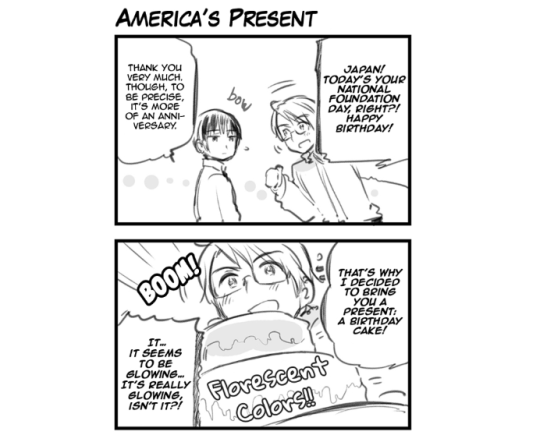
Your wish is my command [x].
image

Why are Austria and Switzerland suddenly so
distant from each other? Okay their relationship was cut because of their boss,
but after that, why are they like cold towards each other like ex lovers or
something?

As far as I’m concerned, it’s
literally just that reason. There isn’t much of a romantic overtone (they were kids). It was more like a very tight partnership or camaraderie. I say this because Switzerland has flashbacks of the times he spent with Austria when he experiences similar moments of fondness with Lichtenstein. 

He’s still bitter over the loss, having been discarded and mistreated by someone he trusted. Please remember that nations follow their bosses orders, so it’s not like Austria had any malicious intent [x].


Okay, just a quick question. Do you remember
that strip where Romano wanted his room of hopes and dreams cleaned? There was
a roman emperor looking statue on the front. Maybe he wanted to rule the empire
once? I’m feeling curious y’know.

That’s an interesting thought. My personal take on it is that it represents Romano’s failed hopes to live up to his grandfather’s legacy and inheritance [x].

image

You see this complex with him when he’s younger too [x].

image

Veneziano isn’t exclusive to failing up to this legacy either. Germany actually overestimates him when they first encounter each other in WW1 (Volume 1, Prologue). 

image

Which character do you think is least accurate
to the country they are based upon?

Poland 100%

Best Hetalia Quotes

America: 

“Hey England, I will choose liberty after all. I’m no longer
your child or your baby brother. From now on I’m independent,” [x].

[Speaking to Canada]—

“Aren’t you the one who’s been all England this and England
that lately? …You’ve been obliging England and eating nothing but marmalade,
even though you actually like maple syrup more, right? Your will’s like a
fluffy feather,” [x].

“I guess it’s because laughing off the negative as something
positive is my style,” [x].

Canada: 

“J-Jackasses…saying whatever they want…yeah, okay, fine, I’m
Mr. Blandy Bland! Dammit!—Argh, today I’m going to show-em! But what argument can I make—?” [x].

To a sick and bedridden England following the American Revolution— 

“Please don’t say such sad things Mister England…I’m…I’m not
as strong as America and I don’t think I can make much money. I might be
useless, but is there anything I can do to help..?” [x]

(About America)—

“It’s true that we’ve been together since we were born, and
I do think we’re more than brothers. But the paths we’ve taken are completely different
and most importantly, our personalities are polar opposites…” [x].

China: 

“War has really changed Japan, aru…Japan is not Japan
anymore, aru…I don’t like it, aru…” [x].

“Time goes so quickly when you are having fun…I’ve lived for
several thousand years and yet…really, the good things are over in the blink of
an eye…” [x]

England: 

After becoming young America’s guardian—

“So, somehow I managed to kick France out and become this
boy’s big brother. But since that means I’m his guardian, it’s also a big
responsibility for me…I’ll have to give him more than he’s ever been given,
always keep him safe…I’ll have to work hard. He’ll have many obstacles and hard
times ahead. Hard trying times. And even this wide and bountiful land must give
him his share of misery. Now It’ll be the two of us. He and I. We’ll support
each other. That’s how we’ll live,” [x].

During the American Revolution—

“Eh…it couldn’t be…? Does this mean you’re all turning
against me? Why is it turning out like this? [Have I handled things so poorly
that I have nothing but enemies now!?]” [x].

“I will teach you a good word; ‘Discretion.’ Have you ever
heard of it? Seeing you reminds me of my old timid self. Make sure to fix that
before we meet again,” [x].

France:  

“If you can’t be stylish everyday, isn’t life just cloudy skies?” [x].

Talking about his immortality to one of his citizens—

“If you’d like to put it into words, it’d be like a ship!
The Government is the mast, the citizens are the wind and they are swimming on
the sea of time—or so
it was said. If the mast is standing straight and a good wind is blowing, the ship
goes forward. But well, of course, there’s also the possibility of the ship
suddenly getting stranded!

As long as there is
someone who can fix the ship, you can keep on using it forever, right?” [x].

Talking about Jeanne d’Arc to someone he believes is her reincarnate—

“Yes, her execution was on May 30, 1431. The
king abandoned her and no one lent a hand to save her in her final moments. Her
patriotic volition was unbound. She gave everything for the sake of her
country. It’s sad to see that those who have patriotic volition like hers tend
to meet tragic ends…

That’s enough history! Now it’s time for me to share
something about myself. It’s a thought I always keep in mind. I believe that
anyone who’s been toyed with by history is always reborn. They’re born under
normal circumstances. They laugh, they play…and even fall in love just like
anyone else.

In their next life, they live out a happy and peaceful life
somewhere in this world. That’s what I truly think. When I first saw you, I
thought God was pulling a cruel trick on me…but I see you’re living a happy
life. It seems like my wish has been granted.”

—Volume 4, A Bientôt! (Until We Meet Again). 

Russia: 

During the Bloody Sunday Revolt—

“I finally made this nation stronger and more prestigious
than others by myself… I worked so hard. Why is it that nothing goes right…? Why
do they always end up hating me? Everyone says it’s my fault, my fault. I’ve
endured it for centuries. Why can’t everyone just get along nicely with each other…? [x].

Lithuania asks him about a dream that he wishes to come true—

“Living in a warm place…surrounded by sunflowers,” [x].

Germany:

“Geez! I don’t know if you meant it as a joke, or if you really didn’t know, but instead of a collection of shady people, surely there’s much more to Italy that’s charming?! For example, the ancient ruins that speak volumes of history, the amazing works of art, and the unparalleled wealth of culture…the sun that shines upon this beautiful land…” [x].

“Compared to my daily life, torture from you bastards would only be about as bad as getting bitten by a mosquito!”

—Volume 1, Axis Powers.

Italy: 

“Sometimes I get tired of seeing the same people all the
time, but then when I see them so much, it’s like they’re new and refreshing
again, these sort of things happen,” [x].

“Ah, sorry Germany, but I just remembered. If we go back the
way we came, there’s a really amazing ristorante! A ristorante known as ‘my
home’..!” [x].

Japan:

“Well, since you arrived, America, the environment and the people
around me have changed so much. Right after I opened up so many things happened
in rapid succession. I feel that knowing people and cultures of countries I had
only heard the names of before is wonderful…but I’m still a little anxious on
whether I’ll be able to get along well with all of them from here on out.”

—Volume 2, Japan and the Footsteps of Westernization.

“When I don’t get out of my house and only communicate with
those I can read the minds of, I start to forget how to speak verbally…” 

‘The so-called isolationist country’ [x].

image
image

Misconception: The nations are a secret kept from the public.

Canon: The nations are well-known to the public. Their
existence isn’t a secret.

image
image
image

Misconception: The nations can speak all languages and
inherently understand each other.

Canon: There is a general meta language that they all understand but will still sometimes need translators during first meetings [x].

Thank you to @jammerlea for bringing the former point to my attention [x].

image
image

Misconception: “Flying Mint Bunny” and “Gilbird(s).”

Reality: These are fanon names. Both pets haven’t been given
an official name.

image

Misconception: Holy Rome died immediately after his dissolution.

Reality: He didn’t die right away and instead sought refuge in
Prussia’s home. To this day, his death has never been seen or confirmed [x].

image

Even in the deleted strip—not to be taken as canon—where France informs
Italy that Holy Rome is “no more” leaves things vague and open-ended.

image

Q & A

 Do you think America trusts his own gov?
currently only 18% of the us trusts the gov and the rest doesn’t. I’m not really
sure if they’ve gone over that in hetalia, the only time I can actually think
of one time were america was unsure(??) of his gov, is that one ep where he
finds Tony but his boss or gov tells him that he can’t tell anybody and that it
didn’t happen. Maybe I haven’t found anything yet or I’m just looking too deep
but yeah I was kinda wondering that.

It’s not clear on
whether he trusts them or not, not that he really has a choice on obeying them anyway. Nations are
forced to comply with their bosses’ orders regardless of their own will/
opinion over the matter [x].

image

You’re talking about the
Roswell incident where he was deliberately lied to about the UFO by his boss
(the president) and was instead told that it was a weather balloon. (Source: Assault☆The neighbor’s Roswell Incident.)

image

Because
that’s one of the minimal scenes where we see him interacting with his boss
(another example would be in the “Black Ships have sailed” strip), there isn’t
enough information to form a solid conclusion on what you’re asking.


@amuamoami asked: Are
there any other african (black) characters in hetalia besides Seychelles? The
only issue i have with hetalia is that I dont see much color diversity.

There
is color diversity (e.g., Ecuador, the Asian nations, Spain, and Portugal— not to be confused with race, which doesn’t exist in Hetalia).

Cameroon is the only other official black character with a full
design [x].

image

There’s an unconfirmed female who may or may not be an African nation that visits Seychelles in Volume 6 (most people speculate that it’s Madagascar due
to the use of third person in one panel).

image

 Lastly, there were some “chibi head”
illustrations that appeared in Gauken Hetalia [x].

I understand your sentiment. On the other
hand, Himaruya does have a habit of travelling to countries before he creates a
character for them. There’s also the whole matter of how messy and complicated
it would be to try to depict the subject of colonialism intersected with race.
It would be pretty unavoidable if he were to create these characters.


What are your personal opinions on Czechia and Slovakia?
They’re some of my favourite characters!

They’re hilarious
together! I love them! Taken out of context, this scene is even funnier for
some reason [x].

image

image

There isn’t much to base
my opinion on, unfortunately. There are very few interactions between them.

Ex: They have tea
together [x].

image

Ex: India comes to
England’s aid after the American Revolution and heals the latter [x].

image

Do you have any particular mischaracterizations of Hetalia
characters that you absolutely hate? This can also include falsely portrayed
relationships and such.

Hate is a strong word, but I definitely get irritated.

People’s inability to reconcile the idea that
deleted material is deleted material and that the shock “perverted” humour used
in the past by Himaruya, while incomprehensible, is no longer incorporated in
the series. France, in particular, would be a prime example of this.

image
image

What this post will explore
is the impact of Austria’s and Hungary’s parenting style on Italy. There is no
good and bad here. All I aim to do is give reason and meaning to the
problematic behaviour and relationships that are depicted in the series. The
characterization is done for a specific purpose. What I seek to do is bring
several parallels to light to prove this.

Horney’s Theory of Parenting and its Relation to Hetalia: 

One of psychologist Karen Horney’s theories explored how problematic
parent-child relationships often result in the child developing neuroses
(mental health complications), such as anxiety or depression.

However, rather than assert
all the blame on the parent, she went on to explain how parents who have been
reared in an environment void of love, care, and affection are incapable of
raising their kids in any other manner.

Put another way, parents pass
on their neuroses to their children. You can’t expect someone to provide the
care, warmth, and love that they’ve never experienced and learned themselves.
On the other end of the spectrum, these problematic parent-child-relationships
and parenting techniques are learned and repeated through
generation-to-generation. It’s a cyclical process, that, unless consciously
recognized, results in all sorts of emotional trauma.

image

What Horney believed to be the Basic Evil of these problematic
parenting styles is Parental Indifference, which can also include a
hostile or rejecting attitude of the parents toward the child. This parental
indifference can cause the child to develop feelings of Basic Anxiety or Basic Hostility –
both of which, if not attended to, can lead to mental health issues.

For the purposes of this
post, I only need to focus on Basic Anxiety. Basic Anxiety occurs when the
child develops feelings of loneliness and helplessness in a world that they
perceive to be hostile and dangerous.

image

That said, what I’ll now
analyze is how Austria’s and Hungary’s upbringings were passed down to Italy.

Let’s tie this back to the
strips.

Austria and Italy: Intergenerational Helplessness 

As expected, having had to
fight for their autonomy to prevent themselves from being conquered caused
most of the nations to have rough childhoods. The world of war is full of
uncertainties, fears, and insecurities. Of course, Austria was no exception and
had to experience this too. However, rather than fighting, he attained his
security through many alliances and marriages (e.g., the Swiss-Austro
partnership and the Austro-Hungarian empire).

image

Nonetheless, Austria did
experience a total loss of control as a child [many times].

Ex: He lost several battles to Hungary [x].

image

This total loss of control is
later inflicted onto those who Austria conquers. Again, I’m not attempting to
justify any of the following behaviours. What I hope to do is provide insight
into the reasoning behind these behaviours. I should also mention that there
are a lot of grey areas in the manga; to depict the scenarios as black and
white doesn’t do the series and characters any favors.

What’s important is that
these behaviours have been wrongly normalized as the ways in which nations
function and interact with each other. It’s a cycle that’s repeated.

When Austria first assumes
control over Italy, he makes him the equivalent of a servant. As such, Italy
loses total control over his political affairs [x].

image
image
image

It’s a harsh world where
deviance [rebellion] is strictly prohibited. The punishments are respectively
just as strict and harsh—this would entail the hostility component of Horney’s
theory.

image
image

Of course, this doesn’t mean
that Austria wasn’t only hostile with Italy. They shared several fond moments
together and were considered to be a family unit. 

image
image

What would matter to Horney
is how Austria’s inconsistent parenting style of being a simultaneous source of
love and affection and a hostile enemy to be feared affects Italy’s mental
health later in life.

Italy’s helplessness in
adulthood is most seen in his clinginess, stemming from his desire to seek
safety and security from the world that has consistently proven to be dangerous
to him. First, Rome died and Italy was conquered by Austria. Flash forward to
WW1 and he’s once again in the hostile, unpredictable, and insecure world of
war.

So, what does Italy do?

He seeks safety.

With who?

Germany, his enemy at the
time.

When taken as a prisoner of
war by Germany, Italy doesn’t attempt to escape, even when provided with the opportunity
to. How I’ve interpreted this before is that Italy does this to seek security.
He explicitly states this too. Even as a POW, he still has a roof over his
head, can sleep without worrying about being attacked, and can expect to be
fed.

image
image

On the other hand, war isn’t
the only sphere in which Italy feels helpless. Corruption and the tyranny of
the mafia have once again rendered him void of total control over his political
affairs. I would even go so far as to say that he’s adopted a sense of learned
helplessness.

Learned helplessness occurs
when a being recognizes the inevitability of their negative situation. The result
is that they don’t attempt to escape from this situation but instead cope with
it.

A prime example of this would
be when Italy has his car and wallet stolen from him. Rather than calling the
police, he goes to Germany for help. The fact that it’s Germany and not Italy
who reports to the police implies a conscious recognition on Italy’s part of
their inability to do anything about the event [x].

image
image

In other words, being stolen
from is something that Italy’s normalized.

image

Italy and Hungary: Intergenerational Trust

Hungary, having been reared
in a more supportive environment, doesn’t pass down neuroses to Italy, unlike
Austria. 

Instead, Hungary passes down the ability to trust in others. She had the
rare privilege of growing up with a parent figure. Magyar raised her to be just
like him [x]. 

image

Point is, this ability to love and care unconditionally is replicated
in Hungary’s treatment of Italy.

image

The cycle repeats as Italy learns
from Hungary that even in the most hostile of environments, trust can still be
established with other nations. This trust is often excessive and nonsensical
at times, as Italy forgives quickly and will openly befriend enemies.

Ex: Italy is noted to be a
nation that doesn’t hold grudges. He hugs Austria despite having recently
fought a naval battle against him.

image

Ex: Italy fondly refers to
France as “oni-chan” when they both get shipwrecked during WW2.

image
image

In sum, when looking at Italy
from this perspective, it’s easy to see how Austria and Hungary have influenced
his personality.

image
image
image

Aside from the muddled waters of his previous [deleted] and
inappropriate characterizations, which, unfortunately, have bred several
accompanying misconceptions—an important topic that I will eventually delve into in greater detail—Spain’s
personality is arguably one of the most benign, kind, caring, and compassionate
among the nations.

image

Being oblivious to the feelings of those around him and goofy-natured,
Spain has a tendency to act with his heart rather than his head. It’s not so
much that he’s emotionally-unintelligent. It’s more so along the lines that he
doesn’t always read into others correctly because he doesn’t bother to read
them at all.

Nonetheless, there are notable moments where he’s able to
see right through to those he cares about, knowing exactly how they’re feeling,
what needs to be said, and, of course, expressing his support for them.

In the past, I’ve seen his character unjustly be watered
down as a “plain” type, merely because he’s cheerful, as if people like this
don’t exist in real life. There’s nothing wrong with a character being sweet
and genuinely cheerful to those close to him. It’s this overcritical
attitude that causes people to overlook how benign and supportive characters
like Spain serve to compliment others and their respective relationship
dynamics. Often times, this support comes at the cost of self-sacrifice.

Ex: Spain gave Romano a whole new wardrobe at the cost of
wearing rags.

image

That said, below will be a list of examples detailing just
how much of a gem Spain is.

While Spain may have generally favored Veneziano over Romano
when they were younger—[not always the case, post on that here [x]]—this
dynamic has since changed. As adults, Spain’s attention has almost completely
been diverted to Romano.

What’s humorous is that Spain’s smothering irritates Romano
greatly.

image

Ex: Spain asks a tourist to stop Romano in order to get his
attention [x].

image
image

Ex: The two of them have matching tomato boxers [x].

Ex: He escorts a drunk Romano home [x].

image

Ex: Spain’s perceptiveness comes to light when he realizes
the real reason why Romano dressed Roman style for Halloween. 

He smiles
knowingly when Romano refuses his suggestion that this is done in honor of
Rome. Having been his guardian for centuries, Spain knows Romano better than
anyone else [x].

image

In the same strip, Iceland, having experienced the same type
of overbearingness with Norway, alludes to the fact that Romano doesn’t
actually mind Spain paying him all this attention. Romano’s blush says everything.

image

The two are just really good friends. There’s a reason why
they’re always depicted together [x] [x].

image
image

It’s not just Romano who Spain’s excessively kind with
either. As mentioned, it’s  just who he is as a person.

Ex: In recognition of how Germany has trouble smiling, Spain covertly tries to teach him how [x].

image
image

Ex: He’s described as the type of person who would ask about
the contents of a book he’s not interested in [x].

image

Ex: Spain’s kind nature is what makes the Bad Friends Trio dynamic complimentary and memorable. It just works [x] [x]

image
image
image

image
image

In light of
Canada day, I think it’s about time that I dedicated a full character analysis
to him. What I aim to do is disprove any claims that Himaruya has made Canada
into a flat, two-dimensional character. It’s quite the contrary.

Canada’s
well-known for his invisibility and the overused jokes that accompany this
characterization. However, to say that this is all that defines Canada is to
overlook the amazing depth that this invisibility has on his personality.

image

While it’s
easy to look at Canada as the nation that’s ignored during meetings, what this
post will explore is the ways in which Canada’s character is far more fleshed
out than what is popularly conceived in fanon.

Childhood:  

From birth,
Canada was objectified by European colonizers for his abundance of resources [x].

image
image
image

After
England fights France to assume control over Canada, Canada mistakenly assumes
that England is the first nation to actually look at him as a person and not
merely as an asset.

image

In reality, England was staring at Canada’s hair, which he
had inherited due to French influence.

image

When told
that England will become his family, Canada is ecstatic. He had grown
accustomed to being valued for his resources rather than as a living being. Already,
we begin to see how Canada’s worth is not attributed to his person—who he
is.

image

The
importance of this scene will be critical to understanding why Canada suffers
from such poor self-esteem in his adulthood.

Identity Crisis and Devaluation:  

The main
complex that Canada suffers from is that he lacked a solid identity and
conception of himself. Being surrounded by greater, more politically and
economically relevant powers when he was younger can mainly be attributed to
this.

Canada’s
self-esteem was contrived in relation to those around him. He felt inferior,
and these feelings later became entrenched in how he views himself.

Ex: Canada
grew up alongside America, who excelled and aged at a much faster rate [x].

image

Ex: England
devoted a lot of his attention toward America, leading Canada to feel neglected
and excluded [x].

image

Living in
America’s shadow consequently caused Canada to believe that he wasn’t worthy
of the latter’s attention.

Ex: He once believed that America was disinterested in him [x].

image

Ex: He used England as a mediator to speak on his behalf to America. Notice
how America is perplexed by Canada’s behaviour here. Canada thinks poorly of himself and attributes this same train of
thought to how he perceives others to think of him [x].

image
image

Although, it also has to do with the fact that America doesn’t believe that Canada has an accurate conception of the real world, and, therefore, isn’t ready to gain his independence [x].

image

What’s even
more unhealthy is that Canada uses America as the means of assessing his worth.

Ex: He
believes that he’s simply a plainer version of America given their similar looks [x].

image

Ex: He
doesn’t believe that he’s handsome [x].

image

Ex: When England
falls ill after the American Revolution, Canada cries and claims that even
though he’s not as strong as America and doesn’t possess a lot of money, he’ll
try his best to heal the former [x].

image

The irony
of this is that it’s alluded that Canada may possess his own form of
superstrength. In the same arc, America tries to force himself into Canada’s
home after being denied access to visit the then sick England. Canada is able to shut the door on him [x].

image
image
image

Of particular interest to me is how in Canada’s fantasy, England’s cheering him on, likely symbolizing how badly we wants the latter to pay more attention to him.

Forming an Identity:

Constantly being
overshadowed by America and England and internally comparing himself to America
created a lot of tension and frustration in Canada.

It’s only
during his independence arc where we begin to see him release these emotions.
Canada wants to form his own autonomous identity. To him, America
contravenes and gets in the way of this from happening.

Ex: Canada
reprimands America for being selfish and self-absorbed on several occasions [x].

image
image

Even after
gaining his independence, Canada lacked a solid self-concept and was still
mistaken for America by other nations.

Ex: Cuba mistakes him as America [x].

image

What’s
always been a seamless turning point for me is how it was America who helped Canada
form his multi-cultural identity.

image
image
image

The
culmination of these arcs, albeit seemingly to be nonessential and unimportant,
is when Seychelles recalls Canada as a member of the G8 [x].

image

Years of
being forgotten and neglected caught up to Canada. Trivial as the situation may
be on the surface, to be remembered is to be important enough in the eyes of
another person. It’s a foreign and gripping moment that causes him to cry.

image

Likewise,
because this is so foreign to him, Canada doesn’t know what to do with himself.
In other words, he overcompensates by excessively reinserting his identity,
which remains fragile and still in a developing state.

image

This fragility
is most seen when America appears and laughs at Canada’s ridiculous clothing [x].

“There are times, every now and then, when I want to stand out from the shadow or let my hair down too!” 

image

Another
parallel between the two is then introduced: Canada doesn’t want to remain in the
shadows and vies to be well-known in the world just like America; meanwhile,
America is jealous of Canada for his ability to get along with everyone.

image

In sum,
Canada’s invisibility lends his character most of its strength. It is through his
journey to establish himself that it becomes clear that Canada is not as
passive as one may think. For his entire life, he’s fought to
be remembered. It would follow, then, that his invisibility perhaps had a
double meaning to it; it was a physical reflection of how hollow, empty and
lacking he felt on the inside, a personal identity that needed to be filled and discovered.

image

image
image

Misconception: He’s a critical asshole.

Reality: He’s a critical asshole with low self-esteem. This
criticism isn’t only directed at others; he directs it at himself just as much.
As such, he knows he’s misunderstood by others for his actions but doesn’t care
enough to do anything about it.

“He’s quite bad at expressing himself. He himself knows that people often misunderstand him, he uses this fact for self-depreciating jokes.”

Ex: The most common trope for this is how critical he is of
America’s movies.

image
image

Ex: England is described as simultaneously self-deprecating
and condescending.

image
image
image

England also has a notable sweet, compassionate, and sentimental
side.

True to his tsundere
character-type, he’ll get flustered and play off his acts of kindness.

Ex: Usually, he detaches himself and claims that he’s not
doing a favor because it’s in his self-interest.

image

He will also verbally refuse to do things for others yet
still do them anyway.

Ex: He helps France find a hotel to stay.

image

Ex: After learning that Japan took strides to learn parts of
his culture, England returns the favor by drawing him a portrait… It’s the thought
that counts.

image
image
image

Misconception: He’s a horrible parent and is, therefore, a
terrible person.

Reality: He’s a horrible parent figure that loves his
colonies deeply but had a poor way of expressing it. 

image

England grew up alone. The only parent figures that he had
were France and his other three brothers, those of whom all teased him. England’s
brothers would even go so far as to send him hexes. 

image
image

Since isolation is how he
was raised and it’s all he knows, this explains why he repeats these same parenting
patterns on his colonies.

Ex: He doesn’t see anything wrong with leaving America for
long periods of time, as this was something that he had endured in his own childhood.
He’s wrongfully normalized it.

image
image

Ex: When England lost America after the Revolutionary War,
he grieved with anger. His temper is described to have become particularly
stormy in the years following America’s independence. It’s also alluded that
the 100 years of heartbreak that England once suffered from was due to this
separation (Source: 2007 Christmas Event).

In the present, the two have shifted more to a teasing
relationship.

image

Misconception: He hates France.

Reality: As lifelong rivals, France and England both despise
and respect each other. They get on each other’s nerves more than they get
along. Nonetheless, this shouldn’t negate the fact that when the time requires
it, the two will stand together in solidarity.

image
image
image

Ex: The two team up against Finland when the latter proposes
the possibility of becoming America’s older brother by virtue of his similar looks.

image

Ex: England took France in after the Germans occupied the
latter during WW2.

image

Misconception: He’s antisocial.

Reality: England’s rude behaviour has frequently isolated him
from others, hence the nickname of “the Black Sheep of Europe.”

image

On the other hand, he’s a gentleman that knows how to
socialize. More than that, he enjoys it.

image

Ex: He engages in a discussion on gardening with Netherlands
and Japan.

image
image

Ex: He has tea with India.

image

Ex: He bonds with Norway over their affinity for magical
friends.

image
image

Bonus facts:

He acts as both the representative for the UK and England [x].

On the topic of where England’s hypothetical tattoo could
be, Himaruya points…

image

He’s very passionate about steampunk and once gave America
an entire lecture on the subgenre when he learned that they shared a common
interest.

image
image
image
image

One thing I’ve noticed is that fans approach and analyze
relationships between the nations from a human perspective. The problem with
this is that it doesn’t capture the elasticity and interchangeability of
titles of beings who are immortal– not mortal– go through. In other words,
aside from direct biological relations which don’t change, you can’t apply
words of human organization to immortal beings who routinely change how and who
they relate to.

For example, just because a nation lives with another
nation, doesn’t automatically make them family. In the case of a nation, they
don’t live with other nation(s) by choice but rather circumstance. Often
enough, it was the product of being conquered.

Some nations living together will choose to identify as a family,
as their bond as a unit most closely resembles one. Nonetheless, these
families, or households rather, are temporary.

Ex: Hungary refers to Holy Roman Empire’s household as a
family [x].

image

Ex: Having lived with France in Rome’s household
for some time, young Italy referred to France as big brother.

image

Out of respect, some nations will continue to refer to the
other nations they lived with as an older brother. In Japanese, “onii-chan” is
a term coined out of affection and adoration for a figure. It doesn’t mean
older brother in a blood sense.

Ex: France claims to be the older brother figure of the
world. Meanwhile, only Italy and Monaco choose to refer to him with this title
of affection [x]. Again, not to be mistaken with a relation.

image

A nation can be a guardian for several centuries and later
evolve into a companion, friend and/or mentor figure.

This is best seen with America and Canada, biological
brothers who temporarily held a family unit with their colonizers. Although,
they didn’t physically live together, settling for occasional visits instead.

For one thing, it’s important to distinguish the fact that biological relations are inherently sensed by the nations.

There’s a difference between Iceland, who senses Norway to
be his brother from birth [as does Norway]… [x].

image
image
image

…and England and France, who make America and Canada their
family [x].

image
image
image

Ex: America doesn’t inherently sense a brother among his
colonizers, Finland, France, and England.

Instead, they fight over who will assume the role of
America’s brother [x].

image
image

As mentioned, it’s difficult to apply human words for
relationships to capture relationships between immortal beings. It doesn’t
quite fit. Think of it this way: The nations have unique experiences that we as
humans will never have. So, why are we using words that describe our
experiences to describe theirs?

Respectively, England has trouble deciding what America
should call him.

image
image
image
image

Again, notice America’s choice of the word onii-chan.

Titles like guardian and older brother, two very different
terms, are loosely thrown around. Of course, older brothers can be guardians, but you’ll see what I mean by this muddled distinction in a moment. 

image

It’s hard to make sense of a relationship
using words that don’t describe but instead confine and water down the
complexity of the colony-colonizer and simultaneous guardian-adoptive
relationship they’ve established.

This uncertainty and fumbling to find words that best
describe their relationship is seen again when America declares his
independence. Even he doesn’t know if what they had entailed a parent-child or
sibling relationship [x].

Nonetheless, he cuts off these ties and no longer views
England as this type of figure for him.

image

The point I want to emphasize is that due to political
circumstances, the nations’ relationships with each other are dynamic. It’s not
as rigid as human forms of organization; therefore, it doesn’t make sense to
approach these family-like dynamics from a human perspective. It’s like
comparing apples and oranges.

Lastly, to avoid falling into a trap of reasoning, there’s a
stark difference between conquering/ colonizing a nation and living together and
willfully forming a union [economic or political] and living together.

Ex: Switzerland adopted Liechtenstein into his household and
the two consider each other to be siblings. Because this is how they presently
identify and relate to each other, they are siblings.

image
image