Thank you for sharing this! It’s a very interesting and well thought-out take on his character [x].
What we know for sure is that it’s in reference to his prickly personality.

Thank you for sharing this! It’s a very interesting and well thought-out take on his character [x].
What we know for sure is that it’s in reference to his prickly personality.
England: What’s wrong with him? You’d think he’d just been traumatized.
France: He turned on the news.
England: So?
France: It was American news.
England: Oh dear god.


Before I get into explaining why France is easily one of the
most gripping and enthralling aph characters, I have to point out that the
France I’m discussing is not the France that we saw in the earlier years of
Hetalia (2006-2009/10).
I fully recognize that France’s old characterization was
appalling, offensive, and harmful and condemn it wholeheartedly. On the other
hand, I believe in the potential for creator growth. Said growth is so evidently
seen in how Himaruya has characterized France up to now. Eight plus years of
material is enough to conceptualize a character completely anew.

In fact, the France I admire and hold a deep reverence for
is so vastly different from his previous personality that I consider them to be
separate. Again, I would be dishonest if I weren’t to admit that his old
characterization leaves a bitter taste in my mouth. The reason for this is
because of how beautifully his personality has blossomed in the present. Unfortunately,
he’s most known for his former characterization and isn’t given credit for the deep
life questions that he provokes later in the series.

What this post will explore is how France acts as the go-to
vessel for giving readers insight into the painful consequences of immortality.
Jokes aside, there are moments where France says something so intricate and
profound that it pulls you into his world and gets you to really think.
As stated in more detail in previous posts [x], we learn in the “Though
I may depart, you shall remain” strip that the nations exist because of the belief
of their people [x]. The personification is compared to a ship; the gov’t, a mast;
the people, the wind; and the sea, time itself.

Essentially, the metaphor frames how the ship will continue
forward [live] so long as the mast [the gov’t] is strong and functioning and the
wind is blowing [the people still hold a common identity].

The consequence of immortality is revealed in how the
nations continuously push forward without having the privilege of enjoying
intimate relationships with others. It’s because they’re immortal that they
detach themselves from close human relations. This way, they’re able to spare
themselves from the hurt of loving someone, only to watch them grow old and
die.
My favourite theme of this strip is the contrast between the
human outlook on immortality and the immortal outlook on immortality. One of
France’s citizens grows jealous upon realizing that France gets to live forever
but is later reminded by his wife that to live forever would draw more
suffering than it would benefits. Immortality, while seeming to be ideal and
utopic, produces the misfortunes of isolation and loneliness.


The scene ends with France watching a young family with a
longing gaze. As a country that’s supposed to symbolize love, France is
tantalized by the prospect of bestowing his love [of all kinds] onto others but
knows that if he’s to protect himself, he can never truly do this.


The metaphor of time is likewise seen with Jeanne d’Arc.
France encounters an American tourist named Lisa, who we learn is Jeanne’s
reincarnate.

At first, France questions whether God has played a trick on
him.

He then realizes that history has paved a kinder path for Jeanne, albeit
it being in another life. It was of his personal belief that those who have been toyed with by history will be reborn into a better life.

This tongue-in-cheek approach to confronting how
unfair and brutal history can be is best seen in France’s initial skepticism
and mistrust. At the same time, the scene culminates with France placing trust
and faith in fate, recognizing that while he has no control over it, good still
exists in the world.

This is perhaps the most powerful image that Himaruya has
ever created to date. With just one image, he’s captured the throngs of France
surrendering himself and placing trust in the people that will come to define
his history – him [x].

Life produces many wounds and scars, but it’s the brave who embrace
these harmful experiences and integrate them into their understanding of self [x].

What you’ll see is that how France presents himself – either
by humour or egotistical remarks – is a mask. Of course, this is to be expected
given that he served as the country of philosophical enlightenment in the late
1700s.
In a quick slip of his teasing and lively façade, France
reveals that he believes children should have carefree upbringings. How I read
into this is that France vies to give children the childhood he never had.
After all, wars, self-interest, and politics robbed him of his [x].

Another definitive moment involves him being asked what he’ll
dress up as for Halloween. Never being one to settle for simplicity, France
gives this cryptic answer:
“I’m always disguising myself. The wild beast of the heart
is hidden within this work of art known as me,” [x].

Translation: By mastering his looks through good
self-presentation, France has respectively mastered the art of concealing the
bad in his life. Unfortunately, this is to the detriment of not being able to
express and expose his true self to others. Again, notice the theme of
protecting oneself against the hostilities of the external world.
The irony of this is that whereas France is unable to live
his life in a carefree manner and has lost full trust in the world, he
encourages others to live their lives to the fullest; that way, they won’t have
to bear any regrets or emotional burdens [x].

In this sense, France’s life
experiences have forced him to be brave and resilient, the pitfalls being that the
constraints of his immortality have also rendered him fearful and hesitant to
strive for a fulfilling existence.
In sum, you can think what you want about how awful France’s
character was in the past. I’m not denying that and never will. But, to
demarcate his character today is something that I’ll always disagree with.
There are many precious moments that France has offered us. Let’s not negate
them.

Prussia: *laughs*
France:

It’s not whether I think, that’s 100% canon! It’s a recurring
theme between the three; France blames England and England denies it.
Although, I really like this example, because it’s one of
those times where America says what’s really on his mind [x].


Sure! I’ve touched a bit on France’s early characterization here [x], but do plan to go more into depth in another post.
Hmmm. I’d love to talk about France’s philosophy and approach to life, so post on that coming up tonight :)!
I went a bit overboard with this, by the way…


Note: This post will explore the mystery behind why Russia
covers his neck. This isn’t a theory, as I use facts to come up with a
speculation that, while probable, hasn’t been substantiated in canon. I find it
very important to distinguish between facts, theories, headcanons, and
opinions.
I know, I know. This
post is about Russia’s neck, but I have to do some backtracking first.
All right. In canon, it’s normal for Russia’s heart to
spontaneously burst out from his chest.


In earlier posts, I’ve speculated that
this acts as a metaphor for how Russia’s conception of love has been equated
with violence.
He grew up being routinely conquered and chased after.
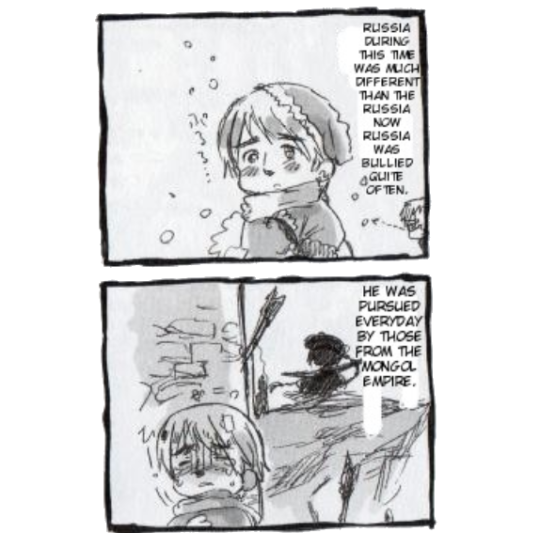

Not
only that, but General Winter – who acted as Russia’s de facto parent figure
due to the protection he provided the latter with – also attacked [abused]
Russia on an annual basis [x].


As such, what Russia
grew to understand as love and friendship became irreparably warped.
Ex: He thinks that anyone he meets is his friend. This
includes General Winter, his abuser.

Ex: He uses violence as a solution to his problems. He’s
normalized it [x].
In conjunction with the first reason, I also believe that
Russia’s heart falling out so violently symbolizes being cut up from the inside.
Since the personification’s body is a physical representation of their nation’s
landmass, this would relate to the act of partitioning and being partitioned. The
heart and soul of a nation are tarnished upon being conquered.
Ex: Russia’s hobby during WW2 is partitioning Poland [x].

Ex: When he exerts political pressure on Japan, notice how
Russia sends a heart. Again, I interpret this as another example where Russia
has conflated love and violence [aggression], confusing the two of them.


As many others in the fandom have pointed out, there is a mystery
surrounding why Russia takes great lengths to cover his neck, most notably with
his scarf. It’s not just his neck, but I’ll get back to that in a moment.
Originally, the scarf was a gift given to him by Ukraine.
While she wanted him to keep warm, she also did this to get him to make Kiev
successful in return.

On the other hand, the scarf has taken on a much darker
meaning in Russia’s adulthood.
Ex: In Italy’s Chest Test Series, instead of his usual
scarf, Russia’s wearing bandages around his neck [x].

Ex: In the History Copy Book, there’s a strange panel with
an angle that reveals Russia wearing a single bandage around his neck [x].

What I haven’t seen people mention is that it’s not just his
neck that Russia tries to cover.
1) He’s often spotted clutching his chest, an
action that I believe is done to prevent his heart from falling out.


2) Russia takes great lengths to cover his chest
too [x] [x].


The answer I have that possibly explains all this isn’t
grandiose or complicated. It’s simply medical. I think that by covering up his
chest and neck, Russia’s concealing the physiological effects of heart failure.
The heart failure here is his heart falling out.
Conditions like Congestive Heart Failure occur when the
heart is unable to pump enough blood to give your body the sufficient oxygen it
needs. A symptom of this failure in the right side of the heart can cause
bulging tube-like veins to appear on the right side of the neck – jugular vein
distention.
If that’s the case, then no wonder Russia wants to cover up
his neck. Not to mention that he would without a doubt have massive scars and
damaged unhealed tissue from his heart popping in and out like a revolving door.
He’s not exactly great at raising pets either.


America mistaking England’s request for a rubber – eraser –
and instead handing him a condom [x].
“A guy like you?”


France referring to England as a golden caterpillar [x].

Greece’s reaction when Turkey gets his ass
handed to him by Chibitalia [x].


Germany and England’s temporary ‘truce’ one Christmas during
WW2. England hurls the soccer ball at Germany’s face, and he gets it right back.


I’m not particularly big on headcanons, but I sometimes do charts like this 😀
Most insecure nations
–
America, Canada, England, Germany, Italy,
Romano, and Poland.
Loneliest nations
–
America, England, Iceland, Prussia, and Russia.
Happiest nations
–
Denmark, Finland, Seychelles, and Sweden.
Most sarcastic nations
–
England, France, Norway, and Romano.
Nations we need more of
–
Belgium, Belarus, India, and Vietnam.
 Ellawritesficssometimes