Of course. Switzerland acts rough and claims to put himself first, but he’s actually a very generous and considerate person.


Of course. Switzerland acts rough and claims to put himself first, but he’s actually a very generous and considerate person.


Note: This post will explore the mystery behind why Russia
covers his neck. This isn’t a theory, as I use facts to come up with a
speculation that, while probable, hasn’t been substantiated in canon. I find it
very important to distinguish between facts, theories, headcanons, and
opinions.
I know, I know. This
post is about Russia’s neck, but I have to do some backtracking first.
All right. In canon, it’s normal for Russia’s heart to
spontaneously burst out from his chest.


In earlier posts, I’ve speculated that
this acts as a metaphor for how Russia’s conception of love has been equated
with violence.
He grew up being routinely conquered and chased after.
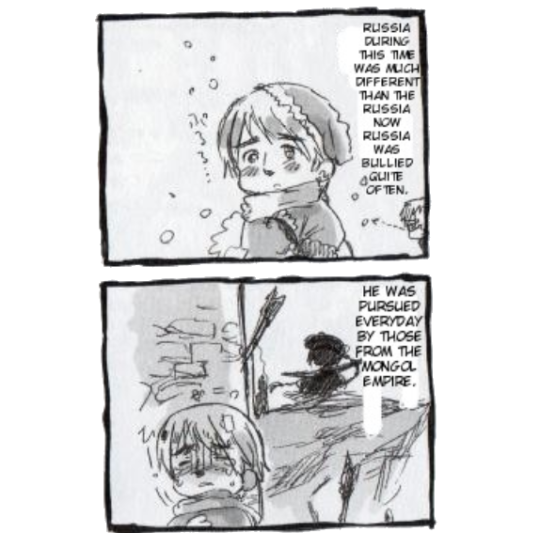

Not
only that, but General Winter – who acted as Russia’s de facto parent figure
due to the protection he provided the latter with – also attacked [abused]
Russia on an annual basis [x].


As such, what Russia
grew to understand as love and friendship became irreparably warped.
Ex: He thinks that anyone he meets is his friend. This
includes General Winter, his abuser.

Ex: He uses violence as a solution to his problems. He’s
normalized it [x].
In conjunction with the first reason, I also believe that
Russia’s heart falling out so violently symbolizes being cut up from the inside.
Since the personification’s body is a physical representation of their nation’s
landmass, this would relate to the act of partitioning and being partitioned. The
heart and soul of a nation are tarnished upon being conquered.
Ex: Russia’s hobby during WW2 is partitioning Poland [x].

Ex: When he exerts political pressure on Japan, notice how
Russia sends a heart. Again, I interpret this as another example where Russia
has conflated love and violence [aggression], confusing the two of them.


As many others in the fandom have pointed out, there is a mystery
surrounding why Russia takes great lengths to cover his neck, most notably with
his scarf. It’s not just his neck, but I’ll get back to that in a moment.
Originally, the scarf was a gift given to him by Ukraine.
While she wanted him to keep warm, she also did this to get him to make Kiev
successful in return.

On the other hand, the scarf has taken on a much darker
meaning in Russia’s adulthood.
Ex: In Italy’s Chest Test Series, instead of his usual
scarf, Russia’s wearing bandages around his neck [x].

Ex: In the History Copy Book, there’s a strange panel with
an angle that reveals Russia wearing a single bandage around his neck [x].

What I haven’t seen people mention is that it’s not just his
neck that Russia tries to cover.
1) He’s often spotted clutching his chest, an
action that I believe is done to prevent his heart from falling out.


2) Russia takes great lengths to cover his chest
too [x] [x].


The answer I have that possibly explains all this isn’t
grandiose or complicated. It’s simply medical. I think that by covering up his
chest and neck, Russia’s concealing the physiological effects of heart failure.
The heart failure here is his heart falling out.
Conditions like Congestive Heart Failure occur when the
heart is unable to pump enough blood to give your body the sufficient oxygen it
needs. A symptom of this failure in the right side of the heart can cause
bulging tube-like veins to appear on the right side of the neck – jugular vein
distention.
If that’s the case, then no wonder Russia wants to cover up
his neck. Not to mention that he would without a doubt have massive scars and
damaged unhealed tissue from his heart popping in and out like a revolving door.


This guide will go over
the stereotypes that affect how the Germanic nations are able, or rather, unable
to express their feelings. The steely emotionless stereotype of Germans/
German-speaking countries often prevents the respective nations from being
understood properly. It’s not that they’re incapable of experiencing love or
feeling care and affection. It’s quite the contrary. Instead, they just have a
difficult time showing and communicating how they feel [x].

For the purpose of this
post, I’ll only be going over the Germanic nations that are listed in this
strip, as they are what Himaruya characterizes to be of German inheritance and influence.
I recognize that there are many more Germanic countries than this. I’m just
going by what we see portrayed in the manga.
That said, let’s go over
some examples.
The German stereotype of
being emotionally steely and hot-tempered is a complex that Germany is defined
by in the manga.
He’s sweet and
compassionate but is often mistaken to be angry by those around
him [x].

Germany also claims to
have trouble smiling. It’s not something that comes naturally to him [x] [x].


In terms of
relationships, Germany is emotionally withdrawn. This is most seen in Buon
San Valentino [x].
There, the premise of
the arc is that Germany has trouble defining what his relationship with Italy
is.
He first buys a popular
book in Germany titled “Communicating with your partner.” The comic gag
of this is the stereotype that Germans aren’t savvy at reading emotions; they’re
‘emotionless.’ Obviously, this isn’t truly the case.

As Germany reads this
first book, he begins to question whether Italy likes him as a friend or as a
romantic partner.
When Germany gives
details of his relationship with Italy to Austria, Austria is repulsed due to
the romantic overtones = seeing someone every day, kissing and hugging them,
bathing with them etc. The irony is that Austria later realizes that Germany
was talking about Italy, an anomaly of a person who normally does all these
things.


Unfortunately, Germany
doesn’t know this, and he forms the conclusion that Italy has romantic feelings
for him. It’s a “misunderstanding.”
Since he’s still clueless about this aspect of human relations, Germany then buys a book that gives dating advice.


His dismay grows when he remembers that Italy’s a guy [wow!] so of course, his next course of action is to ask Austria if he can practice these newly learned romantic gestures on him.


He later reveals to Austria that he has no previous experience with romantic relationships and that he’s only read romance novels.

The strip culminates in
Germany mistakenly proposing to a very confused Italy.

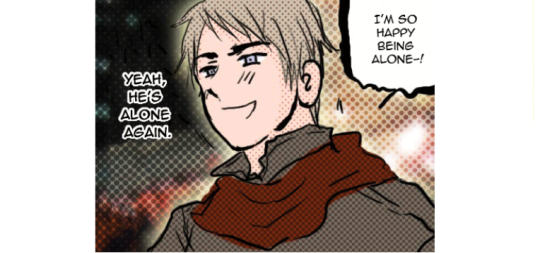
Despite having never
been married, Prussia is the most sensitive and emotionally-expressive Germanic
nation.
He’s often found crying
and lamenting over the fact that he’s single and “alone.”
Ex: He cries when he
spots Hungary and Austria spending their Christmas together during the 2007 Christmas event [x].


The Germanic stereotype
has more to do with the fact that he’s a poor socializer.
For example, he’s given a
book on “How to Socialize with People.” He sneezes and claims to be bored with
it [x].

In direct contrast to
Prussia, as someone who’s been in several marriages, Austria is arguably just as
clueless as the German brothers.
He may have solved his
problems with marriages…

…but when it comes to
relationship troubles, he’s read his fair share of manuals and guides too.
Austria had copies of both
books that Germany purchased in Buon San Valentino. Had he have known this
beforehand, he would have lent them to him.


He becomes flustered
when Hungary reads the dating book and laughs at how inaccurate it is. It would
be to his own embarrassment should he have admitted that he had been an avid
reader of it.

On the other hand, in his defense, it’s largely hinted that he’s the one who gave Hungary flowers on Valentine’s Day.

Switzerland’s similar to
Germany in that he’s an angry-type that’s soft on the inside and well-intentioned.
He shouts at Japan to
give his own opinion, scaring the latter despite the good intentions of this
action. It’s tough love in that he’s trying to get Japan to stand up for himself.


He cringes and gets
angry for remembering all the fond moments that he had experienced with Austria during
their childhoods. This is sometimes at the expense of ruining the fond moments that
he shares with Lichtenstein [x].


Nonetheless, Switzerland
shooting at Italy in the frilly pajamas that Lichtenstein made for him is
iconic, and you can’t tell me otherwise.

Sweden’s slightly
different in that his minimal facial expressions are intimidating to people.
Finland finds Sweden
scary at first… [x]

…but later warms up to
him and realizes that Sweden smiles and expresses his happiness subtly [x].


In reality, he’s also
quite the softie.
He sews smaller
clothes for Finland [x].

He acts as a father
figure to Sealand [x].

In sum, while the
Germanic nations may come across as hard and steely, they’re easily among some
of the sweetest, most considerate characters in Hetalia.


[You’re so polite omg
bless you]
Yes, both Austria and
Prussia share similar issues, likely because of the steely stereotype that’s often applied to the German people. I think this
is the post you’re talking about [x].
And for sure! I’ll put together a quick guide
on this tonight!


America mistaking England’s request for a rubber – eraser –
and instead handing him a condom [x].
“A guy like you?”


France referring to England as a golden caterpillar [x].

Greece’s reaction when Turkey gets his ass
handed to him by Chibitalia [x].


Germany and England’s temporary ‘truce’ one Christmas during
WW2. England hurls the soccer ball at Germany’s face, and he gets it right back.


Most dangerous nations: Belarus, China, Germany, Finland, Hungary, and Russia.
Most underestimated nations: Belgium, China, and Italy.
Hardest workers: America, Germany, Japan, and Romano (if he has the motivation).
Laziest nations: Austria and Romano.


Note: This theory will make use of Freudian theory. While I
recognize that Freud’s ideas do not bear much contemporary relevance, that
shouldn’t take away from the fact that many of his concepts (e.g., erogenous
zones, childhood memory repression, catharsis) are nonetheless employed by Himaruya
in the series. The purpose of this post is to give some insight into the
psychologies of the characters.
Ever wonder why Italy
acts so childish sometimes? From a perspective of psychoanalytic theory, this
would be seen as a re-enactment of the insecurity and fear of abandonment that
Italy’s held since his childhood.


Regression occurs when a
person experiences stress and reverts back to an earlier stage of development
where life was easier. A lot of these childish behaviours have to do with
insecurity and the seeking out of comfort.
For example, if social
situations stress you out and you have a tendency to cling to a friend or
spouse, this behaviour is comparable to a child that clings to their parent for
protection. Another common example would be grown adults sucking their thumbs
when they’re stressed. An even milder version would be biting your nails.
Babies teeth and suck as a form of tension reduction; it soothes them, just
like an adult biting their nails or sucking on their thumb would.
We know that Italy’s
childhood was far from healthy. He went from the security, comfort, and
undivided care of Rome to being routinely conquered, subjected to countless
wars, and being forced to live in a strange and foreign environment – Holy Rome’s
household [x].


This abandonment, insecurity, and
fear of being left behind is still alive and well in Italy’s adulthood. What
you’ll see is that just like a child who seeks comfort in the ‘big’ and ‘strong’
authority figure that is their parent, Italy unconsciously sees Germany as a
replacement for Rome.
That said, let’s tie
this back to the strips.
When Italy and Germany
first meet in WW1 as enemies, Italy pleads for Germany not to open the tomato
crate that he’s hiding in. He comes up with the childish ruse that he’s the
spirit of the tomato box. While this could just be used for comic effect, I
still think it’s interesting to consider.

This example, on the other
hand, makes a lot more sense to me if I analyze it from a Freudian perspective.
Remember when Germany takes Italy as a prisoner of war and we get that bizarre
scene where Germany lets Italy escape, only for Italy to come waltzing right back
into his imprisonment?

Of course, the reason
that Italy does this is that he doesn’t want to go back to war and fight. On
top of that, what Germany’s providing for Italy here is a sense of comfort and
security – just like a parent would. That’s why Italy wasn’t so keen to leave.


We also get this scene. Italy has a nightmare where he’s left behind by Germany and Japan.
What prompted this was Russia’s alliance with Germany. His greatest insecurity
is that he’s useless and doesn’t bring any value to his allies [x].


He fears being alone.
The parallels between
these next two scenes are uncanny.
After waking up from his
nightmare, Italy runs all the way to Germany’s house in the middle of the
night. While he may not realize it, Italy’s seeking comfort and reassurance.

Now, compare this to the
scene with Chibitalia. Upon being frightened by thunder, he hops into bed with
Holy Rome [x].
Side note: Holy Rome and
Germany literally have the same emotional and verbal responses, just saying.

Point is, Italy’s fear
of being alone was developed early in his childhood and it’s continued into his
adulthood.
In sum, Italy’s childish
behaviour doesn’t appear to be simply for the fact that he was originally
intended to be a derpy character by Himaruya. A lot of Italy’s clinginess stems
from childhood fears of abandonment and the subsequent insecurity of being left
to fend for himself in a world that has consistently proven to be hostile,
brutal, and unfair.

Him straining not to lose his composure when a dog appears during a training session.


 Ellawritesficssometimes