Well, they weren’t exactly successful at being stealthy.


Well, they weren’t exactly successful at being stealthy.

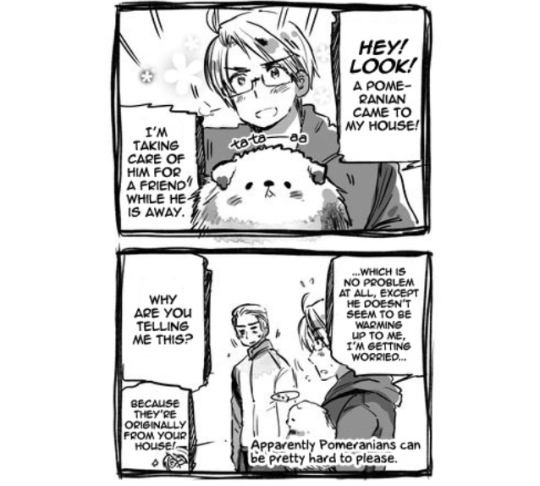
America taking care of his friend’s Pomeranian and asking for
Germany’s help.
Canada crying and doing his best to heal England after the
American Revolution [x].


Hungary secretly cleaning up for Austria after their empire
is dissolved.

After telling the story of Germany’s birth, you see a break
in Prussia’s egocentrism – or rather the act of it. He goes from “worship me
all you like” to agreeing to do laundry for Germany. In reality, he’s an
incredibly helpful, hardworking, and diligent person.


As stated in “In just 2 minutes, you can grasp the exterior of
the European Economy,” a nation’s health is dependent on two factors – the
stability of their economy and their politics.
This post will examine what happens to a nation when their
political situation lacks stability.
Let’s go through some examples.
The recent divide between Republicans and Democrats have
been a cause for concern for America’s health. The fighting between the two
political parties is enough for England to comment that the 2016 election must
have been exhausting for America [x].


America denies this, claiming that his body is strong enough
to handle the infighting.

The running gag is that all parties will bond over
how much they hate the new president once the election is over [x]. Point is, it’s
the fact that England’s worried about America’s health – stemming from his
political situation – that’s significant.

China’s rough history of ups and downs, consisting of many rebellions,
conquests, moments of prosperity and unification, and division was a lot for
his physical body to handle. The consequence of these political conflicts is
that he develops aches and pains [x] [x].


England is notorious for falling ill after/during political
conflicts.
Ex: After the American Revolution [x].

Ex: After the Napoleonic Wars [x].
Ex: During WW2 [x].
This example is undeniably the most important one.
Remember that nations are representations of their citizens.

They exist because of them. Said body of citizens encompasses all groups within
the population. A German is a German, regardless of their ethnic heritage,
culture, and race.
That’s why I believe that Germany is described to “tolerate
his way through pain” during WW2 [x]. German Jews were still his people regardless of their ostracization and the monstrous atrocities
committed against them. This all had to be felt by Germany.
Not everyone was favourable of the Nazi regime either
(obviously) – the executions of those who spoke out against Hitler, assaults,
raids, and surveillance carried out by the Gestapo created an immense sense of
fear and terror for many Germans. Combine that with air raids. The politics of
this time were far from stable.

As always, I must point out that the nations are
subordinates to their bosses and are forced into complying with their orders, often
against their own free will and conscience. Full post on that here [x].


Ex: Germany didn’t want to annex Austria, but was forced to
by his ‘strange’ boss [Hitler]. [x]

Ex: He’s screamed at by his boss, and yet, still takes down
notes. [Out of obligation.] [x]

Ex: Germany didn’t want to form an alliance with Russia. He
did so out of a sense of duty [x].

Ex: While joking, Finland darkly hints at the real
possibility of Hitler being capable enough of imprisoning Germany should he
complain too much about him. It’s more than just “boss troubles” [x].


Ex: When taken as a prisoner of war, Germany compares torture to a mosquito bite. This is because of the pain he experiences on a daily basis during the war.

With all this in mind, what I want to stress most is that
the nations feel pain for their people in whole, aside from whatever actions
their government decide to take.

I’m not particularly big on headcanons, but I sometimes do charts like this 😀
Most insecure nations
–
America, Canada, England, Germany, Italy,
Romano, and Poland.
Loneliest nations
–
America, England, Iceland, Prussia, and Russia.
Happiest nations
–
Denmark, Finland, Seychelles, and Sweden.
Most sarcastic nations
–
England, France, Norway, and Romano.
Nations we need more of
–
Belgium, Belarus, India, and Vietnam.
No worries, and yes! Remember that my posts only give examples, they’re not a comprehensive list of everything. There’s always more evidence that I encourage the rest of you to look at for yourselves. Evidence from previous posts can be found here [x] [x]
Germany’s first character note also makes this differentiation from his ‘strange’ boss pretty freaking clear [x].


This post will use attachment theory to analyze Romano’s
attachment style – how he forms relationships with others – in adulthood. The
previous post to this analyzed how Romano’s unhealthy and insecure attachment style was
developed as a result of his childhood [x].
Previously in
Psych-talia…
Attachment
theory focuses on the relationship between a child and their caregiver.
Central to the theory is the concept of needs. A child relies on their
caregiver to protect them, provide for them, and care for them. If all these
needs are consistently met, the child develops a healthy attachment to their
parents. This healthy attachment style positively
affects both the child’s personality and their capability to establish and maintain
healthy relationships as they grow older.
However, if needs are not met at all,
or are sometimes met and at other times are not, this inconsistency causes the
child to develop unhealthy attachment styles. As such, they
develop unhealthy personalities and form unhealthy relationships with others.
The Ainsworth
experiment was where this theory originated. To test the attachment styles
between toddlers and their caregivers, they would put them in a room together
at first. After a while, the parent would leave and the child would be left on
their own. Then, a stranger would be introduced to the room and leave after the
toddler had a chance to react. The last part of the experiment analyzed the
toddler’s reaction once they were reunited with their parents again.
Being in a “strange
situation” – a foreign room, absence of a parent,
and meeting a stranger [danger] – created a lot of stress in the
child. Since children seek protection from their caregivers, this stress and
fear would typically cause the child to become upset and seek reassurance from
their caregiver. It’s a survival instinct that innately kicks in.
Those with a secure
[healthy] attachment style would cry or be upset for a bit but would be
easily calmed once their caregiver soothed them. The healthiness of this
attachment style means that the child knows that the parent is there for them –
they can be relied on to satisfy their needs.
While there are several different
unhealthy attachment styles, only one is important for this post. An insecure
ambivalent/ preoccupied attachment style is seen where the caregiver
returns but is unable to sooth the child. The child often responds with anger, and sometimes they can even become aggressive.
The unhealthiness of this attachment style means that the parent
inconsistently meets the needs of the child. In other words, their care for the
child is inconsistent. They’re either overbearing when they meet the child’s
needs, or they’re completely unavailable and don’t meet them.
This inconsistency causes a sense of hostility and distrust to develop
in the child. They don’t want to rely on their parent, but know that they have
to if they want to survive… a love-hate relationship if you will. The anger and
aggression are symptoms of this contradiction. Anger is also a way that the
child learns to communicate their needs to their parents.
Let’s tie this back to the strips.
What you’ll see with Romano is that he has an ambivalent/
preoccupied attachment style stemming from two parental relationships. His
needs were not consistently met since Ancient Rome spent most of
his time rearing Veneziano. The unavailability of care.

Then, Romano falls under Spain’s rule, someone
who goes out of his way to care and provide for Romano. The overbearingness of care.

A full
analysis of Romano’s attachment style in childhood can be found in the first
part of this series.
While
attachment styles are developed in childhood, they often follow a person throughout
their whole life. It affects how they form relationships with other people, how
they maintain them, as well as, you guessed it, how secure they feel in romantic
relationships. Given that Romano hasn’t been depicted to be in a romantic
relationship, this analysis can only cover platonic or familial relationships.
Adults
with ambivalent/ preoccupied attachment styles are hot-tempered, angry often,
constantly complain, and get pissed off easily. In relationships, they embody an
“I love you, I hate you” pattern of communication. In other words, they have
jealousy issues and will say one thing but mean another. Another example of
this would be person A being reliant and dependent on their partner, person B, and
yet claim that they don’t need person B.

Romano
and Spain share a very complicated relationship, given that Spain evolved from
a parent/ older brother figure to a confidant and close friend of Romano’s.
The
love-hate relationship is made clear in one character note that claims that
Romano doesn’t see Spain as a friend or an enemy and that their relationship is
in a grey area.

Other
interactions in canon completely contradict this.
For
example, when Romano moves to America for work during the Second Industrial
Revolution, it’s stated that he’s closer with Spain than he is with his own
brother, Veneziano [x]

It’s
for this reason that the first person Romano calls when he’s in this new,
scary, and unfamiliar environment is Spain.


Spain
is happy to give Romano advice and acts as his biggest supporter.


Notice
how frustrated Romano gets at certain points in the conversation. The running
gag between the two of them is that there are times where they completely
understand each other and times where they don’t at all. In this case, Spain’s
easily distracted mind irritates Romano.


Point
is, Romano is dependent on Spain despite constantly cussing at the latter and
insulting him. Remember, anger is a communication of needs for these people.
Here, Romano has trouble getting through to Spain, who is available to
talk seriously for some parts of the conversation, only to get completely
side-tracked and be emotionally-unavailable for the majority of the phone call.
Romano
is also dependent on Spain in terms of comfort.
Ex:
This occurs when the price of pasta sky-rocketed.

One
last example of this love-hate relationship with Spain would be when Spain
experiences an economic recession and almost dies from it [x]. Pay attention to how
Romano shows his love and care for Spain through actions, yet repeatedly verbally
berates Spain as he saves him.


Romano even had to square off against the Mafia, whom he’s normally terrified of and is coerced into doing favors for.


Ever
since Unification, the two haven’t seemed to get along.


Romano still resents
that Veneziano was given the special treatment by their grandfather and feels
inferior. Longer post on that here [x].
Ex:
Romano insults Veneziano’s innovations during the Second Industrial Revolution.
This appears to stem from jealousy given that Romano compliments this very same
innovation when Veneziano can’t hear him [x].


Later,
he moves to America just so he won’t have to rely on Veneziano.


He’s
jealous of Veneziano in that he’s often referred to as “Italy’s older brother.”
He resents and perceives this as him not standing out on his own.
Ex:
When he doesn’t get a part in a movie, he states that people only care about
his “stupid younger brother.”


Ex:
He doesn’t react well when Prussia refers to him as Italy’s older brother.

Ex:
One character note states that Romano detests Veneziano “a bit. [x].

Ex:
Veneziano once said that Romano is nice to him every eight years [x].

The
dependency of this love-hate relationship is clear as Romano relies on
Veneziano’s economy in the present, but will still bicker with him and refuse
to cooperate [x].


Romano
also complains that Veneziano doesn’t give him a chance to work – although this
is valid considering that Veneziano has a habit of taking over most of Romano’s
workload.

When
Veneziano gets Germany to help clean Romano’s messy room, Romano has one of two
reactions. Of particular importance is the mixed signals and contradictions in
how Romano communicates with others, a characteristic that ambivalent/
preoccupied people all share.
1) Excessively insulting both Veneziano and Germany, telling Germany to go
home.
2) Shock and surprise when Germany actually offers to go home – Romano wanted Germany to clean his room but was too prideful/stubborn to say this out loud.


Lastly,
the love and care of their relationship is mostly behind the scenes for Romano.
He secretly looks out for Veneziano.
Ex:
Romano scrutinizes Germany during WW2 and doesn’t like his influence on
Veneziano.

In
sum, if you look at Romano’s anger from an attachment theory perspective, it’s
not all malicious. A lot of it originates from jealous and hostile feelings
that he’s kept contained since his childhood. Romano’s capable of love and compassion
– he just has a terrible way of verbally expressing it.

Q: i read on one of the hetawikis that italys curl was added as a last
minute thing to make him cuter, but himaruya said that now the curl is
“important.” any thoughts?
A: There’s one character note that states that the curl represents “the
sexual something of the Italians” [x].
Q: Your post on how fascism isn’t promoted in the manga was
extremely helpful, so thank you. Just wondering. Is there any strips that
depict how the people react to the war?
A: Disclaimer: This is
coming from someone who’s half Jewish. I shouldn’t have to say this, but
knowing the internet…
All that’s shown is how hopeful the people are [x].
You have to situate the context and realize that the German people had just
come out of a massive economic recession. The war promised them a solution. (Unfortunately, this solution and the many years leading up to it involved scapegoating, unjust persecution, assaults, and discrimination).

Point is, Hetalia never promoted Fascism. As
discussed in this post [x], all it does it situate the reason why the Germans
went to war – namely because of how stringent the compensation mandated by the
Treaty of Versailles was. It doesn’t tackle anything past that. Given the young targeted demographic, the atrocities committed during WW2 aren’t covered or touched on.
Again, there’s a difference between situating a
historical context vs promoting a horrible political ideology.

A: Thank you! I’m by no means a gun expert, but in one
of the first original web comics, he does appear to be holding a sniper rifle [x].

There’s also the famous Finnish sniper Simo Häyhä “White Death” from WW2 that might have made such a headcanon
to be taken as fact. Other than that, you’re right. I don’t recall any of his
character notes mentioning this ability. Most of them can be found here [x].
Q: What’s your favorite time Germany
wasn’t being “strict follow the rules never smiles” in the manga. ( I just saw
a picture of Germany putting on a puppet show for America and Russia and he
said “don’t nuke it out, hug it out” and I was like man I need more of this
side of Germany).
A: Chapter 20 of World Stars! Italy asks Germany
to help him clean Romano’s messy room. Germany seems looser here and even
returns some of Romano’s snark, although still being up to the challenge [x].


Q: Can Norway and England see General Winter?
A: It seems to be Northern countries who experience winter that have interactions with
General Winter.

What I’ve always found to be insane is that not
only is Finland immune to the cold, but he’s friends with General Winter [x].


Before, I used to dismiss the idea of time travel in
Hetalia. Looking back, I can see that this limited my understanding of several
bizarre and inexplicable occurrences in the manga.
In a fictional series
where the nations are immortal, being referred to as “strange” and “odd”
beings, it’s honestly not that far-fetched to consider that they’re capable of
time travel.


This is especially true given the facts that…
1) Time is experienced differently by the nations.
Ex: Canada spends an entire weekend staring at Kumajiro’s
eyelashes. It passes by without him realizing this [x].


Ex: If a human were to spend enough time around a nation,
their perception of time would become so warped that they’d go mad.
Ex: Pets don’t go mad when they’re around their nation
owners. Instead, their lifespans increase. Should they separate from the
nation, however, they would become normal pets again and resume aging [x].
2) Some nations are capable of magic,
fortune-telling, clairvoyance and other supernatural abilities.
Ex: England’s and Romania’s ability to cast spells.

Ex: Japan’s powers of clairvoyance and mind-reading [x]– I’ll
get back to this later.

Evidence of time travel in Hetalia is either extremely
subtle or so right in your face that it’s easy to overlook.
Could it be that the pets don’t age because the nations are beings that are able to transcend space and time? In other
words, what if time is bent around the nations, which, in turn, causes their
pets not to age?
They’re timeless beings in that they’re immortal. While they
do age, it’s very incremental. They still remain youthful, likely because time
is slowed for them. In that case, the reason that the pets won’t go mad by
being around a nation is that they don’t perceive time the same way that humans
are able to.
Are the nations able to time travel then?
Evidence from the manga suggests that they’re indeed able
to.
Let’s go over some of these examples.
If you factor in time travel, this would explain the sudden
appearance of anachronisms when you least expect it. I used to think that these
were silly comic gags. My opinion has since changed.
Ex: When America pulls out a computer to google where
Germany is in 1942, England isn’t surprised. Instead, he’s able to pinpoint
exactly how far into the future the model is and reprimands America for showing
off.

Ex: Why is it that during the 18th century, Japan
appears to be listening to music…with earbuds? [x].

Ex: The Roman Emperor Nero is once depicted to be playing an
acoustic guitar.

They’re aware that it’s an
anachronism. Perhaps either Rome or Quintillus – another Roman Emperor who’s
canonically able to time travel – brought that there. I’ll get back to
Quintillus in a moment.
As mentioned above, Japan has been shown to be able to read
minds, see into the future, and establish contact with others without having
ever met them in person before.
Ex: Japan demonstrates his clairvoyant powers during the
Meiji Era. The fourth wall is broken as the scene pans in on
Himaruya scrambling to finish a comic.


Ex: When Japan first becomes acquainted with the Italy
brothers, they’re put off by how silent and reserved he is. Japan later admits
that he’s not used to speaking out loud with those whom he’s read the minds of [x].


If anything, this alludes to the fact that Italy and Japan
have technically met before.
Notice the title of the strip too. “A melody that transcends
history and reaches you…”


After falling into bed with Holy Rome, Chibitalia has a
strange dream where he encounters a presumably divine being that leads him to –
yes, Japan. This confirms what Japan claims in World Stars. He did, in fact,
read the mind of Italy and communicated with him far before they formed their
alliance in WW2 [x].


That’s not it, either.
Italy in adulthood has a ‘unpleasant dream’ of a child that looks
exactly like him pressing to be acknowledged [x] [x].


How I’ve interpreted this before is that it symbolically
represents Italy’s unconscious mind repressing memories from his childhood. Put
another way, he’s refusing to remember – acknowledge – bits of his past.
Taken literally, this could also mean that Italy’s child
self is transcending time and space to get him to remember his past.
Or, what about this scene? Italy encounters his child self, recognizes this, and feels ashamed for
lying about how [not] strong he’s become [x].


Germany also appears to have these strange encounters with chibis.
Ex: In the same strip, a child that looks
exactly like Germany/ Holy Rome presses to be acknowledged as well [x].

Ex: Germany’s once shown to be holding up Chibitalia.
“It’s me!”

What if this is Chibitalia traveling into the future
to get Germany to remember about his past as Holy Rome? At the same time, it could symbolically represent childhood memory repression. Of course, this is all making the assumption that Germany is, in fact, Holy Rome.
Most obvious of all is that there’s a real character in the series
who’s physically able to time travel.
The play on Quintillus’ time-traveling abilities is that
because historical records about him are shifty, his timeline leaps back and forth.
Himaruya took this, made it literal, and gave Quintillus time-traveling powers [x].


Ex: We see Quintillus visit Germany in modern times making
sure that the latter’s research and re-writing of Roman history are accurate [x].

With all the evidence I presented, I truly do believe that
the nations are able to time travel. It’s not just limited to their ability to
slow time for those around them. They seem to be able to manipulate it too, being able to disappear on
a whim…


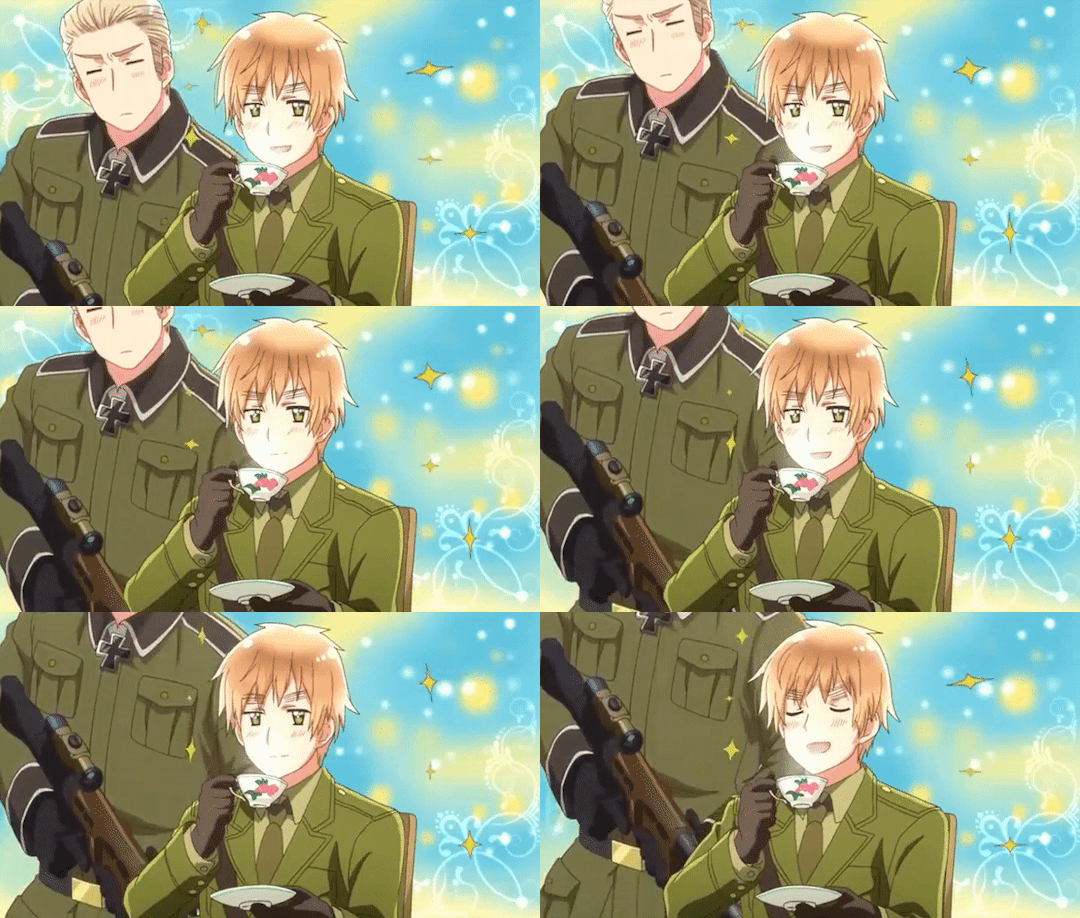
England [to America]: Relax, you yank. Germany’s not anywhere near here.
Germany:
You’ve been hit by
You’ve been struck by
My smooth arsenal
No. What happens is that America chooses China to attack the
axis so that he can assess China’s feats. How I interpret this is that America
is covertly analyzing China’s strength and possibly feels threatened by him.


 Ellawritesficssometimes