When the sun shines, we shine together
Told you I’ll be here forever
Said I’ll always be your friend
Took an oath that I’m a stick it out till the end
You’re part of my entity, here for infinity When the world has took its part
When the world has dealt its cards If the hand is hard, together we’ll mend your heart
The purpose of this post will be to analyze the ways in
which childhood traumas and unhealthy relationships are continuously repeated
in how the nations lead their adult lives.
England:
What you’ll see with England is that the rocky relationship
he has with his brothers is replicated in how he maintains future
relationships. As a child, his brothers, Scotland, Wales, and Northern Ireland
had a profound hatred of him. The hatred was so deep that they would send hexes
to England in the mail or attack him with arrows and stones.
The consequence of this, from a psychological standpoint,
would be that England learned to have a hostile distrust of others. Just like
his brothers would send him away, England replicates this through his own
hostility. He denigrates others because it’s something he grew accustomed to –
it’s all he knows how to do.
In other words, he isolated himself and became the Black
Sheep of Europe.
Likewise, this denigration is also imposed on himself. England
has poor self-esteem and deprecates himself just as much as he does to others.
Those who have problematic upbringings unconsciously pass on
their own neuroses (inferiorities) to their children. You can’t expect a parent
to be a true parent if they haven’t experienced what it’s like to be a child
who’s cared for and loved.
This would explain why England did such a poor job in
raising America, despite caring so deeply for him. He’s capable of love but has
a terrible way of expressing it. He was alone in childhood, so leaving America for long periods of time was, in his mind, ‘normal’. It’s not.
This is why I also believe he was so critical of America
post-Revolution. The relationship he shared with America was full of unconditional
love and care on the part of the latter. He could come back and visit at anytime and be able to expect a warm welcome from America.
America was naïve and had no reason to hate him. The hostility came when America declared his independence. England was being pushed away again… The care was gone, and not knowing how to cope with this, England
went back to being hostile.
Notice the repetition in behaviour where England, the older
brother figure, casts a hex on America, the younger ‘brother. ’I don’t think
this was done for no reason.
He attempts to get America to sit in the cursed Busby Stoop chair. Russia sits in it instead.
America:
With England gone for long periods of time, America had to
grow up fast. Of course, this didn’t stop him from [initially] having panic
attacks over being left alone, especially given how young he was biologically.
In more modern strips, America still panics over the thought
of being alone.
Ex: America pokes his nose into other nations’ business to
the detriment of them ‘hating’ him. Desperately, he tries to convince himself
that at the very least he has Japan as a friend.
Germany:
As a nation that was thrust into wars right from birth,
Germany has trouble understanding sincerity in others.
He also has difficulty understanding the concept of
praise and doesn’t know how to react when he’s on the receiving end of it.
Similarly, when he gives praise himself, it takes him a
while to realize that he’s done so.
Russia:
Growing up under repressive rule warped Russia’s conception
of what a healthy relationship should be like. As such, he mistakenly grew to
believe that power is what is needed and essential in a relationship. The
adults [conquering leaders] are giants that can do whatever they please. Russia,
as the child [underling], is both powerless and coercively subject to
satisfying what the adult wants.
He claims that he and Lithuania can’t be friends until they have more power.
This child imagery pops up again during Bloody Sunday. The
way he describes the protestors as children, as something to be controlled and suppressed,
is even more telling of what he perceives to be a ‘normal’ relationship.
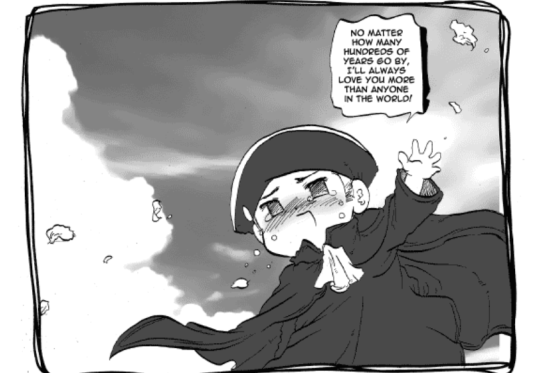
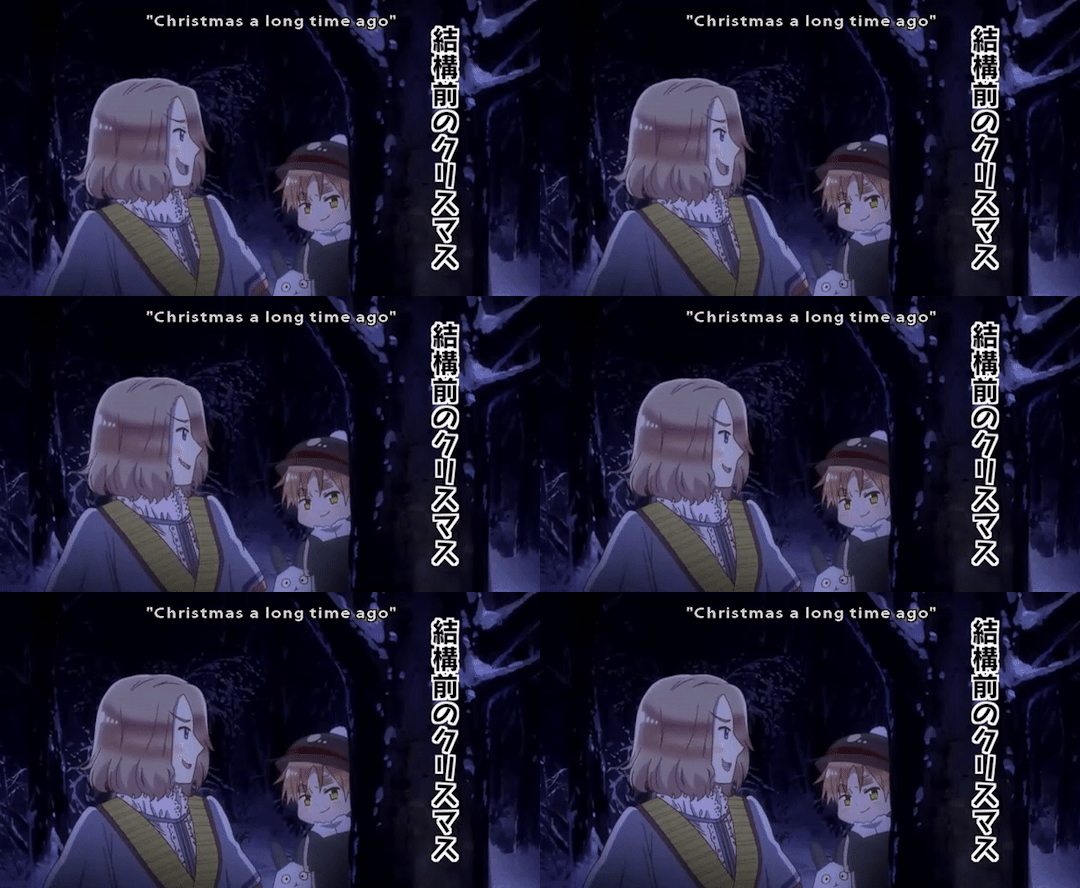
Russia is attacked during the 2010 Christmas Event and calls
on General Winter for help. When they’re both defeated, Russia realizes that
his power has been taken away. He’s no longer in control of the situation and tears
up over how nostalgic this is of the past. It’s the perverse power dynamic
that is most important here.
I’ll end on the note that a lot of the ‘childish’ behaviour
that Hetalia is criticized for has meaning and purpose to it. There’s a ton to
unpack if you step past the simplicity of external appearances and dig deeper –
that’s just how detailed Hima’s characterization is. It’s easy to overlook if
you only look.
I’ll
preface this by saying that I know Prussia is East Germany. On the other hand,
we don’t have any strips that concretely refer to Prussia as East Germany.
That said, until Prussia is either referred to
as East Germany or labelled as such, by rules of canon, he technically isn’t
East Germany. Yes, I know this is a bit confusing since his wiki page states
that he’s East Germany… I’ll get back to that in a moment.
Essentially,
the purpose of this post will be to illustrate how we know that Prussia is East
Germany; it just hasn’t been confirmed with a direct reference.
Opening Misconception:
Some people
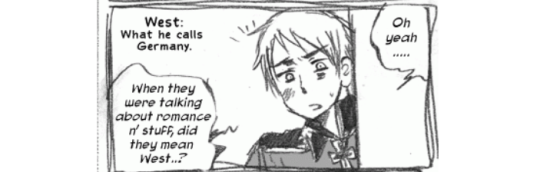
claim that Prussia is East Germany because he refers to Germany as West. This
is incorrect because we see Prussia referring to Germany with this nickname
well before WW2 ended. The nickname likely has to do with geographic proximity, as Prussian
territory is located in the East of the country.
Is it possible for a personification to exist after dissolution?:
Yes.
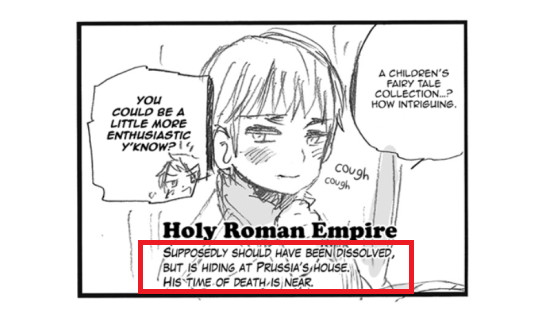
Ex: We’ve seen
Holy Rome exist well after his dissolution.
“Usually, when the culture or the country’s personality
dies/disappears, the country would gradually disappear or entrust him/herself
to the country that takes over him/her.” [x]
In other
words, the personification’s existence is personality-based. This personality
is based on how strong their people’s culture is. Even after dissolution, if
the culture doesn’t die right away, the personification will still have a
reason to be. Basically, the path to death is gradual.
The second
part of this rule is what is of particular interest to me. It’s an option where
death isn’t required, regardless if the culture is gone or not.
“… or
entrust him/herself to the country that takes over him/her.”
In the
present day, Prussia mentions that he’s no longer afraid
of Russia because Germany is strong enough to protect him. Of course, this is making
the obvious assumption and conclusion that he’s East Germany.
Lastly,
another reason that could account for Prussia still being alive is that
personifications who have lost their culture can still live on as
representatives of their region.
“There are also cases that
him/her is not a country but continues to live leisurely as a representative of
a region.”
How I see
this is that the personifications become active in politics. In that case, this
would explain why we see Prussia still attending world meetings.
Character
notes state that he fell under Russia’s control and was stuck working unprofitable
jobs for him [x]
Ex: Russia’s
political indoctrination of Prussia.
Ex: Prussia
working alongside the other Soviet countries.
Ex: In the
Christmas 2010 strips, Prussia reveals his deep hatred of Russia. He’ll puke if
Russia touches him. If not, he’ll lose four eyelashes – this is likely a
reference to the Allied-controlled zones that divided Germany into four post-WW2.
Ex: When
asked why Prussia’s alone so often, Hima answered that he’s in an enclave of a pitiful state. [x]
“An
enclave is a territory, or a part of a territory, that is entirely surrounded
by the territory of one other state.”
If that’s the case then this would translate into Prussia
being amalgamated into/surrounded by Germany. Take note of this mention of weakness, because I’ll be bringing it up again soon.
Why we know he’s East Germany…
[…despite it not being confirmed.]
There are
several hints of the East-West divide that still lingers in the country.
Ex: In
terms of infrastructure, the East is on average poorer than other regions of
the country.
Ex: During
the same EU meeting from the example I listed above, Prussia talks about Ostalgie
and uniting the wall in [his and Germany’s] hearts. *Ostalgie is nostalgic
feelings for East German life and culture.
“We have to get rid of the “wall in our
hearts,” so that the country can get better and the progress will be
naturally more effective! When the Ostalgie level gets higher, Russia
imposes himself on my big brother.”
An obvious
reference to German Unification. No doubt.
Ex: When
the two brothers are finally unified, Prussia comes to Germany wearing old clothes.
Of more importance is the car he arrives in. It has an uncanny appearance to
a Trabant, an East German car.
He’s grown weak:
As seen in
one of the examples above, Prussia relies on Germany to protect him from
Russia since the latter is strong.
We also
know that Prussia doesn’t heal as fast as a typical nation would. This doesn’t
mean that he’s dying, given that personifications can still live on without
culture, but it does mean that he’s weaker than he used to be.
Ex: He’s
bitten by Germany’s dog. A full week passes, and his wound still hasn’t healed. What’s even more troubling is that Prussia lies to Germany about how long he’s had the wound for.
Prussia’s always been reluctant to admit to
weakness, so I wouldn’t say that this is all too surprising…
The nations are two-fold representations. By that I mean
that they have a literal body and a figurative body.
Bear with me, things get a bit tricky, but I’ll break it
down to the best of my ability.
Basically, the figurative body is what influences the nation’s
physical body.
The figurative body
is composed of two parts.
1) There’s the geography of the nation. The landmass is sometimes referred to as their body or house,
despite the real physical one that they possess.
The geography can influence both the physical appearance and
personality of the personification.
Ex: Since Sealand’s geographic body is small, so is his physical
one.
Ex: Iceland’s contrasting volcanic and freezing temperatures respectively
causes him to have a hot and cold side.
2) There’s the personality
of a nation. The personality of a nation (not to be confused with the
personification’s personality) is defined in terms of culture in the manga [x]
If the culture is well-developed
and thriving, then the personification will also thrive and be able to grow; to
age. However, if the culture is repressed, then the personification’s growth
will also be stunted.
The reason I’m outlining this is essentially to show how
geography/climate and historical events are reflected in the personifications’
appearances and personalities. Information on the impact that this has on their
health can be found here [x][x]
What this post will focus on, however, is why some nations
have scars and either suffer from or are affected with other physical symptoms.
Let’s go over some examples.
Ancient Rome:
Before dying, Rome was noted to have many wounds and scars –
a physical reflection of the turmoil his people suffered from.
Lithuania:
We know from his time spent in the USSR that Lithuania acquired
several scars on his back. The military repression of several revolts and the
banning of diverse cultural practices in favor of an atheist state very likely
had a role in causing these scars to appear.
Latvia:
Latvia’s case is similar to Lithuania’s. While we don’t know
if he has any scars, we know that Russia pushing down onto his head ultimately
stunted his growth. How I interpret this is that it’s a metaphor for political repression.
Put another way, Russian control stunted Latvia’s growth,
which, in turn, was reflected in the personification’s physical body.
China:
It’s hinted that China gained scars after being betrayed by
Japan in WW2. It’s both a literal and symbolic stab to the back.
Germany:
Each time America engages in reckless financial activities,
a new wrinkle develops on Germany’s forehead.
Finland:
Estonia’s quest to become a Nordic causes Finland’s back to
be itchy whenever he’s talked about.
Bonus cases that aren’t so clear…
Russia:
When he’s not wearing a scarf, Russia is shown to be wearing
bandages around his neck.
Netherlands:
An unknown event caused him to develop a scar on his
forehead.
Before I start, it’s important to go over and situate a few
things. The nations’ immortality is more of a curse than it is a blessing.
They’ve experienced countless wars, plagues, political strife, and have even
died, only to be regenerated.
Now, unlike humans who have been blindsided with the rough
backhand of fate, the nations are forced to relive these pains over and over
again. It would be enough to drive a normal person mad.
In other words, their immortality was a prison that kept them
locked into a systemic cycle of bloodshed. What adds to this prison imagery is
that they’re obligated to listen to their bosses and fight in wars that they don’t
necessarily want to participate in.
Nowadays, this prison more has to do with loneliness. They
still follow their bosses’ orders, but the restrictions on their freedom are
not nearly as pervasive.
Ex: England’s sweet and alcohol intake is regulated by his
boss.
Regardless, Germania and Ancient Rome best exemplify how
their freedom was gained not by their immortality, but rather, the loss of it.
They were “liberated” from their bosses and war upon dying.
France is another good example of this. He gives better
insight into how heartless history can be in tossing peoples’ lives around. When
he first sees Lisa, Jeanne d’Arc’s reincarnate, he believed that God was
playing a cruel trick on him. On its own, this already proves how betrayed and
hurt France felt after her death.
Nonetheless, France still keeps his faith and believes that
humans who have had rough past lives will be reborn into happier ones. He
doesn’t have this privilege.
The purpose of this post will be to illustrate how the
nations’ immortality has historically caused them to live through many
traumatic events. It would follow, then, that being reared in such unhealthy
environments would cause some of them to develop PTSD.
In fact, there is a mounting pile of canon evidence that
depicts the nations having discomforting flashbacks, severe anxiety, and
nightmares. That said, let’s go over some examples.
America:
When his settlers moved inland, America didn’t have many
belongings to his name. England ponders why America produces things in mass and
comes to the realization that America’s overconsumption of goods likely stems
from this impoverished period of his life.
Note the use of the word traumatized.
Lithuania:
Lithuania has a flashback to when he and the other Baltic
States declared their independence from the USSR. He then experiences another
flashback, where Russia squeezes his shoulder – it’s used as a metaphor to
represent political repression.
Lithuania is so immersed in this second flashback that he
begins squeezing Estonia’s and Latvia’s shoulders without realizing it.
One of his character notes also mentions that he’s been rebilitating after his time spent in the USSR.
England:
England doubts his capacity to care for young America. The
stress of this new responsibility causes him to have a flashback of his older
brothers sending him hexes.
It’s noted that England once suffered from 100 years of heartbreak, presumably a reference to the American Revolution.
This is a theory of mine, as it isn’t confirmed in canon, but given that England coughs up blood and gets ill on the fourth of July, I think that it is meant to symbolize how he still hasn’t recovered emotionally from America’s independence. In other words, each year, England’s heart is both literally and figuratively ripped open on the inside.
Japan:
While this example is a more subtle depiction of trauma, it’s
not surprising.
Although this isn’t covered in the strips, following WW2, Japan
would have become America’s underling. As such, the atrocities committed by the
atomic bombs would have made him visibly more compliant to America’s demands,
regardless if he agreed or not.
This is seen in a world meeting where Japan unanimously agrees
with America’s ridiculous global warming plan. Switzerland even calls out Japan
for not voicing his true opinion.
Switzerland:
Switzerland’s mercenary past still haunts him. Lichtenstein
perceptively reads into this as she asks him why they’re working to boost her income through tourism.
Italy:
Italy’s perhaps one of the most anxiety-ridden characters in
the series.
Ex: He worries that Germany hates him and has nightmares
about this. His greatest fear is being left behind to fend for himself.
This insecurity leads him to make Germany reaffirm to him several times that he’s not actually hated.
Ex: Italy has nightmares where a childhood version of himself
presses to be acknowledged.
The dream ends with Italy screaming and refusing to
acknowledge the child. To me, and as I’ve theorized in the past, I read this as
Italy repressing parts of his childhood to minimize and forget about the trauma
that he experienced. The child is merely a representation of his unconscious
mind.
Germany:
Germany also has a childhood version of himself pressing to
be acknowledged. Of course, this is running on the assumption that he’s
actually Holy Rome and has forgotten about his childhood.
Similarly, he’s once depicted to be holding Chibitalia,
looking visibly confused.
“It’s me.”
Again, how I see this is that perhaps Germany is repressing
aspects of his childhood. In that case, Chibitalia is an unconscious
representation of these memories attempting to pierce through to his conscious
mind.
All in all, given how long the nations have lived, it’s not
novel to assume that they’re still traumatized by things that have happened to
them in the past.
I’ve answered this indirectly in other writings, but as a
subject that repeatedly comes up in the manga, it deserves its own post.
This is one thing that I’ve always been careful with, given
that labels like Stockholme Syndrome are loosely thrown around in the fandom.
Thing is, the underling situation doesn’t quite fit the medical definition of
SS. It’s certainly not a healthy
situation, though, and I have no problem clearing that up in the future. Point
is, it doesn’t do any good to attribute serious conditions like that, especially
since these exaggerations result in gross misrepresentations of the characters.
PTSD, on the other hand, is something that the nations have
canonically been shown to have real symptoms of, right to the nail of the medical
definition.
Post coming up tonight.
Misconception:
Greece and Turkey genuinely hate each other.
Reality: They say
they hate each other, but their actions tell another story. It’s more like
they’ll break out into arguments whenever they see each other, despite being
too prideful to admit that they actually care for one another.
The whole Greece wishing death upon Turkey gimmick is used for
exaggerated comedic purposes.
To be as transparent as possible, they do get on each
other’s nerves. A lot.
Ex: They’re often compared to cats and dogs.
Regardless…
This doesn’t stop Turkey from checking in on Greece. He did
play a part in raising him, after all.
Ex: They’re noted to be making advances in their
relationship, but still break out into arguments easily.
Ex: Greece offers to be stripped naked during the Christmas
2007 event to prevent Turkey from having his mask ripped off by France [don’t
ask].
That’s not the face of hatred – it’s far from it.
When Turkey enters, with his mask taken off nonetheless,
only then does Greece get hostile.
How I see it was that he had no problem
looking out for Turkey as long as Turkey wasn’t there to witness this and later
have something to gloat about.
Ex: Turkey’s form
of “bullying” is taking Greece to a bathhouse to bathe him and remedy his stiff
bones.
Misconception:
His slow and languid form of speech must mean that he’s unintelligent.
Reality: Greece
is incredibly intelligent. His culture’s philosophies and sciences had and
still have profound influence in how humankind organizes itself today. His
laziness, aside from the Greek stereotype, also stems in part from that fact
that he’s a night person.
“The whole problem started as he joined the Euro zone.Thanks to Greece, Germany had to mobilize all his resources, and he is now fully dependent on him.
Despite this situation, he’s mostly eating good food, sleeping, thinking about philosophy, and is generally happy like usually.”
Misconception: Because he’s so absorbed in his mind, he’s a
recluse.
Reality: He’s one of the most sexually active aph characters
out there.
Ex: He’s very natural and forthcoming about the topic of
sex.
Ex: It’s hinted that he once slept with Japan, although
Japan dismisses this as a dream.
Bonus Facts:
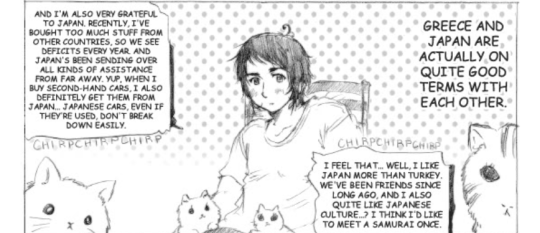
Still on the topic of Japan, Greece shares a very close and
wholesome friendship with him.
The two have undergone many cultural
exchanges.
His hobby is excavating his mom’s ruins [Ancient Greece].
In an EU meeting, he once proposed to get rid of the concept
of debt.
Hetalia Webcomic: Is hilarious and silly but also grim and thought-provoking.
Hetalia anime: Only animates the weird stuff because money.
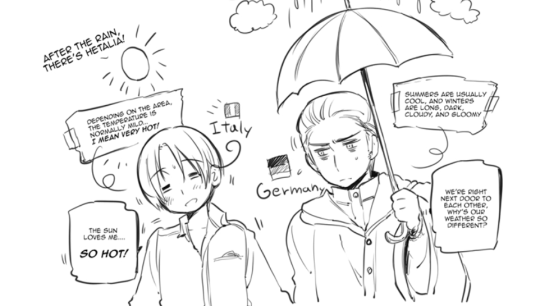
It depends on their position within the global economy.
As such, a nation’s health depends on their political and economic situation. They catch colds during economic recessions.
The Great Depression strips are a good source for this, as each negative number assigned to a nation has a differential impact on their health. Since America was a manufacturing powerhouse at the time, his stock market crash affected them all.
Ex: Japan obtains a cough, meanwhile Poland runs a high fever.
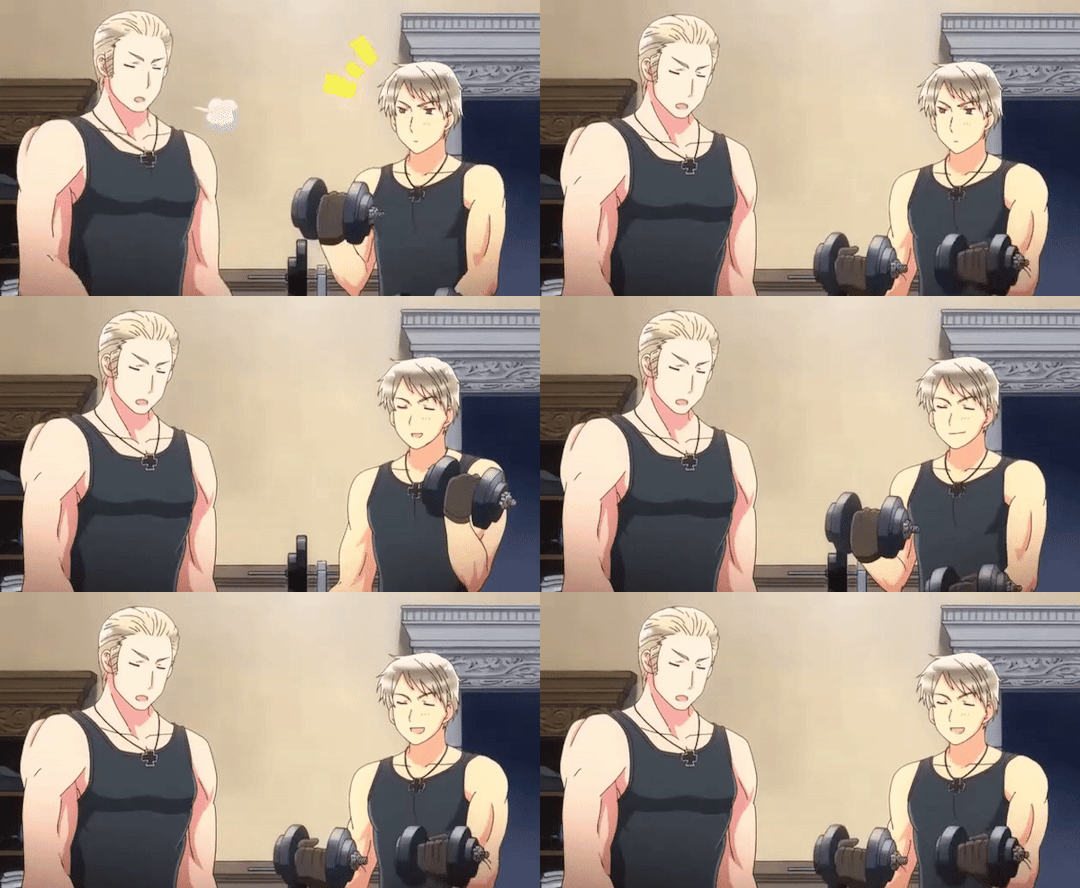
In modern strips, we’re also provided with the fact that Austria will slip into a high fever and eventually collapse if Germany even so much as catches a cold.
“A reliable country that likes to approach things with a sober seriousness. He approves of and supports lots of Germany’s ideas so he may look like one of the helper countries, but in reality the level of his dependency is pretty high. So high that when Germany catches a little cold, Austria goes straight to high fever and eventually collapses, and so he doesn’t have much of a choice than to take good care of himself.”
As for how serious it can get? Spain almost died from an economic recession.











 Ellawritesficssometimes