We don’t take the anime
as canon material. You go to the primary source of material for that – the strips
or any character notes/ blog posts that Hima shares.
Anyways, the scene from
Hetalia of the Dead that you mentioned is added. It didn’t happen in Volume 5,
where Hetalia of the Dead pt. 2 is located.
As for episode 3 of Axis
Powers, Germany isn’t smiling because Italy’s there. Germany’s smiling because
Italy’s not there given how much stress and annoyance the latter caused him in
WW1.
That said, Germany
smiling in this episode isn’t canon in the strips. This is the same scene from the
strips = no smile, but otherwise the same content. Again, he’s glad that Italy’s
not there. Problem is Italy shows up anyway.
As I mentioned in a
previous post, the only time we see Germany widely smiling is when he’s drunk.
He comes close to
smiling when he feels elated, though.
Ex: His love for
machinery. Here, it’s implied that he’s smiling, but it’s not shown. It could
just be something close to smiling too. It’s left open-ended.
Ex: He gets close to
smiling when he goes sight-seeing in Italy. He loves it there.
However, you are right
in that Italy does cause Germany to smile. We see that happen right before the
two of them go off to war in WW2. This is the most explicit example
of him smiling with full conscious awareness.
We already know from
chapter 1 of World Stars that the nations let their bosses order them around.
As such, they often have no choice over what they’re commanded to do.
I always use this
example, but it’s still important to point out that Germany’s sense of duty overrode
his personal unwillingness to annex Austria.
The control that
national leaders have over their personifications is pervasive. While Finland
is joking in part, he still alludes to the possibility of Germany’s boss [Hitler]
being more than capable of imprisoning Germany should he disobey orders.
In that regard, the
nations are just like regular citizens. They may cast votes…
…and hold meetings to
discuss world issues, but for the most part, they have little to no control
over what happens in their government. They recognize that there’s corruption
present, but don’t seem to be able to do much about it.
That doesn’t mean to say
that they have no agency, either. They’re not complete puppets in that they
have a mind of their own. It rarely happens, but some nations have in fact
resisted or gone against their boss’s wishes.
Either way, boss control
over personifications has historically been all-encompassing. While in present
times it’s not as extreme as what we saw during both world wars, the control is
still there. For example, England’s boss has control over his sweets and alcohol
intake.
Point is, there’s an
evident and wide power differential between a personification and their leader.
If that’s the case, what
happens to a personification when they’re captured?
The answer is nothing,
as Finland implies in this line of dialogue. More importantly, this strip takes
place in the present [2010].
The only material that
we have to work with on the subject can be found in
the instances where the nations are taken as prisoners of war.
Even when they are
rescued, it’s the personifications who do the liberating, not other human
soldiers. As you’ll see, when a nation is taken as a POW, they’re treated just
like any other soldier; no special treatment or protection is offered to them.
Let’s go over some
examples:
Russia:
As I’ve stated before,
Russia isn’t exempt from being exposed to the brutal conditions that his
soldiers had to endure.
The war-time conditions
are so bad that Russia even thanks Germany when he’s taken as a POW. He claims
that Germany is heaven compared to what he was used to dealing with.
Further, Russia’s bosses
are notorious for their brutal treatment of him. They clearly didn’t give a
damn about Russia given that they tortured him when they were bored.
That said,
I don’t think they would care all that much when news of Russia’s capture
reached them. Again, we don’t see any rescue attempts depicted.
There’s also the fact
that Russia was once given the order to stop a tank with his own body. What’s
crazy is that he actually obeyed this.
Germany:
When taken as a prisoner
of war, Germany claims that the torture there is nothing compared to what he
has to experience back home on a daily basis.
Italy:
Italy seems perfectly
comfortable upon being captured by Germany in WW1, citing that he doesn’t want to leave
as it would mean fighting again.
Usually it’s Germany who
rescues Italy when he gets into trouble on the battlefield. Of course, these strips take place during WW2.
However, in this case, Germany didn’t have to rescue Italy
from the Allies. He was so useless that they mailed him back.
England:
We also see that it’s
America who rescues England when he’s taken as a POW by the Italy brothers and
Germany.
In sum, when captured, it seems that the nations aren’t given any
special treatment or priority by their bosses. Instead, they’re treated just
like any other citizen. It would follow, then, that this type of treatment
would also carry into the present given the time in which Finland’s statement
was made.
[Pssst. Read it! Most of
the strips can be read online thanks to the amazing mods at Hetarchive.]
It’s more like the
nations have been taken as prisoners of war before, and their bosses don’t seem
to care all that much. They’re treated just like any other human soldier in
this case. I’ve already mentioned before that they don’t have all that much say
in their gov’ts, other than being able to cast a vote and hold meetings to discuss
world issues with other personifications.
Anyways, post coming up
tonight!
I’ll start this by doing a brief summary of what I’ve already theorized on the topic before adding my recent addition to it.
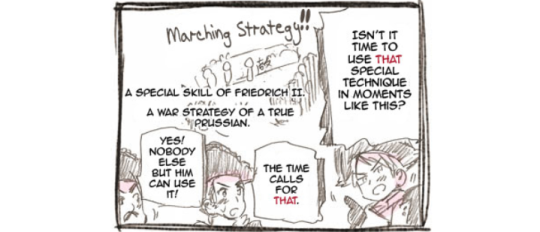
Prussia and Fritz’s flute playing, along with the motif of
marching forward and national consolidation in a military context, also bears
extreme significance when you connect it to some of the underlying themes
running through Germany and Prussia’s current relationship.
The flute is symbolically important in that it’s often
depicted as an instrument used by the Gods. It’s used to channel their voices.
For instance, Ancient Egyptians believed that it channeled the voice of Isis,
the Goddess of life and magic. She was also known for her healing spells, those
of which cured the sick and brought the dead back to life.
In Greek mythology the flute is associated with Pan, God of
the wild. He is also associated with the shepherd, whose primary duty is to
tend to their flock of sheep by bringing them together.
Now, the flute was first used by Fritz in a marching song
intended to instill a sense of consolidation and strength among his troops.
Taken symbolically, Fritz, as the shepherd, used the flute to bring his flock of
troops together.
I’ve also theorized before that Prussia, who adored Fritz
and therefore likely adopted the flute-playing from the latter, also took on the
role of the shepherd when he united the flock of fragmented German
states to form one sovereign nation – the German Confederation. It was a
military march that culminated in unification.
With that said, this theory will be making the assertion
that Prussia has chosen his next successor to undertake the role of the
shepherd – Germany.
The strip “Private Flute Concert” is essential to this
theory in that it gives us some of the biggest hints of connections
between Germany and Holy Rome. Evidence of this symbolic divine reference can be found
when Prussia talks about the “sacred journey of the flute.”
As designated by the title, Prussia gives Germany a private
flute concert.
Notice how as Prussia plays, he has a flashback to another private concert he had… with his little brother no less.
There, a sick
and bed-ridden Holy Rome expresses surprise at Prussia’s ability to play the
instrument. What’s important here is that Holy Rome refers to Prussia as a “war-maniac.”
The connection surfaces once Prussia halts playing and removes himself from the flashback. Germany expresses surprise at Prussia’s ability to
play, and Prussia echoes his previous conversation with Holy Rome by likewise referring
to himself as a “war-maniac” in his defense of this ability.
So, why is it that I think Germany is the next shepherd to
be?
For one thing, in another chapter that echoes Prussia’s
flashback, Prussia reads Grimm Fairy Tales to a dying Holy Rome.
Another connection emerges when you notice that one of the
illustrators was named Ludwig Grimm, who also
just so happened to play the flute. Once again, notice the flute’s herding
properties; in this case, Ludwig Grimm’s flute causes a flock of pigeons to come
together.
Perhaps this is why Germany’s human name is Ludwig. What if
it was Prussia who gave it to him, either as a tribute to his predecessor, or as a tribute to his forgotten past? [I lean more towards the latter]
While Holy Rome himself was not good at drawing and was more erratic and impulsive in temperament, we know that
Germany has a more structured and composed personality. He would therefore be more adamant
on practicing and perfecting this skill. Here, he’s shown to have considerable artistic competency when
he draws Italy.
That said, it’s also important to mention that this personality
difference between Holy Rome and Germany is accounted for and justified in
chapter 1 of World Stars. When a personification gains a new title, it’s
possible for them to acquire a new personality.
Since Holy Rome is seen to exist well after his
dissolution, it’s not farfetched to assume that he never actually died. A
theory on that [here]. In fact, given how much evidence there is that Germany
is suffering from amnesia [theory here], these two arcs seem to form yet another
connection whereby Hima’s implying at the possibility of him being Holy Rome.
All right. With all that said, let’s tie this together.
Prussia is no more in modern times, and so is East Germany, albeit formally. [It’s heavily and painfully obvious that he’s East Germany, but I have yet to
see him explicitly be referred to as this].
Here’s one example of how obvious, yet indirect the hints of Prussia being East Germany are:
“We have to get rid of the “wall in our hearts”, so that the country can get better and the progress will be naturally more effective!
When the Ostalgie level gets higher, Russia imposes himself on my big brother. [ T/N: Ostalgie is a combination of Ost (East) and Nostalgie] ”
Nonetheless, in the same concert strip, we also know that Prussia doesn’t
heal as fast as he should after being bitten by Germany’s dog. On top of that, he lies to Germany about when he acquired the injury. It would follow,
then, that perhaps Prussia’s immortality is waning.
However, this shouldn’t cause us any panic, since we know that
it’s possible for personifications to live on and become state representatives
after losing their nationhood:
“Usually, when the culture or the country’s personality dies/disappears, the country would gradually disappear or entrust him/herself to the country that takes over him/her.
There are also cases that him/her is not a country but continues to live leisurely as a representative of a region.”
[Source: It’s a treasure box of countries.]
It’s these particular panels that are of interest to
me.
That’s right. Prussia’s pushing for Germany to take up
playing the flute. Situating this in its symbolic context, doesn’t it seem that
Prussia is asking for Germany to heal his newfound mortal weakness?
The country was consolidated by a march that Prussia led. Now that the country is consolidated again after the fall of the
Berlin Wall, his reason of being [a personification] is no more.
It’s Germany who now leads the figurative march in running
their country. There’s also the fact that Germany has a character song titled “Vorwärts Marsch!”Translation: Forward March!
If Germany’s marching forward
in running an already consolidated nation, he leaves Prussia behind. There’s
not much use for the latter now.
How I interpret this is that
by giving Germany the flute, Prussia is recognizing that 1) his time has
passed or 2) he’s relying on Germany to help fix/heal his broken immortality.
Prussia gave life to Germany, but what about vice-versa?
Expectation:
Reality:
Before I start, it’s important to lay out some ground rules.
Thanks to Finland we know that the nations aren’t that
different from humans with regards to their physical strength and anatomy (with
the exceptions of Russia and America who are exceptionally strong).
The point in this is that the “not-so-different from a human
rule” pertains to their basic physiological structure. On the other hand, there
are immortal perks of nationhood, such as being impervious to experiencing the fatality of illnesses. They still can
fall ill, though. This happens when they’re….
1) Suffering from political instability.
2) They’re experiencing an economic recession.
3) There’s a rampant illness in their population (i.e Romano’s
Chorea).
With that said, we know that the nations are stronger than
normal humans regardless. They don’t age as fast, and as such, their memories
don’t deteriorate at nearly the same rate.
What this post will explore are the different examples where
nations have been shown to have gaps in their memories.
The thesis I’m putting forward includes a variety of
reasons to account for this:
One, older nations such as Japan and China have even larger gaps
in their memories as a result of their physical bodies aging. They’re therefore
unable to recall memories as fast as younger nations [This in part goes with my
third argument].
Two, the influence of their citizens pertaining to whether
or not the nations can see and therefore remember the existence of magical creatures.
Three, the nations simply aren’t able to remember
everything; it would be impossible.
And four, some
nations actively repress bad memories to minimize the anxiety and trauma they
previously experienced.
Without further ado, let’s go over some of these examples.
Age:
As stated above, the nations’ chronological age, while
influenced by their economic and political affluence, also seems to be affected
in part by how long they’ve lived (I.e. Both Japan and China refer to
themselves as old men.)
If Japan is shown to have higher blood pressure levels and hip pains as a
result of his old age, then it wouldn’t be too farfetched to assume that his
memory wouldn’t be as up to par as it would be in comparison to a nation younger
than him. Put another way, his age would cause him to have greater slips in his
memory.
It’s the body that’s old, despite not looking like it.
Ex: He’s unable
to remember who Lithuania is, and almost mistakes the latter to be Livonia.
Ex: While looking
through an album of him and Pochi throughout different periods, Japan
mistakenly recalls the chronology of them.
Likewise, China’s also referred to as an old man.
Ex: He admits to
being forgetful.
The Ability to See Magical Creatures:
We’ve also seen the impact on how a population’s belief in
magical creatures respectively influences whether or not the nation will be
able to see them.
Ex: During the
Meiji Era, England could see the kappa and youkai spirits, meanwhile Japan couldn’t
as a result of his people no longer believing in them as strongly.
However, just as a nation can forget about magical
creatures, they can also re-remember them if popular culture strongly believes
in them again – presumably it would have to go past folklore superstitions.
While enjoying Japan’s hot springs, the two talk about
folklore.
Notice how Italy spots a strange creature beginning to approach them.
Although it’s not shown, the discussion of the topic could possibly mean that
Japan [and not just Italy] is also able to see the creature.
There’s also an exact replica of this hot spring scene
dating back to when they first met during WW2. I don’t think Hima did this for
no reason:
Repression of Traumatic/Guilt-Ridden Memories:
As Russia darkly puts it, perhaps it’s a good thing that the
nations don’t remember everything.
When Lithuania and Germany allegedly meet for the first time
during WW2, Lithuania expresses relief over Germany not remembering him. It’s
noted that Lithuania once beat-up one of Germany’s family members. This is
possibly a reference to when Prussia became a lackey to Poland under the
Lithuanian and Polish Commonwealth.
This is highly indicative of Germany existing well before
his ‘birth’ in 1871 given that Lithuania is fearful of being remembered and/or triggering
Germany’s memory. If anything, Lithuania’s fear of this points further in the
direction of Germany suffering from amnesia.
Why else is there a childhood version of Germany/Holy Rome pushing to be acknowledged in older strips? I’ve theorized before that this is
simply a part of his unconscious mind trying to get him to remember about his
forgotten childhood.
Or why is it that he’s seen to confusedly hold up Chibitalia in another strip?
“It’s me.” Jogging his memory much?
Similarly, Italy also dreams of a childhood version of
himself pushing to be acknowledged by him, only for Italy to refuse in doing so. Like
Germany, it seems that Italy has actively striven to forget his childhood.
Lastly, the most obvious hint of repressed childhood
memories is found in Buon San Valentino, where Germany appears to recall fuzzy
images of Chibitalia.
They Can Only Remember So Much:
Prussia is the one to confirm this rule, considering that he’s
taken to recording every experience as a method in circumventing the inability
to recall them. It’s simply a matter of jogging his memory.
In sum, while the nation’s memories are limited, there are
different factors and contexts that account for this phenomenon. Age, trauma,
civilian belief, and limited physiological brain capacity seem to be the most
common reasons in accounting for this.








 Ellawritesficssometimes