It’s interesting that you brought this up, because I’ve actually developed a mini-theory about it!!
[All of this is making the assumption
that Germany is Holy Rome]
However, we only know that Germany
has a thing for maid dresses. Here, Prussia is reading an entry from Germany’s diary.
Germany’s embarrassed reaction when he finds out that Prussia has read this is a dead giveaway.
What I’ve seen other people validly speculate about,
and what I also believe could be true is that this might be Germany
subconsciously [indirectly] remembering Chibitalia.
This would fall consistent with how he appears to recall fuzzy memories of Chibitalia in Buon San Valentino.
Now, while the subject of a school
uniform is not quite the same as a maid’s uniform, it’s the fact that they’re similar
enough. In that case, perhaps France is inadvertently trying to jog Germany’s memory
in getting him to remember that he’s Holy Rome.
This would explain why France asks
Germany to come over “discreetly” – in a hush-hush manner. Perhaps this is
because the other nations have an unwritten but nonetheless agreed on pact to
not mention Germany’s past.
Ex: We’ve seen England grow uncomfortable
upon recalling a memory of Holy Rome, Lithuania is relieved when Germany doesn’t
remember him when they first meet, Japan notices that Prussia doesn’t tell
Germany everything about his past.
Also, notice how Germany is wearing a cloak…. another tribute to Holy Rome?
Misconception: He’s
lazy and unmotivated
Reality: He’s extremely
strict, neat, and places great importance in his appearance. Nonetheless, on
occasion, he has been shown to grow bored easily when faced with the prospect of
work.
Ex: He trained America and his military during the American
Revolution.
Ex: He keeps his clothes spick and span.
Ex: He gets bored and sneezes when he’s given a book on how
to socialize with people.
Misconception: He’s
full of himself, so he doesn’t need anyone.
Reality: He’s
painfully lonely.
Ex: He never
married.
As such, he’s brought to tears when he sees Austria and
Hungary as a couple on Christmas.
He unconvincingly rationalizes to himself that he’s happy to
be alone.
This is repeated in his character song Mein Gott!, where he claims
that “Being alone is too much fun.”
Ex:
He misses Frederick II, and hasn’t found someone to fulfill this strong [but nonetheless implicit] desire for companionship.
It’s even said that he grows
depressed at the mere mention of Fritz. Ironic considering that he has a picture
of him on his nightstand.
Notice how Prussia also calls
on Fritz during Valentine’s Day, and once again attempts to convince himself
that he’s happy to be single.
Misconception: He’s overly-confident.
Reality:
Prussia’s narcissistic, but this stems from being extremely insecure about
himself.
He’s always trying to gain
power for self-reassuring purposes. This reassurance acts to discount his
insecurities over being weak. His use of the word awesome, then, is more
defensive and reparative than it is an exercise of confidence.
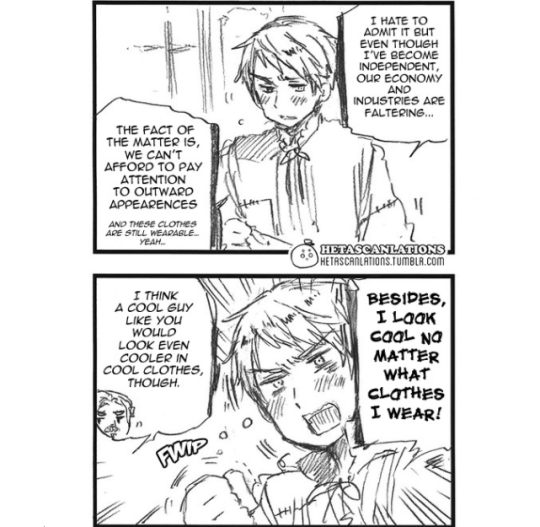
Ex: He associates fancy
clothes with strength + brags to bolster and reinforce confidence within himself.
Before his country grew in
strength, notice how he falsely tries to convince himself that his clothes are
still cool, despite them being worn down. The important difference is that he
doesn’t make use of the word awesome. This a time where his confidence and
morale is low. Awesome for him is equated with strength.
Bonus Facts:
He’s noted to feel like an enclave as opposed to an actual
nation.
He’s an incredible older brother:
Ex:
He reads Fairy Tales to a dying Holy Rome, and is revealed to be heartbroken
after the Napoleonic Wars.
Ex: He immediately
steps in to protect young Germany when he’s born.
Ex: He’s very supportive
and encouraging of Germany, despite teasing him a lot.
To be honest, given all this, I find it redundant for
Prussia to refer to himself as awesome.
When the caffeine kicks in.
As a series that works with stereotypes, it isn’t surprising
that Germany comes off as relatively
stiff and cold. However, what’s important to realize is that the stereotype is
used for a specific purpose; it’s essential to Germany’s characterization in proving
that he’s anything but stiff and
cold. Nonetheless he’s still perceived that way because of his stereotype.
In other words, Germany is anything but this stereotype.
Instead, what you’ll see is that he has trouble expressing his sentimental side
as opposed to lacking it entirely. It’s not that he doesn’t want to smile and
be expressive either. He simply isn’t able to.
He’s seen as angry, when all he truly wants is to be able to
be himself with others, void of being fearful, anxious, and hesitant in doing
so. You’ll see that he’s actually quite shy and uncertain with regards to how
he navigates around social situations.
That said, this is a pivotal inner conflict that he’s
consistently experienced. I’ll get into why a little bit later. First, it’s
important to demonstrate how pervasive and repetitive this theme has been.
In Comic Diary 4, he’s revealed to possess an
intimidating aura.
As
such, even Italy misinterprets Germany’s genuine intention to get drinks
together as him being angry.
A more explicit mention of this frequent misinterpretation of
his mannerisms is found in this character note.
He’s troubled because his voice comes across as harsh and he’s seen as angry. The
only beings he feels openly comfortable in expressing his affection for are his
dogs.
But, what about his troubles with smiling?
For one thing, he’s once shown to be reading a manual on “how to
smile naturally.”
In the 2010 Christmas event, he states that he “can’t smile
the way Italy can.”
Likewise, in an exaggerated comic gag from the Strange Laws
mini-series, Germany is kicked out of an area where it is legally required for
people to be smiling all the time.
In the few times where we do see Germany smiling [widely],
he’s drunk. If anything, this only reiterates how he’s repressing and
containing a whole other side of his personality. It’s in these rare moments
where we see the masked frontier of inhibitions that he’s constructed fall apart,
thus revealing the realer aspects of his true person.
Further, we know for a fact that Germany experiences chronic
loneliness in his character song “Einsamkeit.” The literal translation of this
is loneliness.
This song gives us the best insight into how Germany feels
about constantly coming across as harsh and angry to others. It’s not only
loneliness that he feels in being isolated from others – there’s also a
considerable internal estrangement from himself. He feels lost in his own skin
given that he doesn’t know how to express this happier, more expressive, and
thereby less restricted aspect of his personality.
Though I look like I’m lecturing,
I’m actually just conversing
It’s not really…
At times my face may look grim,
But I’m actually just cold
Though I don’t mind it…
What’s interesting here is that he recognizes that others
tend to misinterpret him. This only ripens the possibility of losing a sense of
one’s self. The social mask he puts on is not who he truly is.
Einsamkeit
Einsamkeit
Einsamkeit
I want to be found.
This could have a plethora of meanings.
I’ll go over the main two. One, it simply means that he wants people to see him
for who he actually is, and that he’s helpless in being able to change these
perceptions.
Two, it could act as a double-meaning
to represent him being unable to recall the lost memories of his childhood [as
Holy Rome]. Simply put, he feels lonely because he’s missing a part of himself.
I’m always said to be scowling,
But my smiling face hasn’t been erased
You may think I’m frightening,
But it’s only because I’m straining to laugh
Now, in a previous post (link here), I
talked about the psychological concept of catharsis. Basically, when a memory
causes a person too much anxiety or trauma, they repress the memory as well as
the emotions associated with it. The result is that the person can no longer
consciously access the memory, and sometimes, depending on how strongly they’ve
repressed the memory, they don’t experience the emotions associated with it at
full capacity. You only experience them partially.
Perhaps this is why Germany is
“straining to laugh.”
The role of the psychologist is to bring that traumatic
memory back into the patient’s conscious mind. Catharsis is the emotional relief
that comes upon recalling and subsequently resolving the internal unconscious
conflict tied to the traumatic memory.
Let’s tie this back to the strips.
Germany’s stated before that he doesn’t have much experience
with relationships, hence the reason why he’s constantly referring to manuals
all the time. Similarly, because he was born into war, the hostility and trust
he grew accustomed to also caused him to be relationally-stunted.
It’s for this reason that he has trouble interacting with others and
expressing emotions other than anger or frustration; these are more primal. Happiness
and compassion is something that’s taught. In psychology, there’s a general
agreement that how one’s raised impacts how they are as an adult.
This doesn’t mean to say that his personality is fixed
though. All it really means is that he’s still affected and possibly traumatized
by being thrust into war from birth.
On the other hand, let’s take another route in approaching
this. If Germany is Holy Rome, then he would have likely repressed the
traumatic memories of the war that caused his dissolution. However, for that to
happen, he would have also had to have repressed his entire life as Holy
Rome to get rid of this trauma.
As such, this would involve repressing all the happy emotions
that Holy Rome experienced with Chibitalia.
If that’s the case, when Germany feels happiness, his mind
unconsciously subdues it to avoid triggering any accounts of his past as Holy
Rome. It’s because his brain unconsciously minimizes the anxiety generated from
these traumatic memories that Germany is completely unaware as to why he’s
unable to smile. All he knows is that he’s unable to.
Simply put, when Germany experiences happiness, his brain
represses it to prevent him from accessing childhood memories associated with
the same emotions.
In sum…
Germany may have trouble smiling because…
1) He’srelationally-impaired
and inexperienced due to having been originally reared in a world of hostility
and aggression. He can express happiness, but it very rarely has to do with
people. I.e. His dogs, machinery during the Industrial Revolution.
He hasn’t quite learned to become
comfortable in showcasing this other side of himself to others. Maybe this is
because of the anxiety generated from only being seen as stiff and cold and him
not knowing how to compensate for this by expressing how he truly feels.
2) He’s repressed all childhood memories from his
past as Holy Rome, which just so happens to include the happier ones. If he
smiles and consciously –not drunkenly, which doesn’t involve full awareness–
expresses happiness, he risks recalling his traumatic dissolution. To safeguard
against this, his brain suppresses feelings of joy and happiness. As such, he
isn’t aware of the reason why he has trouble smiling.
It’s not quite like that. I think it’s more a matter of
how old the strips are.
A lot of the national stereotypes were heavily exaggerated in
earlier characterizations.
Ex: Germany is in fact noted to be humourless + jokes go
right over his head.
In newer strips, the stereotype remains with Germany, but not
nearly to the same degree.
His humour is subtle and less explicit. In other words, he
does possess a sense of humour, a pretty sly and sarcastic one, but it’s not expressive
or obvious.
Ex: He takes a photo of Italy when he makes a silly face.
It’s more like he’s misinterpreted by other nations for his stereotype rather than him embodying it. He’s far from emotionless. He has trouble expressing his emotions.
There’s a distinct, but nonetheless subtle sentimentality and loneliness in him that he doesn’t show off very often. We only get small clues here and there of it.
More detailed post coming up tonight!
I’ll specifically be focusing on Germany’s inability to smile.
The title is a bit
provocative in the sense that I mean aside from the obvious reasons of both
world wars. With that out of the way, I’m going to be fair to Holy Rome =
Germany skeptics, and will give an alternative reason as to why France’s hatred
of Germany extends well before 1914.
First, while this
strip is deleted and should not be taken at canon value, it’s still important
in potentially giving us more insight as to what Hima might plan to do should
he portray how the nations react to the news of Holy Rome’s dissolution and
subsequent death (that is, if he ever died. Yes, I’m biased).
Either way, this
demonstrates that France was severely impacted by what happened to Holy Rome,
and for very good reasons considering that it was Napoleon who caused his dissolution.
1) Holy Rome look-alike
Since France grew up
with Holy Rome, having a new nation [Germany] spring-up in his place, looking
exactly like him would be like rubbing salt to the wound. You can see why
France would be hostile to this substitute; a replacement of someone
irreplaceable.
2) Germany is Holy Rome + France’s Guilt
Consider this. You ‘kill’
someone who you view to be a little brother –or well, at the very least, he’s believed to be dead (bias x 2)–only to
have him become a new nation with no memories of the past.
In that case, France’s
initial hatred of Germany (while unfounded) is what we in psychology call a
projective defense mechanism. France is taking the hatred that he feels towards himself for dissolving Holy Rome, and constructs Germany as the
object to be hated.
In other words, to
minimize anxiety over his past, France represses these emotions and inflicts this
hatred onto Germany, who then becomes the focus of said hatred.
Obviously, this hatred
is amplified in the world wars. This, of course wanes over time, as it’s noted
that he no longer hates Germany and that they hang out regularly.
However, what’s
important to note is the substantial degree of hesitancy, nervousness, and
skittishness that France sometimes shows when he’s interacting with Germany.
From an interpretative
standpoint, this could mean that France is still wary of Germany. Or in the
case that Germany’s Holy Rome, France is still left to deal with the
consequences that he caused back in the Napoleonic Wars; that is, Germany’s
estrangement and amnesia from his past as Holy Rome.
This hesitancy is
shown as France secretly backs Germany in an EU meeting. Of course, there’s an economic reason for this too.
Likewise, the
contradictory skittishness and desire to form a strong relationship with
Germany is seen when France offers to let Germany tell him about his troubles, only to plugs his ears and run away.
While this could just
be a joke of him not wanting to deal with EU matters, if you read into it, it could also possibly mean that France is afraid
that Germany might say something indicative of his forgotten past. We’ve
already gotten a few hints of this in other strips (i.e. Prussia not telling
Germany everything about his past, or Germany recalling a memory of Chibitalia
in San Buon Valentino).
Regardless, their
relationship does progress, making significant grounds as they take leading positions in the EU.
Ex: When England
leaves the EU, Germany and France ease each other’s worries and work together.
As the character note
states, they do hang out as well.
Ex: They vacation in Seychelles together.
Lastly, there seems to
be another projective metaphor with regards to France’s desire to strengthen
his relationship with Germany.
Here, France invites
Germany to his house. When Germany arrives, France randomly blurts out that he
thinks school uniforms are “awesome.” He then communicates his desire to share
“complex aesthetics” with Germany.
Immediately, I’m
already seeing hints at an unconscious conflict manifesting itself here…
…which is well
substantiated when you consider how it seems like France is, well, desperately
grasping at any seams that he can use to mend his relationship with Germany. I
mean, when have you ever seen Germany take an interest in fashion?
It’s the topic that’s trivial, not the repressed emotions behind it.
If anything, this can
be taken as France projecting his broken past onto the object of a school
uniform, and in doing so, represent his desire to sew and repare the figurative seams of
his relationship with Germany.
I think he suffers from a lot of guilt. To be fair, I’m going to branch off and give two alternative explanations for France’s previous hatred of Germany (asides from the obvious war reasons). Of course, I’ll still link it back to Holy Rome.
One will be based on the fact that Germany is an amnesiac Holy Rome, and the other explanation will focus on France simply attempting to mend his relationship with Germany (a Holy Rome look-alike) after the world wars.
Either way, I’ve noticed a lot of metaphors of France projecting his guilt in communicating his desire to fix things with Germany.
Post coming up tonight!
In previous posts, I’ve discussed how more often than not,
the nations are forced to comply with their bosses’ orders, often at the
expense of going against what they think is right. It would follow then, that
there’s a discrepant irony between what the nations represent (their people),
and who they serve (their bosses).
Despite this direct involvement of the gov’t facilitating nation
action, there are many instances where the nations lack very minimal political
power and influence. In other words, you don’t commonly see the nations facilitating
much gov’t action.
One of the prime examples of this would be how powerless
they are to stop corruption. Nonetheless, they still possess a deep awareness and
recognition of these political issues.
Without further ado, let’s go over some examples, shall we?
The Italy Brothers:
The Italy brothers experience a lot of troubles back home.
For one thing, they have the mafia and pick-pocketers who routinely steal from
him.
Italy has his car and phone stolen.
The mafia attempts to steal imports that Romano intends to
send to Spain.
As such, the prevalence of being constantly stolen from and
victimized ultimately motivated Romano to learn how to defend himself against
pick-pocketers.
Lastly, we get an explicit recognition from Italy that the
Italian Parliament suffers from transparency and corruption issues.
America:
America’s involvement in his politics is a tricky puzzle,
all right.
He’s incredibly optimistic about the outcome of his
elections…well, at the very least he leads on the façade of believing that
everyone will get along in the end.
England notes that because of how partisan America’s
citizens are, it divides the country.
America responds by saying that the “powerful enthusiasm” of
his citizens is a good thing…
…to which England counters by deeming America to be blithe
about the political division in his country. Basically, England is saying that
America is cheerfully indifferent about how polarized the Republicans and
Democrats are.
What makes me think that America is putting on a façade is
the fact that when he claims that everyone will get along in the end, the image
he pictures is in stark contrast to his statement. It reveals two beaten-up and
worn-down citizens agreeing on the fact that the President isn’t doing his job
well.
Go back to the first panel where America refers to their political
activism as “lively.” When comparing that statement to the fact that America is
implicitly acknowledging how potentially violent his politics can become, it shows a
reluctance on his part to confront the volatile–both verbal and sometimes
physical i.e. rallies or protests–aspects of his elections.
The “United after all” phrase seems like America is trying
to convince himself that the situation in his country isn’t that bad. It’s also
important to consider that this strip is recent, having come out in 2016.
It doesn’t end here, either. As a result of America’s
dividing politics, England expresses concern for the former’s health– a small
reminder that a nation’s health can be affected by the stability or instability
of their political situation.
Of course, America waves off England’s comment, likely not
wanting to admit that even with his super strength, he can grow weaker just
like any other nation can during dire economic recessions or turbulent socio-political
disputes.
What he says next, however, gives a better hint as to how
involved he is in his politics. It’s quite worrisome.
To surmise, means to accept something as true without possessing
the evidence to confirm it. If that’s the case and America’s merely guessing
what his citizens want, it would mean that he’s not directly involved in the campaigning and gathering of public opinion.
Without a decent grasp of what the polls are like before
voting, perhaps America is relying on media reports and/or word of mouth from
other gov’t officials on who the people are leaning toward. Point is, he doesn’t
seem to be directly involved in the process of actively talking to people
during elections.
This doesn’t mean to say that America is completely removed
from his politics. He hails and takes the privilege of voting very seriously.
What I’m trying to get at is that he might have more of a sideline role with
regards to how active and engaged he is during elections.
Russia:
This one is pretty disturbing and unsuprising, but it still
goes to show how little control a nation has over their gov’t.
Bluntly and with a
troubled look on his face, Russia admits that votes [and people] in his country disappear, and
that he doesn’t even know if all of the votes are counted.
France’s Speculation about Germany:
While this is just a speculation on France’s part, it
nevertheless demonstrates the recognition that nations are capable of taking
part in corrupted schemes. As stated above, however, they don’t always have the
discretion to oppose these gov’t orders.
France suspects
that Germany took part in a conspiracy where he knew that letting Greece into the
EU would cause the European economy to crash.
Germany obviously denies this.
It’s the realized possibility that matters here, not the
actuality of it playing out in real life.
That said, while the nations are often used as puppets by
their leaders, that doesn’t mean that they share a similar mindset. Instead,
when presented with issues like corruption, it causes them to experience reciprocal
internal conflict.




 Ellawritesficssometimes