Note: This theory will make use of Freudian theory. While I
recognize that Freud’s ideas do not bear much contemporary relevance, that
shouldn’t take away from the fact that many of his concepts (i.e erogenous
zones, childhood memory repression, catharsis) are nonetheless employed by Hima
in the series. The purpose of this post is to give some insight into the
psychologies of the characters.
Comic Diary 3…an old strip
that’s very easily forgotten despite how crucial it is in allowing us to get a
good understanding of what Italy may or may not remember from his childhood.
In Italy’s dream, he conjures a lost child that looks exactly
like Chibitalia. When encountered by an unknown man, the child asks to be taken
to a person with a face exactly like them.
The pair go up to Italy. What the unknown man says
next is crucial.
“I have a lost child here.”
The scene then takes a disturbing turn for the worse as the
child eerily repeats “Please acknowledge me” over and over again. Even more important
is that Italy refuses to acknowledge the child.
Freud had a profound interest in dreams, as they act as a
pathway in gaining access into the unconscious mind of the patient. Your
unconscious mind is where your deepest desires, worries, and insecurities lurk;
you’re not aware of them. If a memory is traumatic enough, especially in
childhood, then they too can be pushed into your unconscious mind so that
you’re unaware of/ unable to remember them.
In the context of dreams,
this is where your unconscious has the free reign to express itself. What you
experience in your dreams has both a literal and a symbolic meaning. It’s the
symbolic meaning of dreams that psychologists look at. Basically, your
unconscious paints the dream in a way that something irrelevant – such as an
ordinary everyday object – could represent a repressed conflict, vulnerability,
or unpleasant trauma that is plaguing your mind.
Manifest Content is the
literal element of the dream. It’s what you see and experience. For example, in
this case, it would be Italy encountering a child that looks just like him and
reacting fearfully towards it.
The Latent Content is the
symbolic element; the underlying meaning. It’s the unconscious aspect of the dream that is masked by
the seemingly normal manifest content. Because these aspects are a representation
of unconscious conflicts, when brought to the conscious level they can cause us
to experience discomfort.
What I want to focus on is the latent content of Italy’s dream.
The lost child could be symbolic of ltaly’s lost childhood. Likewise, it can
also act as a lost childhood memory that Italy has repressed and refuses to
acknowledge.
The trauma of losing Holy
Rome could have motivated Italy to actively forget about that part of his
childhood. It would follow, then, that Italy’s childhood self appearing in the
dream is the presence of an unconscious conflict and repressed memory, thus
causing him to respond fearfully.
On the same note, it’s not
impossible for the nations to have limited memories, let alone forget bad
experiences. Russia can surely testify to that.
That said, while Italy may have repressed some of his childhood
memories, we know from Buon San Valentino that he hasn’t repressed all of them
as he at least admits that his first love was a boy.
Perhaps this vagueness of
statement means that Italy’s memory about Holy Rome is muddled… that he knows
just enough, and yet, not enough to cause
him to remember and relive the pain of losing his first love.
Prussia: Is your country running?
Holy Rome: We’re hardly unified, what do you think?
Prussia: Well, I better go put it together.
…
[on the phone]
Prussia: Is your country still… is your country running?
It depends. You do have Germany attempting to structure
world/ EU meetings, despite most of them resulting in bickering.
On the other hand, these meetings have also been held in
pubs before.
If anything, this informal, comfortable atmosphere
demonstrates how the nations work together and see each other as friends more
than adversaries.
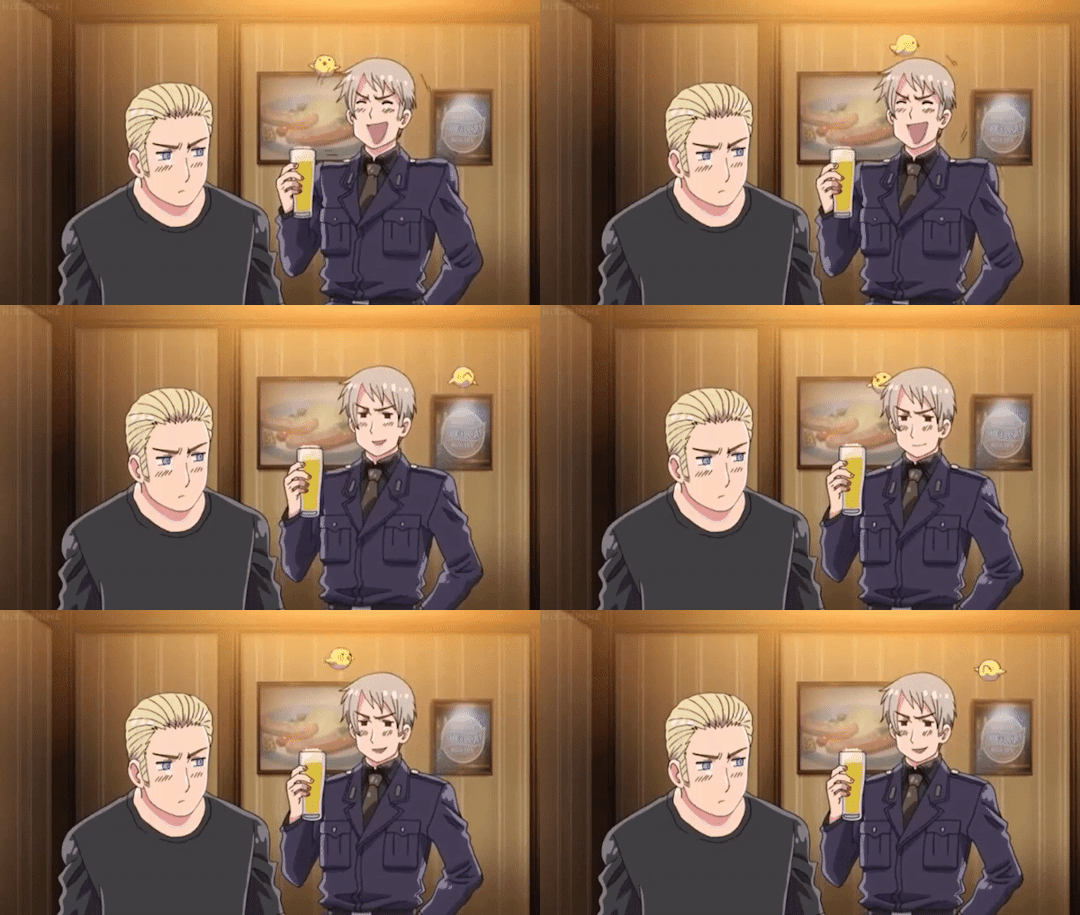
Prussia: I wasn’t that drunk
Germany: You inquired about the cost of nest mortgages for Gilbird.
Prussia: Okay I was drunk.
There seems to be a lot of confusion and sometimes purposeful
misleading regarding what France means when he calls himself a “Big Brother.”
On one hand, you have people who have only watched the dub,
haven’t read a page of the manga, and worst of all, incorrectly declare that
France is related to all the nations who either call him big brother, or who he
claims to be the big brother of. There’s also people who know this is false,
but still use the misunderstanding as a way to immaturely elevate their own
ship and degrade shippers of the opposite kind.
To that, I say this: the dub is never canon. I totally get why
there’s a lot of misconceptions regarding the family tree, though. For example,
in the dub, Switzerland is referred to as France’s relative, meanwhile, in the
strip material, Switzerland is listed as France’s neighbor.
Again, don’t ever use the dub as a source. It’s like the
Wikipedia equivalent of canon material; it gives you a general idea, but in no
way is it totally correct. While I understand how limited the anime medium can
be in portraying all canon information, it’s still your responsibility to do
your research.
That said, if you’ve read the manga, you would know that France
doesn’t have any siblings. That’s right. He’s not a big brother at all, but
rather, he’s listed as a big brother type. Likewise, he’s also referred to
himself as “the Big Brother of the world.”
In other words, because France is self-conscious of his age, he
opts to be a big brother mentor figure as opposed to identifying as an elder.
Although, admittedly, he has occasionally adopted a parental role. This is
especially the case with America, whom France expresses disdain at England for
raising so poorly.
Regardless, the following few strips demonstrate how France will
claim to be the big brother of literally anything.
Here, he deems himself to be the big brother of the reader. No,
I’m not kidding.
When he meets Lisa, Jeanne d’Arc’s reincarnate, he introduces
himself as “Big Brother France.”
The rest is pretty straightforward. Aside from the explicit
character description, there’s no possible way he would be related to them all
without it creating the need for other nations to be related to each other.
England:
Italy:
Germany:
Seychelles:
In sum, “Big Brother France” is not actually a big brother.
He’s a big brother figure.
In addition to coming out of the closet, the nations come into canon.
“Aw, congratulations! We knew it all along! IT ONLYTOOK
YOU SEVERAL CENTURIES THOUGH.”
I wouldn’t apply any labels, just to be fair, but Italy has
been shown on several occasions to like both guys and girls.
Buon San Valentino is a good example of this.
Germany, having already been perplexed by his relationship
with Italy, has his confusion increase tenfold when Italy gives him roses on
Valentine’s Day. It’s noted that in Germany, roses are a confession of love.
Germany then asks Italy if he ever had a first love or girl
or two that he likes. [This is just his attempt to figure out what Italy’s
feelings are towards him].
Italy responds by saying that his first love was a boy –
likely a reference to Holy Rome.
Why I don’t think HRE and Germany are exactly the same person
Since @ellawritesficssometimes asked me to elaborate, here I go. I’m no major in Hetalia or anything but this little guy has always been my favorite characer in Hetalia, even when I really disliked Chibitalia, and I want to share my thoughts on him.
So, first of all, Holy Roman Empire and Germany are really different as ‘countries’. Germany is an unified state despite all differences, Holy Roman Empire was more a pact between german states that never sticked and while originally it included a lot of other countries they started falling apart with time. Poor Holy Roman Empire started dying around 1500 and from the way he acted when he said goodbye to Italy I think he was pretty aware of his impending dissolution.
And another thing I suspect, due to the strip in which we see the german states fighting is that he made it back, to some degree, but he avoided Italy or decided to stay in a completely different place: the HRE Hungary is holding up is the teen we see later in the comigs where Prussia reads him the Grimm comics, not the super small child he was earlier.
I know this doesn’t add much to my Hre=/=Germany discussion but I still feel like pointing it out. Anyway, going back to the main topic: while they share a lot of territory, Holy Roman Empire had more than Germany inside him- like Austria, Switzerland, the whole Czech Republic and ridicolous amounts of the Netherlands, Italy and Belgium. Germany is just… Germany. And it’s compact and strong. They share the same territories, yes, but they’re different things.
Now, let’s alk about the points I see around the most:
But Germany and HRE look exactly like each other!
Who else also look really similar, used to share the same territories, have ridicolous similarities and have common history, traditions and culture? The Italian brothers and their grandfather, especially Romano and his grandfather as seen here (A post from @grandparomeaskblog / @mezzogiornovargas.). Even Prussia and Germany are shown to have strong similarities in some strips so I wouldn’t really base myself on how someone looks like considering family members can look alike on occasion.
Also, I DO admit there’s an high chance the empty shell of HRE was used as empty body for Germany but that doesn’t make them the ‘same’ person.
Thanks go to @ask-useless-german for basically being my german history teacher.
Germany is Holy Roman Empire, he just lost his memories.
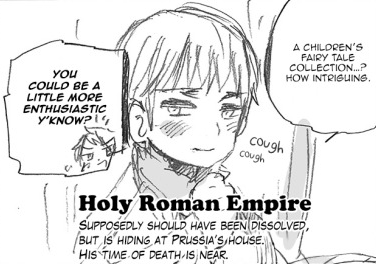
I could buy this if we didn’t have two specific things.This strip in which it’s clearly said the time of his death is close, which implies that he will die soon, he’s not just going to be sick for a while and then return full force-
And the one where they say Germany “already had an exising body” when he was born. I does imply that Holy’s body was recycled but we’re clearly talking about one being dead and the other being born. If anyting it feels like Germany is the legacy of HRE and the one who succeeded where the other failed.
Obligatory Gerita comment here
Feliciano remembers Holy Roman Empire and he still seems to feel something for him as seen in the famous Valentine episode. The only time he blushes is when he mentions his first love was a boy and he has a somehow melancholic face while talking about it.
Italy didn’t forget his first love and he seems to actively ignore when other countries flirt with him (he’s seen being nice to liechtenstein and other girls, sure, but he only flirts with human ladies.). So far we’ve seen him turn down Spain, Prussia’s advance and even Germany’s (the episode ends with Himaruya stating ‘it took them a week to fix the misunderstanding meaning they probably had a good talk about what happened and agreed to be just friends since we don’t see them in any kind of relationship in modern times, if anything it’s Germany who’s still slightly crushing on him), but we do see him blush mentioning Holy- it does feel like he’s still trying to move on. I think that if Holy Roman Empire was Germany Italy would be the first one to notice.
On a more historical note: Italy and Prussia were extremely close during that century so I find relatively strange how Feliciano apparently ‘never met’ Germany during his youth and they only started interacting round WWI- I mean, they’re still countries, they’re supposed to interact and Feliciano had a great relationship with Prussia. I do wonder if he knew Holy’s body had been ‘used’ and that’s why he tried to postpone their meeting as far as he could. Buuuuut that’s just me fangirling. And while I don’t really ship Ludwig with Feliciano IF it’s going to happen I’d rather see Feliciano fall in love with Germany because it’s Germany, not because “oh, look, it’s my long lost love I guess I should be with him”)
This is literally touching the tip of an iceberg since I have a lot of things to add but they’re mostly based on Feliciano’s interactions with Germany, how we italians were hisorically tied to Austria and HRE and this post is probably already a bit too long? I’m sorry if it’s a bit messy, I still struggle a bit with the language and I’m not used to write this kind of things either but this is a very short version of why I tend to consider Germany and HRE two separate entities.
In any case I’d love to discuss more with you.That being said I’m more than open for debate since as far as we go the whole thing is still a big question mark! 😀
Re: Germany is Holy Rome
Note: Germany = Holy Rome isn’t confirmed in canon. I’m merely presenting evidence in support of it.
Okay, before I start, I want
to mention that a lot of the points you brought up have already been explained
in the manga. That said, these rules do have a consistent logic to them. I
think what needs to be recognized here is that while Hetalia may be based on
history, it’s still fictional. What I mean by this is that you can’t apply
technical historical facts to explain a fictional occurrence, such as
reincarnation.
If the fictional rules are provided, then they should be adhered
to while also recognizing the wider backdrop of loose historical influence.
Different Territories, Different Personifications Argument:
The manga provides the
possibility for personifications to adopt new titles “names” and lands. So
while Holy Rome and Germany may differ geographically, it doesn’t negate the
fact that the nations’ borders and land space change all the time.
This
rule of adopting new names (titles) is established in chapter 1 of World Stars.
Likewise, Prussia has long
been established as a character whose geographical representation keeps changing.
He evolved from St. Mary’s Order, to the Teutonic Knights, and eventually to
Prussia. Presumably, he represents East Germany now
In sum, it is 100% canon for
the nations to have the land they represent change. As such, they can acquire
new names.
Memories:
You are correct in saying
that Germany and Holy Rome are not technically the same person, and yet they are. Germany is Holy Rome, except
he doesn’t possess the latter’s memories. That would explain why they have
personality differences.
Again, chapter 1 of World
Stars clearly states that nations can change their personalities out of
nowhere. Personalities are derived from lived experiences, which result in the
formation of memories. That’s why if someone lost previous memories, they would
be a completely different person; if they don’t retain these old experiences,
then it has no impact on who they are as a person.
I’ll get back to the evidence
of Germany’s amnesia in just a little bit.
Why Holy Rome Still Existed After Dissolution:
I’m dreadfully repeating
myself, but I have to refer to Chapter 1 of World Stars again. It states that
they can be called back by a sudden memory…
..but whose memory?
The first answer for this can
be found in “It’s a Treasure Box of Countries”, which outlines 2 outcomes that
can happen once a nation dies.
1) “If the culture of
the country’s personality dies/disappears, the country [personification] will
gradually disappear or entrust him/herself to the country [another
personification] that takes over him her.”
2)There are also cases that
him/her is not a country but continues to live leisurely as a representative of
the region.
Since this strip outlines
exactly what happens to a nation after their culture/personality dies, your
empty shell theory has no canon support.
Anyways, the first case
appears to explain why Holy Rome hasn’t died yet in chapter 187 of World Stars.
While he may have been dissolved, German culture and identity never waned.
It’s for this reason that the
vague statement of “his time of death is near” is used. At the time of the
strip, it was uncertain whether other national identities/ personalities would
eventually develop to replace Holy Rome.
On the same note, it’s human
belief in the nations that allow them to exist. Here, France lays out ground
rules regarding how a nation’s immortality is maintained.
1) They need a strong
and stable government (which Holy Rome didn’t have, admittedly)
2) A body of citizens (which Holy Rome had.
Regardless of how many individual states he consisted of, they were all united
by the German language).
Existing Holy Rome Body Theory + (non) Teenage Holy Rome:
With all that in mind, I
don’t think Holy Rome ever died if I’m to be perfectly honest. Here’s why.
First, the appearance of Holy
Rome in the 2011 Christmas Event strip does not appear to be a teenager at all.
Look at how small he is. Even when he’s in Hungary’s arms, he’s smaller than a
teenager. Popular opinion is what deemed him as a teenager here, nothing else.
Also consider how small Hungary is herself.
Like you said, the age
between the Holy Rome in the 2011 strip and the Holy Rome from chapter 187 is
consistent. The only difference in opinion that I have is that I see them both
as a middle point between childhood and adolescence, whereas you see them both as teenagers. I disagree.
Also notice how the Holy Rome
from chapter 187 appears to be the same age as the ‘just-born’ Germany from
chapter 12.
What’s more, they’re wearing
the same nightgown, aside from the obvious fact that all the other nations
first appeared in similar dress.
Germany is stated to be born
a few years older than the other nations because he already had an existing
body. But, what if we take that literally?
Holy Rome was on his deathbed
and was notably weak and ridden with illness. Nonetheless, we know from the
evidence listed above that it’s still possible for him to exist even after
dissolution given that people still believe and identify with him.
Now, tie that in with the
fact that nations can adopt new personalities and titles. If Holy Rome still
existed, only to become Germany, it’s very well possible that adopting a new
title caused him to lose all previous memories of being Holy Rome. A quick little
reminder again that your personality is very much driven by lived experience.
Evidence of Germany’s Amnesia:
There’s a ton of strips that
point towards this, but I’ll only cover the most obvious ones.
Right from birth, Prussia
takes to reminding Germany that it’s okay to refer to him as an older brother
close to five hundred times.
The excessiveness of this
makes it seem like Prussia is attempting to jog Germany’s memory, only to fail
in doing so.
There’s also some very old
and very strange strips which involve a child Holy Rome vying to be
acknowledged. Taken symbolically, this can be understood as Germany’s childhood
memories attempting to puncture through into his conscious mind.
Italy too has a childhood
version of himself pressing to be acknowledged, which could mean the same
thing. He could be choosing not to acknowledge that Germany is Holy Rome, but
still remembers him as seen in Buon San Valentino.
What else would Germany have
to acknowledge other than his own past? Not to mention that Prussia is known to
have lied to Germany about his past before.
Why else would he do that
other than to avoid having Germany remember the trauma Holy Rome experienced?
It’s a common psychological reaction to repress childhood memories that cause you to feel discomfort.
Or what about Germany’s first
interaction with Lithuania? This is supposed to be the first time they’re
meeting together, and yet Lithuania expresses relief at the fact that Germany
doesn’t remember him.
How could Germany remember
Lithuania if he hasn’t met him before? It doesn’t add up. What does add up is
if Germany doesn’t have access to the memories where he did meet Lithuania…as Holy
Rome.
Alternatively, you posed the
question about why Italy and Germany didn’t meet before WW1. It’s always possible
for bosses to meet with each other without needing the personifications
present.
The most obvious example that
Germany is suffering from amnesia is in Buon San Valentino. Repressed memories
resurface during times of stress and conflict. After getting embarrassed at
improperly proposing to Italy, notice how Germany freezes.
The scene then pans inwards,
delving into the flurry of confusing emotions he experiences. Why is it that
the strip ends with images of Chibitalia? Look at the fuzziness of them too.
Doesn’t it seem like Germany’s
only then starting to access Holy Rome’s memories, memories that had been
repressed into his unconscious mind?
Similarities among Germania, Holy Rome, and Germany:
I think another issue here is a
misinterpretation of the family tree. Holy Rome and Germany are both noted to
descend from Germania. The problem is that there’s inconsistencies regarding
their relation to him [Germania]. For example, both are referred to as sons of
Germania, while Holy Rome is once listed as Germania’s grandson.
What I’m here to debunk is “Germania and Germany look alike, which means that Holy Rome and
Germany can’t be connected.”
Germania hasn’t been reincarnated.
He’s been shown to exist separately in heaven, and even visits Earth with
Ancient Rome at one point.
Touching on the same topic, there’s a clear distinction
between being descended and related to a personification and being influenced
culturally and historically.
For example – Italy and Romano are related to and descend
from Ancient Rome, whereas while Romania may have been influenced by Ancient
Rome, he doesn’t descend from him.
Overall, there needs to be a balance between fiction and
history with Hetalia. If a fictional explanation is given, then history can
simply be used to complement, rather than override canon.
Considering how much evidence there is linking Holy Rome to
Germany (foreshadowing, themes, motifs, similar phrases of dialogue), I truly do
believe that they’re the same person. But, that’s just my opinion 🙂
The answer to the title is yes, yes indeed. While the nations
aren’t overtly terrified at the sight of America, they’re still nonetheless
wary of him. From their perspective, what’s worrisome about America is his
youth and impulsivity. Now add the fact that he’s one of the leading powers in
the world, and you’re in for some destructive outcomes.
What you’ll see is that America is often equated to a child
given how he had been isolated from the world after gaining his independence. He’s
unpredictable, naïve and bossy. In other terms, he’s inexperienced, and this
leads to a growing sense of wariness and caution among the other nations.
It’s like handing over the reigns of the world to a toddler.
They may have good intentions, but only end up creating an even bigger mess than
before.
This fear of America, then, is often the result of how ridiculous
and childish some of his ideas are. England even states that America has a “flawed
sense of reality.”
Again, given America’s dominant position on the world’s stage,
this isn’t something you want to see in a leader.
Here, America’s ideas are perceived as “nightmarish.” To be
fair, his world defense plan was to construct a ranger squadron, whatever that
means.
Either way, notice how he’s also referred to as a “brat” and “child.”
This child-like imagery comes up in how America interacts with
the other nations too. In that same meeting regarding his squadron defense plan,
America asks for a vote to be taken on it. What’s important here is that when
he offers the possibility of other nations disagreeing with him, he snaps a
bundle of spoons.
To me, that seems like an obvious intimidation tactic of someone
who is incapable of hearing alternative opinions. That said, I want to point
out how well child development patterns fit in with America’s characterization.
Children are inherently egocentric until about 6-8 years
old, as they lack the capacity to think outside of themselves. They only focus
on their own personal world and bubbles of fantasies before eventually
realizing that there’s a much larger world out there. Please note that this
egocentrism is not intentional; they just haven’t matured yet.
Still, this panel clearly illustrates that America believes himself
to be the only “player” [in the game of life].
America’s egocentrism for the most part is unintentional.
His isolation has made it hard for him to think from the perspective of others,
as he had previously grown accustomed to only looking after himself. That’s
where the “not being able to read the atmosphere” running gag likely comes
from.
However, as seen with the spoon incident, America is more
than capable of reading the atmosphere when he wants to if it means getting
what he wants…
…and that’s often other nations agreeing with him. Pay
attention to how uncomfortable South Korea gets here when claiming that he
agrees with America. Even more important is how in the panel above, South Korea
had no qualms in disagreeing with Japan.
No doubt, America is
bossy. Said bossiness and desire to get his way all the time is what’s
intimidating to the other nations.
Another display of this child-like bossiness would be when German-occupied
France and England are having an argument (big surprise), only for America to
step in and declare that he’ll decide on whose opinion is right.
There’s a bit of a discrepancy in the translation, but this
version has France say, “America, you scary boy!”
Meanwhile, my print version says, “What a frightening child,
you are!”
Regardless, both convey the same message. America does in
fact scare the other nations, sometimes.
One last example would be Netherlands warning Isolationist
Japan of America’s impending arrival. Once more, you see America’s youth being touched on.
Likewise, this youth is formulated as a reason of warning and caution.
With all that in mind, and for transparency’s sake, I’ll end
on this note: While America does often make the other nations feel uneasy, he’s
also frightened very easily himself.
Whether it’s ghosts, occasionally Russia, or sleeping alone, America is
possibly and ironically one of the biggest fraidy-cats in the series.
Oooof. That’s tough considering how intricate Hima’s characterization is of him. Literally everything regarding Germany can be taken as a reference to Holy Rome.
But, there is one giant miconception about him (usually by people outside of the fandom) that’s been sitting in my drafts for a while now. It’s in desperate need of being cleared up…








 Ellawritesficssometimes
