Before I get into how Prussia fits into Hungary and
Austria’s relationship dynamic (platonic or romantic), it’s important to
briefly go over Prussia’s background, as it allows more insight into his
behaviour.
In one of his character notes, it’s stated that he’s never
had to marry. It would follow, then, that Prussia’s narcissism likely derives
from the fact that he’s long grown accustomed to fending for himself. He
doesn’t rely on others.
Yes, he’s been subordinated by other nations before (i.e.
Poland, France, Russia), but the point here is that other than Germany, Prussia
hasn’t formed a meaningful and trusting relationship with another nation.
It’s not just a lack of intimacy either; Prussia’s lonely
and desperately craves company.
In the 2007 Christmas event, he tells [lies to] himself that
he’s happy being alone. Likewise, he attributes the tears welling in his eyes
upon seeing couples spending time together on the holiday to this happy mood.
The strip then pans on Hungary and Austria acting seemingly
couple-like, where Austria buys Hungary a hat. Pretty romantic if you consider
how stingy Austria is.
The fact that Prussia cries at the sight of Hungary being
with Austria hints at an unrequited romance. I’ll touch on this again soon.
Prussia’s alone because he lacks the skills to socialize and
develop relationships with others. The most obvious evidence of this is where
he attempts to read a book instructing him on how to socialize with people,
only to get bored and quickly abandon his commitment to learning from it.
Buon San Valentino also touches on how relationally-stunted
Prussia is.
Just a quick refresher: Germany reads a book about dating
and marriage, thinking that Italy has romantic feelings for him. Austria has
also read this book.
The comedic relief in the strip, is that after failing to
propose to Italy – given that Germany had misread the situation – the scene flips
to Hungary making a remark on the absurdity of the romance book.
Austria gets flustered, keeping that he had also read the
book a secret. He and Hungary then set off to the book store to fix this mess.
Notice how the scene deliberately shifts to Prussia. On cue,
he claims how happy he is to be alone. He then secretly watches from afar as
Hungary and Austria ask the store owner if they have a book on how to comfort
someone who’s “been rejected in his romance.”
The store owner doesn’t appear to have a book of that kind, so of
course Prussia takes things into his own hands and pulls a prank on Austria by
forging a fake book.
I would like to thank @shirokage218 for correcting my original misinterpretation of this part. I really appreciate it.
Take note of the title.
“How to properly comfort a German man who has failed in love.”
Here, it seems like Prussia might be projecting his own insecurities, even in something as trivial as a book title.
With all this in mind, I want to end by pointing out that
Prussia isn’t entirely alone either. He, Austria and Germany have lived together before, likely during Germany’s annexation of Austria.
Lack of romance aside, Prussia is close enough with Austria
and Hungary for them to be considered family. Yes, he does tease Austria by
referring to him as a “lesser German”, but they still spend their holidays
together.
That said, the irony in Prussia’s
life is that he feels alone and depressed despite being surrounded by others.
Okay, so you know when
Holy Rome says farewell to Chibitalia and leaves to go to war?
“I’ll definitely come see you when the fight is over.”
Assuming that Holy
Rome was reincarnated into Germany, the fight never really ended.
Germany was literally
born into war, which could possibly explain why he didn’t meet (see) Italy until WW1. Remember that they didn’t purposefully cross paths then.
Likewise, in Buon San
Valentino (which takes place during WW2), Germany also makes a mention of his
war-torn upbringing.
I suspect that Hima
might use the above phrase and place a fun little spin on it. The wars are
over and Germany is united with Italy, but until Germany remembers his past,
Holy Rome’s promise won’t be fulfilled.
Germany needs to come
back to Italy as Holy Rome, with the latter’s memories intact, if he’s to truly see
and recognize Italy as Chibitalia.
Side note: “I’ll make
lots of sweets for your return.”
You know who else really likes his sweets? Germany. I mean… he has an entire
character song dedicated to baking a cake.
It’s because they are
I have two moods when I’m writing fanfiction…
1) Producing ideas like a deranged mad scientist in the middle of the night.
2) Rewarding myself with an undeserved break after writing one sentence and hating my existence.
Chapter 1 of World Stars is crucial in establishing the
rules of nationhood.
The strip outlines how personifications can live for a few
days or several centuries, can disappear unexpectedly, can change their names
and personalities, and if they’ve died, a single person’s memory has the
potential to bring them back.
It would follow, then, that this strip also opens the
possibility for reincarnation/ resurrection.
Either way, sounds pretty simple, right?
That’s how it’s supposed to be.
What’s frustrating is that there’s a massive hint in this
strip that’s so simple, it’s pretty much gone unnoticed. Knowing Hima, he 100%
did this on purpose – just to troll with us.
The answer that, yes,
Germany is in fact Holy Rome has already been revealed, albeit not explicitly. At least, in my opinion.
Now, I want you to look at the first panel again. It says: “They
can live for a few days or for several centuries.”
Okay. Take note of how the being in this panel has an
inverse form.
The one who’s upright has a similar hairstyle to Holy Rome (and Germany). Still, we see Holy Rome with his hair down more.
Meanwhile, let’s flip this image.
Boom. It’s the military hat that gives Germany away.
There’s also the cloak worn by the being on top that could be a reference to Holy Rome.
Take what you want from this, but for Hima to possibly include Germany and Holy Rome
in a strip where they’re literally mirror images of each other pretty much confirms
to me that Germany was reincarnated from Holy Rome.
If that’s the case, then Holy Rome kept his promise and
eventually came back to Italy.
but there’s that one friend who
can’t take the hint
By now, you should realize how damn clever and intricate
Hima’s characterization is. It’s honestly mind blowing to me how chapters and
strips spaced out years apart from
each other are nonetheless effortlessly bridged together to form a logical connection.
On a similar note, you see a lot of similarities and
respective foreshadowing between Holy Rome and Germany. It’s uncanny how they
will say literally the exact same things, like a mimic or relic of the past in
Germany’s case.
As designated by the
title, this post will focus on how fairy tales are used to hint at Germany’s
infamously known, but unconfirmed connection to Holy Rome.
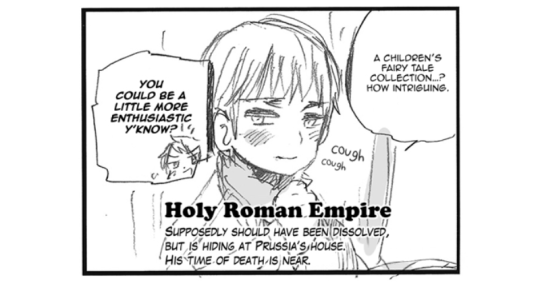
In chapter 187 of World Stars, we learn that Holy Rome hasn’t
died, even though he should have given that he’d already been dissolved at said
time. Still, his end is near as he lays on his death bed.
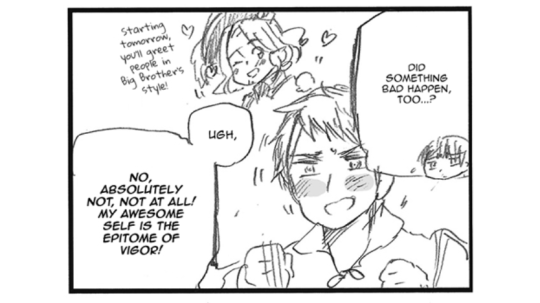
A “heartbroken” Prussia takes to
consoling Holy Rome by reading the latter Brothers Grimm fairy tales.
Notice how Prussia is not only grief-stricken,
but he’s also in partial denial. He refuses to accept that he’ll have to be a subordinate
to France and adopt French manners of propriety.
Meanwhile, even while on the verge of death, Holy Rome is
the more logical of the two. He has no problem in skeptically pointing out the
plot holes in the stories Prussia fabricates. (The original tales contained too
much eroticism, so Prussia had to take a bit a liberty when recounting them to
Holy Rome).
Regardless, what’s important to emphasize is the motif of
fairy tales – which will come up again later – as well as Holy Rome’s use of
concrete logic.
In Chapter 222 of World Stars, as Italy talks about feline
nonsense, Germany responds by saying: “Isn’t that a little too fairy tale like?”
I’m sorry, but I really do think that Hima did this on
purpose. Germany’s skepticism eerily echoes that of Holy Rome. Also, when have
you ever heard of a fairy tale that involves cats?
That one piece of
dialogue, trivial as it might seem on its own, serves as a key link to chapters
which would otherwise be completely unrelated.
The answer to the above question, if there aren’t any
inconsistencies with the timeline, is unbelievably fast. So fast in fact that
Germany completely dethrones America’s path to maturity. America goes from a
toddler, to a young child, a young adolescent, and only becomes an adult after
he achieves full independence.
Meanwhile, Germany goes from a young child to an adolescent/
young adult within one year.
No, I’m not kidding. The strips covering both Industrial
Revolutions testify to this claim.
The first Industrial Revolution took place in England in the
late 1800s (approximately 1760) and lasted up until around 1870.
The Second
Industrial Revolution had less to do with the textile industries and more to do
with machinery and steel. That’s where Germany comes in.
At the start of the second Industrial Revolution, Germany
hadn’t unified and therefore lacked behind in the industrial developments that
neighboring countries experienced.
After unification
(1871), this changed, and Germany became heavily involved in the machining
industry. Notice this panel here. Germany is immediately put to work…right
after being born.
That’s not the type of work a child would be capable of
doing, let me tell you.
Germany’s awkward mannerisms as he and Prussia converse with
England makes me believe that he’s a teenager here. He’s still new to the
world, and hasn’t quite figured out how to navigate it.
Here Germany is again, modifying English machinery.
Throughout these strips, Germany is not once shown to be a
child. His aged appearance combined with the phrase “after the unification”, as
well as the panel illustrating him instantly being put to work, hints at a
dramatic and unparalleled growth spurt in contrast with the other nations.
Now, think about this in terms of how relationally-impaired
and awkward Germany is with others. He never got to experience a proper
childhood. In the field of psychology, childhood is crucial; it’s where you
acquire and develop proper socialization skills.
If this is all true, then Germany never had a childhood. Well,
maybe.
He could always be
Holy Rome, but what’s important to reiterate here is that if Germany is Holy Rome, then he’s shown little signs
of remembering this childhood…





 Ellawritesficssometimes