I agree, that scene
where Italy’s catapulted into the air by a faulty car seat does reveal a bit of
naivety on Germany’s part.
On the other hand, Germany’s
young age is mentioned several times in the manga. There’s also the fact that the scene above took place during WW2. Germany would have learned a lot more since then.
Hetalia has often been mischaracterized as something that
promotes and glorifies violence. Why? Because the initial setting takes place
in World War 2. Somehow that automatically equates to said negative image.
To that, I say this. There’s a difference between situating
a historical context and using explicit insignia to support an abhorrent
ideology. You never see the latter portrayal in the series.
While I disagree with a lot of Hima’s early characterizations and miscalculated jokes, his depiction of
fascism, communism, and war is something that I’ve always respected. It’s done
tastefully (with comical hyperbolic elements, of course), and does anything but
promote violence.
That said, it’s also important to mention that the
insensitive war jokes used in the dub are completely irrelevant to the messages
of peace and solidarity that Hima incorporates into his work. That’s the result
of other people interpreting the series and making it their own, only to botch
it entirely.
Regardless of the fact that war’s going on, Hima makes an effort
to showcase the triumph of humane and compassionate qualities in the nations.
Yes, they ‘hate’ and wage wars against each other – not having much of a choice over the matter,
mind you – but this rivalry doesn’t hold them hostage, nor does it dictate how
they interact with each other.
Conflict doesn’t dehumanize the nations; they don’t become
ruthless killing machines without a semblance of remorse or empathy. Just like
enemy soldiers called ceasefires on Christmas and occasionally organized sports
events, the nations for the most part
engage in similar civilities.
Again, it’s the conflict that’s brutal, not the nations
themselves. In fact, they have some of their admirable, most striking moments during war.
When America occupies Rome, he treats both Italies as if
they were his friends. Romano’s clearly terrified, but America breaks the ice
by politely asking them if they could make him authentic Italian food. That’s
hardly something you would see with individuals who regard each other as
enemies.
You also see nations from different alliances casually
hanging out during war, almost as if there wasn’t one going on at all. Remember
that they’ve fought each other so many times that they’ve likely matured past
being pent up on rivalries, as long as interacting with enemy nations doesn’t
go against their people’s well-being.
As they share and try each other’s rations, familiarity
appears to triumph over hostility.
There’s a clear reason why the series’ main theme is “Draw a
circle, that’s the Earth,” rather than, “Draw a border, that’s my country.”
It’s to bring the world together, not tear it apart.
I know this might sound like a radical thing to say, but
honestly, after reviewing the strips, there’s enough evidence that points
towards the fact that… yes, Holy Rome never truly
died.
Before I start, let’s just get a few disclaimers out of the
way. Otherwise, this theory won’t work.
There’s a deleted comic where France tells Italy that Holy Rome
is dead. Note the word deleted. As such, the strip should not be taken for
canon value.
Next, there’s also the fact that people have said that Holy Rome
is given a teenage appearance in one of the requests Hima completed for the Christmas
2011 event. If this were true, then there would be a notable inconsistency
regarding his other appearances.
However, to me, this hardly seems to be the case. Holy Rome
doesn’t look like a teenager at all here. He still very much looks like a
child, judging by his height and his size when Hungary carries him in her arms.
It’s important that I mention this, because Holy Rome’s appearance in the 2011
strip is consistent with his appearance in World Stars.
With that out of the way, let’s get to the good stuff. In
chapter 187 of World Stars, we find out that even though he’s been dissolved
and should have died already, Holy Rome is very much alive and is hiding away
in Prussia’s house. He’s still very sick though, as “death is near.”
Since Holy Rome’s so weak, a “heartbroken” Prussia reads him
fairytales, likely to distract the former from the fact that he’s dying.
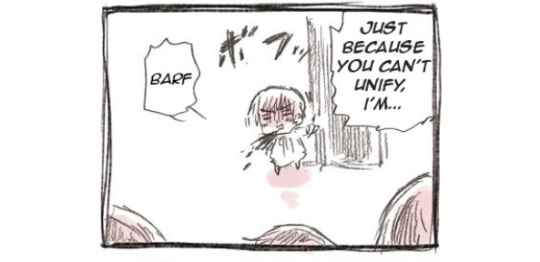
Moving forward a bit, we know that it was Prussia who led
the German Unification movement. He would have every reason to, as we’ve seen
from the Christmas strip how negatively a lack of unity among the German states
affected Holy Rome’s health.
If Holy Rome hadn’t died at this point, which I’m assuming
to be the case, then it would be in Prussia’s best interest to unify the states
and form a stronger country in order to save his younger brother.
This strip takes us to just before the unification process. Pay
attention to the language used by the German states here. “New Country” and “New
brother.”
It seems like they might not be aware of the fact that Holy
Rome is still alive. Being nations themselves, they would know that it’s
possible for personifications to adopt new titles. But, judging by the words
they use, they believe him to be dead. Because of this, the possibility of Holy
Rome adopting a new title wouldn’t have even crossed their minds.
It seems that only
Prussia knew about Holy Rome still being alive…whenever that strip took place
as it’s not entirely clear. (It’s sometime after the first publication of the Brothers Grimm Fairytales.)
Anyways, before the German Confederation is able to form, Austria, also
thinking that they’re about to form a new country, insists that he will be the one to raise the newborn Germany.
Yadda yadda, Prussia and Austria go to war, skip forward, and now we’re at
Germany’s actual birth (???).
This is so important and I cannot stress it enough. There’s
a massive difference in how the anime portrays Germany’s birth versus how the strips
do.
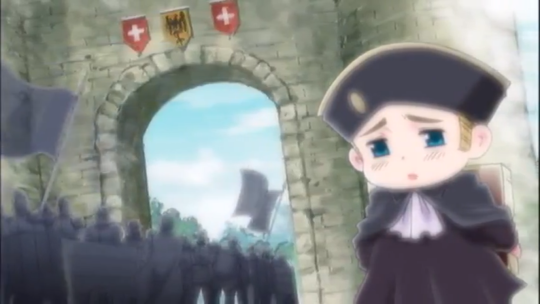
In the anime, it makes it seem like the German states huddle
together, only to have Germany emerge once they’re finished unifying.
The strips, which I’ll be using as the basis for this
theory, depicts an entirely different reality. When Germany’s born for real, it
doesn’t show the German states huddled together. Instead, it only shows a young
Germany being helped up and/or greeted.
He’s wearing a nightgown…exactly like the one Holy Rome was
wearing in chapter 187.
Yes, I’m aware that the nations are born in nightgowns,
but there’s multiple ways of interpreting this. The nightgown/birth motif is definitely
there, but…
Look at the one German nation holding Germany’s hand. He’s
crying. Now, put this into perspective. How would you feel if you thought your
little brother was dead, only to find out that he’s been alive all this time?
Maybe I’m biased, but Germany being helped up as well as
wearing the nightgown seems as if he’s standing for the first time after being
bed-ridden with illness for who knows how long. There’s also the fact that his
age is consistent with the Holy Romes from the Christmas event and chapter 187.
Which brings me to my next point. At the end of the chapter,
it states that Germany wasn’t born as a baby because he already had an existing
body.
We all know Hima and how much he loves to make puns. What if
“existing body” literally means an existing
body. Holy Rome adopted the title of the German Confederation and became a
stronger nation, but never actually died.
The German identity never died either, despite a lack of
formal unification. Maybe that’s why Holy Rome still managed to exist,
regardless of how physically weak he was.
The only setback to this is that there’s hints of Germany
(aka Holy Rome) suffering from amnesia. Remember that in World Stars, it’s been
made canon that it’s possible for the nations to acquire new personalities upon
changing what they personify.
Now, isn’t it weird that in the same strip where Germany’s
born, Prussia takes to reminding Germany that it’s okay to refer to him as an
older brother…482 times? It’s like Prussia’s attempting to trigger Germany’s
memory in the hopes of getting the latter to remember that he’s Holy Rome.
It would seem that on top of adopting a new title and
personality, it might be possible for the nations to also lose memories from
their past personifications.
It’s reincarnation, and yet it isn’t. I’m going to take the
liberty and coin it as “re-personification” from now on.
*When you have to show off in front of bae to get rid of the side hoe*
The
Titanic, but with GerIta:
Italy: I’ll never let go, Germany. I promise.
Germany: That’s nice, but can you move just a bit? I need to be able to shoot.
Having
lived for centuries, or sometimes even for thousands of years, it’s no wonder that
the nations are capable of accomplishing so many feats. They have the
intelligence and knowledge of several lifetimes at their disposal.
You have
your philosophers.
You have your artists.
And you have your inventors.
That said, let’s not sell these characters short by dumbing them down.
Note: This theory
makes the assumption that Germany was reincarnated from Holy Rome.
A lot of people seem to be confused about why it is that
Germany can be seemingly emotionless at times, or rather, too logical and
rational. This is especially true in Buon San Valentino, as Germany is noted to
experience emotions like shame, confusion, and heartbeat (presumably love) for the first time.
From the point of a psychoanalyst, however, they would understand
this perfectly, as Hima consistently adopts Freud’s ideas into his craft. It’s
not so much that Germany is emotionless; it’s more like he’s repressed traumatic
memories where these emotions have been experienced.
This puts the person in an emotionally-stunted and subdued
state. The emotions are subdued because experiencing them can trigger the
recollection of these traumatic memories.
Now, it’s not directly said that Freud’s ideas are used, but
both Germany and Austria have been shown to read psychology books. As the most
famous psychologist and being an Austrian himself, it wouldn’t be a farfetched
guess to assume that Germany and Austria have read some of Freud’s work.
Terminology I’ll go
over: Defense mechanisms, repression, the unconscious mind, catharsis.
Bear with me here. I’m slowly going to go through some
concepts before tying this all back to the strips.
For Freud, anxiety is something that we all experience the
moment you exit the womb. You’re in an unfamiliar environment, and anxiety is
there to warn you of impending danger. Basically, because it’s so uncomfortable
to experience, anxiety controls your behaviour by causing you to avoid
threatening environments or situations.
However, if it’s a certain reality you can’t cope with, a
person will employ defense mechanisms to
avoid confronting it.
Repression is one
of those mechanisms, whereby the person is either unable to reflect upon or
remember an event in their conscious mind. The memories are no longer accessible
to them, hence repression; the burying away of emotions.
The unconscious part
of our mind extends beyond our conscious awareness. It’s where all our
repressed memories, emotions, instincts, and biological urges are stored.
All right, not so bad I hope? Let’s tie this all together.
Holy Rome’s dissolution ended a brutal series of wars. That
said, if Germany is his reincarnate, wouldn’t it make sense to repress these
memories? How nice would it be
to be born, only to have a wave of pain and heartbreak immediately hit you?
It would be too hard for the recently-born nation to handle.
That’s why I believe Holy Rome’s memories were repressed before Germany was
even born. Again, it acted as a safe guard to protect him from the trauma Holy
Rome endured beforehand.
There’s even a small hint that Germany has amnesia and has
possibly repressed his memories. Once born, Prussia reminds Germany that it’s
okay to refer to him as a brother several hundred times. To me, that seems like
Prussia may be attempting to trigger Germany’s memory, only to realize that
Germany doesn’t remember anything from his past.
Last term, I promise.
The job of a psychoanalyst is to bring these unconscious
memories or thoughts to their patient’s conscious mind. In this case, it would
allow Germany to remember the past he’s repressed. The goal of psychotherapy is
to achieve catharsis – emotional relief.
When a patient goes through catharsis and their unconscious conflicts are
resolved, they’re able to healthily experience all emotions again.
As I’ve said before, patients who have repressed traumatic memories
to their unconscious minds are subdued emotionally. Because they are unable to
confront these emotions, they have trouble expressing them, or in the most
extreme cases, don’t express them at all.
You see this with Germany too. He’s emotionally-stunted, not
only from his past, but also as a result of his early life. He was immediately
thrust into wars and likely missed out on learning how to form healthy
relationships with the other nations.
For Freud, what you experience in childhood determines your
personality. So, basically, Germany not being good at socializing and
expressing his emotions is a product of his childhood. Now combine that with
repressed memories from a previous life and you have some serious emotional stunting
at play here.
Repeatedly throughout the series, he’s stated to have trouble
smiling.
Likewise, he also has a habit of improperly expressing his
emotions, coming off as angry and scary to other people.
In summary…
The reason Germany has trouble with his emotions is that he’s
likely repressing memories that prevent him from expressing these emotions
freely. If he does, then it puts him at risk of remembering the trauma from his
past. It’s not a conscious decision to not remember things either, it’s something
he can’t control.
In other words, Germany does experience emotions, but some
of them he may not experience fully or properly. He’s emotionally stuck from
this repression, and his troubled childhood only adds more fuel to the fire.
For Freud, if Germany wanted to be able to smile and express
his emotions more freely, then he would have to confront his past. Until Germany
goes through the emotional relief brought on by catharsis, then he won’t be
able to overcome the present hurdles he faces in forming healthy relationships
with the other nations.
PruCan isn’t technically crack. They’ve interacted before, and what I’m
about to show you is what I believe started the whole ship. Yes, there’s a
place called New Prussia in Ontario, Canada, but what I’m looking for is canon information.
You have to do a lot of digging, back into the prehistoric days of the
fandom. Nevertheless, the 2009 April Fools’ Event is likely where the ship
gained traction. Don’t get me wrong either. Nothing in here is romantic, but I can still nevertheless understand the reasoning behind the formation of the ship.
In this event, we get to explore some posts on Prussia’s blog.
Canada gives Prussia pancakes for free.
Prussia states his love for them, and even goes so far as to grant
Canada with an “Ore-sama” honor award. Ore-sama is basically an arrogant way of
saying “me” in Japanese.
Since Prussia thinks he’s “awesome,” referring to Canada as another
version of himself is quite an honor, especially given how narcissistic Prussia
can be. Cute, right?






 Ellawritesficssometimes