America invents
a gun that makes men fall in love with each other. The intention behind it is
to demoralize enemy troops by distracting them.
Later, Japan points out
that relationships among male soldiers in Ancient Turkey and Greece made them
more focused and ultimately stronger, as they wanted to look good in front of
their lovers. The strip ends when America points the gay-gun at his head.
Survival instincts kick in during war, causing men to feel the urge to reproduce. There weren’t too many women around, hence…
Spain proposes to Romano. Romano doesn’t say yes, but he doesn’t say no either. He sets conditions instead.
The rest are pretty straight forward.
Pretty gay already if you ask me.
Being one of the world’s largest powers is a huge
responsibility. What made America’s ascension into this position all the more
difficult was that it was quick. After WW2, the Western half of Europe relied on
America to help rebuild their economies and infrastructure. That’s a huge
change from their isolationist and non-interventionist policies from before,
where they didn’t intervene and entangle themselves in foreign affairs.
What you’ll see in the series is that America is often referred
to as a “child” or “brat.” He’s also been judged by the other nations as “immature”
and “spoiled.” How I interpret this is that it stems from his isolation and
lack of interaction with the other nations post-Revolution. When he grew up and
became independent, England wasn’t there to teach him the ropes of politics.
In isolation, America only thought in terms of himself, which
would explain that when he finally did enter the world’s stage, he came off as self-centered.
‘Children’ are inherently egotistical, and it’s only until they mature that they
begin thinking outside of their own little bubble.
For example, he thinks a world map is that of his own
country.
In other words, America simply wasn’t used to putting others
first and lacked experience in socialization. He didn’t know any better. However,
what I’ll be arguing is that once America got used to his position as a leading
power, he was no longer unaware of the repercussions of his actions. He grewup fast.
Indeed, it’s canon that he chooses not to read the atmosphere,
something I believe originates from the negative reactions directed at him by
the other nations.
He’s not oblivious. In fact, it’s all a pretense if you dig
deep enough to find the brief moments in the strips where America reveals his vulnerabilities
and ridden insecurities. Instead of being ignorant, America consciously makes
the decision to ignore things; most often
enough, it’s to avoid criticism.
There’s plenty of hints in the strips to support this too. In
Chapter 23 of World Stars, England tells America that he’s “far too removed from
reality.”
What’s worth questioning is perhaps England doesn’t
realize that America’s cheerfulness and whacky ideas potentially serves as a mask
to hide from his problems. Instead of confronting them, America invents wild
schemes such as aliens or spies as an unhealthy escapist mechanism…a
distraction.
You see this again in Chapter 25, where America presents a
ridiculous Earth-defense plan that involves the use of Power Rangers.
On the other hand, what America pulls off next is childish and selfish, but also a fully conscious and calculated tactic. To intimidate other countries into complying with him, he crushes a bundle of spoons.
This is the move of someone who wants power and knows how to get it. You can also say that this is the behaviour of someone who’s afraid of receiving criticism, and uses force to suppress it.
England’s reaction to this reinforces the idea of America’s
childish behaviour.
That said, England will scold America at every opportunity,
to the point of excess.
In particular, England likes to criticize America’s movies. It happens so much that America has normalized it.
Now, I’m going to take you through two mixed reactions. Here,
America doesn’t seem to be bothered by the fact that England hates his movies,
even going so far as to compliment his own works as a hasty pick-me-up.
In Chapter 34, however, we see the potential negative effects
that England’s put-downs has had on America. To compensate for these criticisms,
America makes parody award shows for the worst of his movies. This a very
different reaction from the first one I mentioned, as here America is openly
recognizing that his movies are not all that good.
At the same time, he’s
also putting up a front by scrambling to make something positive out of
something negative. It would seem that this is how he copes with criticism; by
not addressing it at all.
Lastly, America has been shown to be painfully aware that he’s
not well-liked.
Overall, how I interpret this is that America’s big and
larger than life smiles, grand schemes, and supposed obliviousness is all an
act. It helps him hide from acknowledging how low his self-esteem is. He’s unable to handle criticism from others because it shatters this facade.
I’ll go over these in greater detail in separate posts, but here’s a basic chart of what I’ve got jotted down.
America – Wanting to be liked, fear of criticism, fear of being hated, fear of being challenged, his weight/ muscles.
Russia – Wanting to be liked, being alone, fear of being hated, fear of exclusion.
England – Uses biting sarcasm in order to hide feelings of inferiority, feeling like an outsider despite being included, being lonely, can actually be really sweet but is too shy to openly help or give direct advice to the other nations, loss of power.
Canada – Not being unique or relevant enough, not being recognized for his own accomplishments.
France – Loss of power, being alone, worries of becoming irrelevant.
China – Fears being left behind in a more modern world (he’s doing just fine), fear of abandonment (earlier with Japan, now with Hong Kong), feeling like an alien due to his old age.
Germany – Problems with expressivity of happiness, being alone, worries that he comes off as cold to others, works hard but quickly becomes flustered when praised (relates to low feelings of self-worth).
Prussia – Being alone, melancholy over having never married, low self-worth and loss of superpower status.
Romano – Feelings of inferiority in comparison to younger brother, regret over snapping at people and not being seen as agreeable and likeable.
Ukraine – Size of breasts, ambivalence over leaving the Soviet Union and distancing herself from Russia.
South Korea – Wanting to be liked, unhealthily perfecting physical appearance, wanting to be unique despite following in the footsteps of Japan, China, and America.
Misconception: America is lazy and doesn’t take anything
seriously.
Reality: He’s an extremely diligent worker. He didn’t just
magically become one of the world’s top powers.
Misconception: Russia is a psychopath.
Reality: A psychopath
thinks only in terms of themself, has subdued and withdrawn emotions, is
narcissistic, doesn’t understand the consequences of their actions, is extremely
manipulative, and routinely lies.
Russia, while maintaining a child-like personality and not
being able to understand the consequences of his actions all the time, is an
extremely emotional and sensitive individual. He cares about others and wants to
befriend them, but has trouble healthily expressing this.
Misconception: America and Russia must hate each other,
because, ya know – the Cold War.
Reality: Russia and America get along very well, but like to
tease and make passive jabs at each other.
Misconception: The Italy brothers prefer guys.
Reality: They tend to flirt with girls more, despite the
obvious Spamano and Gerita hints in the strips.
Misconception: The nations are portrayed as dumb.
Reality: They play a key role in the intellectual revolutions
their countries experience. They’re all geniuses (some more than others, arguably), having been shown to pioneer and
invent various technologies.
Note: This theory makes the assumption that Germany was reincarnated from Holy Rome.
Those who have read the strips will know that a recurring theme is Germany’s love for Italian culture and history; he thinks of the nation as a sort of paradise.
What strikes a chord with me is this specific panel. Here, Germany has a revelation while vacationing in Italy. Basically, because Italy is such a paradise, he understands why Goethe wrote so many poems about the nation.
All right. I’ll point out the obvious first before delving down into the deeper meanings of all this. Both Holy Rome and Germany have a profound love for the Italian nation, which most people see as a link between the two.
What I’ll be proposing is that this reference to Goethe hints at something extremely significant about Germany’s personality and characterization. It strongly alludes to his possible reincarnation from Holy Rome as well.
Goethe is most known for his play “Faust”, whereby the demon Mephistopheles makes a wager with God. Mephistopheles claims that he will be able to succeed in “luring” God’s favourite human, Faust, away from his pursuit of knowledge of all kinds.
What’s important here is that Faust outgrows scientific, religious, and humanitarian-philosophical teachings, choosing instead to learn magic as it will provide him with “infinite knowledge.”
Sound familiar? It should, because we know that Germany is obsessed with science and data.
He’s also quick to deny the existence of the supernatural because it’s unscientific.
However, there are strips that paint a different picture, one that shows that just like Faust moved from the scientific to that which is otherworldly, Germany is too. There are brief moments where he drops the scientific method and reveals that he may in fact be aware of the supernatural.
It’s possible in canon for deceased nations and humans to fly down from heaven and visit Earth. A human example would be Quintillus, an old Roman Emperor.
Previous to this strip, Germany was collecting ancient records of Rome, and Quintillus visits to give a more favourable account of his older brother, Gothicus, who isn’t depicted favorably in textbooks. Initially, Germany dismisses Quintillus as playing pretend and escorts him home.
What happens next is surprising. Germany privately refers to Quintillus as a “Roman boy”, which to me, seems as if he recognizes that it truly was a Roman Emperor who had just visited him.
Pay attention to the shifting of Germany’s mentality; it doesn’t seem like science is upheld within him as strongly as it used to be.
Perhaps the most important instance of this is when Ancient Rome visits Germany. At first, Germany believes this visit to be a strange dream, but soon falls into the swing of things and starts asking questions.
This question in particular is critical.
Again, notice how uncomfortable Germany looks when he asks this. Disappearing, huh? Could this possibly be a reference to Holy Rome and his newest incarnate, ahem, himself? Just think about it: reincarnation is a supernatural and seemingly magical occurrence…
It’s one thing if Germany merely asked about why and how a nation dies, but the discomfort on his face is likely an indicator of a painful memory.
This isn’t that far of a stretch either. Remember that in Buon San Valentino, after embarrassing himself by clumsily proposing to Italy, Germany panics and blacks out.
It’s precisely when people are distressed that repressed memories resurface according to Freudian psychology, and that’s exactly what seems to be the case here. The strip ends with fuzzy memories of Chibitalia.
It appears that Germany’s belief in science is waning. Either that, or he’s resorted to using science as an explanation to deny the reality of his reincarnation.
When you think of Italy, what immediately comes to mind is a
charming, womanizing, and fashionable individual, someone who’s full of smiles,
laughter, silly pranks, and overall joy.
On the other hand, I don’t see Italy’s anxious, flighty, and
insecure side depicted all that much. Italy isn’t always confident and flashy,
as he’s often low on money, but, nevertheless, there are brief moments in the
strips that reveal how truly broken he is on the inside.
This post will go over some of these insecurities, traumas,
and intrapersonal conflicts.
What you’ll see is that several people leaving Italy over
the course of his life has affected and devastated him in more ways than one;
he’s clingy, but is afraid that he’s being a burden; he keeps lots of private
secrets; and, perhaps most important of all, he’s terrified of being alone.
In “Axis Powers Jokes,” Italy lets his anxiety best him and
worries that his contribution in his alliance with Germany isn’t up to par. He
claims that there isn’t any reason for Germany to like him, and is unable to
get any sleep because of this.
Italy’s worry grows, and he crosses over the border into
Switzerland – in the middle of the night, mind you – to confirm whether Germany
likes him or not. When asked, Germany reassures Italy and puts the latter’s
mind at rest. What I want people to pay attention to is this isn’t the first
time Italy’s asked Germany this question.
There
are some real self-esteem issues present in Italy, and as the strip progresses
this becomes even more evident. Immediately after, Italy gets Germany to repeat
his answer again, except this time more clearly. If that wasn’t enough, he then
requests that Germany say this several times over.
Notice now how uncertain and unsure Italy is of himself. He
wants to make sure that he’s liked by the people around him. That way, from his
perspective, they won’t have any reason to leave him.
In Chapter 7-8 of World Stars (the webcomic), Italy gains some
weight, and of course, this rouses him into another fit of panic. Despite
Germany’s reassurances, Italy still worries to the point that Germany has to
pull out a poll which concludes that most people don’t care if a “handsome
Italian man” has a bit of stomach fat.
Italy’s trouble with relationships didn’t start with Holy
Rome, either. Italy and Romano don’t exactly have the greatest brotherly bond.
Albeit complimenting Italy when the former can’t hear him, Romano explicitly
puts down his brother, often enough to cause quite a large rift between them.
There’s also the fact that Romano left Italy during the second Industrial Revolution, just so he wouldn’t have to rely on him. Which
leads me to my next point…
During this same time, England comes to Italy for help on
attaining better designs for his manufactured goods. Italy’s reaction here is
crucial.
It seems that Romano leaving Italy has deeply hurt him, even
if he doesn’t vocalize these feelings. It’s also important to mention that
Italy hasn’t even met Germany at this point, as this time period ends just
before WW1.
With Ancient Rome and
Holy Rome dead and Romano overseas, as well as not having the best relations with Austria and Hungary, Italy likely grew very lonely during this period. He didn’t
really have any support.
That said, there’s a lot more to Italy than reveals the eye.
Of course! Even in front of Germany, he’s not afraid to shed
tears.
This happened when Germany points out that North Italy is actually
the taller sibling.
Kids learn how to swim by being thrown into a lake against
their will.
Meanwhile, the nations learn how to fight by being thrown
into war.
Germany: I’ll always resent you for doing that.
Prussia: Doing what?
Germany: You abandoned me in the middle of a battle and
shouted, “It’s the circle of life.”
Prussia: You’re welcome.
Note: This post
is making the assumption that Germany was reincarnated from Holy Rome. The rest
is all canon material.
All right! In canon, we know that reincarnation is possible.
The most obvious example would be Jeanne d’Arc and her American reincarnation,
Lisa.
What people often forget is that Hima explicitly states that
it’s possible for the nations to be reincarnated too.
In these panels, Hima makes it clear for us what a nation’s
existence and lifespan is like. They can last for really short or really long
periods of time and can be brought back by a sudden memory. More importantly, is
that nations can change their titles and ultimately, their personalities.
Following this logic, this would explain why Holy Rome and
Germany share some personality differences.
Where Germany is more clear-headed, rational,
and organized, Holy Rome is emotional and sensitive, irrational, impulsive, and
disorganized. I think Hima does this on purpose as a pun to contrast how at
first, Holy Rome was a disorganized collection of nation-states and then became more organized after unification and the subsequent formation of Germany.
Just to highlight this, I’ll go over some quick examples. We
see some of Holy Rome’s impulsiveness not only with his obsession and
compulsion in getting Chibitalia to live in his house, but also in his
interactions with other countries.
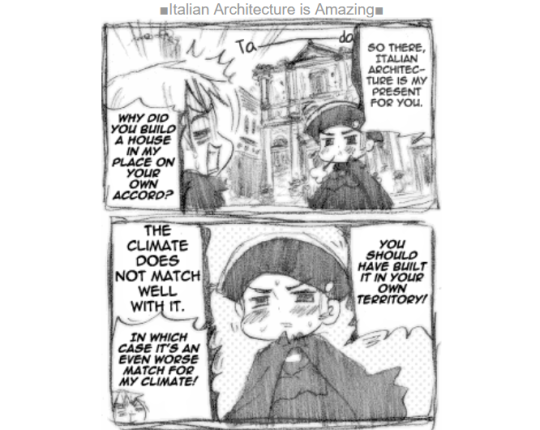
What immediately comes to mind for me is how Holy Rome built
an Italian home in England, without even considering how the architecture
wasn’t designed to endure the harsher English climate.
It would be unprecedented for Germany to pull off something
like that, as he’s always rationalizing and thinking things through enough
times to drive anyone crazy.
You see the organization pun come to life with Germany’s
love for schedules, manuals, and the scientific method. Overall, he’s a much
deeper and rational thinker than Holy Rome.
Further, with unity, comes a stronger sense of national
duty.
On the other hand, due to the fragmentation in his empire,
Holy Rome doesn’t seem to care what happens to it and is more focused on
chasing after Italy. He’s even scolded for neglecting his duties by
Switzerland. Tell me, have you ever seen Germany slack off?
That said, there are more similarities between them than
differences, and Hima sure loves to stress this all throughout the series. They
both share a love for the Italian culture and climate, are flustered easily,
love sweets, own dogs, have Prussia as on older brother, and…
there’s also the obvious fact that they look exactly alike.








 Ellawritesficssometimes