Holy Rome Talk

image

First, I just want to thank you both for participating. I really
appreciate it 😀

image

My theory accounts
for this:

1)   
The nations are
cultural personifications

Usually, when the culture or the country’s personality dies/ disappears, the country would gradually disappear or entrust him/ herself to the country that takes over him/ her.

There are also cases that him/her is not a country but continues to live leisurely as a representative of a region.

Source: Hetarchive, It’s a Treasure Box of
Countries.

The nations are cultural personifications. They
exist when people unite under a common cultural identity. As such, this may
account for the reasons why there are separate personifications for Ancient Egypt
and Greece and Ancient Greece and Greece etc. However, I do agree that the
rules of this are arbitrary and inconsistent if you look at nations like China
and Japan, who don’t have ancient counterparts. Which brings me to my next
point:

2)   
The nations are
described as “strange beings.”

image
image

Because of this, not everything that happens can be explained with an ascribed logic. It’s canon for nations to arbitrarily last
for as short as a few days to 1000s of years. Nations can also keep living and
change their titles over time. For example: Hungary was originally born as an equestrian
tribe and Prussia was originally born as a catholic order.

Therefore, it’s not an easy fix because no rules
were broken.

Source: Hetascanlations, World Stars
Chapter 1 + Hetarchive, Notes & Etc + Volume 2 Character profiles.

On the other hand, given that World Stars is
recent, the “easy fix” argument can still be countered. Himaruya’s been hinting
of the Holy Rome = Germany connection since the first original web chapters
(2006).

See: Hetare 4, Pact of Steel + Hetare 5, Lietuvis.

image

My theory also
accounts for this:

1)      France never killed
Holy Rome in the deleted strip.

He only notified Italy that Holy Rome had died.

image

Source: Hetarchive, Holy
Rome is no more

2)      Cultural personifications
x 2

I’m going to sum up my main points, as I’ve already
written and explained this in greater detail:

  • Basically, because the nations are cultural personifications, the switch
    from Germany to Holy Rome didn’t consist of a significant change in culture.
    They both represented the German people. Germany represented the consolidated nation
    of the previous sovereign states that Holy Rome represented.
  • Holy Rome didn’t die right away after his dissolution–this ties in
    with the fact that as long as the culture exists, the personification won’t die
    right away. 
image

Source: Hetarchive, It’s
a treasure box of countries + Hetascanlations, World Stars Chapter 187.

  • Holy Rome became sick because of fragmentation
    and disunity but nonetheless existed because of the culture. This is consistent
    with the rule where nations get sick if their economy or political situation
    isn’t stable

Source: Hetarchive, In
just two minutes you can grasp the exterior of the European Economy.

image
image
  • This then escalated to him being on his deathbed after dissolution. On
    top of the culture still existing, it’s still possible for personifications not
    to die even after their culture/ personality (essence) disappears 

Source: Hetarchive, It’s a Treasure Box of Countries.

  • The switch from Germany to Holy Rome is consistent with the rule of
    personifications being able to change titles.

Linking them again: 

(All posts can be found in my directory).

Holy Rome theory posts: [x] [x] [x] [x] [x] [x] [x].

Prussia theory posts: [x] [x] [x] [x].

Nationhood posts: [x] [x].

What affects a nation’s health?: [x].

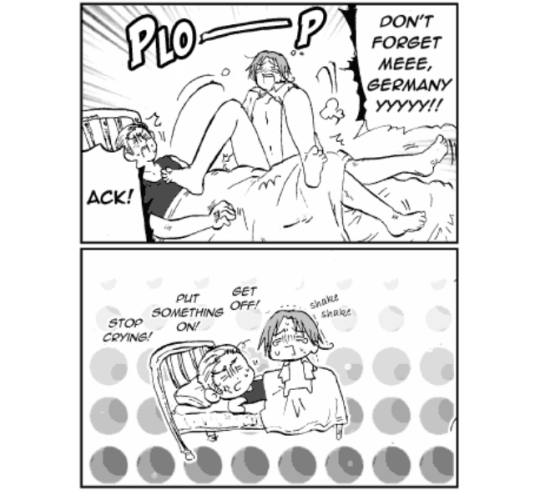
So… what the actual heck happened in Buon San Valentino?

Germany mistook Italy’s feelings for him as romantic,
confused himself more by reading friendship/ romantic guides that listed Italy’s
‘unique’ behaviour as something indicative of romance, fully—and I truly do mean ‘fully’, he
was completely okay with it
—committed himself to dating and proposing to
Italy, only to realize that he had misinterpreted Italy’s feelings/ behaviours
the whole time.

image
image

Source: Hetarchive, Buon San Valentino.

I got a challenge for you, inspired by the buzzfeed challenge. Don’t worry, it’s not another one of those. How about a good argument against the HRE is Germany theory? (Sorry if this sounds rude btw)

It doesn’t sound rude!

New Challenge:

Okay,
so here’s the thing. As someone who has read the manga countless times and has picked
up on all the hints, foreshadowing, parallels, and conjoining logics, I don’t and
presently cannot see that as a possibility. I haven’t seen anyone use good
concrete evidence to prove against the theory. And then there’s those who don’t
believe the theory just because everyone else believes it…

So,
tell you what: you guys put forward your evidence as to why you don’t think
Germany is Holy Rome and I’ll see if I can counter it. This way, it tests the
strength of my theory. This post here outlines a lot of my main counters to the
most common arguments, so please read it over first [x]. 
Also
note that you have to back up your points with evidence from the manga. It can’t
just be based on what you ‘think.’ What you think has to be supported with
proof and examples. Show me how you
reached your conclusions ^^ 

Please submit it in ask form!

image

image
image

Note: This theory
makes the assumption that Holy Rome is Germany.  It also makes the assumption that Prussia evolved
to adopt the title of East Germany. I will also be talking about specific
evidence
in this post. For more detail and evidence regarding my thoughts about
the Holy Rome = Germany connection, here’s a slew of previous posts for that. It
includes things like memory repression, faked rebirth, the role of culture in
nationhood, and other similar goodies.

[x] [x] [x] [x] [x] [x] [x].
The Gap:

As I re-read the material, I’ve noticed something
odd that could account for the reason that Germany hasn’t come to the conclusion
– at least overtly – that he’s Holy Rome.
That is, there’s a significant gap in his relationship with
Prussia.

We know that post-WW2, Prussia ended up under Russia’s
control, working unprofitable jobs.

Source: Hetarchive, Notes & Etc.

We also know that Russia heavily censored Prussia’s communications
with other nations during the Soviet Era.

Source: Hetarchive (Bamboo Thicket, eng trans., Oct 30th 2013). 

Ex: A letter that
Prussia sent to Austria was heavily censored by Russia.

image

If that’s the case, it would be likely that the two had very
little communication with each other outside of meetings. Even then, we know
that Russia attended meetings on the Baltic trio’s behalf, so that’s another
factor to consider if the same rule were to apply to Prussia as East Germany.

More importantly, this gap in communication is demonstrated
in more subtle ways too.

Ex: After the fall
of the Berlin Wall, Germany is surprised to find how tattered and rugged
Prussia’s appearance is (note the presumable East German car model Prussia uses).

Source: Hetarchive (Bamboo Thicket, eng trans., Oct 8th 2013). 

image

Ex: Prussia also
talks about Ostalgie (a combined word illustrating nostalgia for East German life)
in another strip. Point is, it highlights that the brothers lived separately for several decades.

Source: Hetarchive, Germany’s Playing an Impossible Game.

“’We have to get rid of the “wall in out hearts,” so that the country can get better and the progress will be naturally more effective! When the Ostalgie level gets higher, Russia imposes himself on my big brother.”

image

Child of the Past:

Working off the section above, we also know that there’s a
lot of murky waters when it comes to how the series discusses Germany’s past.

For one thing, we know that Prussia has lied about stories
of his own past and that Germany took them at a face value. This scene in the
Christmas 2011 event makes us question whether Prussia may have lied about
aspects of Germany’s past as well.

Ex: Prussia’s account of Germany’s history starts from the
formation of modern-day Germany. He doesn’t delve past that, which is
questionable.

Source: Hetarchive, Christmas Event 2011.

image

We also know from hints in Buon San Valentino that Germany
may be suffering from memory loss. The basic gist of the scene is that Germany
gets so overwhelmed that he blacks out. The scene then pans in on his brain and
the next panels illustrate fuzzy images of Chibitalia as if Germany is
recalling a lost memory.

Source: Hetarchive, Buon San Valentino pt 3.

image

Another instance where Himaruya potentially plays with the
idea of Germany and memory loss is this panel here. It seemingly depicts him
having a fuzzy dream. What’s interesting is that this looks very similar to
what his other birth scenes look like.

Source: Hetarchive (Bamboo Thicket, April 15th, 2011).

image

vs

Source: Volume 6 + Hetascanlations, World Stars Chapter 12.

image
image

The reason I bring up these examples is that if Germany
truly is an amnesiac Holy Rome, then at the time that Buon San Valentino took
place (WW2), he was consciously like a child compared to other personifications
who’ve lived for centuries and millennia.

Perhaps it’s for this reason that Prussia didn’t want to
tell Germany about his forgotten past, because it would be too soon and
traumatic to bring up. 

Now factor in the gap and lack of communication between
Prussia and Germany post-WW2.

The question I’m asking and want people to think about: Is
it that Prussia still sees Germany as a child and hasn’t felt it necessary to
tell him these secrets? There’s also the fact that because it’s such a
personal, familial matter, other nations haven’t bothered to intrude and tell
Germany this themselves.

Not a passive
spectator:

Lastly, I just want to end on the note that Germany isn’t a passive
spectator in this equation.

While he’s quick to denounce anything that isn’t scientific –
e.g., discounting ghosts, such as Quintillus, a Roman emperor – I think at some
level Germany knows that not everything lines up.

Source: Hetascanlations, World Stars Chapter 41.

image

What if he’s interested in looking at Roman history because
he wants to know his roots?

Source: Hetarchive (Bamboo Thicket, October 20th, 2014).

image

Or could it be that he wants to know more about Rome and how
he died and studies Roman history as an indirect way of approaching this?

Source: Hetarchive, Together with Grandpa Rome.

Notice how uncomfortable and unsure Germany looks. 

This RARELY happens.

image
image

If there was another Holy Rome personification that died,
shouldn’t they be in heaven too…like Rome? Could it be that Germany is second-guessing
his status and realizes that just like how Prussia, Austria, and Hungary (to
name a few) have been able to adopt new titles regarding what they represent, the same thing occurred with him?

Source: Hetascanlations, World Stars Chapter 1.

image

Or how about the undeniable fact that they look exactly
alike?

Source: Hetascanlations. Edited photo, from left to right; Germany World Stars Chapter 12 + Holy Rome World Stars chapter 187.

image
image
image
image

Note: This post
will use Adler’s theory of Birth Order.

Birth Order
Psychology…what is it?

In analyzing how children’s personalities develop, Adler was
the first to point out the impact of birth order. Essentially, he contended
that regardless of genetics and the environment children are reared in, the
order in which siblings are born have a unique impact on their personalities.

In fact, the birth order itself was considered to be a
different environment in itself. For example, an only child would have grown up
in a much different environment than a first-born with one younger sibling or a
youngest child with five elder siblings.

While only for fun, I’m going to analyze the personalities
of different siblings in the series. Their personalities don’t correspond with their respective birth order; however, a lot
of their personalities fit very well in Adler’s personality model.

Let’s go through them.

First-born Child:

First-born children tend to adopt the role of the teacher,
the tutor, the leader, and the disciplinarian. They are intellectually mature
and have a deep interest in maintaining order and authority. As such, they’re
good organizers, are very detail-oriented, and hold authoritarian/ conservative
attitudes.

Sound familiar? It should, because this describes both
German brothers: Germany and Prussia.

Both are very disciplined and ordered.

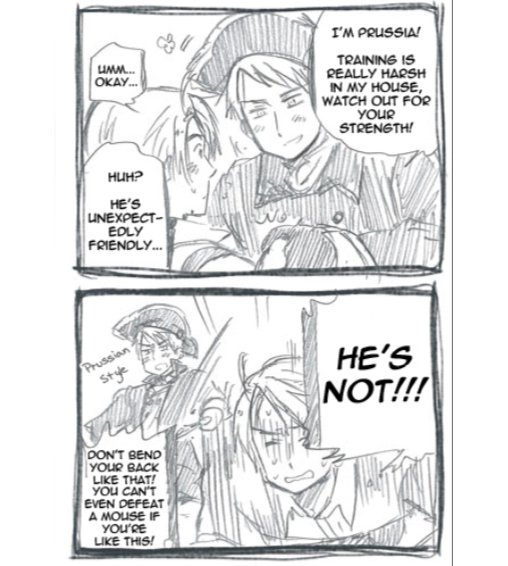
Ex: Prussia
mentored America and gave him vast military knowledge.

Source: Hetarchive, Christmas 2011

image

Ex: Germany
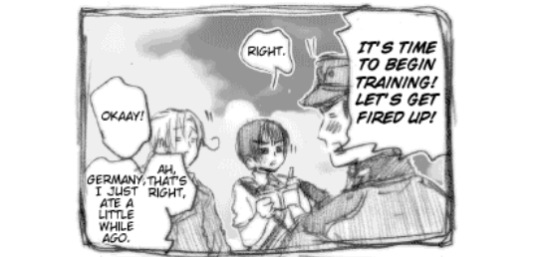
trains his allies, Japan and Italy, in a hierarchical manner during WW2.

Source: Hetarchive, Diary Sketches Summary.

image

Both are very organized and devote a great attention to
detail.

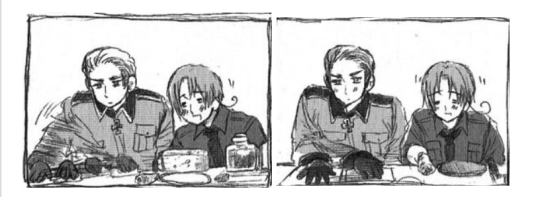
Ex: Germany is
known for his neurotic attention to detail, such as keeping his kitchen clean,
meticulously organizing his day with agendas, and following manuals to the
letter.

Source: Volume 1.

image

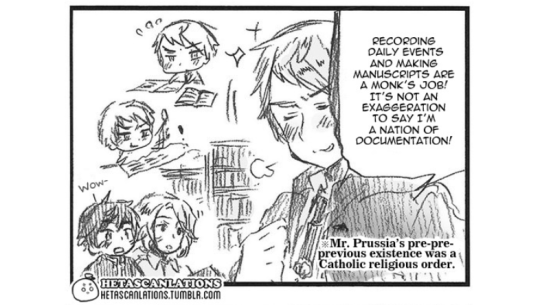
Ex: Prussia has
documented several centuries worth of diary entries and has an entire library
to shelf them.

Source: Hetascanlations, World Stars Chapter 339.

image

Second-born:

Second born children often have a pacesetter set in the
older sibling or vice-versa. A lot of times, this involves becoming locked in a
competition with the other sibling where they may strive to surpass them.

This is especially relevant to Canada and Romano.

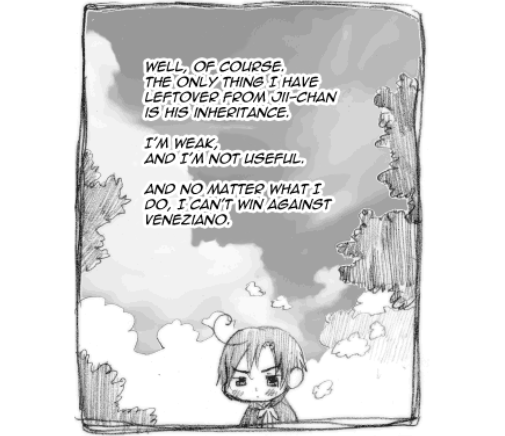
Romano has felt inferior to Veneziano ever since he was a
young child.

image
image

Source: Hetarchive, Boss Spain’s Control of Southern Italy pt. 2

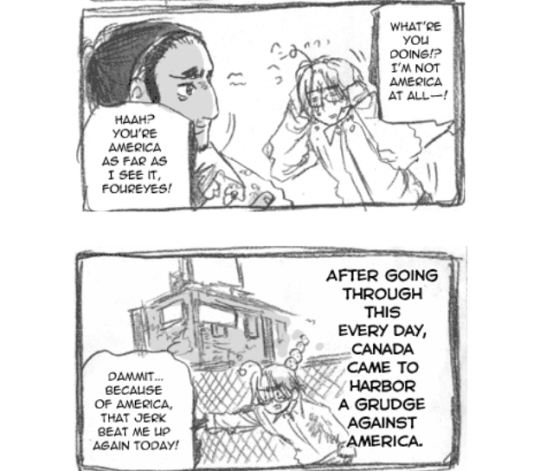
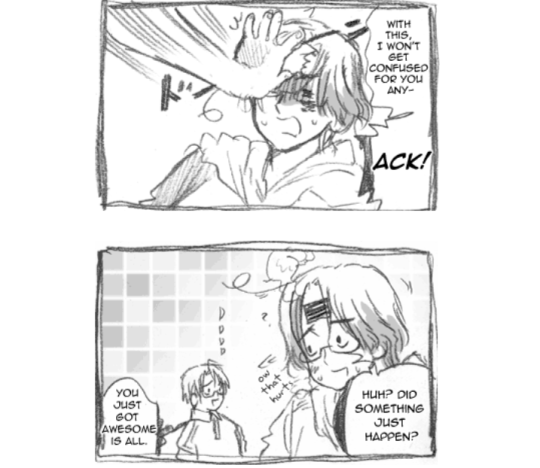
Canada’s characterization often revolves around his struggle
to overcome his invisibility, step out from America’s shadow, and develop a
unique and memorable identity for himself. His greatest irritation is being
mistaken for America.

Source: Hetarchive, Fly Canada-San, Fly!

image
image

Last-born:

Like second-borns, last borns are also driven by the need to
surpass their older siblings and often develop at a remarkably fast rate. They are
high achievers in whatever they decide to undertake. On the other hand, if they
fulfill the role of the “baby” of the family and are coddled too much, they can
also become dependent and helpless in adulthood.

This personality is most relevant to America, who both
developed (aged) at a remarkably fast rate but also rose to surpass England as
a world power to be reckoned with during the second Industrial Revolution.

Source: Volume 3, England Dreaming of Long Days Passed + Hetascanlations, World Stars Chapter 71.

image
image

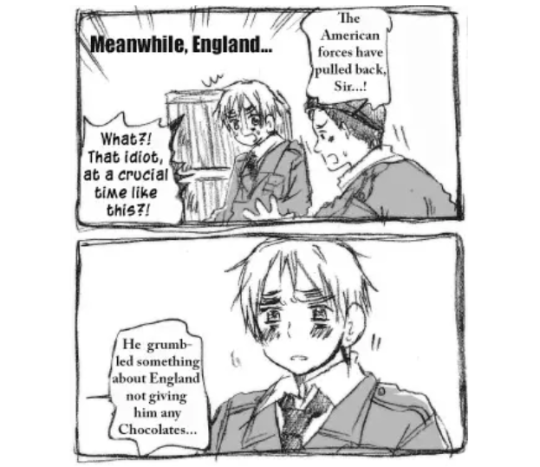
A good example of the baby-like aspect of his personality is
that America is notorious for pouting when he doesn’t get something he wants.

Ex: He pouts and sulks when England doesn’t give him
chocolate on Valentine’s Day.

Source: Hetarchive, Buon San Valentino pt. 2.

image

Only-child:

Only childs are far more mature than their peers due to being reared in an environment with adults. They are likely to
experience difficulties in situations outside the home where they are not the
center of attention.

Italy fits this personality-type best.

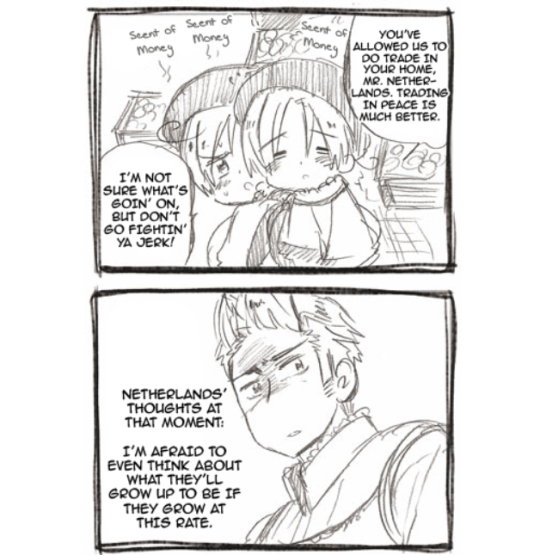
Italy grew up in prosperity and accumulated aptitudes in
several things, such as trade and commerce and art.

Ex: Both he and Romano had a talent for business at a young
age.

Source: Hetarchive, Christmas 2011 Event.

image

It’s not so much that Italy wants to be the center of
attention, but abandonment issues that he suffered from after Rome and Holy
Rome died definitely plays a part in how initially clingy he was towards
Germany.

Source: Hetarchive, Main Storyline Chapter 4.

image
image