When he occupies Rome during WW2, he treats the Italy brothers as
friends rather than enemies [x].
Italy:
He makes temporary peace with France and asks not to fight
when they get shipwrecked during WW2.
Source: Volume 3, United States of Hetalia 2
He calls upon Santa (Finland) so all parties could stop
fighting and enjoy Christmas.
Source: Volume 1, 🙂 in the World.
He opts to reside with Germany as a [euphemistic-style] POW. When
asked why he doesn’t try to escape, he explains that he would prefer not to
fight.
Source: Volume 1, Axis Powers.
He doesn’t hold grudges against anyone regardless of
political conflicts.
Source: Volume 6.
England:
He makes a temporary truce with Germany on Christmas (WW2).The two play soccer together.
Source: Volume 3, A Battlefield’s Kickoff.
Germania:
Most of these can also be applied to other Germanics, but
for the purpose of this post I’ll only be focusing on the similarities between
Germany and Germania.
Emotional stuntedness
+ awkwardness
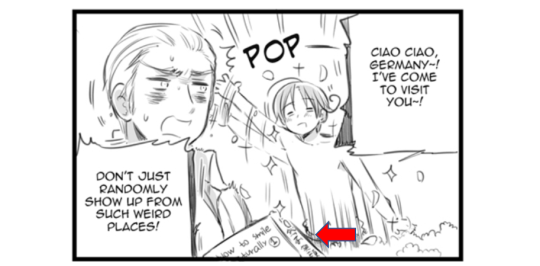
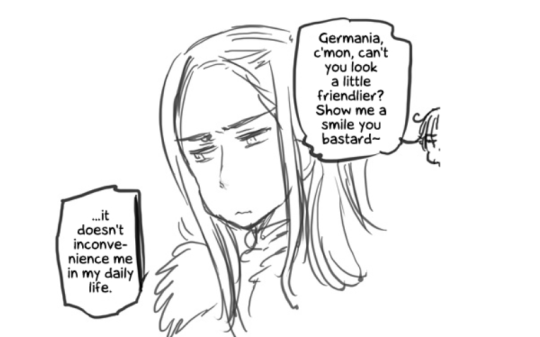
Both Germania and Germany are unable to smile.
Well, at least expressively and regularly.
Source: Hetarchive, Christmas Event 2010 + World Stars chapter 7.
Source: Hetarchive (Bamboo Thicket, Eng trans., Feb 24th, 2015).
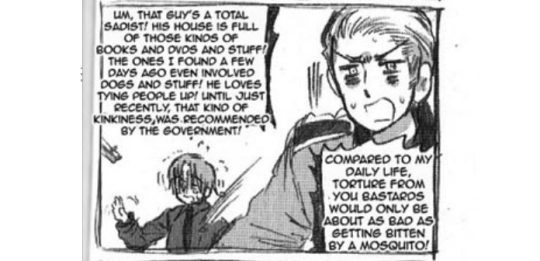
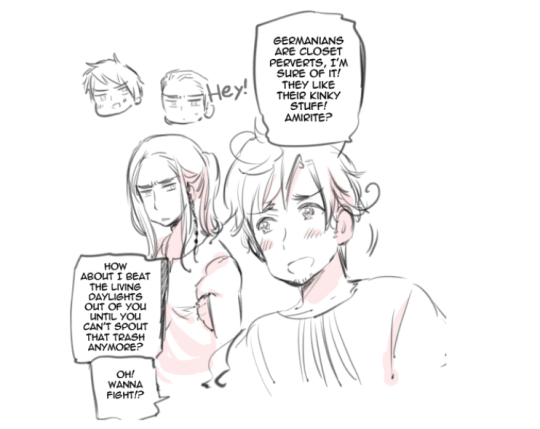
Perverted trope
While I’m not exactly favourable of this, there’s still the
running joke that Germans are closet perverts.
Source: Volume 1 + Hetarchive (Bamboo Thicket, Eng trans., Feb 6th, 2015).
Bridge between
nations: the organizer and ‘Mom of the group.’
Both bridge the gap between chaos and civility. In other
words, they organize those around them and keep them in line.
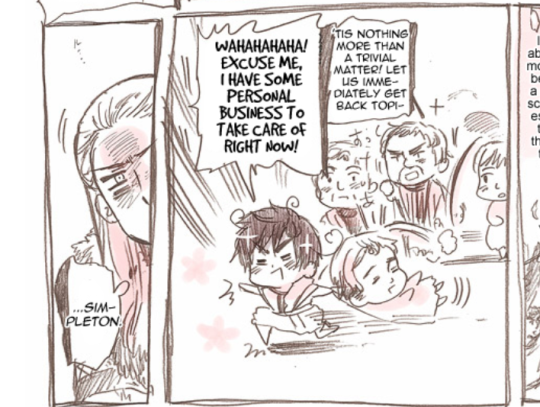
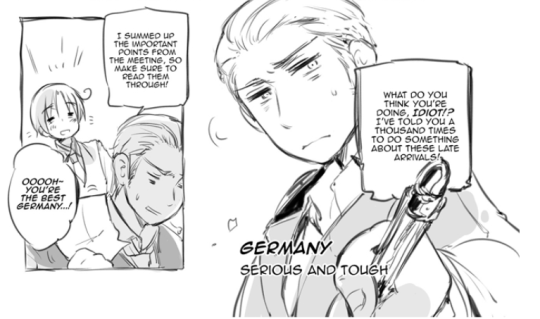
Ex: Germany demanding order at a world meeting vs Germania
making a snide comment when a meeting in Rome goes awry.
Source: Volume 1 + Hetarchive (Bamboo Thicket, Eng trans., May 3rd 2011).
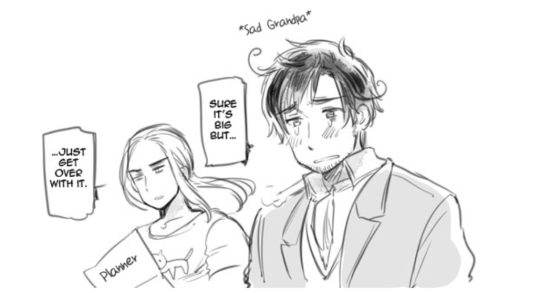
Ex: Both are adept planners.
Source: Hetarchive (Bamboo Thicket, Eng trans., Oct 20th 2013).
Ex: Both have an Italian to look after. This often includes
calming the latter down after an emotional outburst.
Source: Ibid + World Stars chapter 1
Rome + Germania
Italy + Germany
There’s also the tendency for the Italian to be late.
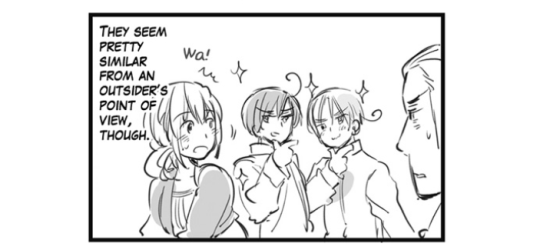
Lastly, it’s obvious that they look pretty much identical
save for hair length.
Ancient Rome and the
Italy Brothers
Both brothers inherited the signature curl and a love for
women. Notice the positions of the curls and then compare them to Rome’s (i.e., one curl for each brother).
Source: World Stars Chapter 20 + ibid
The split between them lies more with the expressions they
make.
Italy is the softer, more relaxed side of Rome, while Romano—while
also considerably vulnerable and soft—bears a more abrasive external shell; that is, when he’s not being a crybaby.
The best way to go about this is to just show comparisons.
Notice how each Italy brother uniquely adopted specific expressions from Rome
that tailor well to their respective personalities.
Source: Vol 1 + Vol 2
Source: Vol 1
Misconception: He’s
dead and no longer exists.
Reality: He is
dead, but he still exists in heaven.
Ex: He once tied
up God so that he was able to visit his grandsons.
(Source: Together with Grandpa Rome, Hetarchive.)
Ex: He visits
Earth with Germania, only to find out that his home has since been replaced by
a bench.
(Source: Grandpa Rome’s visit home, Hetarchive).
Misconception: He
and Germania hate each other and are grave enemies.
Reality: It’s not
so much hatred but rather a strong one-sided dislike on Germania’s part. A lot
of canon information is contradictory, so it’s tricky to piece together.
Ex: A character
note for Germania: “Has a taciturn but rough personality and dislikes Rome
greatly.”
Source: Bamboo Thicket (Eng trans., Hetarchive, May 6th, 2008).
Ex: Germania is
easily irritated by Rome.
Source: Bamboo Thicket (Eng trans., Hetarchive, Feb 6th, 2015).
A condensed explanation of their relationship would be
childhood rivals who teased each other, a disgruntled Germania becoming Rome’s
bodyguard + occasional teasing, tension, Germania probably—although unconfirmed—giving
the finishing blow that ended Rome’s life on Earth, and reconciliation in
Heaven.
Ex: Childhood
teasing.
Source: Bamboo Thicket (Eng trans., Hetarchive, Feb 24th, 2015).
Ex: Germania
acting as Rome’s bodyguard and making a snide comment about the latter.
Source: Bamboo Thicket (Eng trans., Hetarchive, May 3rd, 2011).
Ex: The
unconfirmed status of whether Germania truly killed Rome is mentioned in this
character note “A brave man who is said to had [sic] defeated Rome, although
the truth is hard to find out.”
Source: Bamboo Thicket (Eng trans., Hetarchive, May 6th 2008).
Ex: The two visit
Earth together. Germania consoles Rome, who became distraught after learning
that his home no longer exists.
Source: Grandpa Rome’s visit home, Hetarchive.
Misconception: He
doesn’t care about Romano.
Reality: While he
may have devoted more attention to Veneziano, he very deeply cares about Romano
too.
Ex: Sketches indicate that Himaruya may have intended for them to have a more
tangible family dynamic.
Source: Bamboo Thicket (Eng trans., Hetarchive, May 1rst 2011).
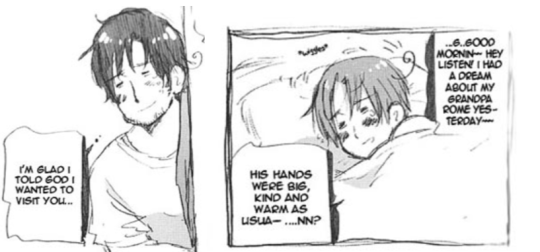
Ex: Rome visits
both Italy brothers in their dreams [x].
Ex: Romano bursts
out into tears of happiness when Rome visits him from heaven. The meetings don’t
occur often because Romano gets embarrassed by his crying.
Source: Bamboo Thicket (Eng trans., Hetarchive, April 5th 2011).
Misconception: He’s
not biologically related to the Italy brothers.
Reality: While
the labels attributed are awkward due to the absence of a traditional birth
process, the three of them are, in fact, biologically related.
Ex: Rome is said
to have many grandchildren, both biological and adopted.
Source: Bamboo Thicket (Eng trans., Hetarchive, Oct 30th, 2014).
Ex: On several
occasions, the Italy brothers are said to have inherited his legacy.
Source: Grandpa Rome’s visit home, Hetarchive).
Ex: The presence
of a curl is later used to distinguish a direct blood relation from Rome [x].
Bonus facts:
He was originally conceptualized as a much older man.
Source: Main story line chapter 4, Hetarchive.
He also visits Germany quite often to check up on the latter’s
research on him.
Source: Bamboo Thicket (Eng trans., Hetarchive, Oct 20th, 2014).
Himaruya intended to give him a retired playboy vibe.
Source: Bamboo Thicket (Eng trans., Hetarchive, May 6th, 2008).
As fans have pointed out in the past, many of the nations in
the series are not psychologically healthy. However, if I’m to use R.D. Laing’s
criteria of what differentiates a psychologically healthy person from someone
who’s not, three nations in particular stand out: America, England, and
Germany.
Psychological
Embodiment vs Disembodiment:
An embodied person is psychologically healthy. The person
experiences the world as if they’re “biologically alive” and develop a “sense
of being” in which they are acutely aware of their flesh, blood, and bones–
their body. Likewise, they understand themselves to be both a subject and an
object. In other words, their self and their body are one as they engage with the
outside world.
In a healthy
individual: (self/body) ↔ other
On the other end of the spectrum are those who are
consciously unembodied. These people experience a disconnect and divorce
themselves from their body. The body is felt like an object rather than part of
themselves and does not constitute the core of their being. This leads to
ontological insecurity. Essentially, they suffer from a weak, fragmented, and
unconsolidated sense of self.
The unembodied state:
Self ↔ (body-other)
There are three modes of ontological insecurity that an
unembodied person may experience but for the purposes of this post, I only need
to talk about one.
Implosion occurs when an unembodied person feels like a vacuum
and possesses an empty, unfulfilled sense of self. The external world is
overwhelming and crushes this empty identity. The individual then compensates
by attempting to fill this emptiness, albeit fearing what they could possibly be
filled with.
Some common examples of this would include the stress of
university. Unembodied individuals experience erasure under the pressure to
conform to uniform codes (standardized testing) and feel unimportant and insignificant
when they underperform. To deal with this stress, they turn to things like
fanfiction or Netflix to help fill the void of their disappointment and unmet
expectations.
That said, let’s tie this back to the strips.
America:
America’s fragmented sense of self lies in his inaccurate and
dichotomized perception of the world: everyone is either a hero or a bad guy,
and there are no grey areas in between [x] [x].
Ex: He tends to
include these clichés in the movies he makes [x].
While I may be reading into this too much, it’s still
interesting to look at it from the perspective that this is a coping mechanism
of his. America took on a lot of responsibility post–WW2 and became a
superpower. To deal with the stress, he adopted a hero persona to help him
forget about any misgivings or failures that would compromise this reputation.
I say this because even though America claims to be a hero, it’s
more of a persona than it is his true sense of self. I say this because America’s
actually quite the fraidy cat [x].
The hero persona helped fill in the gaps of any
grey areas that may have called the legitimacy of his actions into question. It
would have also consoled him in the times where he felt fear during war but
didn’t want to express it.
Overeating is also widely known as a stress-reduction
technique, something that America is notorious for [x].
Another instance of implosion would include America’s
tendency to overproduce. I’ve speculated before that this could be a result of
not only the poverty he experienced when he was younger but also as an attempt
to reduce any feelings of loneliness [x]. Longer post on that here [x].
England:
England’s experience of implosion falls with him turning to
the supernatural to avoid feeling lonely. He’s experienced chronic loneliness over
the course of the series. Some more notable mentions would include the American
Revolution and the Splendid Isolation strips [x].
After the Revolution, his relationship with America suffered
tremendously. Despite offering to become his friend in one strip [x], it took them
a while before they reconciled their differences. Although, it’s important to note that America secretly considered
England to be his friend, as mentioned in a Volume 2 character note.
Ex: During WW2, England’s still spotted talking to his fairy
friends, much to America’s confusion.
In modern times, we still see England favouring fantasy and
the supernatural over the real world [x].
Germany:
Germany experiences two forms of detachment.
The first one has to do with how he experiences himself as a
nation. As a “strange being” [x] that it is supernatural and not tangibly
explicable himself, I find it odd that he’s so transfixed on empiricism and
scientific data and is quick to dismiss anything to do with the supernatural [x].
The second form has more to do with how he experiences
emotions and establishes relationships with others. More detailed post here [x].
The basic gist is that Germany treats his interactions with
others objectively [x], following manuals and guides instead of personally
[subjectively] forming emotional connections. He contrives his body as a
machine that can routinely follow social codes and, therefore, hinders his
experience in forming a connection with another person..









 Ellawritesficssometimes
![[x]](http://i.imgur.com/f03SF.jpg)