
Figured you would appreciate this scene [x].

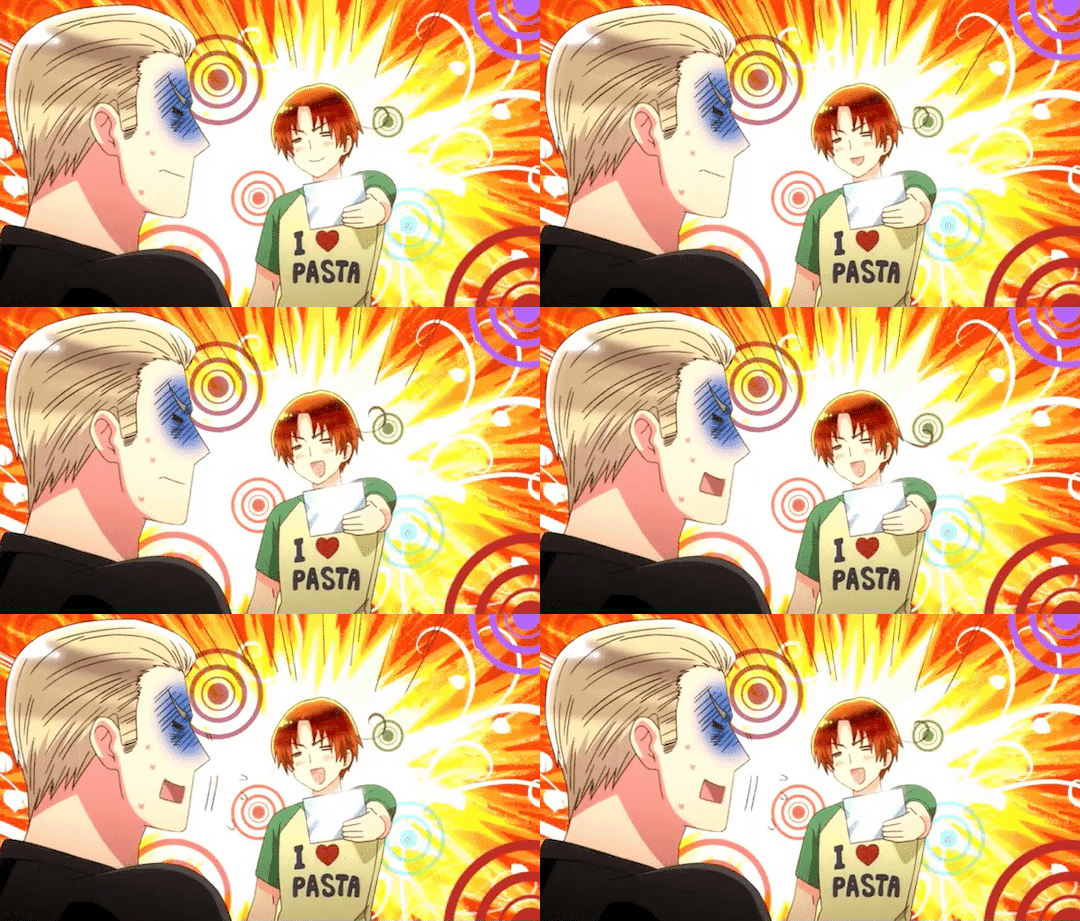
Do You think that it’s okay to think in China,
India and Turkey as Ancients Nations. I don’t know if to be an Ancient, the
nation has to be old and had passed a long time ago.
There’s no explicit rule on what makes an ancient an ancient. I use a
rule of thumb and go by chronological age.
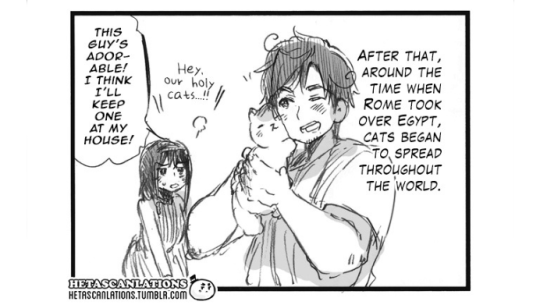
Yes, to China given that he’s lived for 4000+
years (e.g., he’s alive the same time as Rome) [x].

India, we don’t know enough information about
to pinpoint if he’s a more recent personification/ if he has an ancient
counterpart.
Yes, to Turkey too. In one of the drama CDs, it’s
revealed that he was the one who killed the Byzantine Empire (previously Ancient
Greece) [x].
Why does Turkey wear a mask?
No real reason is given. The
closest we’ve come to an answer only leaves us with more ambiguity… (Source:
Christmas 2007 event).


On the other hand,
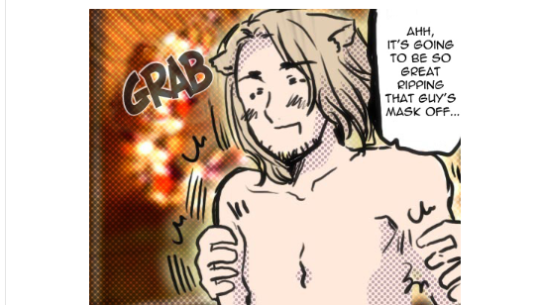
Himaruya does play with the idea of the mask. He’s created posts, where if you
click on Turkey’s image, a new image of him without a mask will appear [x].

What do you think of Germanys character song Steady Rhythmus?
A lot of people seem to be confused because it’s rock/“metal”. Idk
why tho, considering that a shitload of Germans (including me) love those genres.
I mean, we have rock/metal bands and festivals everywhere 
Not a fan of it, but I do get why it’s of that genre. I
actually kind of like Prussia’s “My song that is written for me, by me”, save
for some parts lmao. The instrumentals are good.
Would Prussia still be considered a nation, or is he now
human? If we’re ignoring the East Germany theory, that is.
The simple answer is that he seems to be somewhere in
between. He takes longer to heal, yet Gilbird is still around him. Since
the personifications’ immortality rubs off on their pet, Prussia may have still
retained some of his immortality, although it could be waning. Hypothetically,
if Prussia was human, being constantly around Germany—whom he lives with—would drive him mad [x].
The main reasons I say this are:
1) He’s once referred to as being “in a pitiful state of an
enclave” [x].
2) When asked if Prussia would eventually fade away, Hima states
this: [x].


Do you think that Italy is underestimated by others nations,
sometimes?
Yes and no.
Germany often underestimates him, being biased from what he
witnessed of Italy during the World Wars.
Ex: Germany’s reaction at
the Galata Bridge scene where Turkey recalls how strong young Italy used to be (Source: Volume 4).

There are also moments where nations recognize that it’s
better not to underestimate Italy (Source: Christmas 2011 Event).

So now there are 4 italy brothers?
I suppose if you want to think of it that way. The German
States/ states are considered to be Germany’s brothers, so I don’t see why not [x]. Just know that this isn’t confirmed in canon.

Why there is a personification of Genoa if
Veneziano was the North of Italy since his childhood?
As mentioned in previous
posts, nationhood isn’t exclusive. It can extend to any organization of people,
formal or informal. Veneziano represented all of North Italy, whereas Genoa is
a more specific personification [x].

If it helps, think of it
this way. It’s no different than Holy Rome representing the collective of German
States despite them existing individually. Not to mention that these German
States evolved to become states (note the difference in capitalization).
Which characters do you think are the most developed?
America, England,
Germany, and Italy.
I see that all the cats in nekotalia have the nations as the
owners, but are They the cat versions of their respective nations or just an au
where the nations are cats?
They’re cat versions of
the respective nations. (Source: Volume 6).


Hi there! Love your blog, your theories and
such are very interesting:) You know how countries live by their bosses orders?
What do you think happens when they disobey their orders to stop a war from
breaking out? What are the consequences for them, as a personified country? I’m
very curious.
Thank you!
Unfortunately, I can’t answer that question considering that there are no
facts/ similar situations in the manga for me to base a response on. That’s
more along the lines of a headcanon ^^


What this post will explore
is the impact of Austria’s and Hungary’s parenting style on Italy. There is no
good and bad here. All I aim to do is give reason and meaning to the
problematic behaviour and relationships that are depicted in the series. The
characterization is done for a specific purpose. What I seek to do is bring
several parallels to light to prove this.
One of psychologist Karen Horney’s theories explored how problematic
parent-child relationships often result in the child developing neuroses
(mental health complications), such as anxiety or depression.
However, rather than assert
all the blame on the parent, she went on to explain how parents who have been
reared in an environment void of love, care, and affection are incapable of
raising their kids in any other manner.
Put another way, parents pass
on their neuroses to their children. You can’t expect someone to provide the
care, warmth, and love that they’ve never experienced and learned themselves.
On the other end of the spectrum, these problematic parent-child-relationships
and parenting techniques are learned and repeated through
generation-to-generation. It’s a cyclical process, that, unless consciously
recognized, results in all sorts of emotional trauma.

What Horney believed to be the Basic Evil of these problematic
parenting styles is Parental Indifference, which can also include a
hostile or rejecting attitude of the parents toward the child. This parental
indifference can cause the child to develop feelings of Basic Anxiety or Basic Hostility –
both of which, if not attended to, can lead to mental health issues.
For the purposes of this
post, I only need to focus on Basic Anxiety. Basic Anxiety occurs when the
child develops feelings of loneliness and helplessness in a world that they
perceive to be hostile and dangerous.

That said, what I’ll now
analyze is how Austria’s and Hungary’s upbringings were passed down to Italy.
Let’s tie this back to the
strips.
As expected, having had to
fight for their autonomy to prevent themselves from being conquered caused
most of the nations to have rough childhoods. The world of war is full of
uncertainties, fears, and insecurities. Of course, Austria was no exception and
had to experience this too. However, rather than fighting, he attained his
security through many alliances and marriages (e.g., the Swiss-Austro
partnership and the Austro-Hungarian empire).

Nonetheless, Austria did
experience a total loss of control as a child [many times].
Ex: He lost several battles to Hungary [x].

This total loss of control is
later inflicted onto those who Austria conquers. Again, I’m not attempting to
justify any of the following behaviours. What I hope to do is provide insight
into the reasoning behind these behaviours. I should also mention that there
are a lot of grey areas in the manga; to depict the scenarios as black and
white doesn’t do the series and characters any favors.
What’s important is that
these behaviours have been wrongly normalized as the ways in which nations
function and interact with each other. It’s a cycle that’s repeated.
When Austria first assumes
control over Italy, he makes him the equivalent of a servant. As such, Italy
loses total control over his political affairs [x].


It’s a harsh world where
deviance [rebellion] is strictly prohibited. The punishments are respectively
just as strict and harsh—this would entail the hostility component of Horney’s
theory.


Of course, this doesn’t mean
that Austria wasn’t only hostile with Italy. They shared several fond moments
together and were considered to be a family unit.


What would matter to Horney
is how Austria’s inconsistent parenting style of being a simultaneous source of
love and affection and a hostile enemy to be feared affects Italy’s mental
health later in life.
Italy’s helplessness in
adulthood is most seen in his clinginess, stemming from his desire to seek
safety and security from the world that has consistently proven to be dangerous
to him. First, Rome died and Italy was conquered by Austria. Flash forward to
WW1 and he’s once again in the hostile, unpredictable, and insecure world of
war.
So, what does Italy do?
He seeks safety.
With who?
Germany, his enemy at the
time.
When taken as a prisoner of
war by Germany, Italy doesn’t attempt to escape, even when provided with the opportunity
to. How I’ve interpreted this before is that Italy does this to seek security.
He explicitly states this too. Even as a POW, he still has a roof over his
head, can sleep without worrying about being attacked, and can expect to be
fed.


On the other hand, war isn’t
the only sphere in which Italy feels helpless. Corruption and the tyranny of
the mafia have once again rendered him void of total control over his political
affairs. I would even go so far as to say that he’s adopted a sense of learned
helplessness.
Learned helplessness occurs
when a being recognizes the inevitability of their negative situation. The result
is that they don’t attempt to escape from this situation but instead cope with
it.
A prime example of this would
be when Italy has his car and wallet stolen from him. Rather than calling the
police, he goes to Germany for help. The fact that it’s Germany and not Italy
who reports to the police implies a conscious recognition on Italy’s part of
their inability to do anything about the event [x].


In other words, being stolen
from is something that Italy’s normalized.

Hungary, having been reared
in a more supportive environment, doesn’t pass down neuroses to Italy, unlike
Austria.
Instead, Hungary passes down the ability to trust in others. She had the
rare privilege of growing up with a parent figure. Magyar raised her to be just
like him [x].

Point is, this ability to love and care unconditionally is replicated
in Hungary’s treatment of Italy.

The cycle repeats as Italy learns
from Hungary that even in the most hostile of environments, trust can still be
established with other nations. This trust is often excessive and nonsensical
at times, as Italy forgives quickly and will openly befriend enemies.
Ex: Italy is noted to be a
nation that doesn’t hold grudges. He hugs Austria despite having recently
fought a naval battle against him.

Ex: Italy fondly refers to
France as “oni-chan” when they both get shipwrecked during WW2.


In sum, when looking at Italy
from this perspective, it’s easy to see how Austria and Hungary have influenced
his personality.


Aside from the muddled waters of his previous [deleted] and
inappropriate characterizations, which, unfortunately, have bred several
accompanying misconceptions—an important topic that I will eventually delve into in greater detail—Spain’s
personality is arguably one of the most benign, kind, caring, and compassionate
among the nations.

Being oblivious to the feelings of those around him and goofy-natured,
Spain has a tendency to act with his heart rather than his head. It’s not so
much that he’s emotionally-unintelligent. It’s more so along the lines that he
doesn’t always read into others correctly because he doesn’t bother to read
them at all.
Nonetheless, there are notable moments where he’s able to
see right through to those he cares about, knowing exactly how they’re feeling,
what needs to be said, and, of course, expressing his support for them.
In the past, I’ve seen his character unjustly be watered
down as a “plain” type, merely because he’s cheerful, as if people like this
don’t exist in real life. There’s nothing wrong with a character being sweet
and genuinely cheerful to those close to him. It’s this overcritical
attitude that causes people to overlook how benign and supportive characters
like Spain serve to compliment others and their respective relationship
dynamics. Often times, this support comes at the cost of self-sacrifice.
Ex: Spain gave Romano a whole new wardrobe at the cost of
wearing rags.

That said, below will be a list of examples detailing just
how much of a gem Spain is.
While Spain may have generally favored Veneziano over Romano
when they were younger—[not always the case, post on that here [x]]—this
dynamic has since changed. As adults, Spain’s attention has almost completely
been diverted to Romano.
What’s humorous is that Spain’s smothering irritates Romano
greatly.

Ex: Spain asks a tourist to stop Romano in order to get his
attention [x].


Ex: The two of them have matching tomato boxers [x].
Ex: He escorts a drunk Romano home [x].

Ex: Spain’s perceptiveness comes to light when he realizes
the real reason why Romano dressed Roman style for Halloween.
He smiles
knowingly when Romano refuses his suggestion that this is done in honor of
Rome. Having been his guardian for centuries, Spain knows Romano better than
anyone else [x].

In the same strip, Iceland, having experienced the same type
of overbearingness with Norway, alludes to the fact that Romano doesn’t
actually mind Spain paying him all this attention. Romano’s blush says everything.

The two are just really good friends. There’s a reason why
they’re always depicted together [x] [x].


It’s not just Romano who Spain’s excessively kind with
either. As mentioned, it’s just who he is as a person.
Ex: In recognition of how Germany has trouble smiling, Spain covertly tries to teach him how [x].


Ex: He’s described as the type of person who would ask about
the contents of a book he’s not interested in [x].

Ex: Spain’s kind nature is what makes the Bad Friends Trio dynamic complimentary and memorable. It just works [x] [x]


Note: This post will
use Swiss psychologist Kubler-Ross’s model of grief to analyze how Prussia has
come to terms with his death/ potential [future unconfirmed] death.
Kübler-Ross’ Model:
Having worked with terminally-ill patients, Kübler-Ross
recognized universal themes in which people passed on. There were certain
phases that her patients experienced before dying. While the model isn’t
successive in that patients don’t have to experience one phase in order to
experience the next and that some patients don’t necessarily experience all
stages, these themes were a common phenomenon that she observed. It’s not
measurable and empirically supported, but it does provide a good description of
the phenomenon.
The stages, which can be experienced several times
throughout the dying process are: Denial
and isolation, anger, bargaining, depression, and acceptance.

Denial is pretty
self-explanatory. The person refuses to accept the reality that they’re dying
and will usually avoid talking about it all together. Mostly, there is a
partial acceptance of their death (e.g., recognizing their fatal diagnosed
illness). It’s very rare where the person will maintain a consistent denial
until death. This stage is ultimately characterized by numbness and stoicism.
What’s isolating is that the person refuses to accept any other reality but
the one they’ve constructed.
Anger is also
fairly explanatory. Once the denial
can’t be maintained and upon recognizing their lack of control over the
situation, the person gets angry and resentful. This entails displacing their
anger and projecting it onto everything around them, including their family
members.
Bargaining is a sort of middle ground. If they’ve
consistently denied their death and are still angry at everyone and everything,
including God, they will attempt to bargain with their fate. The lack of
control renders them childlike in that they’ll wish for a postponement of their
death with the implicit promise that they won’t ask for anything else.
Ex: “Just let me
live past one last Christmas. That’s all I ask.”
Depression is seen as a necessary phase if the person is to
die peacefully and with a state of acceptance. Rather than trying to cheer the
person up, Kubler-Ross recommends encouraging the person to accept their
sorrow.
Acceptance includes neither an angry or depressed state.
Nonetheless, it shouldn’t be mistaken for happiness. They may not even feel
anything. This final stage typically involves the person withdrawing into themselves.
They don’t want too many visitors and are more contingent on their family
members presence as their support rather than verbal communication.

That said, the best example where I 100% believe Himaruya
has used this model is with Prussia. Regardless of what he personifies/
personified, it can’t be denied that Prussia has become weaker and may or may
not fade away.
In my interpretation, his character song, Mein Gott!, is an exemplification of
Prussia’s unwilling confrontation with the possibility of his death. He goes
through all stages with the exception of anger. Just like the model, Prussia
flips through the stages in a non-linear manner and experiences them several
times throughout the song [x].
“Someone is calling,
I’m being called
Alright, leave it to me; let’s go
More! More!
To the east and to the west
I’ll keep running”
He hears the call of death but
runs away from it.
“The awesome me’s the most supreme! The
strongest!
The one who gets the last laugh, yeah!
Is the awesome me, of course!
Danke!
The best! The most fearsome!
You guys can praise me
I’ll show you my massive dream
A succession of victories for sure!
…
All of the maps will someday be in these hands…
I’ll laugh as I run through
That’s right, it’s not because I’m weak
It’s because I’m too strong”
He hasn’t come to terms with
the fact that he’s not the political superpower he used to be. Instead, he
deflects by boasting about his strength in a hypermasculine way.
Ex: Prussia flat-out lies to Germany when the latter
recognizes that his bite wound has taken an abnormal amount of time to heal…for
a nation, that is.


The isolation pertains more to how Prussia himself feels alone.
Ex: When asked why Prussia is so alone, Himaruya answers
that it’s because of the “pitiful state of an enclave he’s in,” [x].
Enclave has two distinct meanings. In this case, I interpret
it as Prussia feeling different and excluded from other nations whose
immortality still remains.
Definition: ENCLAVE, a place
or group that is different in character from those surrounding it.
“Danke!
Everyone! Come here!
Let’s exchange email addresses?
Being alone is too much fun
Everything will be in these hands! Just you
wait!”
“Mein Gott!
In a pinch! Punch!
Sometimes even a warrior starts shaking
(…I’ll leave things at this point)
A reverse in the situation, I’m going to be
hasty!”
(Beobachten Sie es bitte,
Fritz Vater) x 3
(Watch over me please, Father
Fritz)”
Here, it’s evident that Prussia desires to reverse
his weakened state. He bargains with fate by asking Fritz, his father figure,
to watch over him.
Ex: Prussia has a picture of Fritz on
his night table. It gives him a sense of security, insulating him from his fear
of dying.

“Hey
little bird chirp for my sake
It will heal me; niyo niyo!”
Prussia actively recognizes
that he’s been weakened. His sorrow is displaced to his bird, whom he hopes
will cheer him up.
“This is bad, a panda that
will bring happiness
I won’t be fooled.”
In the 2009 April Fools’
Event, China gives Prussia a panda with the promise that it’ll bring him
happiness.

“Alone in my room
I’ll write it today too
A memorial of the awesome me
More! More!”

We all know that Prussia’s
been writing diaries since he was little. It’s the mention of a memorial that
signifies his acceptance of death.
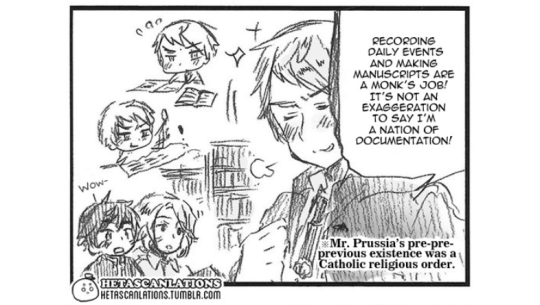

There’s also the recognition
that Germany is his successor.
Ex: When asked if Prussia will
disappear, Himaruya doesn’t rule out the possibility [x].

That said, it still amazes me
how people still conceive Hetalia as thoughtless, random, and simple. With the
large volumes of intertexts and historical and theoretical references woven
into the series, it’s anything but.


Here’s just a list of
terms that have a completely different meaning in the manga. This is aside from
their literal denotation.
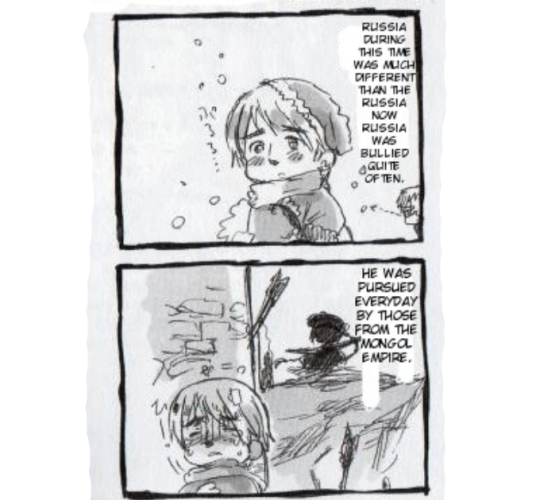
When a nation is referred
to as a bully and/or is bullied, this refers to them being conquered or sought after
by more powerful nations.
Ex: Both Italy brothers being conquered after Rome’s death [x].


Ex: Russia being ‘picked on’ by Mongolia, Denmark, Sweden, and Prussia.

The nation’s leader.
Pretty self-explanatory [x].

While it is possible for
nations to become students and attain degrees, the term “honour student” is
used in reference to how well a country succeeds politically or economically.
Ex: Italy’s referred to as an honour student in the EU [x].
Ex: Seychelles, being among the wealthiest African nations, is referred to
as an honour student.

House refers to the
actual country itself.
“My house [country] is
known for…”
Ex: Italy expressing confusion at the foods that tourist destinations in
his country try to pass off as authentic Italian cuisine [x].


 Ellawritesficssometimes