A run-down of different perceptions
and common disputes over canon material.
Can England really not swim?
It’s taken as a fact by
most that England can’t swim. On the other hand, some people are unsure whether
this should be considered canon given that Himaruya made the post in reference
to how British people in horror films stereotypically can’t swim [x].
Teenage Holy Rome?
It’s a common
understanding that the Holy Rome that appeared in the Christmas 2011 event was
a teenager. The younger Holy Rome that appears in chapter 187 of World Stars
would then be a consistency error…
However, if you really
look at the 2011 version of Holy Rome, he’s too small to be a teenager/
pre-teen. Specifically, look at his size in comparison to Hungary as she holds
him.
His age in 2011
corroborates more with his age in World Stars than it does with old sketches
that depict him more clearly of being of a teenage age.
There’s also the Private Concert strip where Holy Rome is depicted. He seems to match the ages of the 2011 and
World Stars versions [x].
Perhaps what happened
here is that Himaruya decided to make Holy Rome younger in later strips to
better fit some narrative/ plot that we have yet to see unfold.
Human Names?
The human names were
originally posted by Himaruya in response to a fan request. Since he deleted
the yahoo blog these were from, some don’t consider them to be canon despite
their popular usage.
Misconception: The nations are a secret kept from the public.
Canon: The nations are well-known to the public. Their
existence isn’t a secret.
Misconception: The nations can speak all languages and
inherently understand each other.
Canon: There is a general meta language that they all understand but will still sometimes need translators during first meetings [x].
Thank you to @jammerlea for bringing the former point to my attention [x].
Misconception: “Flying Mint Bunny” and “Gilbird(s).”
Reality: These are fanon names. Both pets haven’t been given
an official name.
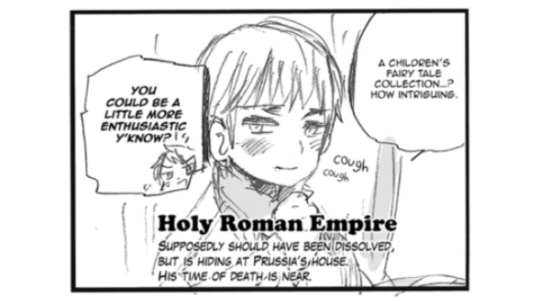
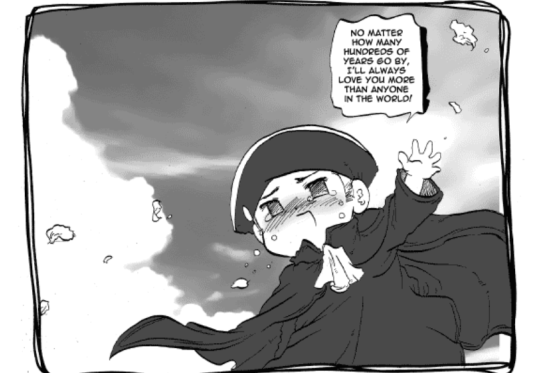
Misconception: Holy Rome died immediately after his dissolution.
Reality: He didn’t die right away and instead sought refuge in
Prussia’s home. To this day, his death has never been seen or confirmed [x].
Even in the deleted strip—not to be taken as canon—where France informs
Italy that Holy Rome is “no more” leaves things vague and open-ended.
What this post will explore
is the impact of Austria’s and Hungary’s parenting style on Italy. There is no
good and bad here. All I aim to do is give reason and meaning to the
problematic behaviour and relationships that are depicted in the series. The
characterization is done for a specific purpose. What I seek to do is bring
several parallels to light to prove this.
Horney’s Theory of Parenting and its Relation to Hetalia:
One of psychologist Karen Horney’s theories explored how problematic
parent-child relationships often result in the child developing neuroses
(mental health complications), such as anxiety or depression.
However, rather than assert
all the blame on the parent, she went on to explain how parents who have been
reared in an environment void of love, care, and affection are incapable of
raising their kids in any other manner.
Put another way, parents pass
on their neuroses to their children. You can’t expect someone to provide the
care, warmth, and love that they’ve never experienced and learned themselves.
On the other end of the spectrum, these problematic parent-child-relationships
and parenting techniques are learned and repeated through
generation-to-generation. It’s a cyclical process, that, unless consciously
recognized, results in all sorts of emotional trauma.
What Horney believed to be the Basic Evil of these problematic
parenting styles is Parental Indifference, which can also include a
hostile or rejecting attitude of the parents toward the child. This parental
indifference can cause the child to develop feelings of Basic Anxiety or Basic Hostility –
both of which, if not attended to, can lead to mental health issues.
For the purposes of this
post, I only need to focus on Basic Anxiety. Basic Anxiety occurs when the
child develops feelings of loneliness and helplessness in a world that they
perceive to be hostile and dangerous.
That said, what I’ll now
analyze is how Austria’s and Hungary’s upbringings were passed down to Italy.
Let’s tie this back to the
strips.
Austria and Italy: Intergenerational Helplessness
As expected, having had to
fight for their autonomy to prevent themselves from being conquered caused
most of the nations to have rough childhoods. The world of war is full of
uncertainties, fears, and insecurities. Of course, Austria was no exception and
had to experience this too. However, rather than fighting, he attained his
security through many alliances and marriages (e.g., the Swiss-Austro
partnership and the Austro-Hungarian empire).
Nonetheless, Austria did
experience a total loss of control as a child [many times].
This total loss of control is
later inflicted onto those who Austria conquers. Again, I’m not attempting to
justify any of the following behaviours. What I hope to do is provide insight
into the reasoning behind these behaviours. I should also mention that there
are a lot of grey areas in the manga; to depict the scenarios as black and
white doesn’t do the series and characters any favors.
What’s important is that
these behaviours have been wrongly normalized as the ways in which nations
function and interact with each other. It’s a cycle that’s repeated.
When Austria first assumes
control over Italy, he makes him the equivalent of a servant. As such, Italy
loses total control over his political affairs [x].
It’s a harsh world where
deviance [rebellion] is strictly prohibited. The punishments are respectively
just as strict and harsh—this would entail the hostility component of Horney’s
theory.
Of course, this doesn’t mean
that Austria wasn’t only hostile with Italy. They shared several fond moments
together and were considered to be a family unit.
What would matter to Horney
is how Austria’s inconsistent parenting style of being a simultaneous source of
love and affection and a hostile enemy to be feared affects Italy’s mental
health later in life.
Italy’s helplessness in
adulthood is most seen in his clinginess, stemming from his desire to seek
safety and security from the world that has consistently proven to be dangerous
to him. First, Rome died and Italy was conquered by Austria. Flash forward to
WW1 and he’s once again in the hostile, unpredictable, and insecure world of
war.
So, what does Italy do?
He seeks safety.
With who?
Germany, his enemy at the
time.
When taken as a prisoner of
war by Germany, Italy doesn’t attempt to escape, even when provided with the opportunity
to. How I’ve interpreted this before is that Italy does this to seek security.
He explicitly states this too. Even as a POW, he still has a roof over his
head, can sleep without worrying about being attacked, and can expect to be
fed.
On the other hand, war isn’t
the only sphere in which Italy feels helpless. Corruption and the tyranny of
the mafia have once again rendered him void of total control over his political
affairs. I would even go so far as to say that he’s adopted a sense of learned
helplessness.
Learned helplessness occurs
when a being recognizes the inevitability of their negative situation. The result
is that they don’t attempt to escape from this situation but instead cope with
it.
A prime example of this would
be when Italy has his car and wallet stolen from him. Rather than calling the
police, he goes to Germany for help. The fact that it’s Germany and not Italy
who reports to the police implies a conscious recognition on Italy’s part of
their inability to do anything about the event [x].
In other words, being stolen
from is something that Italy’s normalized.
Italy and Hungary: Intergenerational Trust
Hungary, having been reared
in a more supportive environment, doesn’t pass down neuroses to Italy, unlike
Austria.
Instead, Hungary passes down the ability to trust in others. She had the
rare privilege of growing up with a parent figure. Magyar raised her to be just
like him [x].
Point is, this ability to love and care unconditionally is replicated
in Hungary’s treatment of Italy.
The cycle repeats as Italy learns
from Hungary that even in the most hostile of environments, trust can still be
established with other nations. This trust is often excessive and nonsensical
at times, as Italy forgives quickly and will openly befriend enemies.
Ex: Italy is noted to be a
nation that doesn’t hold grudges. He hugs Austria despite having recently
fought a naval battle against him.
Ex: Italy fondly refers to
France as “oni-chan” when they both get shipwrecked during WW2.
In sum, when looking at Italy
from this perspective, it’s easy to see how Austria and Hungary have influenced
his personality.
I know it may seem random at times, but there is a
consistent logic running through the manga that explains why some nations live
on despite ceasing to exist politically. The reason that this causes a lot of
confusion among fans is because of how loosely the word nation is defined in
Hetalia.
Nation doesn’t strictly mean an autonomous and politically
recognized sovereign state. Instead, personifications exist as representations
of a group of people and their culture, hence explaining their wide diversity
(e.g., kingdoms, religious orders, micronations, city-states, provinces, etc.)
Remember that the modern nation-state is a recent phenomenon. Humans organized
themselves far differently in the past. Larger post on that here [x].
In “It’s a Treasure Box of Countries”, it’s confirmed that
the nations are cultural and citizen-oriented personifications. Two things can
happen when a nation dies.
1) They gradually fade when their people’s culture
or identity (personality) disappears.
“Usually, when the culture of the country’s personality
dies/ disappears, the country would gradually disappear or entrust him/herself
to the country that takes over him/ her.
2) The ex-nation becomes a state representative.
“Regardless if their people’s culture and
personality disappears, the personification can still live on as a state
representative.”
There are two points to take away from this. One, the
nations don’t cease to exist because of political recognition. First and
foremost, they exist for their people and their culture. Two, nations don’t
necessarily die right away, or at all if they decide not to.
Ex: In World Stars, France reaffirms again that the nations exist because of their people.
That said, let’s go through some examples.
Poland and Lithuania:
After the third partition of their empire, it wasn’t just
Poland that ceased to exist on the political map.
Lithuania did as well. Nonetheless, as Lithuanians and Poles were absorbed by
Russia, Prussia, and Austria, thus ending their political identity, their
cultural identities remained in tact. Lithuanians and Poles didn’t disappear; their states did.
It’s for this reason on top of the fact that nations gradually
disappear that Poland and Lithuania are revealed to have lived during this era.
Poland made friends with Italy and bonded over their desire for independence.
Meanwhile, Lithuania became a servant to Russia.
Holy Rome:
Holy Rome didn’t die right away despite being dissolved,
once more demonstrating the gradual pace of how and when a nation fades.
Whether he’s East Germany or not, it’s clear that Prussia is
losing his immortality.
Ex: When Germany’s dog bites him, Prussia takes longer to
heal from a wound.
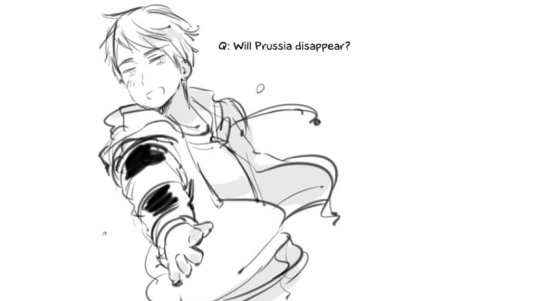
When asked on whether Prussia will disappear, Himaruya doesn’t rule this out as a
possibility [x].
In sum, it’s important to note that the nations don’t exist
for political reasons. If they die, it’s because their people no longer
identify under a common identity, or their culture disappears. This death doesn’t
occur immediately and is a gradual process. On the other hand, personifications
can still choose to exist even without a group of people and culture to
represent.
Note: This is a
guide. It’s not meant to cover an exhaustive list of all relevant examples in the manga. If I did that, this post could
easily be a novel.
Before I get into the direct blood relations of the
characters, this guide aims to chart out and differentiate between the different
types of relationships that we see in the manga.
Biological:
Biological siblings, obviously, means that the nations in question
are blood-related.
Ex: America and Canada.
Ex: Greece and Egypt and their moms, Ancient Greece and
Ancient Egypt.
The best example of a biological relation is that of Norway and
Iceland’s.
Iceland had no native people. Since it was Norwegians alone
who first settled on the island, the two are directly related [x].
Iceland innately senses Norway when he’s first born.
Norway
also senses Iceland.
Likewise, DNA testing – in this case, a land excavation – is
done to confirm their biological relation.
Now, let’s do a comparison.
When America’s born, he doesn’t sense a biological brother
among the countries colonizing him. The reason for this is that he’s referred
to as an ingredient, meaning that not only were there native tribes living on
the land he represented but that America existed as a mix of several European
cultures [x].
The point to differentiate here is that America doesn’t have
a direct biological relation to these colonizing countries due to the large
volume of them.
Instead, what you’ll see is that the colonizing countries
fight over assuming the role/ title of being America’s big brother, or
onii-chan.
Onii-chan:
Continuing from America’s example, after he chooses England
over France, he asks England if he can refer to him as onii-chan – ‘Big Brother.’
As stated in the translator’s note, onii-chan can be used as
an expression of adoration and endearment. Put another way, ‘big brother’ here
has an entirely different cultural connotation. It’s a brother-figure relationship
and isn’t meant to be taken literally.
Not to mention the fact that England initially rejects the
label of onii-chan, claiming that “just ‘England’ is fine.’” The reason England
is hesitant to accept the label stems from the horrible relationship he has
with his own older brothers.
France is another example where the term Big Brother is used affectionately.
Ex: He claims to be the Big Brother of the world.
Ex: He’s described as a Big Brother-type.
Ex: The first thing that he does when he meets Lisa, Jeanne
d’Arc’s reincarnate, is introduce himself as Big Brother.
Ex: The reason that Italy refers to France as Big Brother is simply because they grew up in Rome’s house together for some time.
This title of endearment is confirmed in one of Hima’s blog
posts, where he clarifies that Italy and Monaco both call – as in refer – to France as Big Brother [x].
More examples of France’s use of the title ‘Big Brother’ can
be found here [x].
One last example of this is that of Netherlands, Belgium,
and Luxembourg.
Netherlands and Belgium are biological siblings. Meanwhile,
Luxembourg refers to Netherlands, France, Spain, and Belgium as Big Brother and Big Sister respectively [x].
While the translation is noted to be rough, the distinction
is nonetheless made very clear.
All that needs to be known is that when two nations
willingly unite – not to be confused with being conquered/ annexed – the personifications
involved are considered to be married.
Austria is notorious for this, being noted to have solved
all his problems in the past through marriage (e.g., the Austro-Swiss
partnership, The Hapsburg Monarchy, the Austro-Hungarian Empire).
Ancestors:
In the manga, sharing similar ancestors doesn’t make the
nations involved biologically related. In this case, I’m talking about cultural
influence.
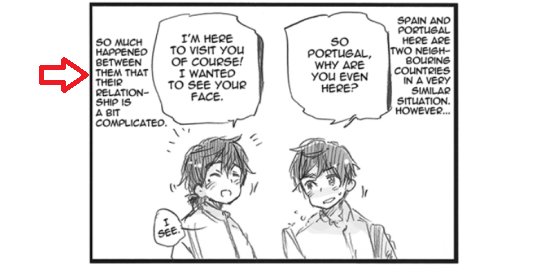
Ex: Spain and Portugal. (Chapters 77-79 of World Stars).
Both are noted to share a similar ancestry. As such,
Seychelles can’t tell which one is Portugal when she has a letter to deliver to
him.
Given the context in which the topic of their physical resemblance and relationship is discussed, if they were siblings, France would have attributed the reason for their likeness to this. He doesn’t.
Not once is a relation ever confirmed except for the fact that they’re neighbors.
Point is, it’s the similar ancestry that causes them to look alike.
While Romania may have inherited much of Rome’s culture, he’s
not related to the Italy brothers.
This brings me to my next point.
Influence:
While cultural influence often affects the physical
and personality traits of nations, it doesn’t make them biologically related.
Ex: Seychelles was originally designed to have one thick
eyebrow and one thin one to represent French and English influence.
Ex: As an amalgamation of several cultures, America
resembles bits of Finland, France, and England.
Ex: France’s influence prevents America, Canada, and
Seychelles from inheriting England’s bushy eyebrows [x].
Ex: Young Canada inherits France’s hair due to his
influence. This is before England had assumed control over him.
The House System:
When a country is conquered and their conqueror is on the
same continent, the conquered personification lives with the conquering personification.
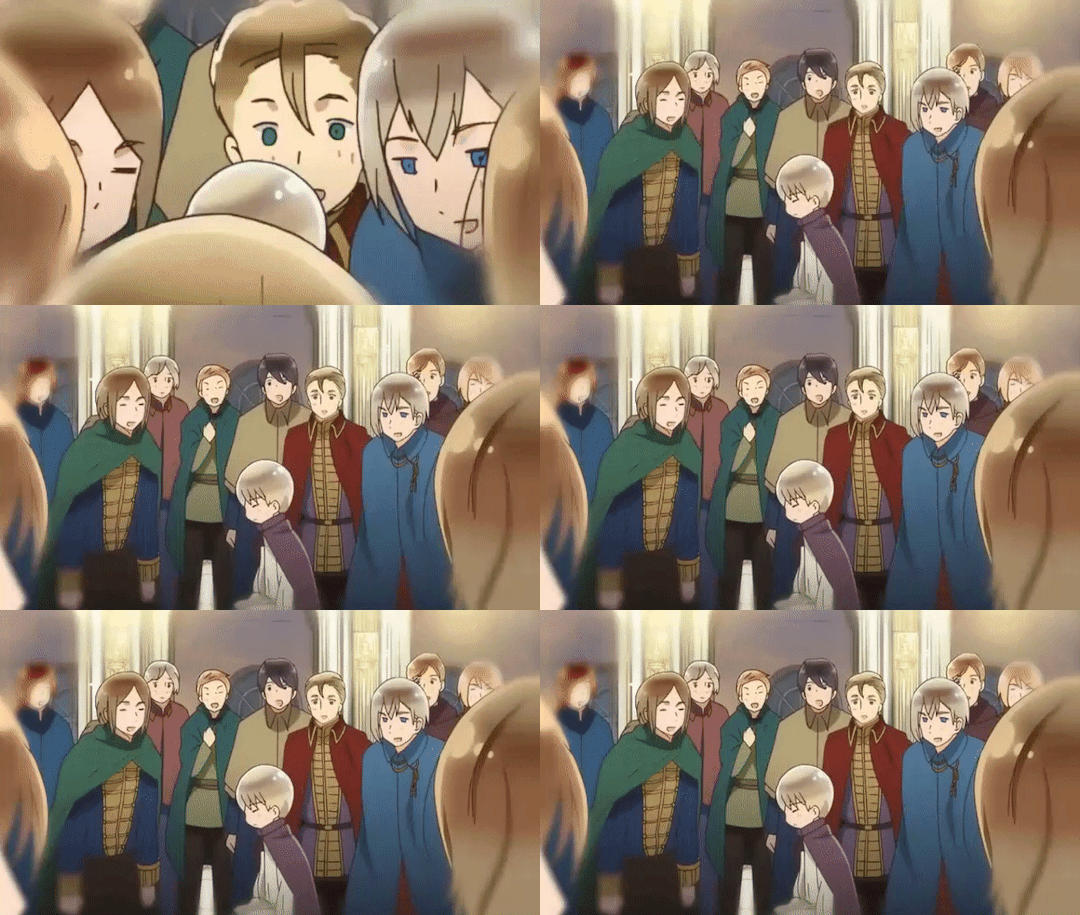
Ex: France, Holy Rome, and Chibitalia living in Rome’s house (panel used above).
Ex: Chibitalia and Hungary living in Holy Rome’s house. Despite the rough start, they become so close that they refer to each other as family.
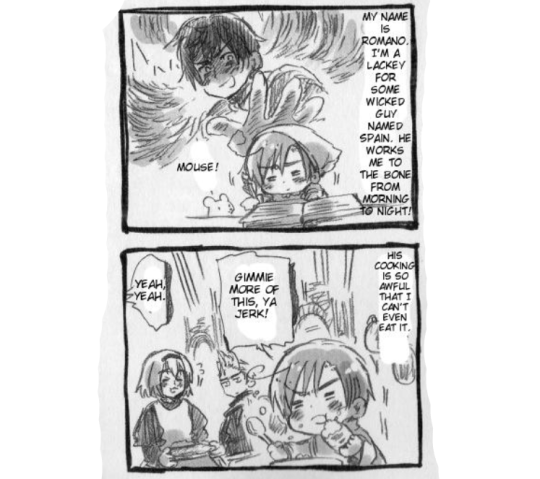
Ex: Romano, Netherlands, and Belgium living in Spain’s house.
In modern times, we still see this occur, albeit it’s a bit
different.
The Chinese provinces +
Macau and Hong Kong (under a one country two systems principle) all
live in China’s household.
The Colony/ Household System:
*Note – I made up the labels of house and household system
to better clarify and more easily distinguish between the two different living circumstances.
In canon, ‘House’ and ‘Household’ are terms used loosely and interchangeably in the translations.
The household system is separate from the house system in
that because the colonies are on separate continents, they’re part of a
household. In other words, they’re together and considered to be a unit despite
not living with the ruling nation.
Ex: England visits America, but America doesn’t live with
him in England.
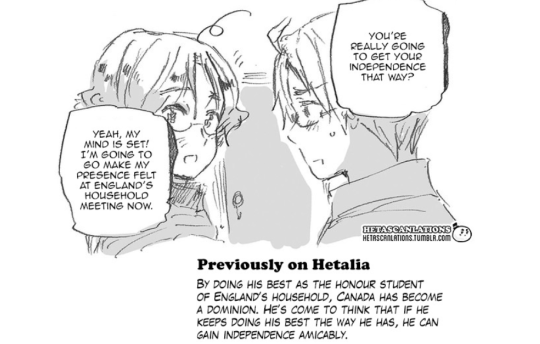
Ex: England hosts a household meeting, requiring the colonies to travel [x]. (America is already independent here, by the way. He’s not part of the household.)
Ex: Likewise, England has holiday houses in Hong Kong and
India, as alluded to in one of his character songs [x].
“
Curry, Chinese cuisine, my holiday houses’ meals.”
Ex: Hong Kong, who used to live with China and referred to him
in a more intimate way [x], changed after he became an English colony.
When he becomes Chinese territory again, he refers to China
as teacher/ Mr., seeing him more as a mentor.
What I want to stress here is how fluid interpersonal relationships
between nations are in Hetalia. They’ve lived for centuries; how they view and
interact with each other changes with time. Their relationships – aside from
biological relations – aren’t as static as human patterns of organization.
Considering that the nations are described as “odd beings”,
many aspects of their existence are either left open-ended or unanswered. It’s probably
meant to be like this, as it allows Hima to have more creative leeway.
On the other hand, there’s a consistent logic in the process
of how the nations are born that I’d like to go over.
How Are They Born?
For the most part, the nations are born as babies.
Ex: Egypt and his mother, Ancient Egypt.
This excludes…
1) The micronations, who are noted to be anomalies outside
the rules of nationhood.
2) Germany, who’s born as a young child given that he
already had an existing body (I’ll get back to this in a moment).
We know from Iceland that the nations spontaneously gain
consciousness and come into existence. It’s not a formal birth process. They’re also instinctively able to tell that they’re different from humans.
What signifies them?
What signifies a nation as a baby is the nightgown they
wear. Personally, I don’t believe that the nightgown has any real significance
other than the fact that it acts as a plot device to distinguish the nation’s
young age.
How do they know who they’re related to?
Just like the nations are able to sense each other, the baby
nation is also able to sense their biological sibling.
This is seen with Iceland when he’s born. He sensed that
Norway was his brother upon gaining consciousness.
Norway also senses Iceland.
Likewise, we also know that later on, Iceland takes a DNA
test–in this case, it’s a land excavation–to confirm that there were no
Icelandic natives. Instead, the first people to settle in Iceland were
Norwegian.
That’s why Iceland and Norway are related.
On the other hand, America was colonized by several nations at once, not to mention that there
were already native tribes living there. As such, he’s referred to as an “ingredient.” He represents a mix of several cultures. [x]
Further, America doesn’t ‘sense’ an older brother from the pool of countries colonizing him. Instead,
Finland, France, and England deliberate over who will assume the role of America’s older brother.
It’s also important to mention that “onii-chan” in Japanese
does not always literally mean older brother. It can be an expression of “endearment” or “adoration.”
There are different cultural connotations that are
unfortunately lost in direct translations.
Despite this, America does, in fact, have a biological brother: Canada [x]
Germany’s ‘Existing Body’:
As mentioned above, most nations are born as babies. Germany
is an exception to this rule as he’s born as a young child…or is he?
Disclaimer, I’m going
outside canon now. This next part is theory based on canon fact.
Many people have speculated that Germany’s ‘existing’ body
means that while Holy Rome died, his body remained. Germany then resumed this
body after German Confederation.
The ‘existing’ body, then, would be the fact that Germany’s spirit
inhabited Holy Rome’s old body, hence the reason why he wasn’t born as a baby.
This perspective doesn’t make sense to me, as we know that
it’s possible for nations to live past their date of dissolution. More
importantly, Holy Rome lived past his dissolution.
Another problem with this perspective is that the nations’
bodies don’t remain when they die, but rather, they fade away. The nations are
personality-based, meaning that when their culture dies, so do they. [x]
Put another way, culture doesn’t die definitively. It fades
with time – A nation’s path to death is reflective of this.
This would explain why Holy Rome didn’t die right away, albeit being ill. The
German culture he represented was still alive and well.
Meanwhile, my take on Germany’s ‘existing body’ is vastly
different. I’m of the mindset that Holy Rome lost all his memories when he
became Germany. [post on that here].
In other words,
Germany wasn’t born as a baby because he was already existing, as in he had a living body.
In sum, while many questions about the nation’s existence
are left unanswered, there is a relative level of consistency regarding the
ages in which nations are born as well as the role that evolutionary instinct
plays in how they find their relatives.
Without exaggerating
and as I’ve proven in other posts, the nations suffer from a lot of things; to
name a few, anxiety, depression, and PTSD. One thing that they don’t have and
have never suffered from is Stockholm Syndrome.
Of course, the whole unequal power dynamic between the conquered country and
their conqueror makes for an unhealthy relationship, no doubt. However, it’s
within these relations, problematic as they may be, that the conquered
countries are able to form better personal relationships with their ruling
country.
What needs to be
differentiated here is that the nations have a persona as well as a person. Put
another way, they relate to each other both politically and on a personal
level. This is why you’ll see nations fight over one seeking to obtain sovereignty
and yet still attempt to befriend each other despite their hostile political
relations.
Ex: America wanting
to visit a sick England after the American Revolution.
Regardless if the
nation is conquered and ruled over, what I’ll argue is that they’re still able to
exercise agency and free will. Not only that, but they don’t wholeheartedly
comply, have their own opinions, and their survival is never threatened should
they oppose their ruling nation. It’s for this reason that Stockholm Syndrome
doesn’t compare to what we see in Hetalia.
There are many
problems with the characterization in these earlier strips [x]. Stockholm Syndrome
isn’t one of them.
What is Stockholm Syndrome?:
Stockholm Syndrome
occurs when a hostage forms an emotional bond with their captor. This, in turn,
is at first a survival response that eventually becomes internalized and warped
into an unhealthy attachment. [x]
The victim’s response
occurs in four stages; shock, denial, traumatic depression and recrimination,
and resolution and integration.
The shock stage
occurs when the victim realizes that their life is in danger. On a surface
level, their behaviour appears to be cooperative and friendly when they abide
by their captor. In reality, they’re only trying to stay alive.
The denial stage occurs
as this cooperative rationality further moulds itself into the victim’s
thinking. The victim minimizes and dismisses the abuse committed by their
captor as they spend more time with them.
The traumatic
depression and recrimination stage occurs when the victim begins to see their
captor more and more as a provider. This is called traumatic infantilism, which
entails the victim’s becoming increasingly compliant, obedient, submissive, and
more sympathetic toward their captor. It’s a survival tactic whereby children
are engrained to cling to their caregivers for protection.
The last stage, resolution
and integration, occurs when the victim loses their agency [identity] and
identifies with their captor. In their eyes, their captor gives them life. This
is especially in cases where the victim’s life is saved by the captor.
The attachment grows
so strong that being released from their captor is now seen as the danger
rather than being with them. Again, it’s like a child being separated from
their parent. The trauma causes the victim to develop an infantized mentality. They cling to the figure with the most power, someone who can offer the most protection.
That said, let’s tie
this back to the strips.
Why Italy didn’t have Stockholme Syndrome:
Don’t get me wrong.
The trauma that both
Italy brothers went through in being conquered and fought over by other
countries is not healthy at all.
Holy Rome attempting
to drag Chibitalia against his will is not healthy.
Austria’s harsh
punishments of Chibitalia are not healthy.
Despite all this,
Chibitalia does not have Stockholm Syndrome.
I’ve said this
before, but a lot of the older characterizations of the nations are cruder,
more exaggerated, and not up to par as they are now. Hima’s grown as a
content creator, and it’s important to recognize that.
I acknowledge the
problems of these earlier storylines. All I’m aiming to do is prove that
Chibitalia isn’t a victim of Stockholm Syndrome.
Chibitalia’s life isn’t
ever in danger, unlike a victim of Stockholm Syndrome. Although, he is
a hostage in that he has no choice but to live in Austria’s house.
It’s bullying that
Chibitalia fears, not a fear for his life.
The boss and house
system that the series depicts involves the conquered nations acting as a
servant to the ruling nation.
Despite this power differential, they live together and have been seen
to treat each other as family members.
Chibitalia still
exercises agency and opposes Austria and Holy Rome on several occasions.
If Chibitalia’s life
was truly in danger, he wouldn’t have drawn a mustache on Austria’s portrait.
Nor would he have painted,
dressed up in costumes, or spent more time with Holy Rome than he absolutely
had to. Politics and nationhood personas aside, they’re people living in one
house, dysfunctional as the reason that brought them all together was.
Not to mention that
Chibitalia refuses to form an empire with Holy Rome.
However little power that
he had, Chibitalia wasn’t wholeheartedly complying to demands in order to
survive. He didn’t sympathize or adopt Holy Rome/ Austria’s perspective as his
own. Instead, he maintained his individuality and held firm on his opinions.
If anything, Holy
Rome learns from Chibitalia and apologizes for all that he’s done before he leaves for war.
Admittedly, there is
one moment where Italy is taken hostage by Spain in the Maria Theresa Series. When given a choice between
the two, Italy chooses to stay with Austria. This is the closest that we come
to an aspect of Stockholm Syndrome, and yet, it’s distinctly not the same.
Just imagine it.
Italy loses his grandfather, his security blanket and protector, and is living in
a new house with big, scary adult nations. Eventually, they warm up to them and
he grows accustomed to the new niche he’s found. Being conquered and having to
move again would disrupt that environment – his comfort zone.
That’s why I believe
that Italy chose Austria. It didn’t have to do with survival. Spain would have
taken good care of him, probably even better than Austria in terms of emotional availbility. Italy
simply wanted to stick with what he was familiar with, with those whom he had
formed a close personal bond.
It’s also important to mention that Italy is still a child in this strip. He’s
terrified and respectively clings to Austria because that’s who he’s been
raised by ever since Rome’s passing.
Lastly, when he’s not
forced to choose between who he’s ruled by, Italy doesn’t perceive his freedom
from Austria to be dangerous, as would someone with Stockholm Syndrome. He
zealously fights for his autonomy.
In sum, while many aspects of the older strips are questionable and problematic, applying a label as severe as
Stockholm Syndrome is not warranted. It actually detracts from the discussion
acknowledging how the series has evolved for the better…
There’s nothing wrong with
acknowledging past mishaps of a content creator if they’ve already proven to
have learned from these mistakes.
This is a lot to unpack, but, to put it briefly for now,
Chibitalia/ Italy does NOT have Stockholm Syndrome. If you research the
definition and the respective components required for it, the situation with Holy
Rome and Austria doesn’t even come close to fitting it.
Yes, there are some
very unhealthy aspects regarding the power dynamic of being conquered and
forced to live under someone else’s roof. I’ll go into more depth of that later. Still,
while Italy may have bonded with Austria and Holy Rome, none of it comes from a
need for survival.
Not only that, but Italy opposed Austria and Holy Rome’s viewpoints
on several occasions rather than wholeheartedly agreeing with them. Stockholm
Syndrome involves no agency on the part of the victim. Italy, on the other
hand, exercised his own agency and independence regardless of how restrained
his freedom was.
This disorder isn’t something to be applied as lightly and
easily as it has been in the fandom. It lends the series a lot of unnecessary
bad rep.
Anyways, post on young Italy’s home environment coming up
tonight.
There’s a profound lack of clarity when it comes to Germany’s
knowledge of the past, including his own. That said, let’s go over a brief
run-down of what we know that he knows.
Knowledge of his
Past/ Ancestors + Fabrications:
Prussia is the one that tells Germany all about his past.
What makes lots of people, including me, believe that Prussia is hiding Germany’s
unconfirmed past as Holy Rome is that the stories he tells Germany are
inaccurate. He’s an unreliable story-teller.
In this case, the stories have to do with Prussia’s own past, as he lies about how “cool” or “rugged” he used to be. Germany’s understanding of what Prussia used to be is very different from reality.
Regardless, Japan is the one who gives us the best insight on this, as
he’s able to pick up on the fact that Germany believes everything that he’s
told about the past.
On the other hand, what’s strange is in another strip where
Prussia begins telling Germany about his past, Germany is completely
uninterested. He’s more focused on chores than he is on his own genealogy.
There is no explicit discussion of Germany’s relation to
Germania either. It mostly focuses on his older brothers – the German states.
However, despite the inconsistencies in Germania’s relation
to Germany, recent strips claim that Germany is his son. Again, what I find
strange is that Germany doesn’t inquire about his past far enough to at least
know about Germania.
He knows about Rome and even encounters the latter when he
visits down from Heaven and yet there’s no interaction/ discussion of Germania.
I’m of the mindset that Hima’s left things unclear and
undetailed on purpose. That way, he has more leeway to work with if he wants to
confirm in later chapters that Germany is, in fact, Holy Rome. Please remember
that this is all theory, none of this is confirmed.
Research:
Despite all this, Germany has been shown on several
occasions to possess knowledge about the past, full of holes and vague as it
may be when we do see this depicted.
He does a lot of research for someone that seems to be
uninterested in his past.
Ex: He has a deep interest in Roman culture and history.
Ex: He’s conducted research in fixing historical records of Ancient Rome to make the narratives more accurate.
Ex: He once referenced the Dancing Conference, which occurred
right after the Napoleonic Wars. The point to emphasize here is that Holy Rome
was dissolved because of Napoleon.
If he has knowledge
about this figure, it inevitably means that he’s aware of the Holy Roman
Empire (duh). Likewise, historically, he would have to given what the Third Reich was
predicated on reviving…
Lastly, what’s interesting is that despite his knowledge of
Roman History, Germany doesn’t know much about Italy’s past.
Ex: He does his initial research in finding out that Italy
is a descendant of Rome.
However, in modern strips, he’s surprised to find out that
Chibitalia was able to ward off the Ottoman Empire on his own. He’s so used to
seeing Italy as a ‘hetare’ that he can’t imagine him in any other way.
Has Germany Recovered Memories of His Past?
There are two theories that I have in making the assumption
that a) Germany is an amnesiac Holy Rome, and b) he’s gaining his memories.
One position I take is that Germany has already recovered
his memories of Holy Rome but refuses to acknowledge the past and doesn’t tell
anyone about this. This would explain his lack of interest when Prussia brings
up their past. He already knows but doesn’t want to confront it.
This is well substantiated given that Germany has a strong
belief in data, and doesn’t believe in the supernatural. Even though Holy Rome
didn’t die right after dissolution, the fact that he didn’t is unexplainable.
Germany is of a scientific mindset and would therefore
probably ride it off. It’s not something he would accept. The surprise at
Chibitalia’s strength in earlier panels is simply because Holy Rome never got
to see Italy be that strong.
The other position I take is that Germany is just beginning
to recover his memories of Holy Rome, having previously repressed them from
before to guard against being re-traumatized.
Ex: In Buon San Valentino, Germany’s stress causes him to
blackout. During this panic episode, fuzzy images of Chibitalia appear, almost
as if they were semi-inaccessible memories.
Ex: Germany is once depicted to be holding Chibitalia.
Take note of the question mark and the phrase “it’s me”.
To me, this seems like
Chibitalia is an unconscious aspect of Germany’s mind trying to pierce his conscious memory.
Ex: There’s also the strange occurrence where a child that
looks exactly like Holy Rome/ Germany is pressing to be ‘acknowledged.’ From a
psychological lens, this would be interpreted as repressed memories of Germany’s
childhood trying to reach his conscious mind.
Ex: Germany’s love for Italian culture and life can be seen
as him unconsciously remembering how much Holy Rome wanted to have Chibitalia
be part of his house.
However you want to see it, you have to admit that the
amount of questions left unanswered with regards to Germany’s past is done for
a reason. We just don’t know why exactly that is just yet.
When the sun shines, we shine together
Told you I’ll be here forever
Said I’ll always be your friend
Took an oath that I’m a stick it out till the end
You’re part of my entity, here for infinity When the world has took its part
When the world has dealt its cards If the hand is hard, together we’ll mend your heart
















 Ellawritesficssometimes