Why I don’t think HRE and Germany are exactly the same person
Since @ellawritesficssometimes asked me to elaborate, here I go. I’m no major in Hetalia or anything but this little guy has always been my favorite characer in Hetalia, even when I really disliked Chibitalia, and I want to share my thoughts on him.
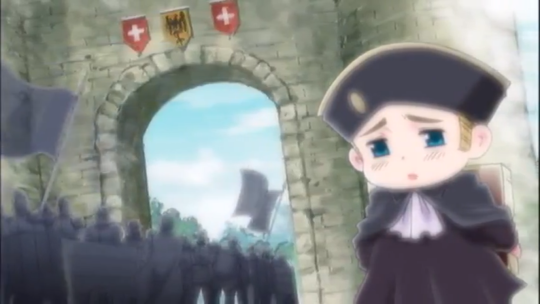
So, first of all, Holy Roman Empire and Germany are really different as ‘countries’. Germany is an unified state despite all differences, Holy Roman Empire was more a pact between german states that never sticked and while originally it included a lot of other countries they started falling apart with time. Poor Holy Roman Empire started dying around 1500 and from the way he acted when he said goodbye to Italy I think he was pretty aware of his impending dissolution.
And another thing I suspect, due to the strip in which we see the german states fighting is that he made it back, to some degree, but he avoided Italy or decided to stay in a completely different place: the HRE Hungary is holding up is the teen we see later in the comigs where Prussia reads him the Grimm comics, not the super small child he was earlier.
I know this doesn’t add much to my Hre=/=Germany discussion but I still feel like pointing it out. Anyway, going back to the main topic: while they share a lot of territory, Holy Roman Empire had more than Germany inside him- like Austria, Switzerland, the whole Czech Republic and ridicolous amounts of the Netherlands, Italy and Belgium. Germany is just… Germany. And it’s compact and strong. They share the same territories, yes, but they’re different things.
Now, let’s alk about the points I see around the most:
But Germany and HRE look exactly like each other!
Who else also look really similar, used to share the same territories, have ridicolous similarities and have common history, traditions and culture? The Italian brothers and their grandfather, especially Romano and his grandfather as seen here (A post from @grandparomeaskblog / @mezzogiornovargas.). Even Prussia and Germany are shown to have strong similarities in some strips so I wouldn’t really base myself on how someone looks like considering family members can look alike on occasion.
Also, I DO admit there’s an high chance the empty shell of HRE was used as empty body for Germany but that doesn’t make them the ‘same’ person.
Thanks go to @ask-useless-german for basically being my german history teacher.
Germany is Holy Roman Empire, he just lost his memories.
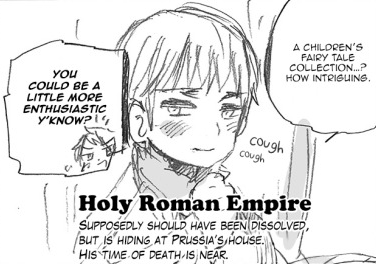
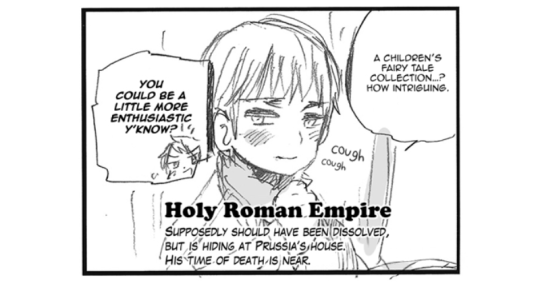
I could buy this if we didn’t have two specific things.This strip in which it’s clearly said the time of his death is close, which implies that he will die soon, he’s not just going to be sick for a while and then return full force-
And the one where they say Germany “already had an exising body” when he was born. I does imply that Holy’s body was recycled but we’re clearly talking about one being dead and the other being born. If anyting it feels like Germany is the legacy of HRE and the one who succeeded where the other failed.
Obligatory Gerita comment here
Feliciano remembers Holy Roman Empire and he still seems to feel something for him as seen in the famous Valentine episode. The only time he blushes is when he mentions his first love was a boy and he has a somehow melancholic face while talking about it.
Italy didn’t forget his first love and he seems to actively ignore when other countries flirt with him (he’s seen being nice to liechtenstein and other girls, sure, but he only flirts with human ladies.). So far we’ve seen him turn down Spain, Prussia’s advance and even Germany’s (the episode ends with Himaruya stating ‘it took them a week to fix the misunderstanding meaning they probably had a good talk about what happened and agreed to be just friends since we don’t see them in any kind of relationship in modern times, if anything it’s Germany who’s still slightly crushing on him), but we do see him blush mentioning Holy- it does feel like he’s still trying to move on. I think that if Holy Roman Empire was Germany Italy would be the first one to notice.
On a more historical note: Italy and Prussia were extremely close during that century so I find relatively strange how Feliciano apparently ‘never met’ Germany during his youth and they only started interacting round WWI- I mean, they’re still countries, they’re supposed to interact and Feliciano had a great relationship with Prussia. I do wonder if he knew Holy’s body had been ‘used’ and that’s why he tried to postpone their meeting as far as he could. Buuuuut that’s just me fangirling. And while I don’t really ship Ludwig with Feliciano IF it’s going to happen I’d rather see Feliciano fall in love with Germany because it’s Germany, not because “oh, look, it’s my long lost love I guess I should be with him”)
This is literally touching the tip of an iceberg since I have a lot of things to add but they’re mostly based on Feliciano’s interactions with Germany, how we italians were hisorically tied to Austria and HRE and this post is probably already a bit too long? I’m sorry if it’s a bit messy, I still struggle a bit with the language and I’m not used to write this kind of things either but this is a very short version of why I tend to consider Germany and HRE two separate entities.
In any case I’d love to discuss more with you.That being said I’m more than open for debate since as far as we go the whole thing is still a big question mark! 😀
Re: Germany is Holy Rome
Note: Germany = Holy Rome isn’t confirmed in canon. I’m merely presenting evidence in support of it.
Okay, before I start, I want
to mention that a lot of the points you brought up have already been explained
in the manga. That said, these rules do have a consistent logic to them. I
think what needs to be recognized here is that while Hetalia may be based on
history, it’s still fictional. What I mean by this is that you can’t apply
technical historical facts to explain a fictional occurrence, such as
reincarnation.
If the fictional rules are provided, then they should be adhered
to while also recognizing the wider backdrop of loose historical influence.
Different Territories, Different Personifications Argument:
The manga provides the
possibility for personifications to adopt new titles “names” and lands. So
while Holy Rome and Germany may differ geographically, it doesn’t negate the
fact that the nations’ borders and land space change all the time.
This
rule of adopting new names (titles) is established in chapter 1 of World Stars.
Likewise, Prussia has long
been established as a character whose geographical representation keeps changing.
He evolved from St. Mary’s Order, to the Teutonic Knights, and eventually to
Prussia. Presumably, he represents East Germany now
In sum, it is 100% canon for
the nations to have the land they represent change. As such, they can acquire
new names.
Memories:
You are correct in saying
that Germany and Holy Rome are not technically the same person, and yet they are. Germany is Holy Rome, except
he doesn’t possess the latter’s memories. That would explain why they have
personality differences.
Again, chapter 1 of World
Stars clearly states that nations can change their personalities out of
nowhere. Personalities are derived from lived experiences, which result in the
formation of memories. That’s why if someone lost previous memories, they would
be a completely different person; if they don’t retain these old experiences,
then it has no impact on who they are as a person.
I’ll get back to the evidence
of Germany’s amnesia in just a little bit.
Why Holy Rome Still Existed After Dissolution:
I’m dreadfully repeating
myself, but I have to refer to Chapter 1 of World Stars again. It states that
they can be called back by a sudden memory…
..but whose memory?
The first answer for this can
be found in “It’s a Treasure Box of Countries”, which outlines 2 outcomes that
can happen once a nation dies.
1) “If the culture of
the country’s personality dies/disappears, the country [personification] will
gradually disappear or entrust him/herself to the country [another
personification] that takes over him her.”
2)There are also cases that
him/her is not a country but continues to live leisurely as a representative of
the region.
Since this strip outlines
exactly what happens to a nation after their culture/personality dies, your
empty shell theory has no canon support.
Anyways, the first case
appears to explain why Holy Rome hasn’t died yet in chapter 187 of World Stars.
While he may have been dissolved, German culture and identity never waned.
It’s for this reason that the
vague statement of “his time of death is near” is used. At the time of the
strip, it was uncertain whether other national identities/ personalities would
eventually develop to replace Holy Rome.
On the same note, it’s human
belief in the nations that allow them to exist. Here, France lays out ground
rules regarding how a nation’s immortality is maintained.
1) They need a strong
and stable government (which Holy Rome didn’t have, admittedly)
2) A body of citizens (which Holy Rome had.
Regardless of how many individual states he consisted of, they were all united
by the German language).
Existing Holy Rome Body Theory + (non) Teenage Holy Rome:
With all that in mind, I
don’t think Holy Rome ever died if I’m to be perfectly honest. Here’s why.
First, the appearance of Holy
Rome in the 2011 Christmas Event strip does not appear to be a teenager at all.
Look at how small he is. Even when he’s in Hungary’s arms, he’s smaller than a
teenager. Popular opinion is what deemed him as a teenager here, nothing else.
Also consider how small Hungary is herself.
Like you said, the age
between the Holy Rome in the 2011 strip and the Holy Rome from chapter 187 is
consistent. The only difference in opinion that I have is that I see them both
as a middle point between childhood and adolescence, whereas you see them both as teenagers. I disagree.
Also notice how the Holy Rome
from chapter 187 appears to be the same age as the ‘just-born’ Germany from
chapter 12.
What’s more, they’re wearing
the same nightgown, aside from the obvious fact that all the other nations
first appeared in similar dress.
Germany is stated to be born
a few years older than the other nations because he already had an existing
body. But, what if we take that literally?
Holy Rome was on his deathbed
and was notably weak and ridden with illness. Nonetheless, we know from the
evidence listed above that it’s still possible for him to exist even after
dissolution given that people still believe and identify with him.
Now, tie that in with the
fact that nations can adopt new personalities and titles. If Holy Rome still
existed, only to become Germany, it’s very well possible that adopting a new
title caused him to lose all previous memories of being Holy Rome. A quick little
reminder again that your personality is very much driven by lived experience.
Evidence of Germany’s Amnesia:
There’s a ton of strips that
point towards this, but I’ll only cover the most obvious ones.
Right from birth, Prussia
takes to reminding Germany that it’s okay to refer to him as an older brother
close to five hundred times.
The excessiveness of this
makes it seem like Prussia is attempting to jog Germany’s memory, only to fail
in doing so.
There’s also some very old
and very strange strips which involve a child Holy Rome vying to be
acknowledged. Taken symbolically, this can be understood as Germany’s childhood
memories attempting to puncture through into his conscious mind.
Italy too has a childhood
version of himself pressing to be acknowledged, which could mean the same
thing. He could be choosing not to acknowledge that Germany is Holy Rome, but
still remembers him as seen in Buon San Valentino.
What else would Germany have
to acknowledge other than his own past? Not to mention that Prussia is known to
have lied to Germany about his past before.
Why else would he do that
other than to avoid having Germany remember the trauma Holy Rome experienced?
It’s a common psychological reaction to repress childhood memories that cause you to feel discomfort.
Or what about Germany’s first
interaction with Lithuania? This is supposed to be the first time they’re
meeting together, and yet Lithuania expresses relief at the fact that Germany
doesn’t remember him.
How could Germany remember
Lithuania if he hasn’t met him before? It doesn’t add up. What does add up is
if Germany doesn’t have access to the memories where he did meet Lithuania…as Holy
Rome.
Alternatively, you posed the
question about why Italy and Germany didn’t meet before WW1. It’s always possible
for bosses to meet with each other without needing the personifications
present.
The most obvious example that
Germany is suffering from amnesia is in Buon San Valentino. Repressed memories
resurface during times of stress and conflict. After getting embarrassed at
improperly proposing to Italy, notice how Germany freezes.
The scene then pans inwards,
delving into the flurry of confusing emotions he experiences. Why is it that
the strip ends with images of Chibitalia? Look at the fuzziness of them too.
Doesn’t it seem like Germany’s
only then starting to access Holy Rome’s memories, memories that had been
repressed into his unconscious mind?
Similarities among Germania, Holy Rome, and Germany:
I think another issue here is a
misinterpretation of the family tree. Holy Rome and Germany are both noted to
descend from Germania. The problem is that there’s inconsistencies regarding
their relation to him [Germania]. For example, both are referred to as sons of
Germania, while Holy Rome is once listed as Germania’s grandson.
What I’m here to debunk is “Germania and Germany look alike, which means that Holy Rome and
Germany can’t be connected.”
Germania hasn’t been reincarnated.
He’s been shown to exist separately in heaven, and even visits Earth with
Ancient Rome at one point.
Touching on the same topic, there’s a clear distinction
between being descended and related to a personification and being influenced
culturally and historically.
For example – Italy and Romano are related to and descend
from Ancient Rome, whereas while Romania may have been influenced by Ancient
Rome, he doesn’t descend from him.
Overall, there needs to be a balance between fiction and
history with Hetalia. If a fictional explanation is given, then history can
simply be used to complement, rather than override canon.
Considering how much evidence there is linking Holy Rome to
Germany (foreshadowing, themes, motifs, similar phrases of dialogue), I truly do
believe that they’re the same person. But, that’s just my opinion 🙂
Okay, so you know when
Holy Rome says farewell to Chibitalia and leaves to go to war?
“I’ll definitely come see you when the fight is over.”
Assuming that Holy
Rome was reincarnated into Germany, the fight never really ended.
Germany was literally
born into war, which could possibly explain why he didn’t meet (see) Italy until WW1. Remember that they didn’t purposefully cross paths then.
Likewise, in Buon San
Valentino (which takes place during WW2), Germany also makes a mention of his
war-torn upbringing.
I suspect that Hima
might use the above phrase and place a fun little spin on it. The wars are
over and Germany is united with Italy, but until Germany remembers his past,
Holy Rome’s promise won’t be fulfilled.
Germany needs to come
back to Italy as Holy Rome, with the latter’s memories intact, if he’s to truly see
and recognize Italy as Chibitalia.
Side note: “I’ll make
lots of sweets for your return.”
You know who else really likes his sweets? Germany. I mean… he has an entire
character song dedicated to baking a cake.
Chapter 1 of World Stars is crucial in establishing the
rules of nationhood.
The strip outlines how personifications can live for a few
days or several centuries, can disappear unexpectedly, can change their names
and personalities, and if they’ve died, a single person’s memory has the
potential to bring them back.
It would follow, then, that this strip also opens the
possibility for reincarnation/ resurrection.
Either way, sounds pretty simple, right?
That’s how it’s supposed to be.
What’s frustrating is that there’s a massive hint in this
strip that’s so simple, it’s pretty much gone unnoticed. Knowing Hima, he 100%
did this on purpose – just to troll with us.
The answer that, yes,
Germany is in fact Holy Rome has already been revealed, albeit not explicitly. At least, in my opinion.
Now, I want you to look at the first panel again. It says: “They
can live for a few days or for several centuries.”
Okay. Take note of how the being in this panel has an
inverse form.
The one who’s upright has a similar hairstyle to Holy Rome (and Germany). Still, we see Holy Rome with his hair down more.
Meanwhile, let’s flip this image.
Boom. It’s the military hat that gives Germany away.
There’s also the cloak worn by the being on top that could be a reference to Holy Rome.
Take what you want from this, but for Hima to possibly include Germany and Holy Rome
in a strip where they’re literally mirror images of each other pretty much confirms
to me that Germany was reincarnated from Holy Rome.
If that’s the case, then Holy Rome kept his promise and
eventually came back to Italy.
By now, you should realize how damn clever and intricate
Hima’s characterization is. It’s honestly mind blowing to me how chapters and
strips spaced out years apart from
each other are nonetheless effortlessly bridged together to form a logical connection.
On a similar note, you see a lot of similarities and
respective foreshadowing between Holy Rome and Germany. It’s uncanny how they
will say literally the exact same things, like a mimic or relic of the past in
Germany’s case.
As designated by the
title, this post will focus on how fairy tales are used to hint at Germany’s
infamously known, but unconfirmed connection to Holy Rome.
In chapter 187 of World Stars, we learn that Holy Rome hasn’t
died, even though he should have given that he’d already been dissolved at said
time. Still, his end is near as he lays on his death bed.
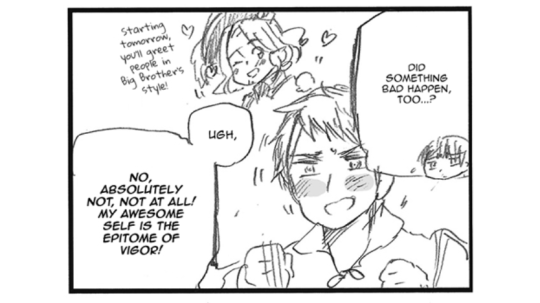
A “heartbroken” Prussia takes to
consoling Holy Rome by reading the latter Brothers Grimm fairy tales.
Notice how Prussia is not only grief-stricken,
but he’s also in partial denial. He refuses to accept that he’ll have to be a subordinate
to France and adopt French manners of propriety.
Meanwhile, even while on the verge of death, Holy Rome is
the more logical of the two. He has no problem in skeptically pointing out the
plot holes in the stories Prussia fabricates. (The original tales contained too
much eroticism, so Prussia had to take a bit a liberty when recounting them to
Holy Rome).
Regardless, what’s important to emphasize is the motif of
fairy tales – which will come up again later – as well as Holy Rome’s use of
concrete logic.
In Chapter 222 of World Stars, as Italy talks about feline
nonsense, Germany responds by saying: “Isn’t that a little too fairy tale like?”
I’m sorry, but I really do think that Hima did this on
purpose. Germany’s skepticism eerily echoes that of Holy Rome. Also, when have
you ever heard of a fairy tale that involves cats?
That one piece of
dialogue, trivial as it might seem on its own, serves as a key link to chapters
which would otherwise be completely unrelated.
I know this might sound like a radical thing to say, but
honestly, after reviewing the strips, there’s enough evidence that points
towards the fact that… yes, Holy Rome never truly
died.
Before I start, let’s just get a few disclaimers out of the
way. Otherwise, this theory won’t work.
There’s a deleted comic where France tells Italy that Holy Rome
is dead. Note the word deleted. As such, the strip should not be taken for
canon value.
Next, there’s also the fact that people have said that Holy Rome
is given a teenage appearance in one of the requests Hima completed for the Christmas
2011 event. If this were true, then there would be a notable inconsistency
regarding his other appearances.
However, to me, this hardly seems to be the case. Holy Rome
doesn’t look like a teenager at all here. He still very much looks like a
child, judging by his height and his size when Hungary carries him in her arms.
It’s important that I mention this, because Holy Rome’s appearance in the 2011
strip is consistent with his appearance in World Stars.
With that out of the way, let’s get to the good stuff. In
chapter 187 of World Stars, we find out that even though he’s been dissolved
and should have died already, Holy Rome is very much alive and is hiding away
in Prussia’s house. He’s still very sick though, as “death is near.”
Since Holy Rome’s so weak, a “heartbroken” Prussia reads him
fairytales, likely to distract the former from the fact that he’s dying.
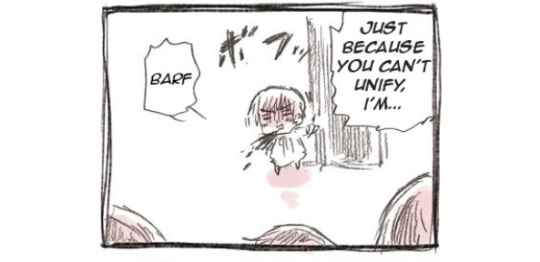
Moving forward a bit, we know that it was Prussia who led
the German Unification movement. He would have every reason to, as we’ve seen
from the Christmas strip how negatively a lack of unity among the German states
affected Holy Rome’s health.
If Holy Rome hadn’t died at this point, which I’m assuming
to be the case, then it would be in Prussia’s best interest to unify the states
and form a stronger country in order to save his younger brother.
This strip takes us to just before the unification process. Pay
attention to the language used by the German states here. “New Country” and “New
brother.”
It seems like they might not be aware of the fact that Holy
Rome is still alive. Being nations themselves, they would know that it’s
possible for personifications to adopt new titles. But, judging by the words
they use, they believe him to be dead. Because of this, the possibility of Holy
Rome adopting a new title wouldn’t have even crossed their minds.
It seems that only
Prussia knew about Holy Rome still being alive…whenever that strip took place
as it’s not entirely clear. (It’s sometime after the first publication of the Brothers Grimm Fairytales.)
Anyways, before the German Confederation is able to form, Austria, also
thinking that they’re about to form a new country, insists that he will be the one to raise the newborn Germany.
Yadda yadda, Prussia and Austria go to war, skip forward, and now we’re at
Germany’s actual birth (???).
This is so important and I cannot stress it enough. There’s
a massive difference in how the anime portrays Germany’s birth versus how the strips
do.
In the anime, it makes it seem like the German states huddle
together, only to have Germany emerge once they’re finished unifying.
The strips, which I’ll be using as the basis for this
theory, depicts an entirely different reality. When Germany’s born for real, it
doesn’t show the German states huddled together. Instead, it only shows a young
Germany being helped up and/or greeted.
He’s wearing a nightgown…exactly like the one Holy Rome was
wearing in chapter 187.
Yes, I’m aware that the nations are born in nightgowns,
but there’s multiple ways of interpreting this. The nightgown/birth motif is definitely
there, but…
Look at the one German nation holding Germany’s hand. He’s
crying. Now, put this into perspective. How would you feel if you thought your
little brother was dead, only to find out that he’s been alive all this time?
Maybe I’m biased, but Germany being helped up as well as
wearing the nightgown seems as if he’s standing for the first time after being
bed-ridden with illness for who knows how long. There’s also the fact that his
age is consistent with the Holy Romes from the Christmas event and chapter 187.
Which brings me to my next point. At the end of the chapter,
it states that Germany wasn’t born as a baby because he already had an existing
body.
We all know Hima and how much he loves to make puns. What if
“existing body” literally means an existing
body. Holy Rome adopted the title of the German Confederation and became a
stronger nation, but never actually died.
The German identity never died either, despite a lack of
formal unification. Maybe that’s why Holy Rome still managed to exist,
regardless of how physically weak he was.
The only setback to this is that there’s hints of Germany
(aka Holy Rome) suffering from amnesia. Remember that in World Stars, it’s been
made canon that it’s possible for the nations to acquire new personalities upon
changing what they personify.
Now, isn’t it weird that in the same strip where Germany’s
born, Prussia takes to reminding Germany that it’s okay to refer to him as an
older brother…482 times? It’s like Prussia’s attempting to trigger Germany’s
memory in the hopes of getting the latter to remember that he’s Holy Rome.
It would seem that on top of adopting a new title and
personality, it might be possible for the nations to also lose memories from
their past personifications.
It’s reincarnation, and yet it isn’t. I’m going to take the
liberty and coin it as “re-personification” from now on.
Note: This theory
makes the assumption that Germany was reincarnated from Holy Rome.
A lot of people seem to be confused about why it is that
Germany can be seemingly emotionless at times, or rather, too logical and
rational. This is especially true in Buon San Valentino, as Germany is noted to
experience emotions like shame, confusion, and heartbeat (presumably love) for the first time.
From the point of a psychoanalyst, however, they would understand
this perfectly, as Hima consistently adopts Freud’s ideas into his craft. It’s
not so much that Germany is emotionless; it’s more like he’s repressed traumatic
memories where these emotions have been experienced.
This puts the person in an emotionally-stunted and subdued
state. The emotions are subdued because experiencing them can trigger the
recollection of these traumatic memories.
Now, it’s not directly said that Freud’s ideas are used, but
both Germany and Austria have been shown to read psychology books. As the most
famous psychologist and being an Austrian himself, it wouldn’t be a farfetched
guess to assume that Germany and Austria have read some of Freud’s work.
Terminology I’ll go
over: Defense mechanisms, repression, the unconscious mind, catharsis.
Bear with me here. I’m slowly going to go through some
concepts before tying this all back to the strips.
For Freud, anxiety is something that we all experience the
moment you exit the womb. You’re in an unfamiliar environment, and anxiety is
there to warn you of impending danger. Basically, because it’s so uncomfortable
to experience, anxiety controls your behaviour by causing you to avoid
threatening environments or situations.
However, if it’s a certain reality you can’t cope with, a
person will employ defense mechanisms to
avoid confronting it.
Repression is one
of those mechanisms, whereby the person is either unable to reflect upon or
remember an event in their conscious mind. The memories are no longer accessible
to them, hence repression; the burying away of emotions.
The unconscious part
of our mind extends beyond our conscious awareness. It’s where all our
repressed memories, emotions, instincts, and biological urges are stored.
All right, not so bad I hope? Let’s tie this all together.
Holy Rome’s dissolution ended a brutal series of wars. That
said, if Germany is his reincarnate, wouldn’t it make sense to repress these
memories? How nice would it be
to be born, only to have a wave of pain and heartbreak immediately hit you?
It would be too hard for the recently-born nation to handle.
That’s why I believe Holy Rome’s memories were repressed before Germany was
even born. Again, it acted as a safe guard to protect him from the trauma Holy
Rome endured beforehand.
There’s even a small hint that Germany has amnesia and has
possibly repressed his memories. Once born, Prussia reminds Germany that it’s
okay to refer to him as a brother several hundred times. To me, that seems like
Prussia may be attempting to trigger Germany’s memory, only to realize that
Germany doesn’t remember anything from his past.
Last term, I promise.
The job of a psychoanalyst is to bring these unconscious
memories or thoughts to their patient’s conscious mind. In this case, it would
allow Germany to remember the past he’s repressed. The goal of psychotherapy is
to achieve catharsis – emotional relief.
When a patient goes through catharsis and their unconscious conflicts are
resolved, they’re able to healthily experience all emotions again.
As I’ve said before, patients who have repressed traumatic memories
to their unconscious minds are subdued emotionally. Because they are unable to
confront these emotions, they have trouble expressing them, or in the most
extreme cases, don’t express them at all.
You see this with Germany too. He’s emotionally-stunted, not
only from his past, but also as a result of his early life. He was immediately
thrust into wars and likely missed out on learning how to form healthy
relationships with the other nations.
For Freud, what you experience in childhood determines your
personality. So, basically, Germany not being good at socializing and
expressing his emotions is a product of his childhood. Now combine that with
repressed memories from a previous life and you have some serious emotional stunting
at play here.
Repeatedly throughout the series, he’s stated to have trouble
smiling.
Likewise, he also has a habit of improperly expressing his
emotions, coming off as angry and scary to other people.
In summary…
The reason Germany has trouble with his emotions is that he’s
likely repressing memories that prevent him from expressing these emotions
freely. If he does, then it puts him at risk of remembering the trauma from his
past. It’s not a conscious decision to not remember things either, it’s something
he can’t control.
In other words, Germany does experience emotions, but some
of them he may not experience fully or properly. He’s emotionally stuck from
this repression, and his troubled childhood only adds more fuel to the fire.
For Freud, if Germany wanted to be able to smile and express
his emotions more freely, then he would have to confront his past. Until Germany
goes through the emotional relief brought on by catharsis, then he won’t be
able to overcome the present hurdles he faces in forming healthy relationships
with the other nations.
“@ all your theories”
I honestly feel so attacked right now.
Note: This theory makes the assumption that Germany was reincarnated from Holy Rome.
Those who have read the strips will know that a recurring theme is Germany’s love for Italian culture and history; he thinks of the nation as a sort of paradise.
What strikes a chord with me is this specific panel. Here, Germany has a revelation while vacationing in Italy. Basically, because Italy is such a paradise, he understands why Goethe wrote so many poems about the nation.
All right. I’ll point out the obvious first before delving down into the deeper meanings of all this. Both Holy Rome and Germany have a profound love for the Italian nation, which most people see as a link between the two.
What I’ll be proposing is that this reference to Goethe hints at something extremely significant about Germany’s personality and characterization. It strongly alludes to his possible reincarnation from Holy Rome as well.
Goethe is most known for his play “Faust”, whereby the demon Mephistopheles makes a wager with God. Mephistopheles claims that he will be able to succeed in “luring” God’s favourite human, Faust, away from his pursuit of knowledge of all kinds.
What’s important here is that Faust outgrows scientific, religious, and humanitarian-philosophical teachings, choosing instead to learn magic as it will provide him with “infinite knowledge.”
Sound familiar? It should, because we know that Germany is obsessed with science and data.
He’s also quick to deny the existence of the supernatural because it’s unscientific.
However, there are strips that paint a different picture, one that shows that just like Faust moved from the scientific to that which is otherworldly, Germany is too. There are brief moments where he drops the scientific method and reveals that he may in fact be aware of the supernatural.
It’s possible in canon for deceased nations and humans to fly down from heaven and visit Earth. A human example would be Quintillus, an old Roman Emperor.
Previous to this strip, Germany was collecting ancient records of Rome, and Quintillus visits to give a more favourable account of his older brother, Gothicus, who isn’t depicted favorably in textbooks. Initially, Germany dismisses Quintillus as playing pretend and escorts him home.
What happens next is surprising. Germany privately refers to Quintillus as a “Roman boy”, which to me, seems as if he recognizes that it truly was a Roman Emperor who had just visited him.
Pay attention to the shifting of Germany’s mentality; it doesn’t seem like science is upheld within him as strongly as it used to be.
Perhaps the most important instance of this is when Ancient Rome visits Germany. At first, Germany believes this visit to be a strange dream, but soon falls into the swing of things and starts asking questions.
This question in particular is critical.
Again, notice how uncomfortable Germany looks when he asks this. Disappearing, huh? Could this possibly be a reference to Holy Rome and his newest incarnate, ahem, himself? Just think about it: reincarnation is a supernatural and seemingly magical occurrence…
It’s one thing if Germany merely asked about why and how a nation dies, but the discomfort on his face is likely an indicator of a painful memory.
This isn’t that far of a stretch either. Remember that in Buon San Valentino, after embarrassing himself by clumsily proposing to Italy, Germany panics and blacks out.
It’s precisely when people are distressed that repressed memories resurface according to Freudian psychology, and that’s exactly what seems to be the case here. The strip ends with fuzzy memories of Chibitalia.
It appears that Germany’s belief in science is waning. Either that, or he’s resorted to using science as an explanation to deny the reality of his reincarnation.














 Ellawritesficssometimes
