
Note: This post
is making the assumption that Germany was reincarnated from Holy Rome. The rest
is all canon material.
All right! In canon, we know that reincarnation is possible.
The most obvious example would be Jeanne d’Arc and her American reincarnation,
Lisa.

What people often forget is that Hima explicitly states that
it’s possible for the nations to be reincarnated too.
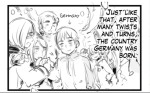
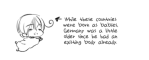
In these panels, Hima makes it clear for us what a nation’s
existence and lifespan is like. They can last for really short or really long
periods of time and can be brought back by a sudden memory. More importantly, is
that nations can change their titles and ultimately, their personalities.

Following this logic, this would explain why Holy Rome and
Germany share some personality differences.
Where Germany is more clear-headed, rational,
and organized, Holy Rome is emotional and sensitive, irrational, impulsive, and
disorganized. I think Hima does this on purpose as a pun to contrast how at
first, Holy Rome was a disorganized collection of nation-states and then became more organized after unification and the subsequent formation of Germany.

Just to highlight this, I’ll go over some quick examples. We
see some of Holy Rome’s impulsiveness not only with his obsession and
compulsion in getting Chibitalia to live in his house, but also in his
interactions with other countries.
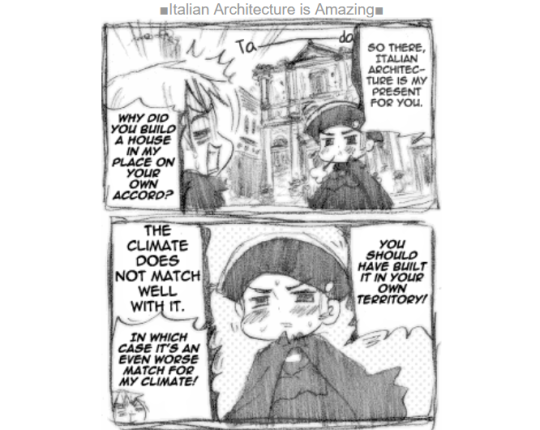
What immediately comes to mind for me is how Holy Rome built
an Italian home in England, without even considering how the architecture
wasn’t designed to endure the harsher English climate.
It would be unprecedented for Germany to pull off something
like that, as he’s always rationalizing and thinking things through enough
times to drive anyone crazy.
You see the organization pun come to life with Germany’s
love for schedules, manuals, and the scientific method. Overall, he’s a much
deeper and rational thinker than Holy Rome.

Further, with unity, comes a stronger sense of national
duty.
On the other hand, due to the fragmentation in his empire,
Holy Rome doesn’t seem to care what happens to it and is more focused on
chasing after Italy. He’s even scolded for neglecting his duties by
Switzerland. Tell me, have you ever seen Germany slack off?

That said, there are more similarities between them than
differences, and Hima sure loves to stress this all throughout the series. They
both share a love for the Italian culture and climate, are flustered easily,
love sweets, own dogs, have Prussia as on older brother, and…
there’s also the obvious fact that they look exactly alike.




























 Ellawritesficssometimes