image
image

What this post aims to do is cover Japan’s relationship with
other Asian nations. While a tricky subject for good historical reasons, I
think that while he initially had a rough start, Himaruya does a fair job of
balancing a narrative that promotes worldwide peace and reconciliation without
trivializing or obscuring the tragedies of the past.

By that, I mean that while there are many unresolved
historical issues between Japan and other Asian nations, Himaruya is still able
to have the respective personifications get along amicably. They’re not
portrayed as close personally, but they are nonetheless civil and friendly. To
portray them in the former fashion would be insulting, especially given how there
are still tensions regarding how these unresolved historical issues are to be
properly compensated for and addressed. 

Nonetheless, Himaruya is able to work
around this and the narrative of world peace by portraying them as being civil
with each other. He even offers several instances where Japan expresses regret
for his past actions—albeit implicitly.

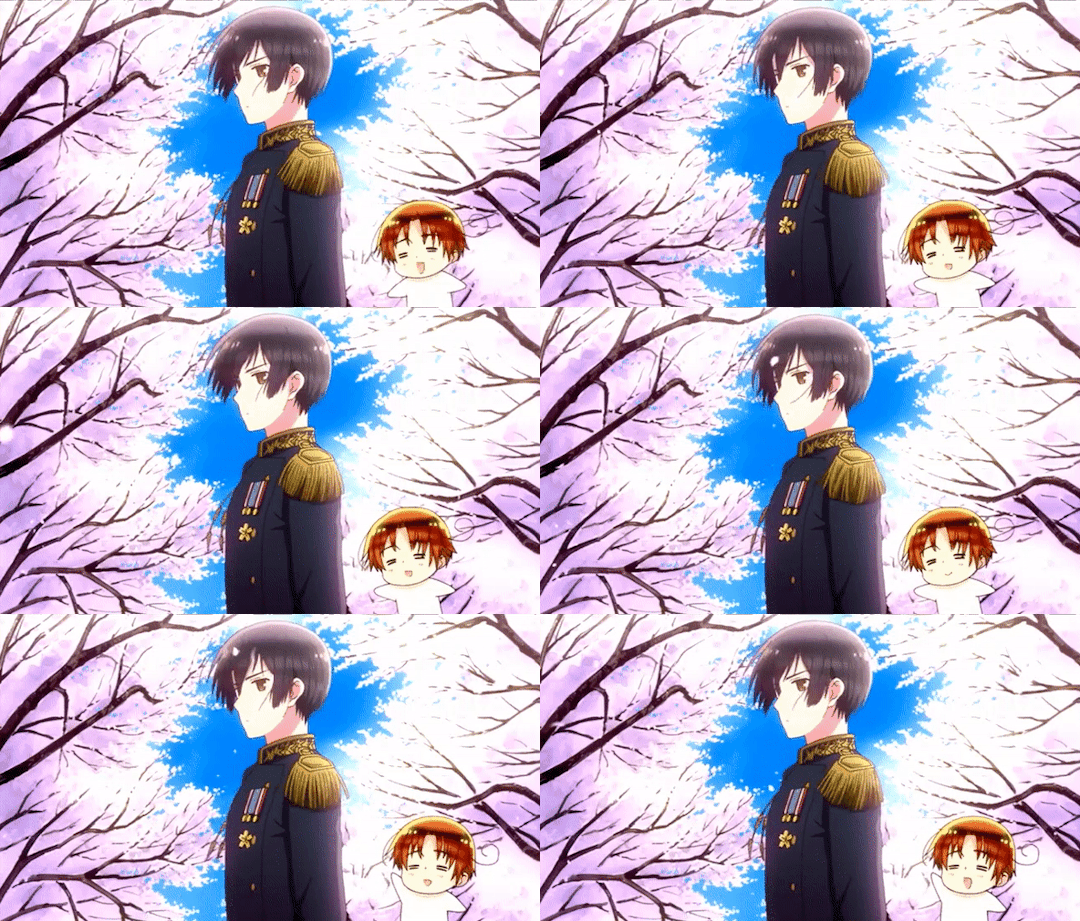
There’s this panel, which alludes to his desire to make
peace in East Asia and achieve reconciliation. I’ve done a longer post on this
here [x], and there’s also a scholarly article that covers the meaning behind this
specific panel in much more detail. Point is, Hetalia doesn’t trivialize or
obscure these dark historical realities but rather it offers hope for the
potential of reconciliation and co-operation as well as the capacity to
overcome grudges.

Article:

Sands, A. T. (2013). Belittling japanese nationalism in hetalia: axis powers. Humanities and Social Sciences Review, 2(3), 125-144.


Source
: Volume 3. 

That said, let’s go over some examples:

China:

There’s the infamous scene where China is betrayed by Japan
during WW2. What I want to place particular stress on is how Japan disconnects
from the situation emotionally—notice how blank his expression is—and asks
China to forgive him.

Source: Hetarchive, The Story about the Early Days of China and Japan.

image
image
image

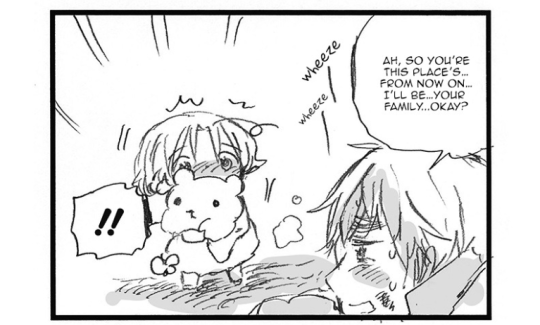
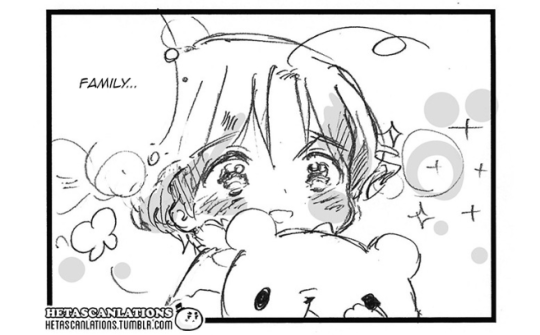
Chafed and devastated, as he raised Japan and considered him
to be a younger brother, China fears that war has changed Japan and that the
two will never reconnect. Russia reassures him that time will heal their wounds…and
they do.

Source: Hetarchive, The Story about the Early Days of China and Japan.

image
image

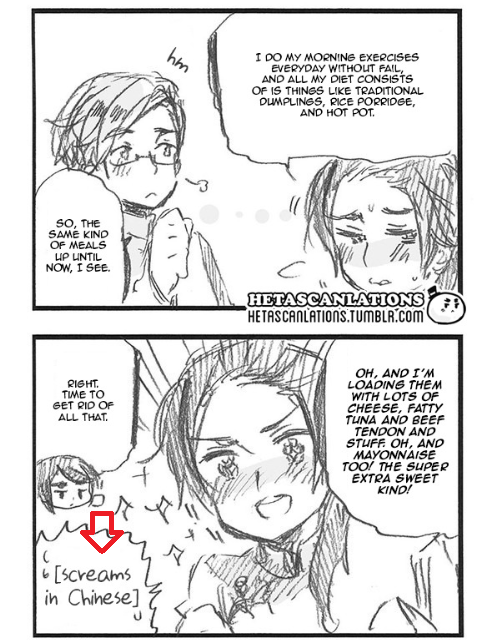
It takes a long time, but the two do in fact reconnect. China’s
character song, “Aiyaa 4000 years” expresses China’s longing to look under the
same moon as Japan again (i.e., to reconnect.) China’s signature verbal tick—aru—is scattered throughout the whole song; it’s not until World Stars that
we learn that his aru is symbolic of his hopes, dreams, and romance.

Source: Hetascanlations, World Stars Chapter 43. 

image

In the same World Stars Chapter, we see the two of them
working on improving their diplomatic relations.

image

Another example of their co-operation would be them
designing postcards together.

Source: Hetarchive (Bamboo Thicket, eng trans., Oct 26th, 2011). 

image
image

Again, they may not be as close as they used to be, but they’re
nonetheless on relatively good terms with each other.

image

South Korea:

As mentioned, Himaruya had a rocky start and many lessons to
learn after his characterization of South Korea received a lot of [warranted]
flack.

South Korea claims to hate Japan and will disagree with
anything he says at world meetings, yet he also seems to aspire for Japan’s
approval by mimicking him and showing the latter his creations.

Source: Hetarchive, It’s My First Appearance and All I Get Are Some Scribbles!  + Hetarchive,  Opening of the Meeting at the Center of the World

image
image
image

Unfortunately, that’s the brink of their relationship, since
South Korea’s poorly chosen perverted tendencies have caused Himaruya to
ultimately abandon using the character. Because of this, I can’t comment on any
progression in their relationship. The point I want to emphasize is that they
don’t outright hate each other. Although, South Korea’s grudge is certainly
present in what little interactions that we have.

Taiwan:

Taiwan is the Asian nation whom Japan probably shares the
closest relationship with.

From the inception and early sketches of the series, she is
seen defending Japan, telling China to back off from him.

Source: Hetarchive, Taiwan’s Web Profile.

image

In the present, the two also get along just as well.

Taiwan is very friendly with him.

Ex: She tells his fortune for fun.

Source: Volume 4, Ilha Formosa ~Beautiful Island~

image
image

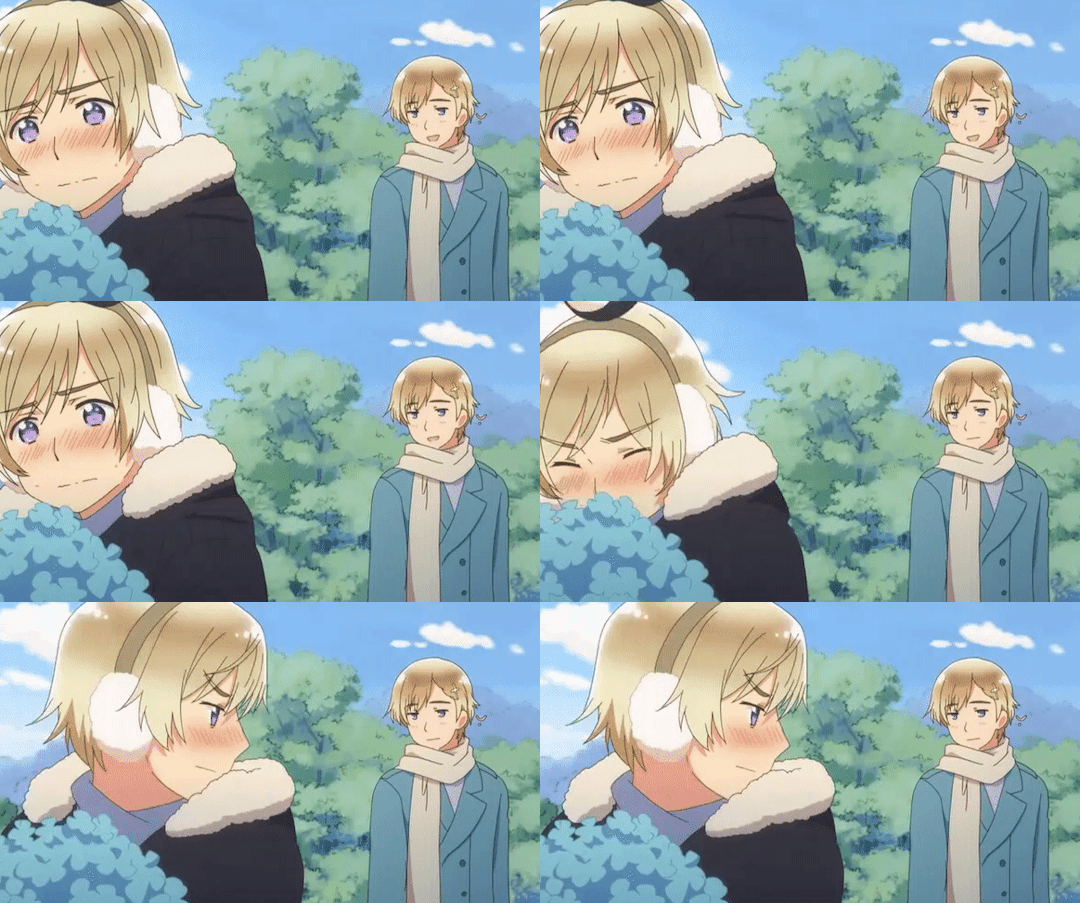
Ex: She gives him chocolates for Valentine’s day. It’s
hinted that she may even have romantic feelings for him, judging by France and
Italy’s suggestive expressions.

Source: Hetascanlations, World Stars Chapter 42. 

image

Hong Kong:

This relationship is more indirect, but it still tells a
lot. Hong Kong considers China to be his teacher, as they currently reside
together. The fact that Hong Kong finds it suitable and acceptable to ask Japan
for favors is indicative of China having no problem with them interacting.
Although, it is humorous that Hong Kong turns to Japan rather than relying on China to
help purify the air in his country.

Source: Volume 6. 

image

All in all, it’s not so much that Hetalia leaves tragedies
of the past unacknowledged. It’s satirical genre in tandem to its promotion of
world peace limits what it can cover and what stories it can tell. On the other
hand, it doesn’t trivialize or erase these tragedies either. Instead, while
seemingly simple, it’s able to promote narratives of co-operation and civility
in spite of past and current political tensions.

image
image
image

Misconception: She’s weak and unassertive

Reality: Even though we don’t get much canon material of her, her
character notes state otherwise.

Those who wish to
accurately depict her should take note of the fact that she’s described as a
smart girl with a strong mind—I’ll get more into that in a little bit.

Source: Volume 2.

image
image

Ex: There’s an old
sketch where she stands up to China and tells him to back off from Japan. The
panel seems to take place in the period where China still held a wartime grudge
against Japan.

Source: Hetarchive, Taiwan’s profile.

image

Ex: Her appropriate
reaction to Italy requesting to place his head on her chest. Please note that
this took place during the Chest Test series, where Italy places his head on the
chests of all complying nations. The intentions weren’t perverted in nature…it’s
more reminiscent of Goldilocks and the Three Bears.

Source: Hetarchive (Bamboo Thicket, eng trans., Nov 8th, 2013).

image

Misconception: She doesn’t get along with other Asian nations and is
reclusive.

Reality: She’s on very friendly terms with other Asian nations.

I know that her
history is complicated, but it’s also important to recognize that Hetalia is a
series that promotes worldwide peace and solidarity.

While it does avoid certain topics—as necessitated
by its comedic and satirical genre—that doesn’t mean they’re trivialized. The
series has shown that in spite of experiencing rocky political relationships,
the personifications are nonetheless able to maintain a personal life separate from
it.

Ex: In the present, Taiwan
is a regular visitor of China’s home.

Source: Volume 4, Ilha Formosa ~Beautiful Island~ + Volume 5.

image
image

Ex: She’s on good
terms with Hong Kong. He visits her, and she visits him. 

Source: Hetarchive (Bamboo Thicket, Nov 25th, 2013).

image
image

Besides that, she’s
particularly close with Vietnam.

Ex: She chooses
Vietnam’s Halloween outfit, much to the latter’s dismay.

Source: Hetarchive, Halloween 2013-2014 Event.

image

Ex: She convinced
Vietnam to take a photo with her. The significance of the moment rests with the
fact that Vietnam is insecure about her inability to smile.

Source: Volume 4, 

Ilha Formosa ~Beautiful Island~.

image
image

Misconception: She’s
a flat character with no personality.

Reality: She could definitely
use more development, but she still has unique attributes.

While Taiwan’s
character is due for some fleshing out, as is the case with most female nations
[unfortunately], the facts that we do receive about her are enough to work with. The
information is all there; you just have to look for it.

Ex: She’s a skilled
businesswoman.

Source: Hetarchive, Halloween 2013-2014 Event.

image

Ex: She likes
fortune-telling.

image

Source: Hetscanlations, World Stars Chapter 239.

Ex: She’s a good cook
and likes fashion.

Source: Volume 5. 

image

Bonus facts:

Strips suggest that
Taiwan may be attracted to both men and women.

i.e., she gives
Valentine’s Chocolates to Japan (France and Italy’s suggestive looks are
important) + she purposefully convinces Vietnam to wear a tight Halloween
costume and oggles at Belarus and Ukraine.

Source: Hetascanlations, World Stars Chapter 42 + Hetarchive, Halloween 2013-2014 Event.

image

She’s a bird
lover. 

Source: Volume 5 + Hetarchive (Bamboo Thicket, eng trans., Jan 22nd 2011).

image
image

She’s an avid fan of
anime.

image
image
image

The purpose of this post is to delineate the fact that
nations that have cultural influences on each other are not biologically
related. While the influencee may adopt traits from the influencer in some
cases, it doesn’t always constitute a biological relation. What’s even more
confusing is that there are specific adopted traits that the nations use to
mark a biological relation.

I know this sounds obscure, but it’ll make sense when I go
through some examples.

Romania and Bulgaria
vs Romano and Veneziano:

A gag with Romania in the series is that he claims that he’s
a descendant of Rome, and, therefore, an Italy brother.

However, even though Rome did, in fact, instill significant
cultural influence in Romania, Romano is quick to reject this claim. He
identifies the presence of a curl as proof of biological lineage from Rome.
Remember that Rome is said to have had many grandchildren and adopted
grandchildren.

Source: Hetascanlations, World Stars Chapter 163 + Hetarchive (Bamboo Thicket, eng trans., October 30th, 2014).

image
image

Later, we see the same rejection occur with Bulgaria, who
has Roman ruins.

Source: Hetarchive (Bamboo Thicket, eng trans., Oct 22nd, 2014).

image
image

England, America,
Finland, and France: (+ more)

As I’ve stated before, England and America are not
biologically related. England is stated to be the fourth and youngest sibling
in his family, consisting of Wales, Northern Ireland, and Scotland.

Source: Hetarchive (Bamboo Thicket, eng trans., Aug 4th 2010).

In the Battle for America, it’s explicitly stated that
England becomes America’s brother. We also learn that because America was a
“melting pot” of several cultures at the time, he inherited certain physical
traits from his colonizers.

Source: Hetarchive, The Battle of America.

image

For example, in the trio’s feud to make America their little
brother, Finland notices that America looks like him.

image
image

The distinction between cultural influence and blood
relation is necessary otherwise it would lead to a slippery slope where all
nations are related to each other. So, unless explicitly confirmed by Himaruya,
nations aren’t related to each other regardless of their histories. Arbitrary
as the biological relations may be, you work with what’s given to you.

Lastly, I’ve seen people comment that there’s a confirmed
biological relation between America and Finland. That’s not the case. Finland says that America has some genes from his people. Remember that America emerged as a personification representing several cultures. The genes are the traits, but because America has so many cultural influences, they don’t consider each other to be blood-related.

The fact that America didn’t identify with Finland as a
family member in the first place is telling of this cultural influence, as well
as the fact that Finland offers to become a father figure for America, who in
the context of the strip had been feeling jealous of kids who get presents from their fathers on Christmas.

Source: Hetarchive, Christmas 2010 Event.

image

France and Canada:

Similar to the situation with England and America, Canada
inherits France’s hair.

Source: Hetascanlations, World Stars Chapter 192.  

image

France, America, Canada, and Seychelles vs England, Hong
Kong, India, Australia, New Zealand, Hutt River, Sealand, and Wy:

We learn that France’s cultural influence is a dominant trait
that prevents America, Canada, and Seychelles from inheriting England’s bushy
brows. Although, interestingly enough, Seychelles had initially been designed
to have one thick eyebrow and one bushy one to represent English and French influence.

Source: Hetarchive, Seychelles profile.

image

Meanwhile, without French influence, Hong Kong, Australia,
New Zealand, Hutt River, Sealand, & Wy inherited the bushy brows.

Source: Hetarchive (Bamboo Thicket, eng trans.,Nov 12th 2013) + Hetascanlations, World Stars Chapter 269.

image
image

Of most importance and what I can’t stress enough is the
example of Hong Kong. It proves, with the most clarity, that cultural influence
does not have a causal relationship with biological relation.

After becoming English territory, Hong Kong’s eyebrows grow
bushy from the resulting English influence on his culture.

Source: Volume 6, A wise man has no specialty.

image
image

It’s said that England put a curse on him to have his eyebrows become so thick, but you also have to remember that England’s eyebrows themselves are cursed. The implications would be that his influence caused the curse to pass on.

Source: Volume 5, Special Booklet.

image

Point is, as far as Himaruya’s concerned with his
characterizations:

Cultural influence ≠ biological relation.

image
image
image

Note: This is a
guide. It’s not meant to cover an exhaustive list of all relevant examples in the manga. If I did that, this post could
easily be a novel.

Before I get into the direct blood relations of the
characters, this guide aims to chart out and differentiate between the different
types of relationships that we see in the manga.

Biological: 

Biological siblings, obviously, means that the nations in question
are blood-related.

Ex: America and Canada.

image

Ex: Greece and Egypt and their moms, Ancient Greece and
Ancient Egypt.

image
image

The best example of a biological relation is that of Norway and
Iceland’s.

Iceland had no native people. Since it was Norwegians alone
who first settled on the island, the two are directly related [x].

Iceland innately senses Norway when he’s first born. 

Norway
also senses Iceland.

image
image
image

Likewise, DNA testing – in this case, a land excavation – is
done to confirm their biological relation.

image
image
image

Now, let’s do a comparison.

When America’s born, he doesn’t sense a biological brother
among the countries colonizing him. The reason for this is that he’s referred
to as an ingredient, meaning that not only were there native tribes living on
the land he represented but that America existed as a mix of several European
cultures [x].

The point to differentiate here is that America doesn’t have
a direct biological relation to these colonizing countries due to the large
volume of them.

Instead, what you’ll see is that the colonizing countries
fight over assuming the role/ title of being America’s big brother, or
onii-chan.

Onii-chan:

Continuing from America’s example, after he chooses England
over France, he asks England if he can refer to him as onii-chan – ‘Big Brother.’

As stated in the translator’s note, onii-chan can be used as
an expression of adoration and endearment. Put another way, ‘big brother’ here
has an entirely different cultural connotation. It’s a brother-figure relationship
and isn’t meant to be taken literally.

image
image

Not to mention the fact that England initially rejects the
label of onii-chan, claiming that “just ‘England’ is fine.’” The reason England
is hesitant to accept the label stems from the horrible relationship he has
with his own older brothers.

image
image

France is another example where the term Big Brother is used affectionately.

Ex: He claims to be the Big Brother of the world.

image

Ex: He’s described as a Big Brother-type.

image

Ex: The first thing that he does when he meets Lisa, Jeanne
d’Arc’s reincarnate, is introduce himself as Big Brother.

image

Ex: The reason that Italy refers to France as Big Brother is simply because they grew up in Rome’s house together for some time.

image
image

This title of endearment is confirmed in one of Hima’s blog
posts, where he clarifies that Italy and Monaco both call – as in refer – to France as Big Brother [x].

More examples of France’s use of the title ‘Big Brother’ can
be found here [x].

One last example of this is that of Netherlands, Belgium,
and Luxembourg.

Netherlands and Belgium are biological siblings. Meanwhile,
Luxembourg refers to Netherlands, France, Spain, and Belgium as Big Brother and Big Sister respectively [x]

While the translation is noted to be rough, the distinction
is nonetheless made very clear.

image

Marriage: 

A full post on this can be found here [x].

All that needs to be known is that when two nations
willingly unite – not to be confused with being conquered/ annexed – the personifications
involved are considered to be married.

Austria is notorious for this, being noted to have solved
all his problems in the past through marriage (e.g., the Austro-Swiss
partnership, The Hapsburg Monarchy, the Austro-Hungarian Empire).

image

Ancestors:

In the manga, sharing similar ancestors doesn’t make the
nations involved biologically related. In this case, I’m talking about cultural
influence.

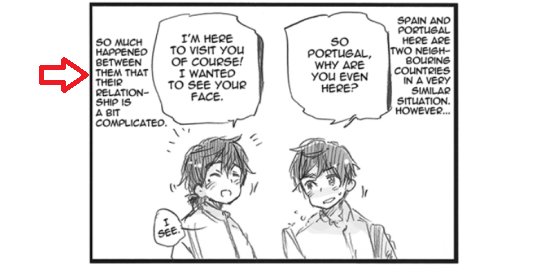
Ex: Spain and Portugal. (Chapters 77-79 of World Stars). 

Both are noted to share a similar ancestry. As such,
Seychelles can’t tell which one is Portugal when she has a letter to deliver to
him.

image
image

Given the context in which the topic of their physical resemblance and relationship is discussed, if they were siblings, France would have attributed the reason for their likeness to this. He doesn’t. 

Not once is a relation ever confirmed except for the fact that they’re neighbors.

Point is, it’s the similar ancestry that causes them to look alike.

image

                                                              +

image

                                                              +

image

Ex: Romania and the Italy Brothers [x]. 

While Romania may have inherited much of Rome’s culture, he’s
not related to the Italy brothers.

image
image
image

This brings me to my next point.

Influence: 

While cultural influence often affects the physical
and personality traits of nations, it doesn’t make them biologically related.

Ex: Seychelles was originally designed to have one thick
eyebrow and one thin one to represent French and English influence.

image

Ex: As an amalgamation of several cultures, America
resembles bits of Finland, France, and England. 

image

Ex: France’s influence prevents America, Canada, and
Seychelles from inheriting England’s bushy eyebrows [x]

image

Ex: Young Canada inherits France’s hair due to his
influence. This is before England had assumed control over him.

image

The House System: 

When a country is conquered and their conqueror is on the
same continent, the conquered personification lives with the conquering personification.

Ex: France, Holy Rome, and Chibitalia living in Rome’s house (panel used above).

Ex: Chibitalia and Hungary living in Holy Rome’s house. Despite the rough start, they become so close that they refer to each other as family. 

image
image

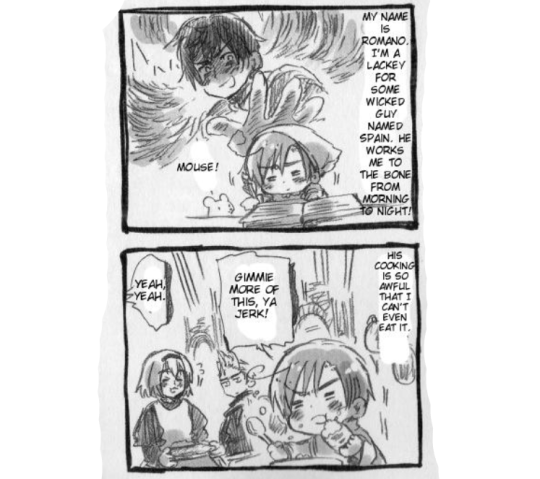
Ex: Romano, Netherlands, and Belgium living in Spain’s house.

image

In modern times, we still see this occur, albeit it’s a bit
different.

The Chinese provinces +
Macau and Hong Kong (under a one country two systems principle) all
live in China’s household.

image
image
image

The Colony/ Household System:

*Note – I made up the labels of house and household system
to better clarify and more easily distinguish between the two different living circumstances.
In canon, ‘House’ and ‘Household’ are terms used loosely and interchangeably in the translations.

The household system is separate from the house system in
that because the colonies are on separate continents, they’re part of a
household. In other words, they’re together and considered to be a unit despite
not living with the ruling nation.

Ex: England visits America, but America doesn’t live with
him in England.

image

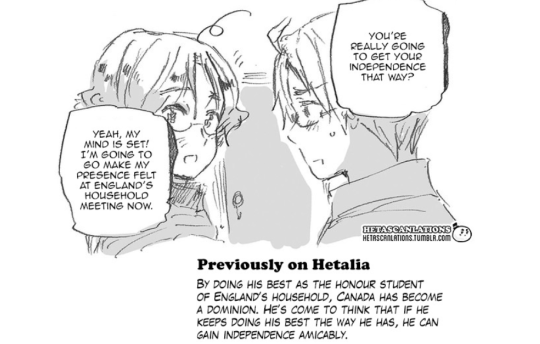
Ex: England hosts a household meeting, requiring the colonies to travel [x]. (America is already independent here, by the way. He’s not part of the household.)

image

Ex: Likewise, England has holiday houses in Hong Kong and
India, as alluded to in one of his character songs [x]. 

Curry, Chinese cuisine, my holiday houses’ meals.

Ex: Hong Kong, who used to live with China and referred to him
in a more intimate way [x], changed after he became an English colony.

When he becomes Chinese territory again, he refers to China
as teacher/ Mr., seeing him more as a mentor.

image
image

What I want to stress here is how fluid interpersonal relationships
between nations are in Hetalia. They’ve lived for centuries; how they view and
interact with each other changes with time. Their relationships – aside from
biological relations – aren’t as static as human patterns of organization.

image
image
image

Before I go through case examples, I want to go over some
important ground rules pertaining to the subject of economics and how nations are
affected by it.

1) When a personification has a cold or is
physically unwell, they’re having problems with their politics and/or are
experiencing a recession.

image
image

2) An economic recession will impact a nation’s
health differentially depending on their economic standing.

Ex: During the
Great Depression, some nations were more affected than others, as designated by
greater negative signs.

image

3) If the nation itself is poor, so will the
respective personification.

image
image

With all that in mind, just like political independence and
a stable, functioning government, the strength of a nation’s economy is an
equally important factor in influencing the personification’s age. The best way
I can explain this process is that a nation’s age is a result of an amalgamation
of factors.

Some personifications will go through a gigantic growth spurt
in reaction to their country’s own surge in economic prosperity. 

Other
personifications, while lacking official political recognition, are able to age
upon achieving and maintaining economic prosperity through high GDPs.

Lastly,
there are officially recognized nations who remain young as a result of poor and
inconsistent economic growth.

America: 

Of course, I’ll start with the most obvious and well-known
example. America grew up quickly in tandem to his growing economy, despite lacking
independence from England.

“Because he was relatively tolerant of religion forms, America became a melting pot for various cultures, arts and crafts. Soon, he began to grow an industrial prowess and rivaled England himself.”

image

Meanwhile, Canada, who didn’t possess the same
economic strength, aged at a much slower rate than America.

image

The point to differentiate between the two brothers is the
impact that their economies had on their biological ages.

Chinese Autonomous Territories: Macau and Hong Kong 

While they are presently considered to be autonomous territories under a one country-two systems mode of governance and therefore lack full
recognition as nations in themselves, Macau and Hong Kong’s strong industrial
economies allowed for them both to age. 

This lack of official autonomy is depicted by both of them
living in China’s household.

image

Macau: 

Macau was originally Portugal’s underling. He was East Asia’s
centralized and most successful trading port before being superseded by a
younger Hong Kong. 

image

As such, despite being part of Portugal’s house, Macau’s
commercial success was enough to make him an adult.

image
image

That’s all we know, as he’s not given an exact canon age.
Now, he remains as an older brother figure in China’s house. Again, it’s his
economy that primarily contributed to his physical maturity.

Hong Kong:

Hong Kong was little when he became English territory. 

image

Becoming an economically-successful trading port is what contributed to his growth. 

image

However, because he’s not a nation-state in himself,
this would explain why he’s 16-17. If he did become a full-blown nation, the
consistency in this rule would likely have him age again.

Historically, Macau’s a lot older than Hong Kong – this might
offer a plausible explanation for their differences in age.

image

Taiwan:

This one’s a bit tricky and controversial given the testy
disputes regarding China’s claim of sovereignty over a self-governing Taiwan.
Nonetheless, there’s still an economic factor that accounts for the reason why
Taiwan is older in age [as opposed to a small child]. She’s also a strong
industrial power, despite not receiving international recognition.

image

On the other hand, Taiwan was officially recognized as China
in the UN before losing its seat in 1971. This also may have had an impact on
Taiwan’s age, although since none of this is presented in canon, all I can do
is speculate.

Latvia: 

Not only was Latvia historically repressed politically, but
his agricultural economy isn’t doing all that great today either. Both of these
factors account for his young age, regardless of how long he’s existed
chronologically.

image

Moldova:

As one of the poorest countries in Europe, it’s no wonder
that Moldova’s growth has been stunted.

image

In sum, while economic sufficiency and success is only one
of the factors that allow a personification to age, it’s influence has a strong impact.

image
image
image

Misconception: He’s
weak

Reality: Far from
it. The man’s been through a lot, emotionally especially.

Ex: During a heated
argument with America, he’s able to close the door on him. It’s hinted that
Canada may have super strength, but he dismisses this.

image
image

Ex: He’s more
than capable of standing up from himself if necessary. Even a pushover has their limits.

image

Admittedly, he does excuse a lot of Cuba’s hostile behaviour
towards him. It’s only because Cuba mistakes him as America, though.

image

Ex: Canada’s
emotional insecurity can easily be seen as a strength. It takes a lot out of a
person to remain so generous and friendly, despite being historically ignored and
neglected by those close to you.

image

Misconception: He
and America hate each other.

Reality: While
they may have had some extremely rough times together, they’ve done more than
enough to make up for this.

Covering the progress of their relationship in more detail
will require a whole series of posts, but these are the basics.

Despite growing up together, they argued a lot following
America’s independence. Britain acted as the most prominent wedge between them. For some time before, they also couldn’t see eye-to-eye due to profound age differences.

Canada held resentment towards America for being selfish,
reckless, and too imposing.

image

Ex: America
actually pushed for Canada to gain his independence. This didn’t occur until quite a while later, obviously.

image

Ex: When Canada
does get his independence, they reconcile for the better…after having another argument of course. Siblings will be siblings.

image
image

Although, as you’ll
see soon, they still argue over the same things. Canada’s main tooth to pick
with America is his egotism and boisterousness.

Ex: America knows
little about Canada’s pop culture, meanwhile Canada knows everything about his.

image

Nonetheless, the two are still extremely close…

Ex: America helps
Canada figure out his identity. Canada’s multiculturalism [in the strips only,
of course] is inspired by America’s own diversity of cultures and ethnicities.

image

As such, Canada suddenly finds South Korea and China staying
at his place. The East Coast of Canada, especially Vancouver, is where many
East Asians immigrate to.

image

Ex: America is
jealous of Canada’s natural ability to get along with everyone.

image

Ex: The two co-host an online cooking show together. Yes, it’s called “America’s Cooking Channel, but Canada is on there enough times to deserve the title of a co-host.

image

Misconception:
France is his father.

Reality: France temporarily
acted as a big brother figure to Canada before England took hold of his
jurisdiction. As such, this would explain why Canada inherited France’s hair. It’s
mere influence. They’re not blood-related.

image

We’ve already see with Hong Kong how one nation’s influence can impact the
physical/ personality traits of another.

Ex: England’s
influence on Hong Kong’s personality. England also cursed Hong Kong to have
thick eyebrows like him.

image
image

Ex: Seychelles was originally supposed to have one
thick eyebrow and one thin one to represent French and English influences on
her nation’s culture.

image
image

Misconception: Canada’s invisible for no reason.

Reality: There’s
a real historical reason for this. Being a dominion, Canada was often
overshadowed by Britain.

For instance, in WW1, other than the occasional Canadian Red
Ensign flag – which also had a Union Jack on it – Canadian troops fought under
the Union Jack. In return, Britain absorbed much of the credit for the feats
accomplished by Canadian soldiers.

Ex: America thinks that Canada hides in Britain’s shadow. He holds back from saying this out loud.

image

Later, Canada’s shown to recognize this on his own. 

image

Ex: Canada wanted
to sign a treaty with America, however he was too scared to talk to America
directly. He was worried that America wouldn’t be able to see him.

image
image

Bonus Facts:

He cried when Seychelles remembered him as being part of the
G8.

image

He served in the French army at Waterloo.

image

Maple syrup is his fuel.

image

He smoked marijuana.

image

He once yelled at America for three hours straight, pointing
out his faults. America cried afterwards. Predictably, this was quickly fixed with
a burger.

image
image

He aged at a much slower rate than America.

image
image