Me: *says something remotely political*
Internet:

Me: *says something remotely political*
Internet:
She was raised to be like a male by Magyar [x] and was surrounded by males as she matured. She had no females to compare her physiology to either. It was only until her physical differences (i.e., her breasts, strength, and stamina) become more noticeable that she recognized her sex.
(I’m less inclined to believe the whole difference in strength and stamina aspects, because it’s stereotypical, but that’s the logic used in the manga).


Sure, I love her too!
Characterization post on Hungary coming up tonight!


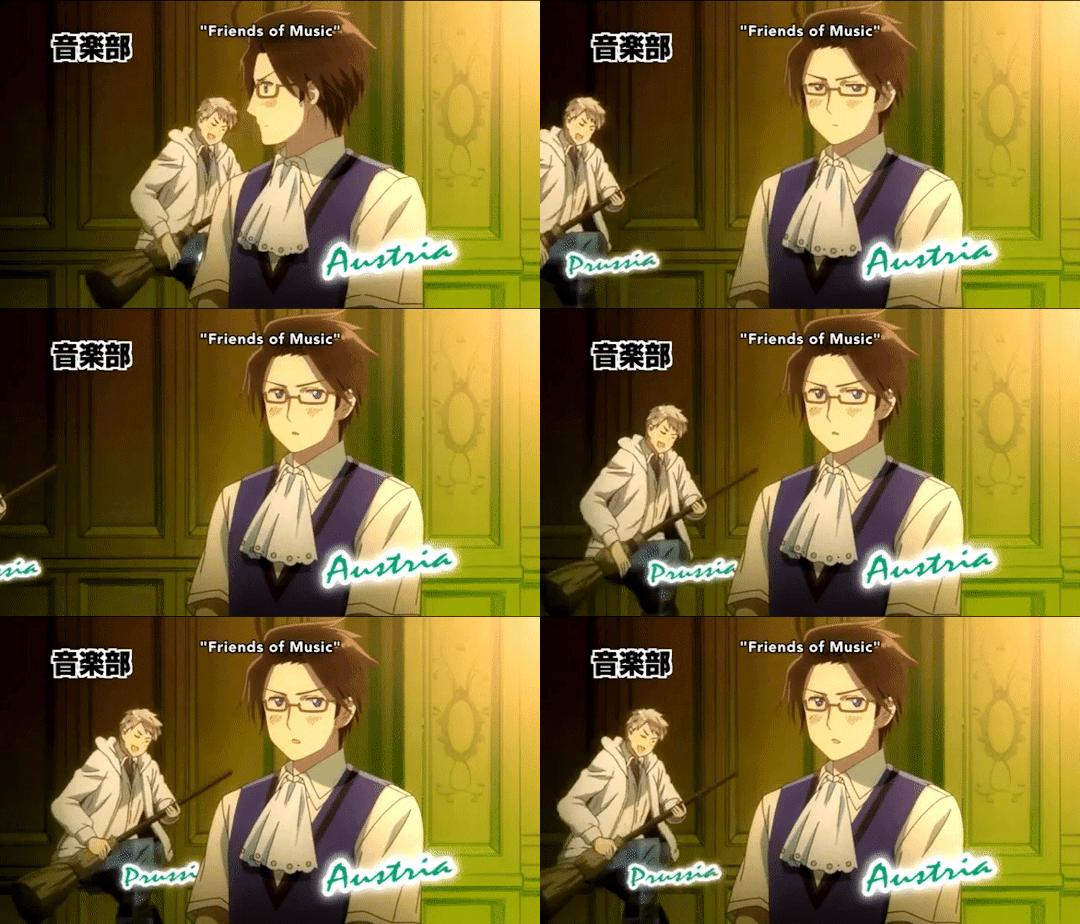
Misconception: He’s
weak.
Reality: Austria
was born a fighter [x], but as he turned to marriage to solve his political
problems, he lost shape and became accustomed to home life. He’s actually quite
lazy now [x].


Misconception: He
was cruel and heartless when he ruled over Chibitalia.
Reality: While he
was strict and stern with Chibitalia, a lot of this can be attributed to the extreme
and exaggerated humour employed by Himaruya in the series’ early days.

Even with the strict punishments, Chibitalia still shared
many fond moments with Austria—nations living in Holy Rome’s household
considered each other to be family and even maintained this sense of closeness
decades afterwards [x] [x].


Misconception:
Due to historical tensions, it’s impossible that he and Hungary were able to
possess such a strong relationship under their empire. [x].

Reality: Yes and
no.
You have to remember that the nations are people too. They
have a political self and a personal self. It’s for this reason that while
Hungary has “defiant” feelings from her time spent under Austrian rule, she also
has “complicated, yearning-like” feelings for him [x].
How I interpret this is that she despised Austria for what
Austria the country stood for at the time but not who he stood for as a
concrete and separate person.
Lest we forget all the times where it’s hinted that the
two still have feelings for each other. The most notable panel that substantiates
this claim is from Buon San Valentino. There, Hungary receives a Valentine’s
day gift from someone with “glasses and one hair standing up,” [x].
“He hides his name but not his Mariazell.”

Misconception:
Austria and Prussia hate each other.
Reality: Again,
yes and no. It depends on the time period. The ‘hatred’ isn’t deep-set but
rather it’s temporary. Himaruya once said that it would be fun to draw Austria, Germany, and Prussia as a “chaotic sort of family,” [x].
Undoubtedly, Prussia gets on Austria’s nerves…a lot [x]. (Another good reference would be the Maria Theresa series).

Still, the strips have also shown that they don’t truly hate each other.
Ex: Austria
receives a censored letter from Prussia (who was under Soviet rule at the time)
and reads it out of pity [x].

Ex: The two still
consider each other to be ‘family’ and spend their holidays together despite
all the fighting it causes (Christmas 2010 Event).
(Prussia initially didn’t want to let Austria spend
Christmas with him because he was a “lesser German”. He was just being an ass;
I wouldn’t take it seriously, especially given Germany’s response).


Bonus Facts:
He’s considerably self-critical.
Ex: He wears his glasses to avoid looking plain. It’s not
from poor eyesight. Instead, they represent his “musical something,” [x].
Ex: Being unsatisfied with his appearance is enough to make
him feel discontented [x].

Similar to Freud’s “anal-retentive” personality-type,
Austria is a stingy [x] perfectionist [x].
His mole acts as an erogenous zone, not his ahoge
[Mariazell] [x].
He gets grumpy when he doesn’t have coffee.

He spent part of his life in a wheelchair [x].
He doesn’t have a sense of direction.

He once avoided fighting with Prussia because he didn’t want
to harm young Germany [x].


For those curious,
it’s 116 f or more up there. Yikes. I’ll take our 83 to 96 f later today. I
wanted to ask yesterday, but the ask box didn’t seem to
be connected to the server (at least that’s what it told). How do you think the
Republic of Ireland is related to the UK brothers? It’s not been stated they
are a sibling, or even a relative, so that makes me curious. Happy Canada Day
up there 🎆
[Thank you! The ask box situation has been fixed, but the
read more coding issue still hasn’t been resolved! I’m so sorry, but I can’t
always answer asks right away….]
Himaruya isn’t sure what to do with Ireland, so no relation
has been confirmed [x]. Thus far, we only know that England is the son of four
siblings, including Scotland, Wales, and Northern Ireland [x].
If I’m to speculate here, they could be siblings if Himaruya ever decides to elaborate on the
character. Aside from historical relations, geographic proximity is
occasionally used as a defining factor for sibling relationships.
Given that Northern Ireland is England’s sibling and was originally
partitioned from Ireland, I don’t think this is too much of a stretch. Things get even
more complicated when you see that Northern Ireland is listed as England’s older brother… what a can of worms, eh?

Do you happen to know why people say APH
England doesn’t know how to swim? I’m pretty sure that was a joke in the comic
strips, but everyone seems to consider it canon.
Like you said, it is a joke, stemming from how British
people in horror films have a tendency of not being able to swim. I know I’ve
talked about this before, but my opinion has since shifted. I personally wouldn’t
consider it to be canon given the context [x].

Which Hetalia character has the biggest amount of
ships/harem? Why is it that a lot of the characters can be shipped with everything?
(including fridges apparently).
(Fridges aren’t even the
brink of some of the madness in the fandom :P)
In my experience of
reading fanfiction, I would probably say England. He’s very versatile and fits
well in several dynamics. (e.g., FrUk, UsUk, AsaKiku, EngSey, EngBel, EngIta, and SpUk).
People have different tastes; of course it’s going to vary.
How do you think the Eastern European countries (Ukraine and
Hungary in particular) would interact with their Romas/Gypsies? What would
their relationships be like?
From what I can recall, there is no canon
depiction of this. It’s difficult to say due to the fact that citizenship in one country
doesn’t have meaning in their way of life.
However, given that the nations
represent all people within their territories, including those of different
ethnicities, race, religion, and class, Hungary and Ukraine would personally treat them the same way as they
would with any other citizen, even if they don’t possess citizenship. Citizenship
is a social construction. I believe what’s more important is the fact that
these people live in certain jurisdictions.
I know you said Luxembourg was referring to Belgium and
Netherlands as older siblings are terms of endearment rather than him being
biologically related but, do you think he could at least be related to Belgium
considering that a lot of his former land now belongs to Belgium and their countries
have close relations? (sorry for this being long.)
(Please don’t be sorry!)
The corroborating source
I mentioned in an earlier post [x].
The post [x].

It’s complicated because
as I mentioned before, the Bamboo Thicket post and the corresponding Hetarchive
page state two different things. The post is listed as a rough
translation, but the fact that Himaruya refers to Luxembourg using terms of
endearment instead of directly confirming a sibling relationship to Netherlands
and Belgium in the question is pretty clear.
I don’t know what else
to say. If it doesn’t claim that they’re biological siblings, then they’re not. I’m not a translator and don’t speak Japanese either. Still, what I would like to look into more is why that translation is cited
as rough…


What this post will explore
is the impact of Austria’s and Hungary’s parenting style on Italy. There is no
good and bad here. All I aim to do is give reason and meaning to the
problematic behaviour and relationships that are depicted in the series. The
characterization is done for a specific purpose. What I seek to do is bring
several parallels to light to prove this.
One of psychologist Karen Horney’s theories explored how problematic
parent-child relationships often result in the child developing neuroses
(mental health complications), such as anxiety or depression.
However, rather than assert
all the blame on the parent, she went on to explain how parents who have been
reared in an environment void of love, care, and affection are incapable of
raising their kids in any other manner.
Put another way, parents pass
on their neuroses to their children. You can’t expect someone to provide the
care, warmth, and love that they’ve never experienced and learned themselves.
On the other end of the spectrum, these problematic parent-child-relationships
and parenting techniques are learned and repeated through
generation-to-generation. It’s a cyclical process, that, unless consciously
recognized, results in all sorts of emotional trauma.

What Horney believed to be the Basic Evil of these problematic
parenting styles is Parental Indifference, which can also include a
hostile or rejecting attitude of the parents toward the child. This parental
indifference can cause the child to develop feelings of Basic Anxiety or Basic Hostility –
both of which, if not attended to, can lead to mental health issues.
For the purposes of this
post, I only need to focus on Basic Anxiety. Basic Anxiety occurs when the
child develops feelings of loneliness and helplessness in a world that they
perceive to be hostile and dangerous.

That said, what I’ll now
analyze is how Austria’s and Hungary’s upbringings were passed down to Italy.
Let’s tie this back to the
strips.
As expected, having had to
fight for their autonomy to prevent themselves from being conquered caused
most of the nations to have rough childhoods. The world of war is full of
uncertainties, fears, and insecurities. Of course, Austria was no exception and
had to experience this too. However, rather than fighting, he attained his
security through many alliances and marriages (e.g., the Swiss-Austro
partnership and the Austro-Hungarian empire).

Nonetheless, Austria did
experience a total loss of control as a child [many times].
Ex: He lost several battles to Hungary [x].

This total loss of control is
later inflicted onto those who Austria conquers. Again, I’m not attempting to
justify any of the following behaviours. What I hope to do is provide insight
into the reasoning behind these behaviours. I should also mention that there
are a lot of grey areas in the manga; to depict the scenarios as black and
white doesn’t do the series and characters any favors.
What’s important is that
these behaviours have been wrongly normalized as the ways in which nations
function and interact with each other. It’s a cycle that’s repeated.
When Austria first assumes
control over Italy, he makes him the equivalent of a servant. As such, Italy
loses total control over his political affairs [x].


It’s a harsh world where
deviance [rebellion] is strictly prohibited. The punishments are respectively
just as strict and harsh—this would entail the hostility component of Horney’s
theory.


Of course, this doesn’t mean
that Austria wasn’t only hostile with Italy. They shared several fond moments
together and were considered to be a family unit.


What would matter to Horney
is how Austria’s inconsistent parenting style of being a simultaneous source of
love and affection and a hostile enemy to be feared affects Italy’s mental
health later in life.
Italy’s helplessness in
adulthood is most seen in his clinginess, stemming from his desire to seek
safety and security from the world that has consistently proven to be dangerous
to him. First, Rome died and Italy was conquered by Austria. Flash forward to
WW1 and he’s once again in the hostile, unpredictable, and insecure world of
war.
So, what does Italy do?
He seeks safety.
With who?
Germany, his enemy at the
time.
When taken as a prisoner of
war by Germany, Italy doesn’t attempt to escape, even when provided with the opportunity
to. How I’ve interpreted this before is that Italy does this to seek security.
He explicitly states this too. Even as a POW, he still has a roof over his
head, can sleep without worrying about being attacked, and can expect to be
fed.


On the other hand, war isn’t
the only sphere in which Italy feels helpless. Corruption and the tyranny of
the mafia have once again rendered him void of total control over his political
affairs. I would even go so far as to say that he’s adopted a sense of learned
helplessness.
Learned helplessness occurs
when a being recognizes the inevitability of their negative situation. The result
is that they don’t attempt to escape from this situation but instead cope with
it.
A prime example of this would
be when Italy has his car and wallet stolen from him. Rather than calling the
police, he goes to Germany for help. The fact that it’s Germany and not Italy
who reports to the police implies a conscious recognition on Italy’s part of
their inability to do anything about the event [x].


In other words, being stolen
from is something that Italy’s normalized.

Hungary, having been reared
in a more supportive environment, doesn’t pass down neuroses to Italy, unlike
Austria.
Instead, Hungary passes down the ability to trust in others. She had the
rare privilege of growing up with a parent figure. Magyar raised her to be just
like him [x].

Point is, this ability to love and care unconditionally is replicated
in Hungary’s treatment of Italy.

The cycle repeats as Italy learns
from Hungary that even in the most hostile of environments, trust can still be
established with other nations. This trust is often excessive and nonsensical
at times, as Italy forgives quickly and will openly befriend enemies.
Ex: Italy is noted to be a
nation that doesn’t hold grudges. He hugs Austria despite having recently
fought a naval battle against him.

Ex: Italy fondly refers to
France as “oni-chan” when they both get shipwrecked during WW2.


In sum, when looking at Italy
from this perspective, it’s easy to see how Austria and Hungary have influenced
his personality.


Oof. Another excuse to make an addition to the psych-talia series. Absolutely, post coming up tonight!


What it really boils down to is that she’s an amazing role model.


Most dangerous nations: Belarus, China, Germany, Finland, Hungary, and Russia.
Most underestimated nations: Belgium, China, and Italy.
Hardest workers: America, Germany, Japan, and Romano (if he has the motivation).
Laziest nations: Austria and Romano.

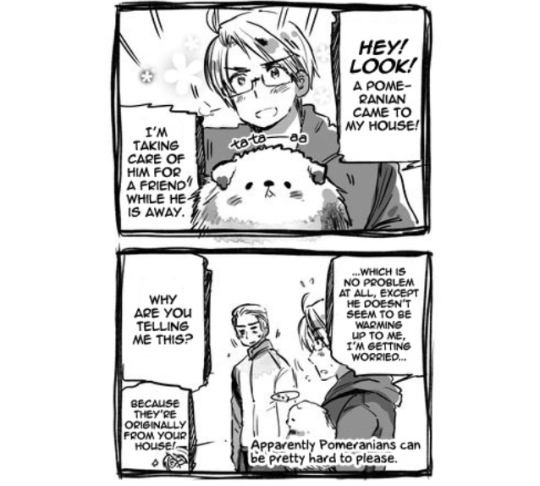
America taking care of his friend’s Pomeranian and asking for
Germany’s help.
Canada crying and doing his best to heal England after the
American Revolution [x].


Hungary secretly cleaning up for Austria after their empire
is dissolved.

After telling the story of Germany’s birth, you see a break
in Prussia’s egocentrism – or rather the act of it. He goes from “worship me
all you like” to agreeing to do laundry for Germany. In reality, he’s an
incredibly helpful, hardworking, and diligent person.

 Ellawritesficssometimes