AusHun (platonic and romantic) would probably need a whole post on its own, but I can certainly go into the relationship dynamic shared between the three of them.
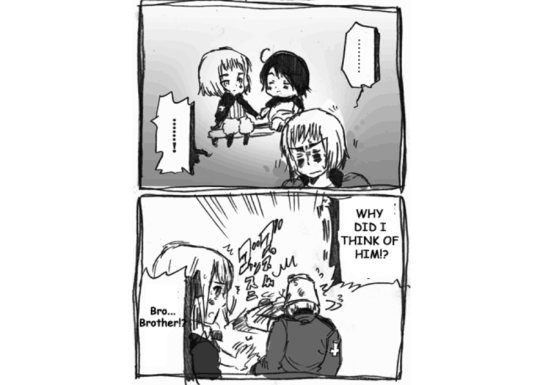
As for PruHun, it’s more one-sided on Prussia’s part. It’s still worth exploring, though, as it requires delving into the depression and loneliness Prussia keeps contained within himself.
Marriage with the nations is a lot different than
traditional, primarily Western notions of it. It arises more out of a sense of
political duty, an arranged alliance or
partnership, and sometimes it just so happens that a romance forms between
the two countries involved.
Typically, what I’ve seen is that marriage at its core in
the series involves two countries merging together, either into a co-state empire,
a co-state kingdom, or a separate sovereign nation with distinct ethnic groups
and cultures. There aren’t any ceremonies, but rather, it entails a mutual dependence
and relative respect between two political entities.
That said, it’s important to mention that two countries joining
together via annexation does not fit into this marriage equation. There’s a
difference between being conquered and subordinated and forming a mutual
union. On the other hand, that doesn’t go to say that there’s perfect equality or
power balances in marriages between nations; Austria’s control over Hungary is
a perfect example of that.
All right. Let’s go over some examples of marriages, shall
we?
Austria’s character is known for his quirky tendency to
solve his problems through marriage.
First, there was arguably his early ties with Switzerland. I’m
counting this as a marriage mainly because it involves the use of the word
partnership and honeymoon (albeit jokingly).
Notice how as soon as one tries to control the other, the partnership ends. While Switzerland does
reveal some fondness over his early memories spent with Austria, there’s
nothing particularly romantic about it, especially given the fact that they
were young children at the time. Again, marriage for them is essentially the
joining together of nations.
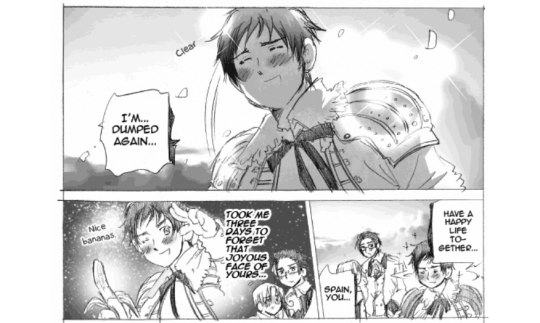
Next, Austria marries Spain via the Hapsburgs Monarchy.
Here, you actually see a hint that Spain harboured romantic feelings for
Austria during the Austrian Wars of Succession. It was a political merger
that likely later involved the development of some intimacy between the two.
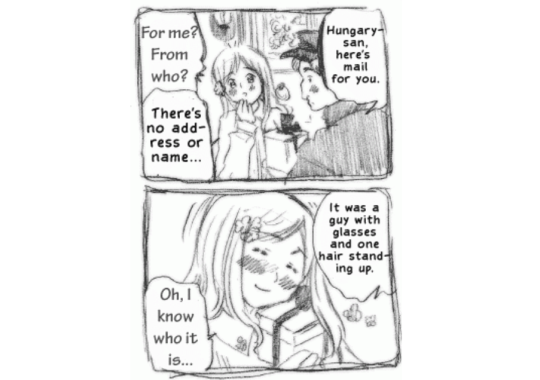
Then, you have Hungary. After the dissolution of the Austro-Hungarian
empire, it’s very heavily hinted that Austria still bears feelings for Hungary.
In Buon San Valentino, Hungary receives roses from an anonymous man that’s
conveniently described as having glasses and one hair sticking up.
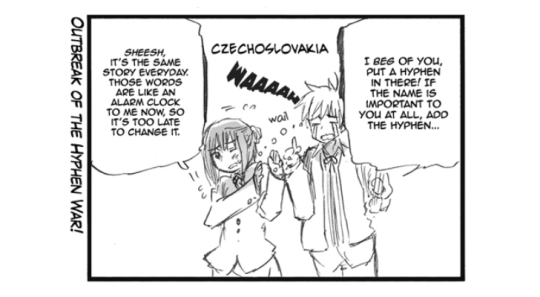
On the other hand, there are marriages that involve little
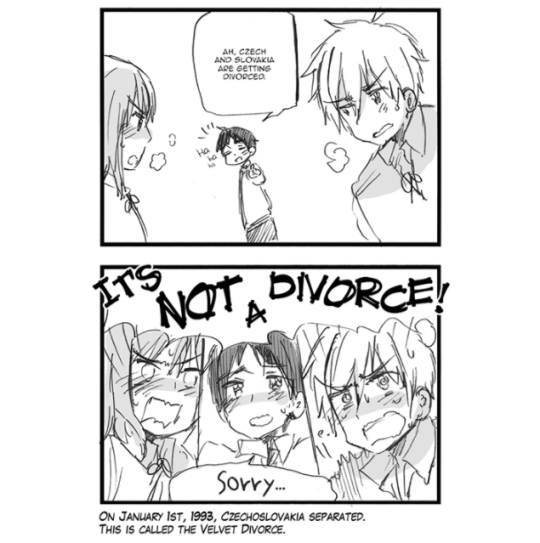
or no romance at all. Take Czechoslovakia for example, two countries united by a
hyphen. Yes, that’s an actual joke in the series.
Still, what’s interesting is that when Bulgaria talks about
their separation in terms of a divorce, they’re quick to deny the claim, mainly
because of the romantic connotation marriage carries.
How I interpret this is that the two may have developed
feelings, but never told each other.
Bulgaria bringing up the topic of marriage in a casual political
sense merely may have caused them to get defensive because of these unvoiced feelings.
This isn’t confirmed, so don’t take it at canon value.
I know I’m repeating this, but it’s important that I make
this as clear as possible:
Marriage = a merger between two countries.
I say this because I’m going to apply these rules to Belarus
and Russia. Belarus wants to marry Russia and loves him to the point of obsession.
She’s even forgotten her own language at one point in favour of learning Russian.
But, does it ever say that Belarus loves Russia in a
romantic way?
No.
What it does say is that she wants to “become one” with him.
Sounds like a merger if you ask me.
When Belarus says marriage, she wants their countries to
join together. There’s nothing romantic about it, so hopefully this stops
people from misinterpreting their relationship.
In summary, marriage between the nations seems to involve a political
merger between two countries (partnership, co-ruled kingdom/empire). It can have
a romantic element to it, but this isn’t always the case.
Note: I made a timeline error, as pointed out
by @feyna-v. Thank you! Please disregard the last few posts. It was a
silly mistake on my part. Thank you!
It’s not clear when exactly
Italy goes through the later stages of puberty, but unless there’s an
inconsistency in the timeline, it appears that it occurs before the Austrian
Wars of Succession. Once Italy voice drops, Austria and Hungary buy him male
clothing to wear.
In the Maria Theresa series, Italy is
shown to be wearing boy’s clothes. He’s also shorter than his adult height,
which means that he hasn’t matured in full yet.
Later, as he begins fighting for his independence from Austria,
you see that Italy has grown up, or has at least come very close to it.
The same thing happens with Romano too. Before he leaves Spain’s house, he’s matured significantly.
That said, Italy went through puberty some time before the Austrian Wars of Succession, and aged into an adult as he got closer to his independence.
Behold, a compilation of gay.
America invents
a gun that makes men fall in love with each other. The intention behind it is
to demoralize enemy troops by distracting them.
Later, Japan points out
that relationships among male soldiers in Ancient Turkey and Greece made them
more focused and ultimately stronger, as they wanted to look good in front of
their lovers. The strip ends when America points the gay-gun at his head.
Survival instincts kick in during war, causing men to feel the urge to reproduce. There weren’t too many women around, hence…
Spain proposes to Romano. Romano doesn’t say yes, but he doesn’t say no either. He sets conditions instead.
The rest are pretty straight forward.
Pretty gay already if you ask me.
Warning, reader discretion
is advised: This post may contain uncomfortable subject matter. Please do
not read this if you are sensitive to mentions of physical and sexual assault.
How they came to be:
Prowling down the red-light district of Berlin, Siren has
claimed this territory as her own, sparking fear in all the men who dare to
venture into this sea of lawlessness. Aside from her obvious gender preference,
she does not discriminate against her victims. They vary widely in age and
class, some being as old as sixty, while others being as young as twenty-one.
It seems the only thing these men all have in common was
that they were in the wrong place at the wrong time. Even among serial killers,
Siren is quite the anomaly in terms of personality. None of the victims are
mugged, nor are they brutalized, tortured, or demarcated as is the case with
those who enjoy killing.
Reports and witnesses are low given the area that these
murders take place in, and the pervasive distrust of the police held by the
residents there doesn’t help either. Prostitutes in the area that have come
forward thus far have claimed to have seen a strange woman with unnaturally
long hair patrol the sidewalks and occasionally the front entrances of bars. Some
have even reported to have been approached by this woman and were strangely
asked whether they had a lift home.
The police are reluctant to comment any further on the
matter, as they are fearful of sparking a public outcry and moral panic. Vampyre
is already on the loose as it is, so they are hesitant to make anything
official just yet. As of now, Siren has claimed the lives of five people.
Killing Methods:
Siren’s method of killing is quick and dirty; she possesses
immense strength. First responders have told reporters that the crime scene is
better described as the echoes of a battle field. All that is known by
forensics is that a blunt metal object is used against the back of the victim’s
head, likely by surprise as there are no indications of defense wounds, before
being beaten to death with said object.
Siren’s signature that links all her murders together is
that she calls 911 as the victim bleeds out before her. It’s been speculated
that her motive and enjoyment of the murders rests in their powerlessness as
she holds their life on, well, a call line.
Inner Psychology:
Elizabeta Héderváry is a recent immigrant from Hungary,
having come to Germany after finishing her Bachelor’s degree in Fitness and
Nutrition. Cheerful on the outside, albeit with the humanizing quirk of a
short-temper, Elizabeta has kept her dark past life a secret and intends for it
to remain that way.
In the last year of her degree, a man broke into her
apartment and attempted to assault her. Thanks to her quick wits, Elizabeta was
able to grab the thing closest to her, a pan, and hit him on the back of the
head. However, she didn’t stop there. She kept hitting the man, until the next
thing she knew, he was dead, and she along with her entire kitchen was a bloody
mess.
Not knowing what to do, she buried the body in a nearby
garbage shoot, finished her last few months of school, and then fled to
Germany. There, after recuperating for a few months until her savings dried,
she decided to open a dojo that teaches women how to fight back
against potential assailants. The dojo also hosts free self-help sessions, providing
a safe-space for women who have been sexually and physically assaulted to speak
about their experiences.
Due to her strong-will and perseverance, Elizabeta quickly
got her personal life back together
and now has her new best-friend, Gilbert, to help her run the dojo, as well as
her fiancé, Roderich. However, no matter how hard she tries to forget about the
past, it still haunts her. She vividly remembers being pinned to the ground,
helpless to the entitlement of a much larger man, and constantly relives this
in her nightmares.
Running the dojo just wasn’t enough. Elizabeta was never the
same after her assault, and is provoked further by the infuriating stories the
women she helps tell her. They don’t get the justice they deserve and are often
not believed. It’s a broken system filled with many broken laws that only break
women down and down until they – snap.
All Elizabeta wants is for her girls and herself to be
happy, but that can’t happen unless all of their assailants die. It takes a bit of coaxing, but
Elizabeta is able to gain their trust and eventually acquires the names of the
individuals who have assaulted them.
She follows these scum around at night and wears teasing
clothing to catch their eye and lure them away from the mains streets, knowing
they will pursue her. She doesn’t see anything wrong with this, and thinks
she’s doing her friends a favor.
What works to her advantage is that the police think these
men came to the red-light district on their own free will, rather than being
taken there. Elizabeta likes to play the role of the prostitute, and has even
been so bold as to take a cab with her last victim. Sexuality, here, is used to
control the man and strip him from all power over the situation.
What gives Elizabeta the most pleasure is having the courage
to call the police directly and taunt them about how she’s doing a far better
job than they are. The cherry on top is the sound of the first responders’ sirens wailing in the distance, the ones that will once again fail to help the
person in need…not that they deserve it.
Note: This post will be looking at potential hints of female pairings or same-sex attraction, as requested. For the most part, the nations I will be mentioning have in fact shown attraction to males too. A more complete post on the nations’ sexuality will eventually be made, though. The examples shown are not all of them either. There are plenty of them, believe me.
Okay, let’s get it out of the way right now: Monaco and Taiwan
are hitting up the charts with their heavily hinted – but not confirmed – attraction
to girls. It makes me incredibly happy to see this possible representation in the
comics, and I’m even more excited to share it with you all.
First, there’s the 2011 Christmas event. There, Taiwan
states that she is unable to concentrate due to the amount of cleavage the Western
female nations are showing. Monaco then reassures her and sweetly waves it off.
Taken alone, this may not seem significant, but you certainly see progress with
Taiwan as you flip forward into later strips.
Now, let’s go over some panels included in the Halloween
2013/2014 event. After spotting Belarus from afar, Taiwan literally exclaims “Gorgeous
lady at 12:00 o’ clock!” and then proceeds to complement Belarus with notable
excitement.
And then comes Ukraine.
I mean, there’s really not that much to say. You can see it
for yourselves: there’s a clear blush on Taiwan’s face and she looks just a little
bit too happy to see Ukraine’s (breasts), don’t you think?
Don’t believe me still? Here’s Taiwan blushing, complementing Vietnam,
and just looking plain elated to be surrounded by them. She doesn’t seem to be
so shy about these feelings anymore.
There also appears to be this scheme where Taiwan purposefully
made Vietnam’s costume smaller and tighter than what it should be, as the costume
is her size as opposed to Vietnam’s – Taiwan is significantly smaller than Vietnam.
Lastly, there’s Monaco, who comments that Ukraine looks “modestly
sexy.” Again, when taken on its own, it doesn’t seem like much.
However, when asked if she would wear a revealing costume,
Monaco says that she’s better at being an onlooker and is then compared to an
old man by Taiwan. I don’t know, I read this as Monaco embodying something akin
to a male gaze…an appreciative male gaze. There’s also the stereotype that old
men are more perverted; obviously this isn’t the case, but it’s a pretty common
gag.
Take what you want from what I just presented, but I personally
believe there is enough evidence in the strips that at the very least hint at the
existence of same-sex attraction among the female nations.
Prussia: “Hey, do you have some troops I can borrow?”
On February 25th, I asked her what day it was.
“February 25th.”
I almost died.
The answer to the title is no, by the way. To
elaborate on why I believe this is, it’s important to understand that the modern
definition of a nation-state is much different now than what it was centuries
ago. People often organized themselves in terms of city-states, kingdoms,
principalities, or small territories.
That said, during the Renaissance era, Italy
consisted mostly of small city-states. This would explain Italy’s full name,
Italy Veneziano, an obvious reference to the city of Venice. This fragmentation
was due to the larger foreign powers of Austria, Spain, France, and the Holy
Roman Empire coming in and taking land for themselves.
However, as I just said, Italy Veneziano is
repetitively referred to as North Italy, which simply includes Venice. He
doesn’t only represent Venice. I
don’t mean to say that North Italy wasn’t born
to represent Venice, though. That certainly seems to be the case. What I am
saying is that as the concept of a nation changed, so did Italy. He likely absorbed
the entire northern region. I mean, we’ve already seen this multiple times in
the series where nations adopt new lands and titles. Take the Teutonic Knights
and Prussia for example.
Now, this wouldn’t be a theory if I didn’t have any evidence, so here.
Then, at the end of the strip, North Italy mentions
that parts of his house were taken. We already know that a nation’s house, or
rather, an empire to be more applicable to the time period, consisted of other
nations under their rule. However, in Italy’s case, his house consisted of the
many different sovereign city-states of northern Italy.
So no, I wouldn’t worry about Italy Veneziano
disappearing anytime soon just because Venice is likely to sink in the coming
years. He’s got the whole rest of northern Italy to embody.
Further, and as I’ll get into with a much, much larger post, there is no dominant
Italy – between the two Italian brothers, I mean. The south and north are different
enough for them both to personify the land, and Hima makes sure to mention this
countless times.
I sure do, that’ll be tonight’s theory! I’ll be building on this panel to explain how his soul, or rather, spirit, is characterized. Big surprise, Hima used another pun.











 Ellawritesficssometimes