In previous posts, I’ve touched on the notion that pets in
Hetalia often function as a mouthpiece for their respective nation. Put another
way, while they are separate physical beings, symbolically they serve to
represent the psyches of their owners (i.e., their thoughts, feelings, and
emotions) [x].
Thus far, I’ve picked up on three consistent themes.
1)
They tell the nation something they need to hear.
2)
They speak what the nation doesn’t dare to say
out loud.
3) In conjunction to #2, they often reveal what the nation is
feeling.
That said, let’s tie this back to the strips.
America:
The best example where America’s pets mirror his feelings is
their fondness of Lithuania.
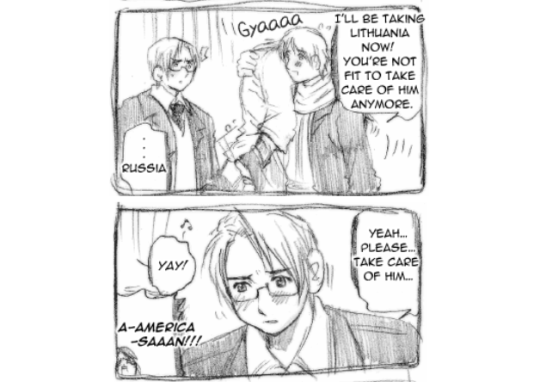
America becomes disheartened when he can’t afford for Lithuania
to live with him anymore [x].
However, in earlier strips, we learn that America’s pets
hold a similar affection for Lithuania [x].
Canada:
Before, I’ve speculated that Kumajiro represents Canada’s
psyche.
The focal point of Canada’s characterization is his struggle
to form a stable and memorable identity and overcome his invisibility. As such,
neither Canada nor Kumajiro getting each other’s names correctly figuratively reflects
how Canada still hasn’t figured out who he is.
Hence, Kumajiro’s infamous “Who are you?” catchphrase has another
level of depth to it [x]. He’s not just asking Canada who he is [as in his name]
but also who Canada stands to represent as a person and a nation. His identity and
self-concept is something that he continues to negotiate and work his way
around.
Some other examples would be…
Canada is too shy to ask England to have lunch with him.
Kumajiro then reassures Canada that it’s okay to be more demanding and urges
him to speak up for what he wants.
In the aftermath of the American Revolution, England diverts
most of his attention toward America. Kumajiro uses stuffed animals to convey Canada’s feelings. The puppet story depicts how Canada feels
neglected and excluded [x].
“I think the well-behaved baby bear should be loved more,
but what do you think, whoever you are over there?”
England:
England becomes dismayed after watching a fantasy movie and
laments over his desire to live in such a world. His magical friends don’t hesitate
to give him a required dose of reality [x].
Iceland:
Mr. Puffin acts as both a mentor and mouthpiece for Iceland.
He’s able to see right through Iceland and recognize what he’s truly
feeling. In this case, he’s aware of how lonely Iceland is [x].
On the other hand, when he first meets baby Iceland, he comforts
him. At the time, Iceland was still figuring out his existence and questioned
why ‘no other guys like him’ existed. Mr. Puffin assures him that other
nations do exist, just in far geographic proximity [x].
He also teaches Iceland knowledge about the world from his
travels [x].
One thing I’ve noticed is that fans approach and analyze
relationships between the nations from a human perspective. The problem with
this is that it doesn’t capture the elasticity and interchangeability of
titles of beings who are immortal– not mortal– go through. In other words,
aside from direct biological relations which don’t change, you can’t apply
words of human organization to immortal beings who routinely change how and who
they relate to.
For example, just because a nation lives with another
nation, doesn’t automatically make them family. In the case of a nation, they
don’t live with other nation(s) by choice but rather circumstance. Often
enough, it was the product of being conquered.
Some nations living together will choose to identify as a family,
as their bond as a unit most closely resembles one. Nonetheless, these
families, or households rather, are temporary.
Ex: Hungary refers to Holy Roman Empire’s household as a
family [x].
Ex: Having lived with France in Rome’s household
for some time, young Italy referred to France as big brother.
Out of respect, some nations will continue to refer to the
other nations they lived with as an older brother. In Japanese, “onii-chan” is
a term coined out of affection and adoration for a figure. It doesn’t mean
older brother in a blood sense.
Ex: France claims to be the older brother figure of the
world. Meanwhile, only Italy and Monaco choose to refer to him with this title
of affection [x]. Again, not to be mistaken with a relation.
A nation can be a guardian for several centuries and later
evolve into a companion, friend and/or mentor figure.
This is best seen with America and Canada, biological
brothers who temporarily held a family unit with their colonizers. Although,
they didn’t physically live together, settling for occasional visits instead.
For one thing, it’s important to distinguish the fact that biological relations are inherently sensed by the nations.
There’s a difference between Iceland, who senses Norway to
be his brother from birth [as does Norway]… [x].
…and England and France, who make America and Canada their
family [x].
Ex: America doesn’t inherently sense a brother among his
colonizers, Finland, France, and England.
Instead, they fight over who will assume the role of
America’s brother [x].
As mentioned, it’s difficult to apply human words for
relationships to capture relationships between immortal beings. It doesn’t
quite fit. Think of it this way: The nations have unique experiences that we as
humans will never have. So, why are we using words that describe our
experiences to describe theirs?
Respectively, England has trouble deciding what America
should call him.
Again, notice America’s choice of the word onii-chan.
Titles like guardian and older brother, two very different
terms, are loosely thrown around. Of course, older brothers can be guardians, but you’ll see what I mean by this muddled distinction in a moment.
It’s hard to make sense of a relationship
using words that don’t describe but instead confine and water down the
complexity of the colony-colonizer and simultaneous guardian-adoptive
relationship they’ve established.
This uncertainty and fumbling to find words that best
describe their relationship is seen again when America declares his
independence. Even he doesn’t know if what they had entailed a parent-child or
sibling relationship [x].
Nonetheless, he cuts off these ties and no longer views
England as this type of figure for him.
The point I want to emphasize is that due to political
circumstances, the nations’ relationships with each other are dynamic. It’s not
as rigid as human forms of organization; therefore, it doesn’t make sense to
approach these family-like dynamics from a human perspective. It’s like
comparing apples and oranges.
Lastly, to avoid falling into a trap of reasoning, there’s a
stark difference between conquering/ colonizing a nation and living together and
willfully forming a union [economic or political] and living together.
Ex: Switzerland adopted Liechtenstein into his household and
the two consider each other to be siblings. Because this is how they presently
identify and relate to each other, they are siblings.
I’m not particularly big on headcanons, but I sometimes do charts like this 😀
Most insecure nations
–
America, Canada, England, Germany, Italy,
Romano, and Poland.
Loneliest nations
–
America, England, Iceland, Prussia, and Russia.
Happiest nations
–
Denmark, Finland, Seychelles, and Sweden.
Most sarcastic nations
–
England, France, Norway, and Romano.
Nations we need more of
–
Belgium, Belarus, India, and Vietnam.
Misconception: She’s average.
Reality: While Hima intended for her to be average, her
characterization took a drastic turn [x]. She’s anything but average.
Ex: She’s a model student within Africa.
Ex: Regardless of her isolated position, she avidly studies
foreign relations [x]. Either way, she’d need to given how globalized the world’s
economies have become. The 2008 Financial Crisis affected her too, after all.
Ex: Prices in her country are more expensive in response to
high volumes of European tourists.
Ex: As a matriarchal society in which women are the
breadwinners of the family – as also cited by Hima in her character notes [x] –Seychelles
is not only strong and tenacious but admirably self-effficient.
Misconception: She’s a ‘stupid’ and ‘plain’ airhead.
Reality: She’s a lively, bubbly personality who simply
smiles a lot. The term airhead is used to describe her weird personality given that she’s composed of a mix of several cultures. It has nothing to do with her intelligence.
Ex: An unconfirmed African nation refers to Seychelles as an
airhead due to French and English influence.
Ex: She’s notorious for her butt-shaped coconuts [x].
Ex: Her isolation from other African nations parallels that
of Iceland and the other Nordics. A unique moment is shared between them where
Iceland senses her situation and relates to her fear of being forgotten. I can guarantee
you this is where the IceSey pairing came from.
Misconception: She’s related to England and France.
Reality: She inherited much of their culture, along with
some Indian and Chinese influence. What ties her and France and England together
is that she used to be a colony of theirs at different points in time [x].
Ex: A scrapped design intended for her to have one thick
eyebrow and one thin one to represent French and English influence.
Ex: Later, it’s shown that French influence on her country
has prevented her from inheriting England’s thick brows [x].
Ex: Her cuisine represents a mix of several cultures.
Bonus facts:
Both the Allies and Axis get stranded on her island during
WW2.
Her costume as Captain Hook during the 2011 Halloween Event
is likely a reference to the fact that young pirates used to have hideouts on
her island [x][x].
She’s tough on litterers.
She was the main character in an unfinished dating
simulation titled “Gakuen Hetalia” [x].
In sum, Seychelles is a wonderful character, regardless of
how little canon representation she has. She’s a cheerful and vibrant spirit
that bravely powers through the obstacles of her isolation, namely economic. Nonetheless,
she makes the best out of her unique cultural inheritance and isn’t afraid to
show it off. What’s unfortunate is that much of this complexity is watered down
in light of disliking her for coming between popular ships.
I believe most of it has to do with Gakuen Hetalia. Fangirls got jealous – don’t ask– and hated Seychelles because she was the main character in the dating simulation with other male nations.
I don’t know how anyone could hate her, though. She’s always smiling.
Note: This is a
guide. It’s not meant to cover an exhaustive list of all relevant examples in the manga. If I did that, this post could
easily be a novel.
Before I get into the direct blood relations of the
characters, this guide aims to chart out and differentiate between the different
types of relationships that we see in the manga.
Biological:
Biological siblings, obviously, means that the nations in question
are blood-related.
Ex: America and Canada.
Ex: Greece and Egypt and their moms, Ancient Greece and
Ancient Egypt.
The best example of a biological relation is that of Norway and
Iceland’s.
Iceland had no native people. Since it was Norwegians alone
who first settled on the island, the two are directly related [x].
Iceland innately senses Norway when he’s first born.
Norway
also senses Iceland.
Likewise, DNA testing – in this case, a land excavation – is
done to confirm their biological relation.
Now, let’s do a comparison.
When America’s born, he doesn’t sense a biological brother
among the countries colonizing him. The reason for this is that he’s referred
to as an ingredient, meaning that not only were there native tribes living on
the land he represented but that America existed as a mix of several European
cultures [x].
The point to differentiate here is that America doesn’t have
a direct biological relation to these colonizing countries due to the large
volume of them.
Instead, what you’ll see is that the colonizing countries
fight over assuming the role/ title of being America’s big brother, or
onii-chan.
Onii-chan:
Continuing from America’s example, after he chooses England
over France, he asks England if he can refer to him as onii-chan – ‘Big Brother.’
As stated in the translator’s note, onii-chan can be used as
an expression of adoration and endearment. Put another way, ‘big brother’ here
has an entirely different cultural connotation. It’s a brother-figure relationship
and isn’t meant to be taken literally.
Not to mention the fact that England initially rejects the
label of onii-chan, claiming that “just ‘England’ is fine.’” The reason England
is hesitant to accept the label stems from the horrible relationship he has
with his own older brothers.
France is another example where the term Big Brother is used affectionately.
Ex: He claims to be the Big Brother of the world.
Ex: He’s described as a Big Brother-type.
Ex: The first thing that he does when he meets Lisa, Jeanne
d’Arc’s reincarnate, is introduce himself as Big Brother.
Ex: The reason that Italy refers to France as Big Brother is simply because they grew up in Rome’s house together for some time.
This title of endearment is confirmed in one of Hima’s blog
posts, where he clarifies that Italy and Monaco both call – as in refer – to France as Big Brother [x].
More examples of France’s use of the title ‘Big Brother’ can
be found here [x].
One last example of this is that of Netherlands, Belgium,
and Luxembourg.
Netherlands and Belgium are biological siblings. Meanwhile,
Luxembourg refers to Netherlands, France, Spain, and Belgium as Big Brother and Big Sister respectively [x].
While the translation is noted to be rough, the distinction
is nonetheless made very clear.
All that needs to be known is that when two nations
willingly unite – not to be confused with being conquered/ annexed – the personifications
involved are considered to be married.
Austria is notorious for this, being noted to have solved
all his problems in the past through marriage (e.g., the Austro-Swiss
partnership, The Hapsburg Monarchy, the Austro-Hungarian Empire).
Ancestors:
In the manga, sharing similar ancestors doesn’t make the
nations involved biologically related. In this case, I’m talking about cultural
influence.
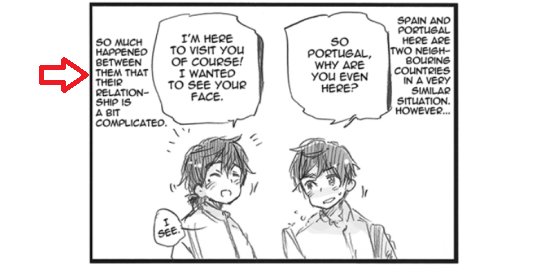
Ex: Spain and Portugal. (Chapters 77-79 of World Stars).
Both are noted to share a similar ancestry. As such,
Seychelles can’t tell which one is Portugal when she has a letter to deliver to
him.
Given the context in which the topic of their physical resemblance and relationship is discussed, if they were siblings, France would have attributed the reason for their likeness to this. He doesn’t.
Not once is a relation ever confirmed except for the fact that they’re neighbors.
Point is, it’s the similar ancestry that causes them to look alike.
While Romania may have inherited much of Rome’s culture, he’s
not related to the Italy brothers.
This brings me to my next point.
Influence:
While cultural influence often affects the physical
and personality traits of nations, it doesn’t make them biologically related.
Ex: Seychelles was originally designed to have one thick
eyebrow and one thin one to represent French and English influence.
Ex: As an amalgamation of several cultures, America
resembles bits of Finland, France, and England.
Ex: France’s influence prevents America, Canada, and
Seychelles from inheriting England’s bushy eyebrows [x].
Ex: Young Canada inherits France’s hair due to his
influence. This is before England had assumed control over him.
The House System:
When a country is conquered and their conqueror is on the
same continent, the conquered personification lives with the conquering personification.
Ex: France, Holy Rome, and Chibitalia living in Rome’s house (panel used above).
Ex: Chibitalia and Hungary living in Holy Rome’s house. Despite the rough start, they become so close that they refer to each other as family.
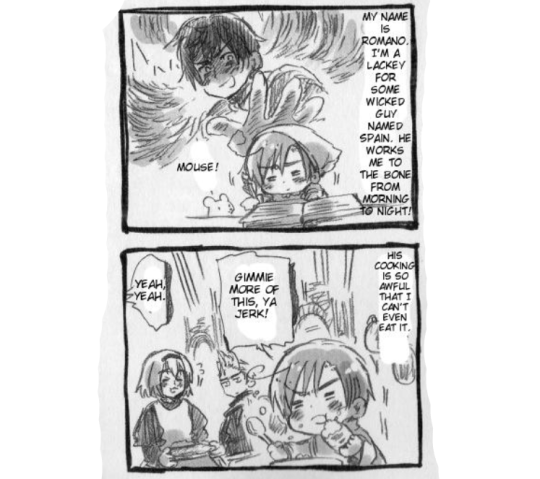
Ex: Romano, Netherlands, and Belgium living in Spain’s house.
In modern times, we still see this occur, albeit it’s a bit
different.
The Chinese provinces +
Macau and Hong Kong (under a one country two systems principle) all
live in China’s household.
The Colony/ Household System:
*Note – I made up the labels of house and household system
to better clarify and more easily distinguish between the two different living circumstances.
In canon, ‘House’ and ‘Household’ are terms used loosely and interchangeably in the translations.
The household system is separate from the house system in
that because the colonies are on separate continents, they’re part of a
household. In other words, they’re together and considered to be a unit despite
not living with the ruling nation.
Ex: England visits America, but America doesn’t live with
him in England.
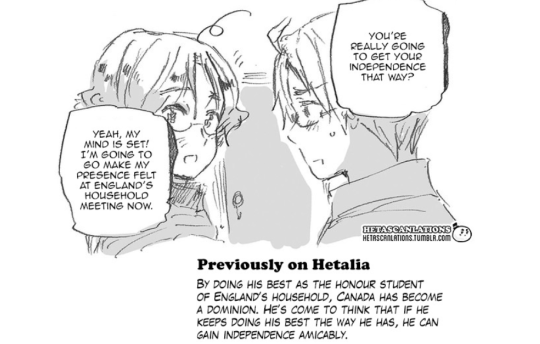
Ex: England hosts a household meeting, requiring the colonies to travel [x]. (America is already independent here, by the way. He’s not part of the household.)
Ex: Likewise, England has holiday houses in Hong Kong and
India, as alluded to in one of his character songs [x].
“
Curry, Chinese cuisine, my holiday houses’ meals.”
Ex: Hong Kong, who used to live with China and referred to him
in a more intimate way [x], changed after he became an English colony.
When he becomes Chinese territory again, he refers to China
as teacher/ Mr., seeing him more as a mentor.
What I want to stress here is how fluid interpersonal relationships
between nations are in Hetalia. They’ve lived for centuries; how they view and
interact with each other changes with time. Their relationships – aside from
biological relations – aren’t as static as human patterns of organization.
Misconception: He’s
Iceland’s father.
Reality: He
raised Iceland and acts as an older brother figure/ mentor.
Ex: He supportively
encourages Iceland to participate in their activities. In this case, they’re
designing a Nordic-inspired hotel.
Ex: He also gave young Iceland diplomatic advice.
Misconception: He’s a playboy that treats Norway like a
loose end
Reality: Denmark treasures Norway as his best friend. As the
leader of the Nordics, he’ll selflessly put others first before himself.
Ex: When Denmark realizes that Norway is struggling under
his rule, he breaks down crying.
Ex: Denmark gets distressed when he’s forcefully separated from
Norway by a British Naval Blockade. He’s more worried about Norway.
Ex: He doesn’t want to let Norway down and look “uncool.”
Because of this, he heads into a battle with Sweden that he knows he’s going to lose.
Notice how he still tries to set an example for Norway.
Misconception: Norway is indifferent toward Denmark.
Reality: While Norway may enjoy teasing Denmark and often gets
irritated with him, he too reciprocates this deep-set affection. The two share
a strong bond.
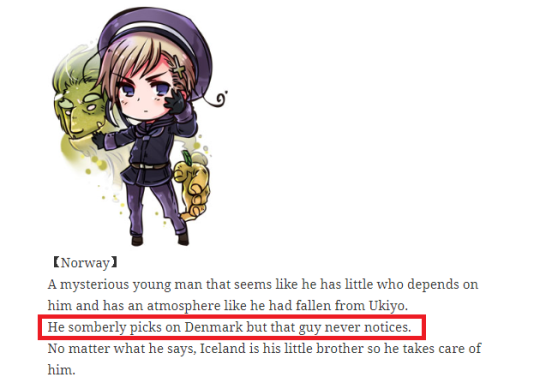
Ex: Norway’s hobby is gently poking Denmark. Denmark doesn’t
even notice Norway’s comments.
Ex: Norway expresses concern before Denmark charges into a
doomed battle against Sweden. Denmark refers to him as a “worry wart.”
Ex: Despite how poor he is under Denmark’s rule, Norway
recognizes that Denmark’s trying his best.
Again, Denmark may annoy Norway, but the two care strongly
for each other.
The running gag between the two of them is Denmark being
overly affectionate and Norway’s cheeky reactions to this affection.
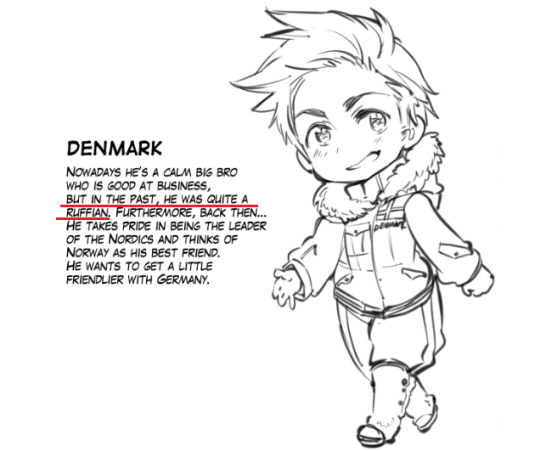
Misconception: He has a hot temper.
Reality:
He had a hot temper.
Due to recent statistics, Denmark is the happiest of the Nordics – his people are rated to be among the happiest in the world. [x]
Misconception: He and Sweden hate each other.
Reality: They hated each other.
Aside from friendly teasing here and there, the two get along really well.
Or, my personal favourite: Denmark and Finland mocking
Sweden.
Bonus facts:
He has a good relationship with Germany, mostly stemming
from their economic ties.
He once watched Hans Christian Andersen water grass with his
own tears.
He’s one of the few nations who can get the Netherlands to
sell him goods at a cheaper price.
Iceland: I’m not buying it. Dan isn’t that gullible.
Norway: Oh please. He’ll believe anything I tell him, no matter how impossible.
Iceland: Come on. I wasn’t born yesterday.
Norway: Shhh!
Norway: Hey, Dan?
Denmark: Yes, buddy?
Norway: I’m pregnant with your baby.
Denmark:
I want to begin by pointing out that I’m simply presenting
canon information. That is, what we’ve seen about religion in the strips.
Just because one nation follows the dominant religion of their
people doesn’t necessarily mean that they don’t hold their own beliefs or can’t
engage in the religious practices of other groups amongst their citizenry – all
I’m saying is that the latter point hasn’t been demonstrated in the series.
It’s also important to mention that the nations are
stereotypical personifications – they’re not characterized for specificity.
With all that in mind, religion in Hetalia encompasses a
generalized population rule. Similar to how they’re affected by the demographic
statistics of their citizens (e.g., their weight, income, behavioural habits),
the nations have also historically abided by the most dominant religion in
their country.
The Clergy as a ‘Boss’:
Since the Church used to be the Head of State, they would
have also been the respective personification’s boss.
Ex: We saw this with England, who spent some time on the run
from a Bishop who ordered him to cut his hair.
The Personification as a Religious Entity:
Ex: Prussia first emerged as a Catholic religious order.
As a reflection of his people and their beliefs, he was
therefore extremely religious.
Ex: There’s also Knights Templar, who likewise represented
a Catholic religious order.
War:
The Polish-Swedish wars are a good example of how the
different religious orientations of the two countries are reflected in their personifications.
Conversion:
As mentioned above, the nations only follow a religion if it’s
prevalent within their population.
Ex: During the year 1000 [the Christian Millennium Apocalypse),
France and England truly believed that the world was going to end.
France feared going to hell. Because he thought they were both
going to die anyway, England fulfilled France’s last wish and pretended to be
conquered by him (ironic, considering that the Norman Conquest wasn’t that far
in the future).
Meanwhile, Hungary who had just converted to Christianity
that year, hadn’t yet acquired the religious beliefs that would have also made
her fearful of the so-called apocalypse.
Ex: There’s also this beautiful gem of a scene where Iceland’s
converted to Christianity. Note again how this happens only because his people
are being converted.
There is a Real God in Canon Verse:
Ex: Despite being a secular state in modern times, France
still believes in God. This is seen in his encounter with Lisa, Jeanne d’Arc’s
reincarnate.
Ex: Ancient Rome ties up God so that he’s able to leave Heaven and visit Veneziano.
Ex: God visits Hungary in her dreams and orders her to hit
France with her frying pan.
Ex: God visits Estonia in his dreams and fulfills his
fantasy to be surrounded by girls.
Of course, this wouldn’t be a religion-based post without mentioning the Vatican. While he doesn’t have an official design and appearance, Hima does say what his personality would be like should he ever become canon.
Misconception: Finland has a sweet, child-like appearance, so he must be weak.
Reality:
Finland’s a warrior, and is noted to possess immense strength and resilience.
Ex: He’s so
cold-resistant that General Winter has no effect on him. They even get along.
Ex: He’s
visibly disappointed when Sweden calls off a battle during one of the Polish-Swedish
wars. Not to mention that he was excited about engaging in the fight.
Ex: His
patience isn’t endless. It’s said that if you poke him ten times, he’ll forgive
you, but once you pester him enough, he’ll get you back ten times harder.
[There’s a slight difference in the translation, but it’s basically the same thing.]
Misconception: Like Iceland, Finland’s one of the tamer Nordics.
Reality:
Finland’s actually quite strange.
Ex: He loves
nature and enjoys being covered in grass.
Misconception: He’s Sweden’s wife = Sufin is canon.
Reality: He
is not Sweden’s wife. Sufin is not canon.
Sweden calls Finland his
wife, but Finland does not accept the label.
The two do share a close
relationship though, enough for Finland to refer to Sweden as “Swe.”
Although, Finland is often
just as perplexed by Sweden as the other nations are.
Misconception: He’s a jittery, nervous, and shy person as a result of being overshadowed
by the other Nordics.
Reality: He’s
soft-spoken, and quiet-voiced, but is far from quiet. In fact, he can be a very
talkative and bubbly character at times. Nonetheless, he is said to be
overshadowed by the other Nordics.
Ex: Finland
jokes with Germany about his boss, despite the fact that the humour goes right over Germany’s head.
Ex: Finland’s
noted to be a particularly nagging person.
Bonus Facts:
He lightly teases Iceland and
once asked the latter to call him Big Brother.
He’s offered to act as a
father figure to America.
He loves saunas, sweets, and
alcohol. Bonus if it’s all combined together.
He’s had the hardest time out
of all the Nordics, likely stemming from the fact that he’s historically been
an underling to other nations.























 Ellawritesficssometimes