image
image

Misconception: He’s
emotionless.

Reality: He’s
expressive through non-expressiveness.

image

Ex: A smile for
him isn’t expressed as obviously as it is for some of the other characters.
Still, that doesn’t negate the fact that he has feelings. I mean really now.

image

Misconception: He’s
humourless.

Reality: He has
an implicitly “evil” and “mischievous” side. In other words, he’s often
playful, albeit subtly.

image

Ex: He’s the one
to come up with France’s punishment after the 2007 April Fools’ Event. This entails
getting France to praise everything about England’s culture for a whole day.

image
image

Ex: When at war
with each other, he was glad to have a legitimate reason to punch Denmark.

image

Ex: He goes along
with the Nordics’ plan to host a secret birthday party for Iceland. 

image

Again, the
humour is subtle as he wordlessly teases Iceland and makes light out of the
latter’s confusion over them meeting outside.

image

Misconception: He’s
intimidating inside and out.

Reality: His
external appearance is intimidating, but he’s tender and sweet on the inside.

Ex: During the
stereotypical café arc, Sweden’s customer is initially terrified of him.
Nonetheless, Sweden gives away the meal for free.

image

Ex: He acts as a
parent to Sealand.

image

Ex: Ladonia
refers to him [and the other Nordics] as an Uncle.

image
image

Ex: He’s good at sewing + uses this skill to adjust smaller clothes for Finland.

image

Misconception:
SuFin is canon.

Reality: Sweden
has confirmed feelings for Finland, but Finland doesn’t reciprocate.

In a lost 2007 blog post, Hima confirmed that Sweden has
homosexual feelings for Finland and only acts this way towards Finland. [That’s
literally what the translation says].

Ex: Finland has
repeatedly denied being Sweden’s “wife.”

image

Nonetheless, the two do share a close relationship, enough for Finland to refer to Sweden as “Swe.”

Ex: The two spend
their New Years’ Eve together in 2009.

image

Ex: This one-sidedness
is seen as early as when they were first colonizing America. Finland spots
America in the wild, and Sweden proposes the option of them having kids.

image

Bonus facts:

It’s left unclear as to whether Sweden can see magical
creatures.

image

He and Denmark used to hate each other, but have recently
calmed down in their temperaments. Of course, this is to be expected from their present welfare
and collectively-oriented nations.

Regardless, the two still tease each other in
the present time. 

image

[Denmark and Finland are imitating Sweden here.]

image

All in all, a somewhat mysterious, yet thoroughly entertaining character.

image

Do you think Canada or America is older? I know Canada believes he is because he learnt the alphabet first, but England’s answer seemed so forced, almost as if he didn’t know himself. Any thoughts?

“People
argue about Canada and America’s age, and who is older, but I think they’re
literally the exact same age. Neither of them is older and neither of them is
younger. Jamestown was settled in America in 1604, and Quebec (though it kept
moving around- It’s final move was in 1608) was also founded in 1604 in Canada.
It would make sense why Canada said in the manga that he and America have been
together since they were BORN, even though we see England introduce them. Any
thoughts?”


 Answer: There’s no [explicit] canon answer

image

[Anon 2]

Like you said, they were introduced to each other in “Fly
Canada-san, Fly!”

Edit: In chapter 178 of World Stars, he does mention that they’ve been with each other since they were born. But, they weren’t with each other from birth. It was more like they were brought together afterwards

The “since” is important here, as it’s to be taken as something that happens after the fact that they were born. 

image

Second, it’s important to differentiate that the
foundation of a country is not their birthday, although they still celebrate it
as such. I know that’s not quite what you were getting at, but you’ll see why the same logic applies in a moment.

image

Lastly, I’m not aiming to be nitpicky about the history
here, but there were earlier settlements in both countries. However, as mentioned
above, the foundation date/ early foundations of a country is not their precise birth date.

For example, America was found wandering about by the
colonizing European nations. The matter of when he manifested is left open-ended.
If I had to guess, the factors causing his existence would possibly have to do
with how many people were located in the settlements and how stable they were.
They would also have to have some form of functioning governance (i.e. unwritten
localized customs).

Likewise, we know from Iceland that even when settlements
and some sort of civilization is formed, the personification doesn’t manifest
right away.

image

That said, I wouldn’t use their earliest foundation dates as an
accurate predictor in determining their age. Not only that, but there’s also
the difficulty in distinguishing which settlement caused them to manifest.

[Anon 1]

You’re right, England’s answer does seem forced. I think
that mostly stems from the fact that he wasn’t there at the precise moment
when both of them were born. While I did list potential factors that can be attributed
to their birth, none of it is confirmed.

image

England’s use of the word “perhaps” is too tentative for it to be
taken as canon.

In sum…

We still don’t know who’s older, as it’s not
confidently stated.

image
image

Italy:          

Is able to see Japanese arcana/ youkai/ spirits.

image
image

Encounters a divine being in a dream + meets Japan as a child in said dream.

image
image
image

It’s hinted that he summoned Finland
when the Allies and Axis got shipwrecked. Obviously, there was no communicative
technology available at the time.

image

Japan:  

Has powers of clairvoyance.

image
image

Made contact with Italy in the latter’s
dreams well before they had first ‘met.’ (see above).

Created mind-reading
technology

image

As a result of his people not
believing in the supernatural as much after contact with the West, he loses his
ability to see youkai/ kappa spirits.

However, in modern strips it’s hinted
that his people’s belief in the supernatural has returned. It would follow that
he believes in them too, as he cleanses spirits and holds many superstitions.

image

Russia:  

It’s hinted that he may have demons
haunting him/ some kind of tangible (not mythical) curse.

Ex: England’s fairies and magical friends
leave the moment Russia arrives at the 2013-2014 Halloween Event. They feel a “dangerous aura.”

image
image

England:

Can see
and communicate with ghosts, fairies, and any other magical creatures. 

image

Can perform magic. 

image

Has the
ability to make anyone but America see and believe in ghosts and spirits when they visit his place. 

America: 

Can only
see magical fairies/ unknown beings on Halloween.

image

Norway: 

Can see
and communicate with magical beings.

Uses
his cross clip to communicate with a troll.

image
image

Iceland: 

Can also see
Norway’s magical friends, but refuses to acknowledge this ability.

image
image

Romania:

Does fortune-telling.

image

His ability to
perform magic is left open-ended here…

image

…but since he’s in
the magic club, whose other member (England) does perform actual magic, I’d confidently assume that he’s also able to.

image

China: 

Holds a
lot of superstitions + believes in fortune and good luck

It’s
hinted that he can summon supernatural beings/ spirits.

image

The other
nations believe that China has prediction powers and can defeat monsters.

image

He is
shown to go searching for monsters at one point, filling out a “monster index.”

image

Taiwan:

 Does
fortune-telling + doesn’t believe in bad luck.

image
image
image

Iceland, huh? For such a minor character, he’s perhaps one
of my favourites, mainly because his personality is so interesting and, well,
relatable.

Let’s get some clarifications out of the way first: Norway is Iceland’s older brother. They’re
related.

After having an excavation done on his land, Iceland finds
out that he has no strictly Icelandic indigenous people. Instead, it was
Norwegians who had first settled there before travelling elsewhere.

image
image
image

Now, this is important in establishing a tentative ground
principle in understanding the family trees in the series. I’ve found a pair of
relatively consistent rules too: It seems that nations are biologically related
when…

1) There is one dominant nationality of sibling #1’s people living on the other
sibling’s land
– Ex: in this case, it would be early Norwegians initially
settling on Iceland.

And/ Or

2)  The
nations of the siblings are typically next to one another
– Ex: America and
Canada, Netherlands and Belgium, Germany and Prussia, &
Russia, Belarus, and Ukraine.

I know it’s messy, but remember that these rules are exceptive
and only apply when Hima explicitly makes them siblings. You can have
nations, like Spain and Portugal, who look alike due to similar ancestral
influences on their histories and cultures, and yet, they’re only listed as
neighbors with no biological
relation.

It’s important that I make this distinction only because the
Nordics all refer to each other as brothers in an affectionate way, despite us
knowing that they’re not actually related. Again, the only ones who are
confirmed to be related are Norway and Iceland.

There’s also the presence of brother figures in the series. Regarding Iceland, he sees the other Nordics as older brothers.

image

What’s
sad is that he didn’t get to meet most of the Nordics until the 18th
century.

image

While Denmark may have raised him…

image

…right from birth Iceland sensed that Norway was his older
brother.

image
image

Now for Iceland’s personality.

Predicating from his childhood and geographic isolation,
Iceland is unsociable. The irony is that he also feels lonely.

image

No one really knows anything about him, and he’s often the
odd man out.

image
image

Despite this alleged unsociability, Iceland still worries
about making friends.

image

Arguably,
Iceland is closest with Norway, who likes to “stick” into the former’s business.

image

While Iceland may snap at Norway and the other Nordics, he
secretly appreciates their concern – especially Norway’s. He doesn’t hate any
of them.

image
image

In fact, this somewhat erratic moodiness is actually part of
Iceland’s personality.

His contrasting warm (volcanoes, hot springs) and freezing
climate gives way to a polarizing temperament. As such, he’s noted to have a
hot and cool side.

image

This unpredictability in mood, metaphorically understood in
terms of how you never know when a volcano will explode, is seen in Iceland
right from birth.

image

His cool side relates more to his unsociability and shyness.

What’s more, his hot side doesn’t always have to do with his
temper or irritability. It can also mean the playfulness and mischievousness of
a young child.

image

Another fun fact is that Iceland is able to see Norway’s
magical creatures, albeit refusing to acknowledge this ability.

image
image

All in all, akin to his climate and geography, Iceland isn’t
static and is therefore far from your typical stock character. He has a
profoundly rich and complex personality stemming from a childhood filled with
neglect, isolation, and loneliness; the problem for him now is whether he’ll be
able to reconcile all this and open himself up to others more.

image
image
image

Shhh. I have to sneak up on Iceland otherwise he’s going to hide from the spotlight.

He’s very shy, so I have to tread carefully. 

I think he’s already suspicious… 

image

Iceland! We choose you!

image

He needs some wholesome attention anyways

Post coming up tonight!

Norway is perhaps one of the most misinterpreted characters,
so I thought I would flesh out the other, lesser-known sides of him. He
actually has a pretty wonderful personality, possessing several unique oddities
and quirks that make Nordic-centred strips a pleasure to read.

image

Misconception:
Norway’s emotionless.

Norway’s far from cold and emotionless. If anything, he’s a
bit spacey and pensive, which can sometimes give off the impression of indifference. Other countries have made
note of this, claiming that Norway “thinks from an entirely different dimension.”

image

Remember that Norway is able to see and communicate with
magical creatures, including England’s. It’s not so much that he’s detached
from emotions, but that he’s occasionally detached from the real world given
how mundane, trivial, and boring it can be.

image
image

Misconception: He’s
not close with the other Nordics

image

While Norway may make passive-sarcastic remarks or even
blunt quips towards the other Nordic countries, he cares about them deeply.
It’s not obvious because he’s a very timid character and doesn’t necessarily
express this affection in an open manner.

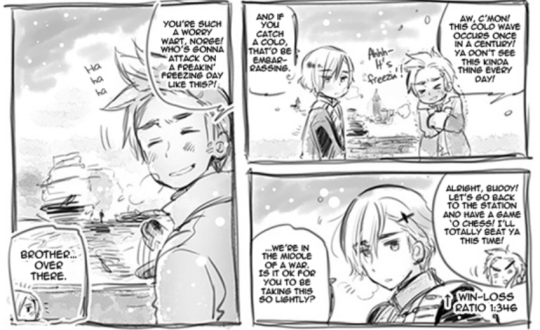
After showing concern for Denmark’s health, Denmark refers
to Norway as a worry wart.

image

Norway is also noted to stick his nose into Iceland’s business a lot.
Notice the use of words. While bugging Iceland may be a bonus for Norway, who
does in fact enjoy teasing Iceland, there’s a clear emotional investment to
look after his little brother’s well-being.

image

Misconception: He
doesn’t have a sense of humour.

Norway has a great and subtle sense of humour, albeit odd.

He and Iceland refer to each other as punks (totally
adorable).

image

When Iceland has trouble getting his goods noticed on the
market, the other Nordics develop a plan to help the former out. During their
brainstorming, Norway jokes and says that he’ll dance as part of the process.

image

Misconception: He’s
mean

Norway has a gentle and shy way of showing his kindness that
is often overlooked.

Back to the idea of him poking his nose into Iceland’s
business, Iceland secretly doesn’t mind Norway’s interference. There’s nothing
but good intentions on Norway’s part, as he’s always looking after Iceland’s
best interest.

image
image

Speaking of which, remember that time when Norway didn’t
know what present to buy for Iceland?

Norway sends Iceland a link while they’re both outside a
present shop and gives Iceland the option to choose what he wants. Iceland gets
flustered and tells Norway that anything will do.

image
image
image

Sweet, thoughtful, sarcastic, and subtle, that’s just how Norway (t)rolls.

image

I know this might be hard to answer, but can the nations be born just by coming into existence without any birth process?

While I can’t really speak for the other nations, as it’s not
made explicit, this does happen with Iceland. He just wakes up and
automatically knows he’s different.

image
image

With Greece and Egypt, they both refer to Ancient Greece and
Ancient Egypt as their mothers, but I’m still skeptical on whether they were
actually born in the traditional way.

When Iceland is born, he instinctively senses Norway as his
older brother. Maybe that’s what happened with Greece and Egypt too. They woke
up and automatically knew who their mothers were.

image
image