I’ll kindly direct you to my post directory, considering
that most of my posts tackle how Hetalia is riddled with serious,
thought-provoking, and dark subject matter [x].
The scars that accumulated on Lithuania’s back, a
consequence of being under Russia’s rule [x].
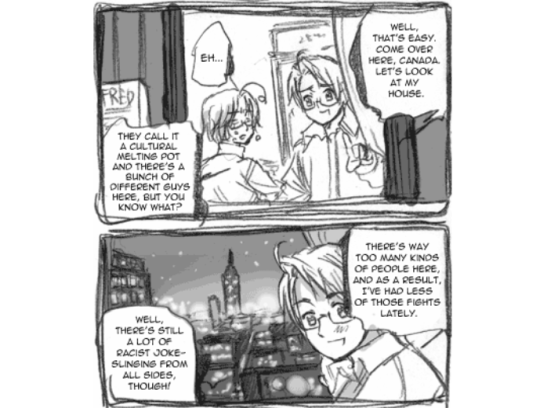
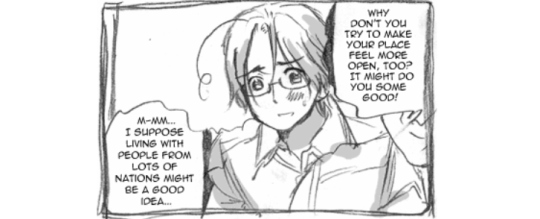
America giving advice to Canada on being open to welcoming people from different races, ethnicities, cultures, and religions [x].
England asking for Italy’s help in improving his artistic
skill during the second Industrial Revolution. Due to his and Romano’s rough and
sudden unification, Italy breaks down crying:
“It’s been so long since anyone has trusted me this much.” [x].
Prussia signing a treaty with Japan and teaching him German during the latter’s Westernization period [x].
Okay, but don’t you see how problematic it can be when angst overrides history and culture?
Don’t get me wrong either. I’m not a canon-police type person. I 100% believe in artistic liberties, but from the fics that I’ve seen depicting this trope, they don’t label it as an AU. It’s portrayed as canon-verse. If the author states at the beginning that they’re departing from canon and recognizes these cultural and historical differences, then maybe, but you also have to recognize how sensitive and personal this topic is to some people.
They’re two separate personifications for a reason. There are other ways to enjoy angst in the series too. No one’s stopping you from doing that.
Anon 1: Yes and no. The meme was literally just me
expressing confusion over why people find it so difficult to understand that there
are two Italies despite the fact that Himaruya’s explained the reason several
times lol. As for the Civil War, in all the civil war strips we’ve seen thus
far, a second personification hasn’t been officially created.
I really just think it’s mainly the historical and cultural
differences that prompted two personifications. The old post you’re talking
about (2006) simply explains that Italy was divided into two countries during WW2
and that it was only Romano who switched sides [x] [x]. The decision to divide them
wasn’t just because of their relations in WW2, as you see Romano separately characterized
in the original Chibitalia webcomic (2006).
Anon 2: All important points. I’ll never understand why the “only
one Italy can exist, one’s going to die” trope was ever made up. On top of
Himaruya repeatedly explaining why there are two of them, there’s no
canon evidence that substantiates this.
Himaruya: There are two Italies due to their different cultures
and histories. Romano represents the South, and Veneziano represents the North. Simple!
Most dangerous nations: Belarus, China, Germany, Finland, Hungary, and Russia.
Most underestimated nations: Belgium, China, and Italy.
Hardest workers: America, Germany, Japan, and Romano (if he has the motivation).
Laziest nations: Austria and Romano.
Note: This theory will make use of Freudian theory. While I
recognize that Freud’s ideas do not bear much contemporary relevance, that
shouldn’t take away from the fact that many of his concepts (e.g., erogenous
zones, childhood memory repression, catharsis) are nonetheless employed by Himaruya
in the series. The purpose of this post is to give some insight into the
psychologies of the characters.
Ever wonder why Italy
acts so childish sometimes? From a perspective of psychoanalytic theory, this
would be seen as a re-enactment of the insecurity and fear of abandonment that
Italy’s held since his childhood.
What is Regression?:
Regression occurs when a
person experiences stress and reverts back to an earlier stage of development
where life was easier. A lot of these childish behaviours have to do with
insecurity and the seeking out of comfort.
For example, if social
situations stress you out and you have a tendency to cling to a friend or
spouse, this behaviour is comparable to a child that clings to their parent for
protection. Another common example would be grown adults sucking their thumbs
when they’re stressed. An even milder version would be biting your nails.
Babies teeth and suck as a form of tension reduction; it soothes them, just
like an adult biting their nails or sucking on their thumb would.
We know that Italy’s
childhood was far from healthy. He went from the security, comfort, and
undivided care of Rome to being routinely conquered, subjected to countless
wars, and being forced to live in a strange and foreign environment – Holy Rome’s
household [x].
This abandonment, insecurity, and
fear of being left behind is still alive and well in Italy’s adulthood. What
you’ll see is that just like a child who seeks comfort in the ‘big’ and ‘strong’
authority figure that is their parent, Italy unconsciously sees Germany as a
replacement for Rome.
That said, let’s tie
this back to the strips.
Italy’s Adulthood:
When Italy and Germany
first meet in WW1 as enemies, Italy pleads for Germany not to open the tomato
crate that he’s hiding in. He comes up with the childish ruse that he’s the
spirit of the tomato box. While this could just be used for comic effect, I
still think it’s interesting to consider.
This example, on the other
hand, makes a lot more sense to me if I analyze it from a Freudian perspective.
Remember when Germany takes Italy as a prisoner of war and we get that bizarre
scene where Germany lets Italy escape, only for Italy to come waltzing right back
into his imprisonment?
Of course, the reason
that Italy does this is that he doesn’t want to go back to war and fight. On
top of that, what Germany’s providing for Italy here is a sense of comfort and
security – just like a parent would. That’s why Italy wasn’t so keen to leave.
We also get this scene. Italy has a nightmare where he’s left behind by Germany and Japan.
What prompted this was Russia’s alliance with Germany. His greatest insecurity
is that he’s useless and doesn’t bring any value to his allies [x].
He fears being alone.
The parallels between
these next two scenes are uncanny.
After waking up from his
nightmare, Italy runs all the way to Germany’s house in the middle of the
night. While he may not realize it, Italy’s seeking comfort and reassurance.
Now, compare this to the
scene with Chibitalia. Upon being frightened by thunder, he hops into bed with
Holy Rome [x].
Side note: Holy Rome and
Germany literally have the same emotional and verbal responses, just saying.
Point is, Italy’s fear
of being alone was developed early in his childhood and it’s continued into his
adulthood.
In sum, Italy’s childish
behaviour doesn’t appear to be simply for the fact that he was originally
intended to be a derpy character by Himaruya. A lot of Italy’s clinginess stems
from childhood fears of abandonment and the subsequent insecurity of being left
to fend for himself in a world that has consistently proven to be hostile,
brutal, and unfair.
Well, they weren’t exactly successful at being stealthy.
This post will use attachment theory to analyze Romano’s
attachment style – how he forms relationships with others – in adulthood. The
previous post to this analyzed how Romano’s unhealthy and insecure attachment style was
developed as a result of his childhood [x].
Previously in
Psych-talia…
What is Attachment Theory?
Attachment
theory focuses on the relationship between a child and their caregiver.
Central to the theory is the concept of needs. A child relies on their
caregiver to protect them, provide for them, and care for them. If all these
needs are consistently met, the child develops a healthy attachment to their
parents. This healthy attachment style positively
affects both the child’s personality and their capability to establish and maintain
healthy relationships as they grow older.
However, if needs are not met at all,
or are sometimes met and at other times are not, this inconsistency causes the
child to develop unhealthy attachment styles. As such, they
develop unhealthy personalities and form unhealthy relationships with others.
The Ainsworth
experiment was where this theory originated. To test the attachment styles
between toddlers and their caregivers, they would put them in a room together
at first. After a while, the parent would leave and the child would be left on
their own. Then, a stranger would be introduced to the room and leave after the
toddler had a chance to react. The last part of the experiment analyzed the
toddler’s reaction once they were reunited with their parents again.
Being in a “strange
situation” – a foreign room, absence of a parent,
and meeting a stranger [danger] – created a lot of stress in the
child. Since children seek protection from their caregivers, this stress and
fear would typically cause the child to become upset and seek reassurance from
their caregiver. It’s a survival instinct that innately kicks in.
Those with a secure
[healthy] attachment style would cry or be upset for a bit but would be
easily calmed once their caregiver soothed them. The healthiness of this
attachment style means that the child knows that the parent is there for them –
they can be relied on to satisfy their needs.
While there are several different
unhealthy attachment styles, only one is important for this post. An insecure
ambivalent/ preoccupied attachment style is seen where the caregiver
returns but is unable to sooth the child. The child often responds with anger, and sometimes they can even become aggressive.
The unhealthiness of this attachment style means that the parent
inconsistently meets the needs of the child. In other words, their care for the
child is inconsistent. They’re either overbearing when they meet the child’s
needs, or they’re completely unavailable and don’t meet them.
This inconsistency causes a sense of hostility and distrust to develop
in the child. They don’t want to rely on their parent, but know that they have
to if they want to survive… a love-hate relationship if you will. The anger and
aggression are symptoms of this contradiction. Anger is also a way that the
child learns to communicate their needs to their parents.
Let’s tie this back to the strips.
What’s Romano’s attachment style?
What you’ll see with Romano is that he has an ambivalent/
preoccupied attachment style stemming from two parental relationships. His
needs were not consistently met since Ancient Rome spent most of
his time rearing Veneziano. The unavailability of care.
Then, Romano falls under Spain’s rule, someone
who goes out of his way to care and provide for Romano. The overbearingness of care.
A full
analysis of Romano’s attachment style in childhood can be found in the first
part of this series.
Romano’s Attachment Style in Adulthood:
While
attachment styles are developed in childhood, they often follow a person throughout
their whole life. It affects how they form relationships with other people, how
they maintain them, as well as, you guessed it, how secure they feel in romantic
relationships. Given that Romano hasn’t been depicted to be in a romantic
relationship, this analysis can only cover platonic or familial relationships.
Adults
with ambivalent/ preoccupied attachment styles are hot-tempered, angry often,
constantly complain, and get pissed off easily. In relationships, they embody an
“I love you, I hate you” pattern of communication. In other words, they have
jealousy issues and will say one thing but mean another. Another example of
this would be person A being reliant and dependent on their partner, person B, and
yet claim that they don’t need person B.
Romano
and Spain share a very complicated relationship, given that Spain evolved from
a parent/ older brother figure to a confidant and close friend of Romano’s.
The
love-hate relationship is made clear in one character note that claims that
Romano doesn’t see Spain as a friend or an enemy and that their relationship is
in a grey area.
Other
interactions in canon completely contradict this.
For
example, when Romano moves to America for work during the Second Industrial
Revolution, it’s stated that he’s closer with Spain than he is with his own
brother, Veneziano [x]
It’s
for this reason that the first person Romano calls when he’s in this new,
scary, and unfamiliar environment is Spain.
Spain
is happy to give Romano advice and acts as his biggest supporter.
Notice
how frustrated Romano gets at certain points in the conversation. The running
gag between the two of them is that there are times where they completely
understand each other and times where they don’t at all. In this case, Spain’s
easily distracted mind irritates Romano.
Point
is, Romano is dependent on Spain despite constantly cussing at the latter and
insulting him. Remember, anger is a communication of needs for these people.
Here, Romano has trouble getting through to Spain, who is available to
talk seriously for some parts of the conversation, only to get completely
side-tracked and be emotionally-unavailable for the majority of the phone call.
Romano
is also dependent on Spain in terms of comfort.
Ex:
This occurs when the price of pasta sky-rocketed.
One
last example of this love-hate relationship with Spain would be when Spain
experiences an economic recession and almost dies from it [x]. Pay attention to how
Romano shows his love and care for Spain through actions, yet repeatedly verbally
berates Spain as he saves him.
Romano even had to square off against the Mafia, whom he’s normally terrified of and is coerced into doing favors for.
Love- Hate Relationship + Jealousy – Veneziano
Ever
since Unification, the two haven’t seemed to get along.
Romano still resents
that Veneziano was given the special treatment by their grandfather and feels
inferior. Longer post on that here [x].
Ex:
Romano insults Veneziano’s innovations during the Second Industrial Revolution.
This appears to stem from jealousy given that Romano compliments this very same
innovation when Veneziano can’t hear him [x].
Later,
he moves to America just so he won’t have to rely on Veneziano.
He’s
jealous of Veneziano in that he’s often referred to as “Italy’s older brother.”
He resents and perceives this as him not standing out on his own.
Ex: When he doesn’t get a part in a movie, he states that people only care about
his “stupid younger brother.”
Ex:
He doesn’t react well when Prussia refers to him as Italy’s older brother.
Ex: One character note states that Romano detests Veneziano “a bit. [x].
Ex: Veneziano once said that Romano is nice to him every eight years [x].
The
dependency of this love-hate relationship is clear as Romano relies on
Veneziano’s economy in the present, but will still bicker with him and refuse
to cooperate [x].
Romano
also complains that Veneziano doesn’t give him a chance to work – although this
is valid considering that Veneziano has a habit of taking over most of Romano’s
workload.
When
Veneziano gets Germany to help clean Romano’s messy room, Romano has one of two
reactions. Of particular importance is the mixed signals and contradictions in
how Romano communicates with others, a characteristic that ambivalent/
preoccupied people all share.
1) Excessively insulting both Veneziano and Germany, telling Germany to go
home.
2) Shock and surprise when Germany actually offers to go home – Romano wanted Germany to clean his room but was too prideful/stubborn to say this out loud.
Lastly,
the love and care of their relationship is mostly behind the scenes for Romano.
He secretly looks out for Veneziano.
Ex:
Romano scrutinizes Germany during WW2 and doesn’t like his influence on
Veneziano.
In
sum, if you look at Romano’s anger from an attachment theory perspective, it’s
not all malicious. A lot of it originates from jealous and hostile feelings
that he’s kept contained since his childhood. Romano’s capable of love and compassion
– he just has a terrible way of verbally expressing it.



 Ellawritesficssometimes