
Haha…oh no…

It’s more like I’m confused that the fandom portrays Italy as this super confident person, when in reality he’s incredibly insecure. Like, this is the one time where it would be appropriate to amp up the angst and you choose not to???


Sure, it’s very subtle, but the two do share a very close relationship. I’d love to explore it in detail!
Post coming up tonight!


Unlike in fanon depiction, Germany’s anger isn’t senseless and inherently
driven by aggression. While Germany’s short temper may have originated from aggression,
having been reared in a hostile environment, his anger later shifts to an expression
of frustrated confusion.
What this post will also explore is how Germany gets in
touch with his kinder, softer, and sentimental side, as well as his troubles in
expressing this aspect of his person.
To understand why Germany was so aggressive and angry, it’s
important to situate his life.
Germany’s childhood was not a healthy one. He was reared in
an atmosphere of constant war, hostility, and aggression. As such, he didn’t
learn how to trust and form healthy relationships with others, but rather, he
learned to view others with distrust and suspicion.

Ex: When Germany
first meets Italy as enemies in WW1, notice how suspicious, paranoid, and
hostile he is of Italy. Regardless of the fact that they’re in a war, Germany’s
reactions here are over the top.


Likewise, when Germany became frustrated with Italy, he
would use physical force. His childhood was primal in that the use of physical
force was wrongfully normalized.
Ex: Germany would put
Italy into headlocks when he fell out of line.

What you’ll see is that as Germany’s relationship with Italy
deepened into a true friendship, Germany not only learns how to be receptive
toward others, but his temper diminishes significantly. He still has a short
fuse, although in no way does he see aggression – verbal or physical – as an
appropriate method of communicating.
Ex: He begins
hugging Italy, albeit being confused by this.


As mentioned above, Germany’s friendship with Italy changed
him dramatically. Italy was the first person that indirectly taught Germany
what a healthy relationship entails.
To put things into perspective, Germany’s understanding of
relationships was so warped from his past that he needed Austria to clarify
what his relationship with Italy was.

Before asking this, he had also bought a manual on relationships.

The running gag of Buon San Valentino is that Germany panics
over whether Italy is his friend or “partner.” It’s a big misunderstanding on his part.


What’s important here is that as Germany confronts his
relationship with Italy, he comes to realize how he had normalized hostile
relationships. His relationship with Italy confused him because he hadn’t been
used to experiencing something so pleasant or “fun.”


Additionally, Italy causes Germany to experience emotions that
he’s never felt before. He never felt anxiety on the battlefield, meanwhile, his
friendship with Italy causes him to experience it. Even more extreme, is that he’s uncertain if what he experiences with Italy is happiness.

How I interpret this is that
war was something that Germany was used to; receiving unequivocal affection was
foreign and strange to him, which would explain why it produced so much panic and confusion. Similarly, happiness was not something he had learned. He’s experiencing it for the first time.
The last thing I want to mention here is how Germany’s anger
shifts to a frustration over being confused.
As Germany experiences these new emotions – confusion, shame, happy, and heartbeat– he gets angry as a result of his inability to process/
handle them properly.
Ex: Germany getting mad at Italy for flirting with girls, as
he had mistakenly perceived their dinner to be a date. The ellipses are
extremely important here as it demonstrates how overwhelmed he is.

These new emotions make him feel vulnerable and confused,
resulting in him losing his composure. For someone as ordered as Germany,
losing this sense of composure is terrifying, especially since he doesn’t like to
show weakness.
This refusal to show weakness still persists in modern
times. Perhaps this is yet another link to his do-or-die war-ridden past – it’s
a primal instinct.

Ex: I find it interesting that when Germany experiences confusion at Italy’s behaviour, it’s his mind that explodes.

Ex: When Germany’s misunderstanding is taken a step further
and he proposes to Italy, the shame of the event is enough to cause him to
blackout. We are then introduced to a pan-in on his brain, which reveals another
surplus of emotions that Germany is experiencing for the first time.


The progress in Germany’s character, then, is that as Italy
inadvertently helps Germany learn how to form trusting relationships, Germany’s
inherent hostility and distrust of others disappears. This is especially the
case following both world wars, as he no longer has to keep up his guard.
Another problem that Germany faced was that even when he
attempted to reciprocate Italy’s affection, he came across as angry and
intimidating.
Ex: Germany scares Italy just by asking him if he’s all
right after a training session and if he needs anything to drink. Italy interprets
this as Germany being angry with him.


The irony with Germany is that even though he learned how to
get over the majority of his anger and hostility, he has trouble expressing
himself.
While he may have mellowed out and calmed down considerably…

…he still comes off as angry and troubled to others.

On top of that, he also has trouble smiling. It’s something
that doesn’t come naturally to him. Just like he read a manual on
relationships, he’s once shown to be reading a manual on how to smile properly.
It’s something that he’s still working on and isn’t very easy to undo. Point
is, he’s trying.


Ex: He still has difficulty receiving praise from others.


That said, I want to end this by pointing out that however
poorly Germany expresses himself, his actions are what is truly important in
proving how sweet and considerate he is.
Ex: He loves his dogs.

Ex: He loves baking, especially with friends.

Ex: He’ll come to his friends’ aid without any question or
deliberation, no matter how ridiculous the request.


Ex: He worries about others more than himself. This is
especially relevant when you consider that he’s pretty much holding up the EU.


All in all, to portray Germany as a strictly angry character
doesn’t do his personality any justice.
Yes, he may have been
an angry and hostile character, but you have to situate that with his childhood
and understand that he’s evolved past his initial distrust of others. Germany
has always been an inherently kind person – all it took was another person,
Italy, to bring this side out of him.
It’s a tedious process, but Germany’s slowly opening himself up
more and more as the strips progress. For a person who was born in a primal
environment, of course it’s going to take some emotional priming before he’s
truly ready to show all sides of himself.

Italy: I’m going to go flirt with those girls over there.
Germany: Why are you telling me this? Do what you want.
Also Germany:


What this post aims to do is illustrate why Romano has such
a poor personal relationship with Veneziano. Aside from the fact that they’re
brothers, the two simply don’t get along.
Of course, this doesn’t mean to say that Romano doesn’t care
about/ love Veneziano, because he does. What it does say and what I will
elaborate on is that Romano holds onto a lot of anger and resentment from his
childhood which still affects how he relates and interacts with Veneziano.
To understand why Romano is so hostile toward Veneziano, we
need to situate how this hostility stems from feelings of inferiority.
An inferiority complex is a “condition that develops when a
person is unable to compensate for normal inferiority. Such individuals have a
poor opinion of themselves. They feel helpless and unable to cope with the
demands of life.”
In other words, these individuals are unable to come to
terms with the fact that there will be people in their life who are better than
them at certain tasks. They compare themselves to the person above them and let
this difference inform their self-worth.
As such, they have a low self-esteem and opinion of
themselves. The helplessness occurs from being unable to change this self-perceived
inferior position.

There are three sources in childhood that can lead to the
development of an inferiority complex. In the case of Romano, we only need to
focus on the last one – neglect.
Childhood neglect results in the child developing an
indifferent or hostile attitude of their parents. They can later develop
feelings of worthlessness and anger and view others with distrust.
That said, let’s tie this back to the strips.
Right from the get-go, early strips in the series depict
Romano feeling inferior in comparison to Veneziano.
While he still does get part of Rome’s inheritance, he feels
undercut in that he doesn’t inherit Rome’s aptitude for trade and art, unlike
Veneziano, who does.

The helplessness and inability to cope with life’s demands
reveals itself as Romano admits that he “can never win against Veneziano”,
regardless of what he does.
This unhealthy drawing of comparisons between him and his
brother, therefore, leads Romano to develop a poor opinion of himself. He views
himself as “weak” and “useless.”

He can still show his love and affection for Veneziano, but
notice how he also feels compelled to undermine him with a demeaning insult.
*They didn’t see each other very often during their separation. This is a rare occasion.


That’s why I believe that Romano constantly refers to others
as bastard, shitstain, idiot, etc. It’s because he has very low self-worth and
unconsciously needs to degrade others.
What doesn’t help is that just like Rome, Spain initially
plays favouritism toward Veneziano due to his polite manners and dedicated work
ethic in performing household chores…something that Romano wasn’t capable of.


However, as I’ve pointed out in another post [x], Romano’s distrust
of Spain when they first begin living together is a symptom of Romano acting
out the frustration of his childhood neglect.
Rome didn’t pay as much attention to Romano as he did to
Veneziano. This childhood neglect is the source of Romano’s inferiority.
This would then explain why Romano views Spain with
distrust. He wasn’t used to being consistently cared for and didn’t “attach”
himself to Spain right away, not to mention that Spain had originally wanted to
trade Romano for Veneziano.

Nonetheless, Spain eventually realizes how harmful his
valorization of Veneziano is to Romano’s self-esteem.
One strip, in particular, depicts Spain apologizing to
Romano upon realizing that Romano has his own way of expressing affection,
crude as it may be.
Ex: Romano mistakes German soldiers as enemies and ‘sacrifices’
himself to allow Spain to get away.

When Romano’s reprimanded by Spain, who perceived his
behaviour to be rude and him acting out, he gets frustrated with Spain and
snaps at him for not understanding this.


The resolution of this strip involves Spain learning to
value Romano for who he is, instead of constantly
comparing him to his brother and valuing him for what he has to offer as a conquered territory.

The problem now is that Romano’s inferiority complex still
resides with him in the present. Unlike that one childhood strip, however,
Romano isn’t able to openly express his affection for Veneziano.
Their sudden unification left a ridge in their relationship
that has yet to be rectified.


Ex: Romano refused to rely on Veneziano during the Second
Industrial Revolution. This refusal was so strong that he moved to America to
sustain himself.


Despite this, Romano cares
about Veneziano, but he doesn’t express this at a face-to-face level.
He looks after Veneziano behind his back by confronting Germany…

…and yet, will insult and degrade Veneziano and his
accomplishments straight to his face.


It’s not so much that he compares himself to his brother
more than he hates being compared to him by others. Veneziano continues to be valorized,
meanwhile Romano still comes second.
Ex: Romano snaps at Prussia for referring to him as Italy’s
older brother.

One of the few people who puts Romano first is Spain. This
is likely why he’s the first person Romano calls when he immigrates to
America. Romano canonically finds it easier to talk to Spain than with
Veneziano.

It’s not like this hostility toward Veneziano has gone away
either. The division in their relationship is still very much present.
Ex: Romano refuses to cooperate with Veneziano, the consequences
of which are seen in their country’s total economic performance.

Ex: Romano expresses frustration over his brother’s infantilization
of him. He wants to work, but Veneziano tends to take over.

Romano’s actually an extremely dedicated worker if he’s motivated enough. The issue
is that either Veneziano doesn’t give him a chance, or he stubbornly
refuses to cooperate.

While some have argued that in more recent strips, Romano
and Veneziano appear to be getting along better,
this still doesn’t compensate for why Romano continues to refer to
Veneziano as “stupid/ idiot little brother.”


Until Romano stops referring to Veneziano like that, the
inferiority complex and subsequent compulsion to degrade his brother down a
notch have not truly gone away.
Remember that Romano doesn’t express his affection using words. Even with Spain, the person whom he’s closest with, he still refers to him with insults. Nothing about the tone or the way the insults are used indicate fondness. If anything, Romano uses actions to show that he cares.
Much of Romano’s childhood inferiority affected who he is as
a person.
He’s an extremely sensitive and insecure character, having always
felt like he was never good enough.
Ex: He’s noted to be a crybaby.


Ex: He cries when his audition doesn’t make the cut for a
movie. Notice how he immediately cites other people caring about his brother
more than him as a reason for this.

Ex: He cries when Germany points out that Veneziano is
taller than him.

His character notes are the best and most explicit
indicators of his inferiority complex:
1)
He’s said to only be aloof with Veneziano.

2)
He’s said to detest Veneziano “a bit.”

All in all, it’s not that Romano hates or resents Veneziano.
He hates and resents being compared to him.


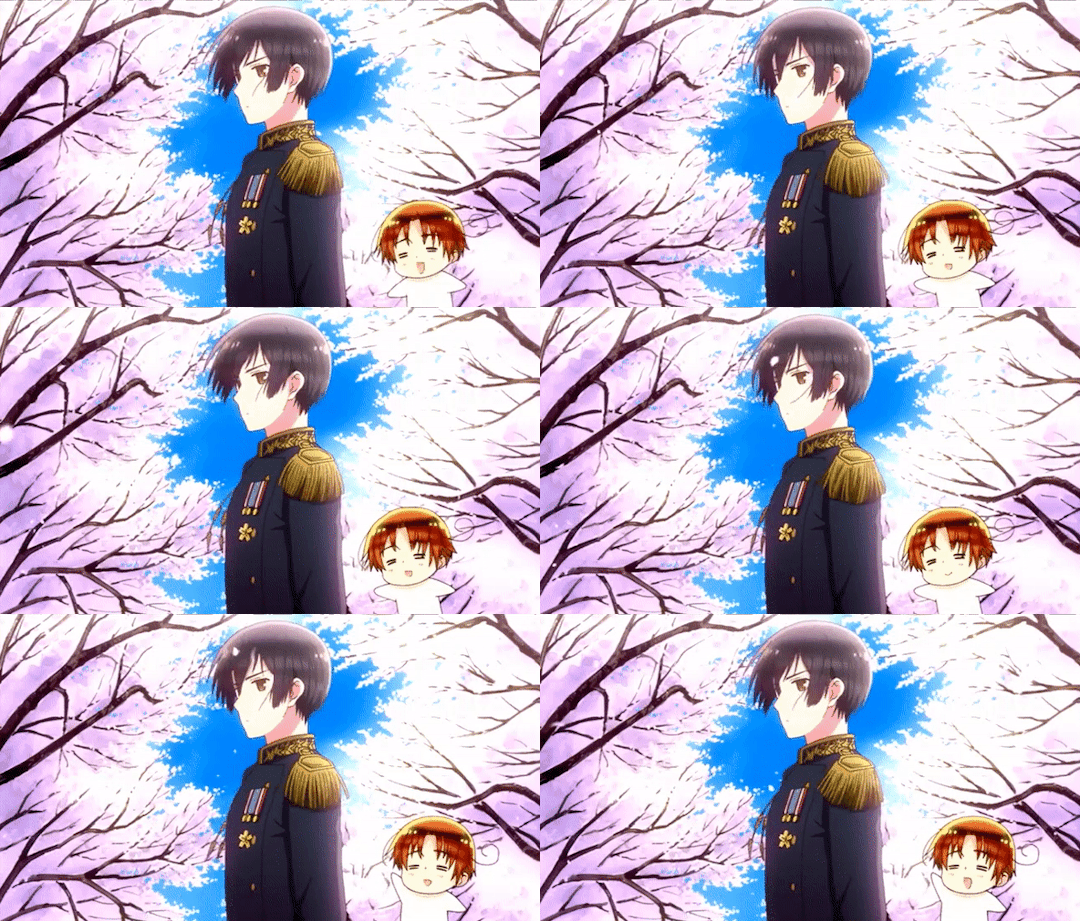
Misconception:
Japan’s emotionless
Reality: He’s shy,
but far from emotionless.
Due to his hikikomori phase, he became used to
communicating with others by reading their minds – he has clairvoyant powers.

Ex: Italy and
Romano initially believe that Japan doesn’t like them because of how contained he
was.

Ex: He’s an
introvert that taps into his extrovert side for business. He’s able to smile and
keep up with pleasantries. Like a true introvert, he’s drained after these
interactions.

Additionally, Japanese cultural display rules for emotion
are vastly different and more reserved than Western nations.

Fun fact: Nowadays, nations that are more reserved
emotionally in public tend to express themselves online in private more,
especially through the use of emojis. The Japanese
have some of the most innovative and creative use of emoticons.
Japan is very active online and has an Instagram account.

He
also has an appreciation for cute things, although he doesn’t realize it.

Ex: When he offers to wash Berlitz, he goes a bit overboard.

Ex: He asks to take a picture of England and America after they put on cat ears.


Misconception: He’s
weak because he doesn’t voice his own opinions.
Reality: He’s
tactful and is extremely careful with what he says out loud.

Ex: Following
WW2, he agrees with what America says, likely because it served to his own
benefit.


If you think about it, it’s amazing how within a decade
after the dropping of the atomic bombs, the Japanese were able to emerge as an industrial power large enough to compete with the United States.
Japan’s intelligence and resilience should be looked at as a
source of strength. It’s also important to mention that before his defeat, he
had pretty much ruled the Eastern Pacific.
Japan’s not always composed either. It’s said
that because he keeps his opinions to himself, he’ll “explode with 100 years
level” and that caution should be taken when this happens. [x]
Ex: He vehemently
opposes the idea of Germany forming an alliance with Russia during WW2.

Misconception: He’s
anti-social.
Reality: He’s extremely social, albeit not overtly.
Ex: He takes great lengths to set aside time to visit his
friends.


Ex: Japan has his own way of expressing
his happiness.


Misconception: He’s
inconsiderate.
Reality: He goes
out of his way to help others. It’s for this reason that he’s probably the most
considerate and sincere APH character.
Ex: He learns Western greetings and attempts to practice
them despite how much it sparks up his anxiety over maintaining his personal
space.


Ex: He helps England with artistic design during the Second
Industrial Revolution.

He also makes sure to praise and commend England for his
efforts, not to mention that these compliments are all genuine.


Bonus facts:
Due to his old historical chronological age, Japan’s body,
while appearing young on the outside, is actually old with age.

He’s a photo-lover.


Although Italy doesn’t remember this, Japan first
communicated with Italy in his dreams. This is the first time we see Japan’s
clairvoyant powers depicted.


He works so hard that even Germany worries about him.

He’s able to perform cleansing and purification rituals.


A pretty neat and complicated character, eh?

Mhmm. There’s an instance where Taiwan gives Japan chocolates for Valentine’s Day. Italy and France’s wink-wonk reactions allude to something more.


No. [x]
One, it’s dress-up.
Two, those aren’t guns. They’re water guns; three, I wouldn’t have expected anything different from Hima.


 Ellawritesficssometimes