If you ever need to explain a fandom to someone,
just show
them this:


By now, you should realize how damn clever and intricate
Hima’s characterization is. It’s honestly mind blowing to me how chapters and
strips spaced out years apart from
each other are nonetheless effortlessly bridged together to form a logical connection.
On a similar note, you see a lot of similarities and
respective foreshadowing between Holy Rome and Germany. It’s uncanny how they
will say literally the exact same things, like a mimic or relic of the past in
Germany’s case.
As designated by the
title, this post will focus on how fairy tales are used to hint at Germany’s
infamously known, but unconfirmed connection to Holy Rome.

In chapter 187 of World Stars, we learn that Holy Rome hasn’t
died, even though he should have given that he’d already been dissolved at said
time. Still, his end is near as he lays on his death bed.
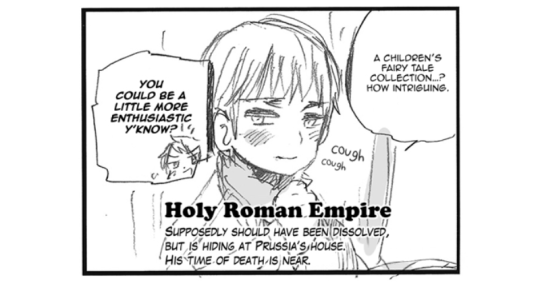
A “heartbroken” Prussia takes to
consoling Holy Rome by reading the latter Brothers Grimm fairy tales.

Notice how Prussia is not only grief-stricken,
but he’s also in partial denial. He refuses to accept that he’ll have to be a subordinate
to France and adopt French manners of propriety.
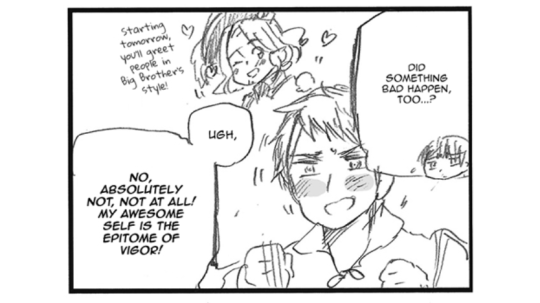
Meanwhile, even while on the verge of death, Holy Rome is
the more logical of the two. He has no problem in skeptically pointing out the
plot holes in the stories Prussia fabricates. (The original tales contained too
much eroticism, so Prussia had to take a bit a liberty when recounting them to
Holy Rome).

Regardless, what’s important to emphasize is the motif of
fairy tales – which will come up again later – as well as Holy Rome’s use of
concrete logic.
In Chapter 222 of World Stars, as Italy talks about feline
nonsense, Germany responds by saying: “Isn’t that a little too fairy tale like?”

I’m sorry, but I really do think that Hima did this on
purpose. Germany’s skepticism eerily echoes that of Holy Rome. Also, when have
you ever heard of a fairy tale that involves cats?
That one piece of
dialogue, trivial as it might seem on its own, serves as a key link to chapters
which would otherwise be completely unrelated.


The answer to the above question, if there aren’t any
inconsistencies with the timeline, is unbelievably fast. So fast in fact that
Germany completely dethrones America’s path to maturity. America goes from a
toddler, to a young child, a young adolescent, and only becomes an adult after
he achieves full independence.
Meanwhile, Germany goes from a young child to an adolescent/
young adult within one year.
No, I’m not kidding. The strips covering both Industrial
Revolutions testify to this claim.
The first Industrial Revolution took place in England in the
late 1800s (approximately 1760) and lasted up until around 1870.

The Second
Industrial Revolution had less to do with the textile industries and more to do
with machinery and steel. That’s where Germany comes in.

At the start of the second Industrial Revolution, Germany
hadn’t unified and therefore lacked behind in the industrial developments that
neighboring countries experienced.
After unification
(1871), this changed, and Germany became heavily involved in the machining
industry. Notice this panel here. Germany is immediately put to work…right
after being born.

That’s not the type of work a child would be capable of
doing, let me tell you.
Germany’s awkward mannerisms as he and Prussia converse with
England makes me believe that he’s a teenager here. He’s still new to the
world, and hasn’t quite figured out how to navigate it.

Here Germany is again, modifying English machinery.

Throughout these strips, Germany is not once shown to be a
child. His aged appearance combined with the phrase “after the unification”, as
well as the panel illustrating him instantly being put to work, hints at a
dramatic and unparalleled growth spurt in contrast with the other nations.

Now, think about this in terms of how relationally-impaired
and awkward Germany is with others. He never got to experience a proper
childhood. In the field of psychology, childhood is crucial; it’s where you
acquire and develop proper socialization skills.
If this is all true, then Germany never had a childhood. Well,
maybe.
He could always be
Holy Rome, but what’s important to reiterate here is that if Germany is Holy Rome, then he’s shown little signs
of remembering this childhood…

I agree, that scene
where Italy’s catapulted into the air by a faulty car seat does reveal a bit of
naivety on Germany’s part.

On the other hand, Germany’s
young age is mentioned several times in the manga. There’s also the fact that the scene above took place during WW2. Germany would have learned a lot more since then.


Hetalia has often been mischaracterized as something that
promotes and glorifies violence. Why? Because the initial setting takes place
in World War 2. Somehow that automatically equates to said negative image.
To that, I say this. There’s a difference between situating
a historical context and using explicit insignia to support an abhorrent
ideology. You never see the latter portrayal in the series.
While I disagree with a lot of Hima’s early characterizations and miscalculated jokes, his depiction of
fascism, communism, and war is something that I’ve always respected. It’s done
tastefully (with comical hyperbolic elements, of course), and does anything but
promote violence.

That said, it’s also important to mention that the
insensitive war jokes used in the dub are completely irrelevant to the messages
of peace and solidarity that Hima incorporates into his work. That’s the result
of other people interpreting the series and making it their own, only to botch
it entirely.
Regardless of the fact that war’s going on, Hima makes an effort
to showcase the triumph of humane and compassionate qualities in the nations.
Yes, they ‘hate’ and wage wars against each other – not having much of a choice over the matter,
mind you – but this rivalry doesn’t hold them hostage, nor does it dictate how
they interact with each other.
Conflict doesn’t dehumanize the nations; they don’t become
ruthless killing machines without a semblance of remorse or empathy. Just like
enemy soldiers called ceasefires on Christmas and occasionally organized sports
events, the nations for the most part
engage in similar civilities.
Again, it’s the conflict that’s brutal, not the nations
themselves. In fact, they have some of their admirable, most striking moments during war.
When America occupies Rome, he treats both Italies as if
they were his friends. Romano’s clearly terrified, but America breaks the ice
by politely asking them if they could make him authentic Italian food. That’s
hardly something you would see with individuals who regard each other as
enemies.


You also see nations from different alliances casually
hanging out during war, almost as if there wasn’t one going on at all. Remember
that they’ve fought each other so many times that they’ve likely matured past
being pent up on rivalries, as long as interacting with enemy nations doesn’t
go against their people’s well-being.
As they share and try each other’s rations, familiarity
appears to triumph over hostility.


There’s a clear reason why the series’ main theme is “Draw a
circle, that’s the Earth,” rather than, “Draw a border, that’s my country.”
It’s to bring the world together, not tear it apart.


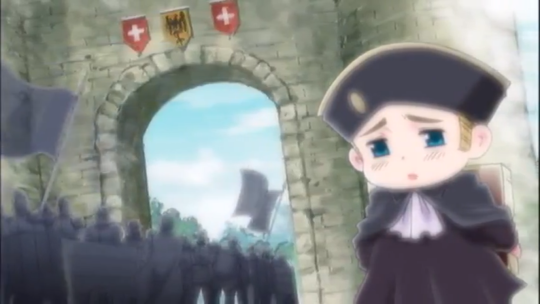
I know this might sound like a radical thing to say, but
honestly, after reviewing the strips, there’s enough evidence that points
towards the fact that… yes, Holy Rome never truly
died.
Before I start, let’s just get a few disclaimers out of the
way. Otherwise, this theory won’t work.
There’s a deleted comic where France tells Italy that Holy Rome
is dead. Note the word deleted. As such, the strip should not be taken for
canon value.

Next, there’s also the fact that people have said that Holy Rome
is given a teenage appearance in one of the requests Hima completed for the Christmas
2011 event. If this were true, then there would be a notable inconsistency
regarding his other appearances.
However, to me, this hardly seems to be the case. Holy Rome
doesn’t look like a teenager at all here. He still very much looks like a
child, judging by his height and his size when Hungary carries him in her arms.
It’s important that I mention this, because Holy Rome’s appearance in the 2011
strip is consistent with his appearance in World Stars.

With that out of the way, let’s get to the good stuff. In
chapter 187 of World Stars, we find out that even though he’s been dissolved
and should have died already, Holy Rome is very much alive and is hiding away
in Prussia’s house. He’s still very sick though, as “death is near.”

Since Holy Rome’s so weak, a “heartbroken” Prussia reads him
fairytales, likely to distract the former from the fact that he’s dying.

Moving forward a bit, we know that it was Prussia who led
the German Unification movement. He would have every reason to, as we’ve seen
from the Christmas strip how negatively a lack of unity among the German states
affected Holy Rome’s health.
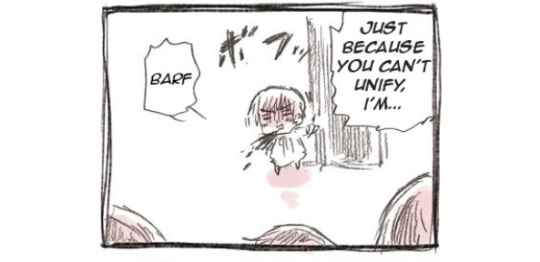
If Holy Rome hadn’t died at this point, which I’m assuming
to be the case, then it would be in Prussia’s best interest to unify the states
and form a stronger country in order to save his younger brother.

This strip takes us to just before the unification process. Pay
attention to the language used by the German states here. “New Country” and “New
brother.”

It seems like they might not be aware of the fact that Holy
Rome is still alive. Being nations themselves, they would know that it’s
possible for personifications to adopt new titles. But, judging by the words
they use, they believe him to be dead. Because of this, the possibility of Holy
Rome adopting a new title wouldn’t have even crossed their minds.
It seems that only
Prussia knew about Holy Rome still being alive…whenever that strip took place
as it’s not entirely clear. (It’s sometime after the first publication of the Brothers Grimm Fairytales.)
Anyways, before the German Confederation is able to form, Austria, also
thinking that they’re about to form a new
country, insists that he will be the one to raise the newborn Germany.
Yadda yadda, Prussia and Austria go to war, skip forward, and now we’re at
Germany’s actual birth (???).

This is so important and I cannot stress it enough. There’s
a massive difference in how the anime portrays Germany’s birth versus how the strips
do.
In the anime, it makes it seem like the German states huddle
together, only to have Germany emerge once they’re finished unifying.

The strips, which I’ll be using as the basis for this
theory, depicts an entirely different reality. When Germany’s born for real, it
doesn’t show the German states huddled together. Instead, it only shows a young
Germany being helped up and/or greeted.

He’s wearing a nightgown…exactly like the one Holy Rome was
wearing in chapter 187.

Yes, I’m aware that the nations are born in nightgowns,
but there’s multiple ways of interpreting this. The nightgown/birth motif is definitely
there, but…
Look at the one German nation holding Germany’s hand. He’s
crying. Now, put this into perspective. How would you feel if you thought your
little brother was dead, only to find out that he’s been alive all this time?
Maybe I’m biased, but Germany being helped up as well as
wearing the nightgown seems as if he’s standing for the first time after being
bed-ridden with illness for who knows how long. There’s also the fact that his
age is consistent with the Holy Romes from the Christmas event and chapter 187.
Which brings me to my next point. At the end of the chapter,
it states that Germany wasn’t born as a baby because he already had an existing
body.

We all know Hima and how much he loves to make puns. What if
“existing body” literally means an existing
body. Holy Rome adopted the title of the German Confederation and became a
stronger nation, but never actually died.
The German identity never died either, despite a lack of
formal unification. Maybe that’s why Holy Rome still managed to exist,
regardless of how physically weak he was.
The only setback to this is that there’s hints of Germany
(aka Holy Rome) suffering from amnesia. Remember that in World Stars, it’s been
made canon that it’s possible for the nations to acquire new personalities upon
changing what they personify.

Now, isn’t it weird that in the same strip where Germany’s
born, Prussia takes to reminding Germany that it’s okay to refer to him as an
older brother…482 times? It’s like Prussia’s attempting to trigger Germany’s
memory in the hopes of getting the latter to remember that he’s Holy Rome.

It would seem that on top of adopting a new title and
personality, it might be possible for the nations to also lose memories from
their past personifications.
It’s reincarnation, and yet it isn’t. I’m going to take the
liberty and coin it as “re-personification” from now on.


I…have no words for this.
(Might as well add to the sin)
*When you have to show off in front of bae to get rid of the side hoe*

Italy: I’ll never let go, Germany. I promise.
Germany: That’s nice, but can you move just a bit? I need to be able to shoot.


Note: This theory
will make use of Freudian theory. While I recognize that Freud’s ideas do not
bear much contemporary relevance, that shouldn’t take away from the fact that many
of his concepts are nonetheless employed by Hima in the series. The purpose of
this post is to give some insight into the psychologies of the characters.
Terminology I’ll go
over: Psychosexual stages, causality, regression, fixation.

Yes, that’s right. Freud’s ideas are very much prevalent in
the series. A big area of his work analyzed the impact of childhood on
personality development. Freud believed in causality, meaning that who you are
as an adult can be directly traced back to your childhood.

How you’re parented and brought up is the most crucial factor.
I don’t need to go into this in too much detail, but basically, we go through
five stages of psychosexual development titled: Oral, anal, phallic, latency, and genital.
For this specific post, we only need to focus on the early
stages of development, which focus on sensual (sensory, not sexual) pleasure and
stimulation, often for the purposes of soothing and experiencing relief.
Each stage has corresponding needs. If these needs are not
met (under-gratification) or if they are too easily met (over-gratification),
then the person develops a fixation.
A fixation essentially
means that the person is stuck at that level of development, which causes them
to develop a problematic personality type.
However, it’s only when that individual is met with confrontation
or a stressful situation that they regress back to the stage in which they
developed this fixation. The stress causes them to revert back to the age where
their needs weren’t met, and as such, adopt childish behaviours.
For example, if you get into an argument with someone and
they start behaving selfishly, like a
toddler, then you have every right to poke fun at them for having Daddy or
Mommy issues. Or, there are those who bite their nails and pick at their lips,
something akin to the soothing acquired from sucking one’s thumb as a child.

The stage that the Italy brothers appear to be fixated on is
the first stage: Oral.
The Oral stage involves the stimulation and pleasure of the
mouth. It’s where babies get their nourishment. The feeding phase within the oral stage of development is labelled
as Incorporative.
Thus, if the baby is given too much nourishment, they’ll
develop an Oral Incorporative personality type.
An Oral Incorporative personality type is someone who’s fixated
on activities that involve the use of the mouth. This can include being
extremely talkative, as well as excessive drinking, smoking, and chewing. In a figurative sense, they’re also
extremely gullible as they will “swallow” anything they’re told.
Sound familiar? If you thought of Italy, then you’d be
correct. Because Ancient Rome coddled and spoiled him, Italy’s needs were overgratified.
Italy’s extremely talkative and social, flirting with girls
left and right.

He’s also quite gullible.

Lastly, he absolutely loves to eat.

Romano, on the other hand, is the product of what happens to
a child that’s been weened off prematurely, meaning that the baby stops drinking
its mother’s milk too early. This second phase within the oral stage of
development entails teething, merely titled as Sadistic.
In the context of Hetalia this weening and subsequent
teething would be better fitted to parental neglect. Romano’s needs weren’t met
by Ancient Rome, as the latter focused most of his attention on Italy.

It’s this lack of nourishment/ care that results in an Oral Sadistic
Personality type.
An Oral Sadistic Personality type is someone that is
verbally abusive. They use “biting” sarcasm.
I mean, come on. That’s literally Romano. Cue montage.


That said, there can also be a mix of these personality
types. It isn’t just one or the other. I think we all know by now that the
characters in the series are extremely fleshed out. They remain likeable
despite bearing so many flaws.
Still, using Freud’s terminology, isn’t it uncanny how well
the Italy brother’s personality/ childhood experiences fit into this chart?
 Ellawritesficssometimes