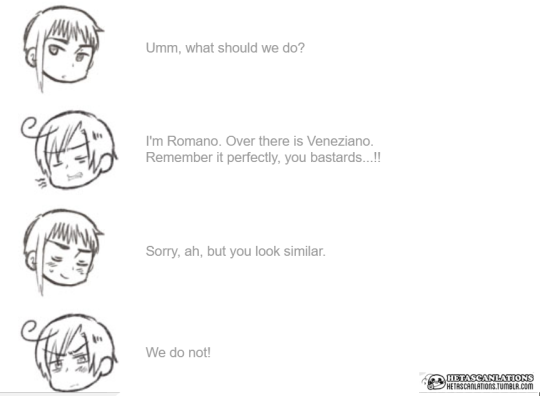
Actually, the Italy brothers have been confused for each
other before. During the Christmas 2011 event, Cyprus can’t differentiate between
them and comments on how similar they look. Romano’s annoyed response hints that
this isn’t the first time he’s explained their differences.
Likewise, just before, Canada isn’t remembered. What I find interesting is that it’s Italy who recognizes him.
I think what distinguishes Italy and Romano from each other
more so than the NA brothers is that the formers’ personalities are conspicuous;
they stand out more.
Because Canada is soft-spoken, he’s easily overlooked. Meanwhile, America’s boisterousness is more memorable.
While marriage in the series is not always romantic and may only equate to a political alliance, it does seem like Spain experienced some heartbreak over Austria.
This takes place in the Austrian Wars of Succession arc.
Then again, Spain also experienced some heartbreak over losing Italy too.
Note: I made a timeline error, as pointed out
by @feyna-v. Thank you! Please disregard the last few posts. It was a
silly mistake on my part. Thank you!
It’s not clear when exactly
Italy goes through the later stages of puberty, but unless there’s an
inconsistency in the timeline, it appears that it occurs before the Austrian
Wars of Succession. Once Italy voice drops, Austria and Hungary buy him male
clothing to wear.
In the Maria Theresa series, Italy is
shown to be wearing boy’s clothes. He’s also shorter than his adult height,
which means that he hasn’t matured in full yet.
Later, as he begins fighting for his independence from Austria,
you see that Italy has grown up, or has at least come very close to it.
The same thing happens with Romano too. Before he leaves Spain’s house, he’s matured significantly.
That said, Italy went through puberty some time before the Austrian Wars of Succession, and aged into an adult as he got closer to his independence.
All right. I’ve seen this pop up every now and then, and this
is what I have to say. I can’t find anything that would confirm this. You would
think that if Hima revealed something as
big as that, there would be screenshots to prove it. Any fangirl would leap
at the chance to prove that their ship is ‘better’ than others.
That said, there is no evidence that Hima ever said this; it’s
all just hearsay with contradictory statements that don’t line up. Likewise, there’s been many similar
instances where fans make posts, claiming to quote directly from Hima. This is disrespectful
on so many levels, and I highly encourage that it stops.
However,
and this is a big however, I’m pretty sure I know where these rumours came from.
Some fan likely used the transcript of this video
made my Hima and changed it in order to promote their ship and spread false
information.
In it, Mochi America says, “He is a British, and he is gay.”
Personally, I wouldn’t consider America x Italy to be a crack ship at all 😊.
They get plenty of interaction together, and even share a few commonalities.
For example, there’s the running gag that they’re both supposedly unable to
read the atmosphere.
Behold, a compilation of gay.
America invents
a gun that makes men fall in love with each other. The intention behind it is
to demoralize enemy troops by distracting them.
Later, Japan points out
that relationships among male soldiers in Ancient Turkey and Greece made them
more focused and ultimately stronger, as they wanted to look good in front of
their lovers. The strip ends when America points the gay-gun at his head.
Survival instincts kick in during war, causing men to feel the urge to reproduce. There weren’t too many women around, hence…
Spain proposes to Romano. Romano doesn’t say yes, but he doesn’t say no either. He sets conditions instead.
From what I’ve seen so far, my understanding is that when
Italy closes one eye, he’s usually telling both a truth and a lie; a half truth
if you will. It’s completely different from when he winks to tease or joke,
like you said.
Here’s an example:
When discussing the amount of work he does to his boss, Italy says that he doesn’t have a lot of spare time and that he’s proud of how quickly he completes work assigned to him. In a smaller blurb, he then sheepishly admits that it takes him a while before he gets around to it.
In the next panel, both eyes are closed as he blatantly lies
about why he lazes around during his afternoon breaks.
Switzerland was neutral in WW2. There would be less fighting or interaction with soldiers if Italy crossed through there, as opposed to France or Austria. It’s the safer route, as Switzerland can only threaten to shoot, but won’t actually if he wants to maintain his neutrality.
Yes, Austria was Nazi-occupied and was on the Axis’s side, but Italy doesn’t like fighting and probably didn’t want to encounter any of it. Hiking over mountains would be more preferable than having to potentially pass through active battlefields.
Misconception: America is lazy and doesn’t take anything
seriously.
Reality: He’s an extremely diligent worker. He didn’t just
magically become one of the world’s top powers.
Misconception: Russia is a psychopath.
Reality: A psychopath
thinks only in terms of themself, has subdued and withdrawn emotions, is
narcissistic, doesn’t understand the consequences of their actions, is extremely
manipulative, and routinely lies.
Russia, while maintaining a child-like personality and not
being able to understand the consequences of his actions all the time, is an
extremely emotional and sensitive individual. He cares about others and wants to
befriend them, but has trouble healthily expressing this.
Misconception: America and Russia must hate each other,
because, ya know – the Cold War.
Reality: Russia and America get along very well, but like to
tease and make passive jabs at each other.
Misconception: The Italy brothers prefer guys.
Reality: They tend to flirt with girls more, despite the
obvious Spamano and Gerita hints in the strips.
Misconception: The nations are portrayed as dumb.
Reality: They play a key role in the intellectual revolutions
their countries experience. They’re all geniuses (some more than others, arguably), having been shown to pioneer and
invent various technologies.
Ella: Yes! I have this marked down in my notes too! Still, I really appreciate that you took the initiative and time to look into this. Thank you for your excellent contribution, it’s immensely appreciated 🙂
For those wondering where these panels are from, it’s in Comic diary 3, titled “A dream I saw once.”
The other strip that I cited in a previous theory is from Comic Diary 7, titled “No-Good Chibis 2.”
Given the fact that both strips were made relatively close to one another, you can tell that Hima’s really trying to emphasize this idea of repressed memories as a result of conflict and traumatic experiences in early childhood.
Remember that while Freud’s theories may be problematic in many aspects, the importance and relevance here is that Hima is very likely incorporating some of these concepts in his writing.
That’s why I’ll eventually be starting a “Psych-talia” series. You’ll find that a lot of the characterization of the nations falls in line with how Freud classified personality types, especially with regards to the five Psychosexual stages. I’ll try to keep it as simple as possible, though.
If you have a basic understanding of Freud, chances are that you’ll understand the motives for a lot of the nations’ behaviours and personalities. You especially see this with the Italy brothers, Germany, Austria, Hungary, England, and America.
Note: This theory makes the assumption that Germany was reincarnated from Holy Rome.
Those who have read the strips will know that a recurring theme is Germany’s love for Italian culture and history; he thinks of the nation as a sort of paradise.
What strikes a chord with me is this specific panel. Here, Germany has a revelation while vacationing in Italy. Basically, because Italy is such a paradise, he understands why Goethe wrote so many poems about the nation.
All right. I’ll point out the obvious first before delving down into the deeper meanings of all this. Both Holy Rome and Germany have a profound love for the Italian nation, which most people see as a link between the two.
What I’ll be proposing is that this reference to Goethe hints at something extremely significant about Germany’s personality and characterization. It strongly alludes to his possible reincarnation from Holy Rome as well.
Goethe is most known for his play “Faust”, whereby the demon Mephistopheles makes a wager with God. Mephistopheles claims that he will be able to succeed in “luring” God’s favourite human, Faust, away from his pursuit of knowledge of all kinds.
What’s important here is that Faust outgrows scientific, religious, and humanitarian-philosophical teachings, choosing instead to learn magic as it will provide him with “infinite knowledge.”
Sound familiar? It should, because we know that Germany is obsessed with science and data.
He’s also quick to deny the existence of the supernatural because it’s unscientific.
However, there are strips that paint a different picture, one that shows that just like Faust moved from the scientific to that which is otherworldly, Germany is too. There are brief moments where he drops the scientific method and reveals that he may in fact be aware of the supernatural.
It’s possible in canon for deceased nations and humans to fly down from heaven and visit Earth. A human example would be Quintillus, an old Roman Emperor.
Previous to this strip, Germany was collecting ancient records of Rome, and Quintillus visits to give a more favourable account of his older brother, Gothicus, who isn’t depicted favorably in textbooks. Initially, Germany dismisses Quintillus as playing pretend and escorts him home.
What happens next is surprising. Germany privately refers to Quintillus as a “Roman boy”, which to me, seems as if he recognizes that it truly was a Roman Emperor who had just visited him.
Pay attention to the shifting of Germany’s mentality; it doesn’t seem like science is upheld within him as strongly as it used to be.
Perhaps the most important instance of this is when Ancient Rome visits Germany. At first, Germany believes this visit to be a strange dream, but soon falls into the swing of things and starts asking questions.
This question in particular is critical.
Again, notice how uncomfortable Germany looks when he asks this. Disappearing, huh? Could this possibly be a reference to Holy Rome and his newest incarnate, ahem, himself? Just think about it: reincarnation is a supernatural and seemingly magical occurrence…
It’s one thing if Germany merely asked about why and how a nation dies, but the discomfort on his face is likely an indicator of a painful memory.
This isn’t that far of a stretch either. Remember that in Buon San Valentino, after embarrassing himself by clumsily proposing to Italy, Germany panics and blacks out.
It’s precisely when people are distressed that repressed memories resurface according to Freudian psychology, and that’s exactly what seems to be the case here. The strip ends with fuzzy memories of Chibitalia.
It appears that Germany’s belief in science is waning. Either that, or he’s resorted to using science as an explanation to deny the reality of his reincarnation.


 Ellawritesficssometimes