The following post is to give a snapshot of
examples in the series that support these ships. Not all examples used are
romantic per say, but they are useful tools should you wish to incorporate them
when depicting these ships.
To break the ice, I’d like to point out that
Prussia is equally as fond of Romano as he is Italy. Himaruya goes on to state
that Prussia’s attracted to their climate and topography [x].Both ships are one-sided.
That said, let’s tie this back to the strips.
Italy:
In response to a fan question, Himaruya said
that Germany constantly worrying after Italy is a Prussian tradition [x].
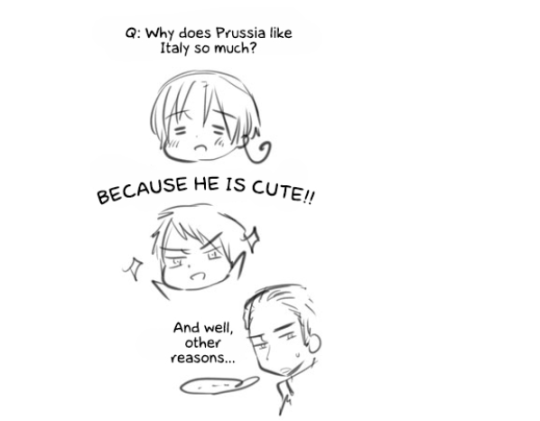
In another Q & A, he claims that Prussia
likes Italy because “a lot of things happened when they fought together,” [x]. Take
that how you will.
Several years later, we also get this panel,
where Prussia declares that he likes Italy by virtue of the latter simply being
cute [x].
This could just be attributed to him being drunk, but Prussia might also be blushing and ogling at Italy here [x].
The most obvious and explicit example is that
Prussia literally asks Italy out on a date [x].
Romano:
Again, this isn’t romantic, but it serves as an
appropriate backdrop for their relationship. When they were younger, Romano
aspired to hit “Prussia’s smirky face someday,” but settled for verbal attacks because he was scared of him [x].
Of course, this doesn’t stop Prussia from taking an interest in Romano [x].
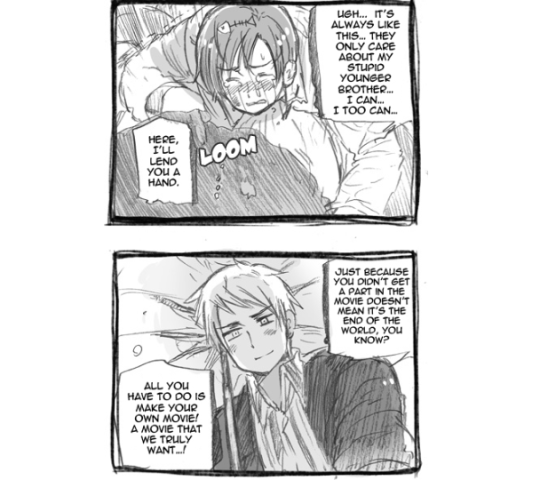
A more notable and sweet example of an
interaction between them is Prussia comforting Romano when he doesn’t get a
part in a movie. The two then decide to make a movie of their own [x].
Lastly, there’s also this strip, where Prussia unabashedly
admits to watching Romano on other occasions. In this instance, he’s watching
Romano work [x].
Sure thing! Prumano/PruIta post coming up tonight!
It’s hard to believe Canada is older than
America lol
Again, given that England’s way of measuring age is who
learned the alphabet first—not to mention the uneasiness on
his face—I don’t think we can take that as a fact. It’s something
to keep in mind, an approximation, but not a tangible answer [x].
How do you think the nation’s interact with major
international/regional events (ie the World Cup). Off the example of the World
Cup, do you think they would have any part of it (ie, helping to greet their
NT, or shaking opposing nations hands before a match, etc) or would they be
just watching it/being as involved as normal people are? Watching tv, going to
games etc. thank you so much for all your content!
You’re welcome! I’m glad
you like it!
As far as I’m concerned,
it would be the latter. We’ve seen Romano and Italy abandon work to watch Fifa
2010 (due to other Italians being reported to do this), and there’s also the
scene where Romano and Spain watch professional soccer together [x].
Can you sum up the depiction of the American Revolution for
me?
That’s something you can
read for yourself! [x] [x] [x][x].
But, you can have an
image of their mochis that’s coincidentally accurate of the event [x].
Hiya! So you’ve probably done a thing on this
already but could you make a thing about how rude Canada is?? He was pretty
mean in parts of the manga but those could’ve been faked idk
After you asked this, I did a post on the subject [x]. This is another misconception
concluding that Canada’s being mean without giving any context. He can be mean,
but it’s important to understand the reason for it. When he loses his temper,
it’s because he’s been pushed and taken advantage of too far. His anger doesn’t
just emerge in a vacuum.
It wasn’t fake either. Canada had and still has
a lot of pent-up frustration from being constantly compared to larger powers, especially America [x].
So Germany’s interested in Roman History?
Yes. There are numerous instances where he’s archiving and compiling
past historical records [x].
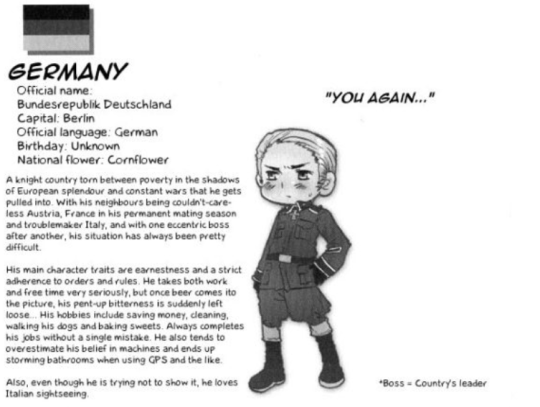
What this post intends to do is use Horney’s theory of
personality to analyze why Germany’s strive for perfection and productivity
comes at the cost of compromising his true self and confidence.
Tyranny of the Shoulds:
The tyranny of the shoulds is a term that Horney coined to
explain the occurrence in which someone’s idealized self-image replaces their genuine
self-confidence. What the person strives to be and appears to others acts as
their confidence, whereas they don’t feel confident in who they truly are,
ultimately forcing them to continually put up the former front of
superficiality. An extreme form of this would be the person developing feelings
of shame and disgrace toward their real self.
Put another way, the real self (who you are) is replaced by
how one should be. For example:
“One should always be productive.”
“One should always be punctual.”
“One should never give up.”
“One should be in control of one’s feelings.”
“One should schedule one’s day to maximize utmost
efficiency.”
Sound familiar? It should, because these are the shoulds
Germany is ruled by.
This neurotic compulsion to strive to be someone you’re not
eventually leads to the person internalizing this ideal, albeit unrealistic,
sense of self. The consequence of surrendering your real self compromises the
person’s chances of achieving personal growth and happiness. They’re never
happy with themselves and only focus
on how they present themselves to others.
How does this relate to Germany?
In Germany’s case, he puts up a front of competence, order,
and productivity. He shoulders a lot of pressure to hold up the EU and has
internalized this responsibility to look after other member-states [x].
His work self has become his primary identity…his master
status.
Of course, this doesn’t mean that he’s incapable of unwinding. He’s very favourable of vacations [x].
Nonetheless, there’s no doubt that he’s a workaholic [x].
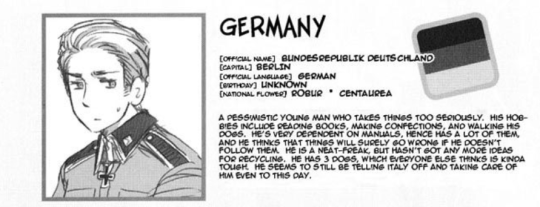
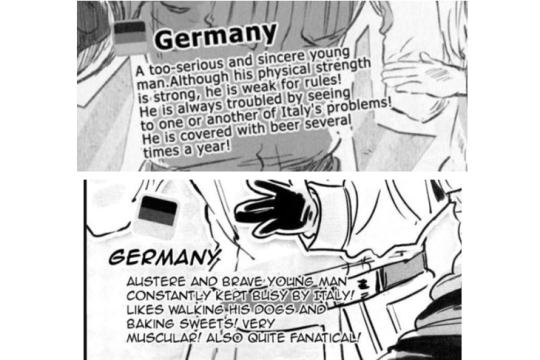
Ex: Several character notes identity him as bearing an
overly serious and compulsive personality type.
Ex: He has a whole character song dedicated to schedules, punctuality,
and routine. Public appearances are an indication of self-worth to him [x] [x]
Consequences:
Because Germany identifies with his work self, he’s
internalized repressing his emotions to the point that when he does experience
them (e.g., embarrassment, happiness), he becomes incompetent and lacks
confidence in himself.
Ex: He’s not used to being praised for his abilities outside
of work life. In this case, he doesn’t know how to react when Italy commends
him for his drawing skills [x].
Ex: He’s well-known for his inability to smile [x].
Ex: When it comes to interpersonal life, Germany is clueless
and has to rely on manuals (e.g., dating advice, teaching him how to smile). He
doesn’t need manuals for matters like business or economics due to familiarity
and experience, but when it comes to socializing he sheds this cloak of
competence and becomes dysfunctional without them [x].
There are also instances where Germany’s work self overrides
others’ impression of him, even when he attempts to be personal and social.
In sum, I’d like to end this with a passage from his
character song “Einsamkeit” that best exemplifies how his work self has
compromised who he truly is. He’s essentially alienated himself despite frequently being surrounded by other nations for his work [x].
The side of him that likes romance novels, dogs, and confectionary is completely overlooked.
I’m always said to be scowling,
But my smiling face hasn’t been erased
You may think I’m frightening,
But it’s only because I’m straining to laugh
Germany inquires about its
relevance to Roman artifacts [x].
Japan…also confuses it for a
fern sprout lmao [x].
Misconception: He’s
weak.
Reality: Austria
was born a fighter [x], but as he turned to marriage to solve his political
problems, he lost shape and became accustomed to home life. He’s actually quite
lazy now [x].
Misconception: He
was cruel and heartless when he ruled over Chibitalia.
Reality: While he
was strict and stern with Chibitalia, a lot of this can be attributed to the extreme
and exaggerated humour employed by Himaruya in the series’ early days.
Even with the strict punishments, Chibitalia still shared
many fond moments with Austria—nations living in Holy Rome’s household
considered each other to be family and even maintained this sense of closeness
decades afterwards [x] [x].
Misconception:
Due to historical tensions, it’s impossible that he and Hungary were able to
possess such a strong relationship under their empire. [x].
Reality: Yes and
no.
You have to remember that the nations are people too. They
have a political self and a personal self. It’s for this reason that while
Hungary has “defiant” feelings from her time spent under Austrian rule, she also
has “complicated, yearning-like” feelings for him [x].
How I interpret this is that she despised Austria for what
Austria the country stood for at the time but not who he stood for as a
concrete and separate person.
Lest we forget all the times where it’s hinted that the
two still have feelings for each other. The most notable panel that substantiates
this claim is from Buon San Valentino. There, Hungary receives a Valentine’s
day gift from someone with “glasses and one hair standing up,” [x].
“He hides his name but not his Mariazell.”
Misconception:
Austria and Prussia hate each other.
Reality: Again,
yes and no. It depends on the time period. The ‘hatred’ isn’t deep-set but
rather it’s temporary. Himaruya once said that it would be fun to draw Austria, Germany, and Prussia as a “chaotic sort of family,” [x].
Undoubtedly, Prussia gets on Austria’s nerves…a lot [x]. (Another good reference would be the Maria Theresa series).
Still, the strips have also shown that they don’t truly hate each other.
Ex: Austria
receives a censored letter from Prussia (who was under Soviet rule at the time)
and reads it out of pity [x].
Ex: The two still
consider each other to be ‘family’ and spend their holidays together despite
all the fighting it causes (Christmas 2010 Event).
(Prussia initially didn’t want to let Austria spend
Christmas with him because he was a “lesser German”. He was just being an ass;
I wouldn’t take it seriously, especially given Germany’s response).
Bonus Facts:
He’s considerably self-critical.
Ex: He wears his glasses to avoid looking plain. It’s not
from poor eyesight. Instead, they represent his “musical something,” [x].
Ex: Being unsatisfied with his appearance is enough to make
him feel discontented [x].
Similar to Freud’s “anal-retentive” personality-type,
Austria is a stingy [x] perfectionist [x].
His mole acts as an erogenous zone, not his ahoge
[Mariazell] [x].













 Ellawritesficssometimes