
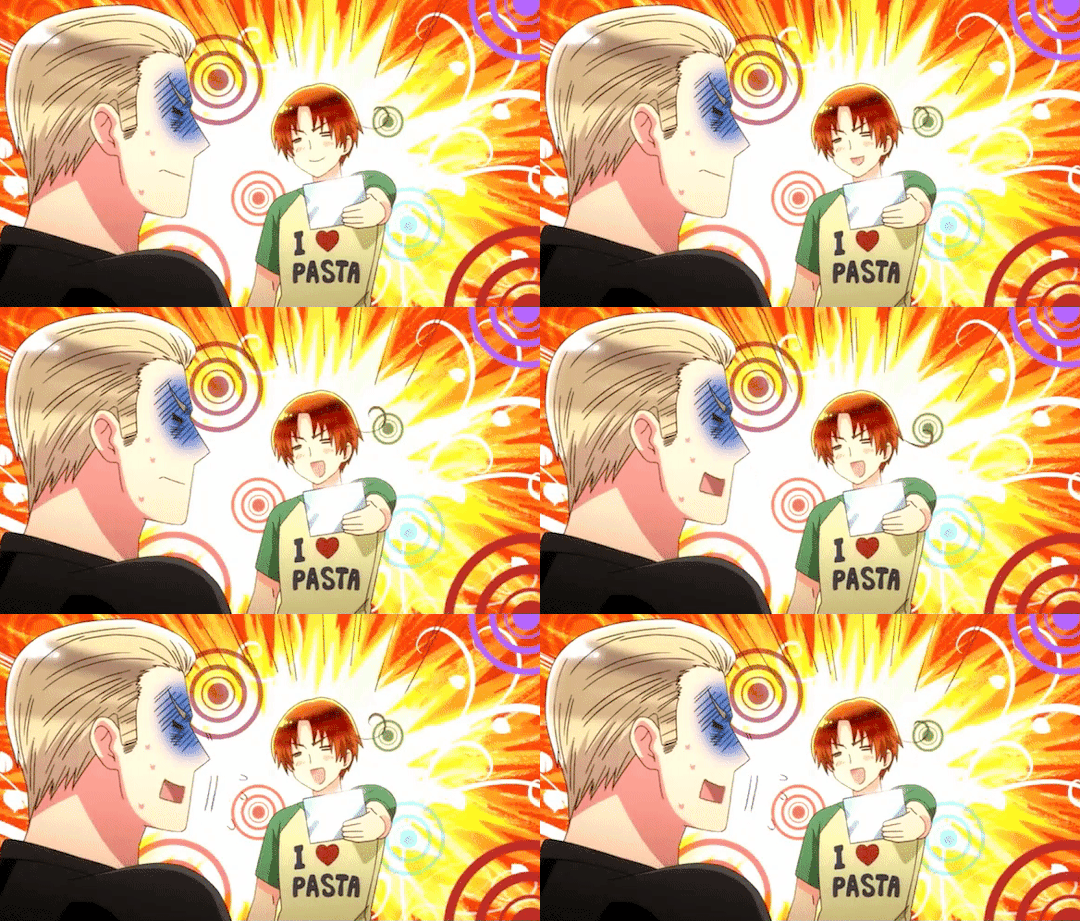
Figured you would appreciate this scene [x].



Misconception: The nations are a secret kept from the public.
Canon: The nations are well-known to the public. Their
existence isn’t a secret.


Misconception: The nations can speak all languages and
inherently understand each other.
Canon: There is a general meta language that they all understand but will still sometimes need translators during first meetings [x].
Thank you to @jammerlea for bringing the former point to my attention [x].


Misconception: “Flying Mint Bunny” and “Gilbird(s).”
Reality: These are fanon names. Both pets haven’t been given
an official name.

Misconception: Holy Rome died immediately after his dissolution.
Reality: He didn’t die right away and instead sought refuge in
Prussia’s home. To this day, his death has never been seen or confirmed [x].

Even in the deleted strip—not to be taken as canon—where France informs
Italy that Holy Rome is “no more” leaves things vague and open-ended.

Do you think America trusts his own gov?
currently only 18% of the us trusts the gov and the rest doesn’t. I’m not really
sure if they’ve gone over that in hetalia, the only time I can actually think
of one time were america was unsure(??) of his gov, is that one ep where he
finds Tony but his boss or gov tells him that he can’t tell anybody and that it
didn’t happen. Maybe I haven’t found anything yet or I’m just looking too deep
but yeah I was kinda wondering that.
It’s not clear on
whether he trusts them or not, not that he really has a choice on obeying them anyway. Nations are
forced to comply with their bosses’ orders regardless of their own will/
opinion over the matter [x].

You’re talking about the
Roswell incident where he was deliberately lied to about the UFO by his boss
(the president) and was instead told that it was a weather balloon. (Source: Assault☆The neighbor’s Roswell Incident.)

Because
that’s one of the minimal scenes where we see him interacting with his boss
(another example would be in the “Black Ships have sailed” strip), there isn’t
enough information to form a solid conclusion on what you’re asking.
@amuamoami asked: Are
there any other african (black) characters in hetalia besides Seychelles? The
only issue i have with hetalia is that I dont see much color diversity.
There
is color diversity (e.g., Ecuador, the Asian nations, Spain, and Portugal— not to be confused with race, which doesn’t exist in Hetalia).
Cameroon is the only other official black character with a full
design [x].

There’s an unconfirmed female who may or may not be an African nation that visits Seychelles in Volume 6 (most people speculate that it’s Madagascar due
to the use of third person in one panel).

Lastly, there were some “chibi head”
illustrations that appeared in Gauken Hetalia [x].
I understand your sentiment. On the other
hand, Himaruya does have a habit of travelling to countries before he creates a
character for them. There’s also the whole matter of how messy and complicated
it would be to try to depict the subject of colonialism intersected with race.
It would be pretty unavoidable if he were to create these characters.
What are your personal opinions on Czechia and Slovakia?
They’re some of my favourite characters!
They’re hilarious
together! I love them! Taken out of context, this scene is even funnier for
some reason [x].


There isn’t much to base
my opinion on, unfortunately. There are very few interactions between them.
Ex: They have tea
together [x].

Ex: India comes to
England’s aid after the American Revolution and heals the latter [x].

Do you have any particular mischaracterizations of Hetalia
characters that you absolutely hate? This can also include falsely portrayed
relationships and such.
Hate is a strong word, but I definitely get irritated.
People’s inability to reconcile the idea that
deleted material is deleted material and that the shock “perverted” humour used
in the past by Himaruya, while incomprehensible, is no longer incorporated in
the series. France, in particular, would be a prime example of this.
So now there are 4 italy brothers?
I suppose if you want to think of it that way. The German
States/ states are considered to be Germany’s brothers, so I don’t see why not [x]. Just know that this isn’t confirmed in canon.

Why there is a personification of Genoa if
Veneziano was the North of Italy since his childhood?
As mentioned in previous
posts, nationhood isn’t exclusive. It can extend to any organization of people,
formal or informal. Veneziano represented all of North Italy, whereas Genoa is
a more specific personification [x].

If it helps, think of it
this way. It’s no different than Holy Rome representing the collective of German
States despite them existing individually. Not to mention that these German
States evolved to become states (note the difference in capitalization).
Which characters do you think are the most developed?
America, England,
Germany, and Italy.
I see that all the cats in nekotalia have the nations as the
owners, but are They the cat versions of their respective nations or just an au
where the nations are cats?
They’re cat versions of
the respective nations. (Source: Volume 6).


Hi there! Love your blog, your theories and
such are very interesting:) You know how countries live by their bosses orders?
What do you think happens when they disobey their orders to stop a war from
breaking out? What are the consequences for them, as a personified country? I’m
very curious.
Thank you!
Unfortunately, I can’t answer that question considering that there are no
facts/ similar situations in the manga for me to base a response on. That’s
more along the lines of a headcanon ^^


What this post will explore
is the impact of Austria’s and Hungary’s parenting style on Italy. There is no
good and bad here. All I aim to do is give reason and meaning to the
problematic behaviour and relationships that are depicted in the series. The
characterization is done for a specific purpose. What I seek to do is bring
several parallels to light to prove this.
One of psychologist Karen Horney’s theories explored how problematic
parent-child relationships often result in the child developing neuroses
(mental health complications), such as anxiety or depression.
However, rather than assert
all the blame on the parent, she went on to explain how parents who have been
reared in an environment void of love, care, and affection are incapable of
raising their kids in any other manner.
Put another way, parents pass
on their neuroses to their children. You can’t expect someone to provide the
care, warmth, and love that they’ve never experienced and learned themselves.
On the other end of the spectrum, these problematic parent-child-relationships
and parenting techniques are learned and repeated through
generation-to-generation. It’s a cyclical process, that, unless consciously
recognized, results in all sorts of emotional trauma.

What Horney believed to be the Basic Evil of these problematic
parenting styles is Parental Indifference, which can also include a
hostile or rejecting attitude of the parents toward the child. This parental
indifference can cause the child to develop feelings of Basic Anxiety or Basic Hostility –
both of which, if not attended to, can lead to mental health issues.
For the purposes of this
post, I only need to focus on Basic Anxiety. Basic Anxiety occurs when the
child develops feelings of loneliness and helplessness in a world that they
perceive to be hostile and dangerous.

That said, what I’ll now
analyze is how Austria’s and Hungary’s upbringings were passed down to Italy.
Let’s tie this back to the
strips.
As expected, having had to
fight for their autonomy to prevent themselves from being conquered caused
most of the nations to have rough childhoods. The world of war is full of
uncertainties, fears, and insecurities. Of course, Austria was no exception and
had to experience this too. However, rather than fighting, he attained his
security through many alliances and marriages (e.g., the Swiss-Austro
partnership and the Austro-Hungarian empire).

Nonetheless, Austria did
experience a total loss of control as a child [many times].
Ex: He lost several battles to Hungary [x].

This total loss of control is
later inflicted onto those who Austria conquers. Again, I’m not attempting to
justify any of the following behaviours. What I hope to do is provide insight
into the reasoning behind these behaviours. I should also mention that there
are a lot of grey areas in the manga; to depict the scenarios as black and
white doesn’t do the series and characters any favors.
What’s important is that
these behaviours have been wrongly normalized as the ways in which nations
function and interact with each other. It’s a cycle that’s repeated.
When Austria first assumes
control over Italy, he makes him the equivalent of a servant. As such, Italy
loses total control over his political affairs [x].


It’s a harsh world where
deviance [rebellion] is strictly prohibited. The punishments are respectively
just as strict and harsh—this would entail the hostility component of Horney’s
theory.


Of course, this doesn’t mean
that Austria wasn’t only hostile with Italy. They shared several fond moments
together and were considered to be a family unit.


What would matter to Horney
is how Austria’s inconsistent parenting style of being a simultaneous source of
love and affection and a hostile enemy to be feared affects Italy’s mental
health later in life.
Italy’s helplessness in
adulthood is most seen in his clinginess, stemming from his desire to seek
safety and security from the world that has consistently proven to be dangerous
to him. First, Rome died and Italy was conquered by Austria. Flash forward to
WW1 and he’s once again in the hostile, unpredictable, and insecure world of
war.
So, what does Italy do?
He seeks safety.
With who?
Germany, his enemy at the
time.
When taken as a prisoner of
war by Germany, Italy doesn’t attempt to escape, even when provided with the opportunity
to. How I’ve interpreted this before is that Italy does this to seek security.
He explicitly states this too. Even as a POW, he still has a roof over his
head, can sleep without worrying about being attacked, and can expect to be
fed.


On the other hand, war isn’t
the only sphere in which Italy feels helpless. Corruption and the tyranny of
the mafia have once again rendered him void of total control over his political
affairs. I would even go so far as to say that he’s adopted a sense of learned
helplessness.
Learned helplessness occurs
when a being recognizes the inevitability of their negative situation. The result
is that they don’t attempt to escape from this situation but instead cope with
it.
A prime example of this would
be when Italy has his car and wallet stolen from him. Rather than calling the
police, he goes to Germany for help. The fact that it’s Germany and not Italy
who reports to the police implies a conscious recognition on Italy’s part of
their inability to do anything about the event [x].


In other words, being stolen
from is something that Italy’s normalized.

Hungary, having been reared
in a more supportive environment, doesn’t pass down neuroses to Italy, unlike
Austria.
Instead, Hungary passes down the ability to trust in others. She had the
rare privilege of growing up with a parent figure. Magyar raised her to be just
like him [x].

Point is, this ability to love and care unconditionally is replicated
in Hungary’s treatment of Italy.

The cycle repeats as Italy learns
from Hungary that even in the most hostile of environments, trust can still be
established with other nations. This trust is often excessive and nonsensical
at times, as Italy forgives quickly and will openly befriend enemies.
Ex: Italy is noted to be a
nation that doesn’t hold grudges. He hugs Austria despite having recently
fought a naval battle against him.

Ex: Italy fondly refers to
France as “oni-chan” when they both get shipwrecked during WW2.


In sum, when looking at Italy
from this perspective, it’s easy to see how Austria and Hungary have influenced
his personality.

Oh, I remember [x].


Oof. Another excuse to make an addition to the psych-talia series. Absolutely, post coming up tonight!


Here’s just a list of
terms that have a completely different meaning in the manga. This is aside from
their literal denotation.
When a nation is referred
to as a bully and/or is bullied, this refers to them being conquered or sought after
by more powerful nations.
Ex: Both Italy brothers being conquered after Rome’s death [x].


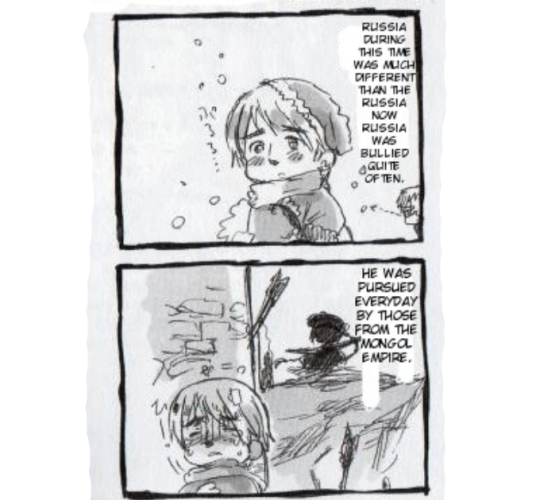
Ex: Russia being ‘picked on’ by Mongolia, Denmark, Sweden, and Prussia.

The nation’s leader.
Pretty self-explanatory [x].

While it is possible for
nations to become students and attain degrees, the term “honour student” is
used in reference to how well a country succeeds politically or economically.
Ex: Italy’s referred to as an honour student in the EU [x].
Ex: Seychelles, being among the wealthiest African nations, is referred to
as an honour student.

House refers to the
actual country itself.
“My house [country] is
known for…”
Ex: Italy expressing confusion at the foods that tourist destinations in
his country try to pass off as authentic Italian cuisine [x].


 Ellawritesficssometimes