I’m not even surprised by how well this fits.
Tag: aph Japan
Why
Hetalia isn’t racist + why it doesn’t promote Japanese imperialism/nationalism
Before I start, it’s important to get a few points out of the
way given that many of the misinformed critiques of Hetalia have been made by
people who haven’t read the original source material (i.e., the manga).
- There’s a difference between historical
situation and promoting a horrid ideology. Just because a series depicts war
and Nazis doesn’t mean that they’re inherently glorified. Of most importance is
that Hetalia promotes peace and reconciliation in spite of depicting war.
- The wars that are depicted are general and the atrocities
are deliberately glossed over. This is necessary because Hetalia is comedic in
nature.
- Hetalia is based on stereotypes, good or bad.
While some of the jokes are admittedly offensive, no nation is singled out nor
are any specific nations made to be superior in comparison to others. Every
character is made fun of for their stereotypes. Its humour isn’t meant for everyone.
- Hetalia is satire. It mocks war and nationalist
sentiments rather than promoting it.
- The dub is not canon. That includes many of the
insensitive jokes that Funimation scripted.
- The anime itself is unrepresentative of the
manga. It can only cover so much material. Don’t judge a manga by its anime
just the same as you wouldn’t judge a book by its cover.
- It’s also important to note that Seychelles has
always been dark-skinned in the manga, unlike in the anime where she was drawn
as pale-skinned. However, I do concede that even in the manga, her skin should
be darker [x].
Since I’ve already created many posts on this subject, here
are some resources corroborating the above points: [x] [x] [x] [x] [x].
In addition, I’ve also found a scholarly article in a
university publication that does a fantastic job of not only dismantling many
of the misconceptions about Hetalia but also many of the baseless critiques
that have been aimed toward it:
- It’s a fair, level-headed piece that uses original source material to prove that
Hetalia mocks and undermines sentiments of Japanese imperialism and nationalism
while also demonstrating that it takes a definitive anti-war stance.
- What I particularly like about it is that it
acknowledges that some of Himaruya’s early choices were made in poor taste but
is still able to substantiate the stance that this insensitivity isn’t
supportive of racist sentiments.
- It also shows artwork/content that glorifies
Japanese imperialism and nationalism and then compares it to Hetalia.
Overall, it’s very well-written, sourced, and informed. Below
will be a list of important quotes that I took from the article. I highly
encourage for people to read the whole thing, as it breaks down a good amount of examples from both the manga and anime [x]. The article can be found through Google Scholar.
Source:
Sands, A. T. (2013).
Belittling japanese nationalism in hetalia: axis powers. Humanities and Social Sciences Review, 2(3), 125-144.
Quotes:
“Hetalia does not
portray violence or accurate portrayals of history; Hetalia is a collection of
gags mocking militarism and stereotypes,” (125).
“Hetalia condenses
history for comical effect but retains an anti-war sentiment by belittling
wartime axis beliefs…In Hetalia, each character’s nation is targeted for
ridicule through its stereotypes, and I argue the stereotypes are not intended
to create a sense of racial inferiority,” (126).
“A close examination of
plot, character development and imagery reveals a subtle disdain for
nationalism, which purposes racism and false history,” (126).
“Manga and anime can be
a good outlet for nationalists to use, but it can also be a tool to combat
nationalism,” (128).
“For every Hetalia fan,
there is another furious anime blogger appalled by it. As the battle over
Hetalia’s purpose rages in anime and manga circles, academia has of yet not
entered the discussion with earnest,” (129).
“Hetalia does gloss over
almost all of the war, especially the darker parts of the war, but if you watch
the whole show, it is easy to realize the show is not about WWII,” (129).
“Korea as an ‘other’ in Hetalia is not nearly as
physiologically different from his Japanese counter part… Although Korea is not
portrayed physically inferior to the Japanese, critics argue his immature personality
and actions are racist. Himaruya’s choice to make Korea an immature teenager
rather than an adult may not have been the most sensible of choices, but it was
also necessary for him to create jokes tailored to Japanese stereotypes of
Koreans, which he could then subvert…On some levels, the jokes are insensitive,
and they are not politically correct,” (130).
The author also goes
on to mention how inappropriate and weird some of the “sexually charged” jokes
were, starting from page 131.
“In Hetalia, every nation has its moments when its actions
are designed to make people laugh at it, and Japan is no exception. Rather than
idolizing Japan, Hetalia’s representation of Japan is a socially awkward,
emotionally repressed, and sometimes obsequious character to be laughed at. He
is neither the proud solider in Sensoron nor the charismatic scholar of
Kenkanryu…
If Japan’s character had been a fearless soldier immune to
cultural gaffes, I would argue Hetalia would be purporting an idealized notion
of the “self” in order to promote nationalism. Himaruya’s version of Japan,
however, could not be farther from an “idealized self,” nor does he try to
blatantly dichotomize or attack a perceived “other,” (132).
“Hetalia does have politically incorrect and at times
racially insensitive caricatures. Gag comedy is based on jesting stereotypes
and thus has to have some degree of politically incorrect imagery and character
personalities. Neither in the original web comics nor in the anime version that
followed it did Hetalia attempt to isolate Japan as the dignified “self” people
should idolize. The “others” are often portrayed at the butt of the jokes, but
each nation also has its turn to be the dominant character, even at the expense
of Japan’s pride. Critics can dislike Hetalia for being tactless at times, but
I argue their accusations of supporting malicious racism are based on curt
examinations of the show, which do an injustice to Himaruya’s true intentions,”
(133).
“Hetalia’s critics decry it for more than just its perceived
racist notions; they also denounce it for its interpretation of WWII and other
historical events, which lack acknowledgement for grievances against Japan.
Gag-comedy constrains Himaruya to a small amount of time to touch on important
historical events, such as China’s discovery of Japan, Russo-Japanese War, and
WWII amongst others. The time constraints naturally appear as historical omission
for the sake of defending the nations; however, Hetalia does not attempt to
omit history to protect Japan’s pride, but rather it condenses history for
comical effect,” (133).
“By mocking the tools and ideas of war and degrading it into
a minute-long gag, Himaruya expresses his contempt for war and the foolishness
of man to pursue it, thus creating an anti-war message rather than glorifying
the imperial state as Kobayashi did,” (135).
Page 136: a good
example of how the Axis were anything but glorified, season 1 episode 18.
“Himaruya may have glossed over the atrocities of war, but
he did not glorify Japan,” (136).
“I believe that in season 4 episode 26, the final three
fragments before the credits represent Himaruya’s sincere belief in the need
for reconciliation amongst East Asian nations and Japan…Japan informs the viewer
he wanted to wait until the last to show his final technique, and in a close up
of Japan’s emotional face he proclaims, ‘But if you’re serious, I’ll get
serious, too! My final secret technique: Expression of Regret!’…
“The simplicity of the idea that peace could be solved by a
pair of underpants is the joke’s punchline, but I believe, underneath the surface,
it represents a metaphor that the path to peace and reconciliation in East Asia
is far simpler than assumed. For Japan, the path is regret,” (136-137).
“Himaruya is trying to make a comedy out of history. Hetalia
does omit many historical facts, but it was never trying to be a serious
historical discussion. When Hetalia condenses history for comical effect, the
imagery and dialogue indicate the scene is solely a gag. Himaruya’s metaphors
and cinematography suggest he views war as senseless. Rather than supporting right
wing nationalism, Hetalia appears to be a satirical anti-war anime,” (137).
Conclusion:
With all that in mind, Hetalia may have had its faults—and
still does to a far lesser extent—but
it has never advocated for war, racism, or nationalist and imperialist drives.
If anything, interpretations of the series have caused the exact division that
Himaruya’s writings have long been opposed to.

Personality-wise are Germany’s dogs the same?
I don’t think so. It’s different from the Nekos.
Ex: Berlitz is softer. He prefers to wear cute clothing [x].


I really liked how you illustrated the volume character notes. Do you think you could do that with more characters.
Thank you! Sure, I don’t see why not. Here’s one for
Germany (Volume 2):


“A
pessimistic young man who takes things too seriously. His hobbies include
reading books, making confections, and walking his dogs.
He’s
very dependent on manuals, hence he has a lot of them and things that things
will surely go wrong if he doesn’t follow them.
”


“He
is a neat-freak, but hasn’t got any more ideas for recycling.”


“He seems to still be telling Italy off and taking care of
him even to this day.”


Sure! These character notes are super helpful. Here’s just
some evidence from the manga to corroborate and flesh them out [x].
• “Before he was a little
brother-like crybaby who would immediately rely on England or France but getting blown at by the harsh
wind of the Wild West, at some point he grew abnormally quickly both mentally
and physically.”


• “Because of England’s
influence has no taste, no matter what kind of colours it has he’ll just settle
with ‘cute.’ But I
think he has some more taste left than England. Lately he has been getting into
sushi.”


•
“In fact, it’s not that he
can’t read the situations but that he doesn’t on purpose.”

•
“He’s quite much
quantity over quality.” [x].


I’m confused? Is America egocentric or not?
The comic gag is that while he genuinely cares about his
friends, claiming to be a hero, he’ll also say obnoxious things like “I’m
number one!”, “NPCs” or won’t tolerate deviating opinions.


If you think about it, this isn’t too far off from what American
foreign policy has historically been like.
The key difference is that America genuinely thinks
he’s helping, as do most Americans when they’re polled.

Okay so Italy’s curl represents the sexual something of Italians but is there anything else that it could mean?


What are your favourite England and Japan moments? The interactions between those two are always amusing or sweet. ;D
Totally agreed!
1) The Anglo-Japanese Alliance
between two lonely people [x]–
Japan reassuring England
that he wishes to form an alliance with him, not Russia.
+
England not knowing
how to react to someone legitimately wanting to be his friend, as this takes
place during the Splendid Isolation period.


England teaching Japan English despite having no idea what he’s doing.

2) World stars chapter 68– [x].
Japan teaching England Japanese ceramic art and design.


3)
World Stars chapter 142
–[x].
England sending Japan a custom postcard in reciprocation after learning that the latter had appealed to aspects of his culture.


4)
World Stars chapter 133–[x].
England inviting Japan to the opening of his maid cafe.


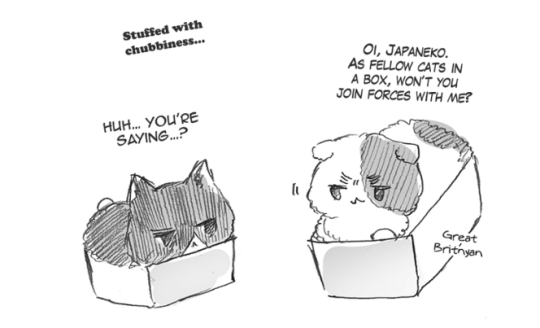
Funny puns or metaphors?
In the Nekotalia AU,
Himaruya uses boxes as a metaphor to illustrate Japan’s and England’s
historical political isolation [x].


 Ellawritesficssometimes