


Mother of God.
Post on RusEng/ RusJap Relations and Russia’s curse coming up tonight!

Mother of God.
Post on RusEng/ RusJap Relations and Russia’s curse coming up tonight!


Looking at potential hints at ships is great, but I’d also like to use this forum to explore some of the most wholesome friendships in Hetalia. Today, let’s look at Japan and America. They’re compliments of each other, representing two polar personalities that balance out perfectly to create great comic relief. Among my favourites are the cultural misunderstandings that the two share.
A lot of Japan’s bewildered reactions to America’s culture
is based on the own reactions that Himaruya experienced himself when he moved to New York.
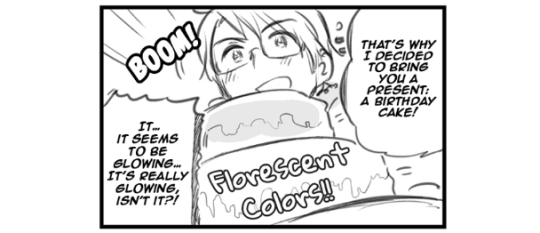
Ex: Japan takes a picture of the brightly coloured cakes in America.
So does Himaruya, who finds the colouring to be weird [x].


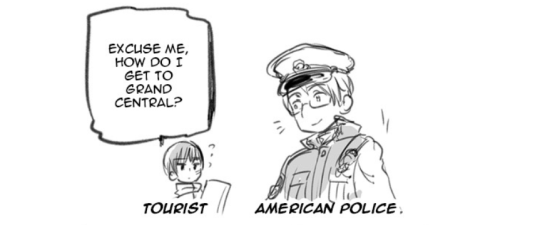
Ex: Through the strips, Himaruya advises Japanese tourists that American
police officers aren’t the best at giving street directions, unlike in Japan
where that’s their main purpose [x].


When Japan opens his country to the West during the Meiji
Era, Netherlands warns him that because America is young, he may force himself
in.

Despite this, America and Japan hit it off very well. Of
course, this is still exhausting for Japan, who’s both physiologically and chronologically
older.


One moment that really sets the pace for their relationship
is when America introduces table-turning to Japan. He wants to surprise Japan
into believing that it can answer any question.


What America didn’t expect was for Japan to reveal his
anxiety over whether he’ll be able to get along with other countries in the
future.

The sweetest moment is when America doesn’t hesitate to
reassure Japan of this by moving the table so as to say yes.

Since this post covers
their friendship, WW2 will be purposefully glossed over.
This one panel here has puzzled many people. When America
proposes a ridiculous world defense plan, Japan agrees without any debate.
Switzerland then reprimands Japan for not voicing his own opinion.
If we’re to take this meeting as occurring right after WW2, this
fits with the Japanese-American relations of the time, where the Japanese
government and society were completely restructured. If this were to be
depicted in the manga, Japan would have become a lackey to America during the
American Occupation of Japan.

Culture shock or accidental misappropriations between them
make up the flesh and bones of their relationship.
Ex: Japan’s version of horror is far different than America’s [x] [x].


Ex: Japan is astounded by how large the food portions are in
America. Meanwhile, America is just as astounded by how small the food
proportions are in Japan.


Ex: Again, Japan likes to take photos of the fluorescent cakes
in America [x].

Ex: America likes to dance. Japan doesn’t.

Ex: America visits Japan on New Year’s day. He
takes it upon himself to study Japanese New Year’s customs, but accidentally
ends up using a wrong reading for “home etiquette.” It comes off as “sword
killing” instead [x].


The two visit and spend time with each other pretty often in
the manga.
Ex: Japan moves in with America for some time. America
kindly greets him with a large meal.

Ex: Japan invites America to come see the sakura bloom in the
spring.

What I also find funny is that there are times where America
becomes too much for Japan to handle.
Ex: Japan runs away when America asks him to sleepover after
watching horror movies. It’s not romantic in context. America’s just a big
fraidy-cat that needs someone there with him [x].

Ex: America invites Japan to his Christmas party, only to
leave the tab of said party on Japan. This prompts a good bout of lecturing [x].


Even more interesting is that we get a small snippet that
expresses America’s fears and secret recognition that he’s not well-received by
other nations. Japan is the only one he believes won’t abandon him [x].

Ex: America unceremoniously breaks Japan’s window. This
prompts another lecture [x].
He goes there to ask for Japan’s help in successfully scaring England on Halloween. (America and England host an annual competition where the two attempt to out-scare each other).

All in all, the relationship that Japan and America share is
definitely a sweet spot in the manga. The two are very close friends, and if
creative inspiration just so happens to dictate it, then yes, they would also
make for a good, well-rounded ship.

America: Aren’t you just the cutest little thing~!
Japan: Don’t touch me.
America: BOOP!

Japan:

I’m leaning more toward no.
When Japan visits him, there are small pieces of garbage all over his carpet. Because there’s the stereotype that Americans are obsessed with infomercial products, America places too much trust in his vacuum cleaner.


I’ll save FrUK for later, but I’d be happy to start a friendship series.
Let’s start with Japan and America. Friendship post coming up tonight!


They’re all massive nerds when it comes to
Japanese culture/ anime. Not all of these attempts are successful either.


Before, I used to dismiss the idea of time travel in
Hetalia. Looking back, I can see that this limited my understanding of several
bizarre and inexplicable occurrences in the manga.
In a fictional series
where the nations are immortal, being referred to as “strange” and “odd”
beings, it’s honestly not that far-fetched to consider that they’re capable of
time travel.


This is especially true given the facts that…
1) Time is experienced differently by the nations.
Ex: Canada spends an entire weekend staring at Kumajiro’s
eyelashes. It passes by without him realizing this [x].


Ex: If a human were to spend enough time around a nation,
their perception of time would become so warped that they’d go mad.
Ex: Pets don’t go mad when they’re around their nation
owners. Instead, their lifespans increase. Should they separate from the
nation, however, they would become normal pets again and resume aging [x].
2) Some nations are capable of magic,
fortune-telling, clairvoyance and other supernatural abilities.
Ex: England’s and Romania’s ability to cast spells.

Ex: Japan’s powers of clairvoyance and mind-reading [x]– I’ll
get back to this later.

Evidence of time travel in Hetalia is either extremely
subtle or so right in your face that it’s easy to overlook.
Could it be that the pets don’t age because the nations are beings that are able to transcend space and time? In other
words, what if time is bent around the nations, which, in turn, causes their
pets not to age?
They’re timeless beings in that they’re immortal. While they
do age, it’s very incremental. They still remain youthful, likely because time
is slowed for them. In that case, the reason that the pets won’t go mad by
being around a nation is that they don’t perceive time the same way that humans
are able to.
Are the nations able to time travel then?
Evidence from the manga suggests that they’re indeed able
to.
Let’s go over some of these examples.
If you factor in time travel, this would explain the sudden
appearance of anachronisms when you least expect it. I used to think that these
were silly comic gags. My opinion has since changed.
Ex: When America pulls out a computer to google where
Germany is in 1942, England isn’t surprised. Instead, he’s able to pinpoint
exactly how far into the future the model is and reprimands America for showing
off.

Ex: Why is it that during the 18th century, Japan
appears to be listening to music…with earbuds? [x].

Ex: The Roman Emperor Nero is once depicted to be playing an
acoustic guitar.

They’re aware that it’s an
anachronism. Perhaps either Rome or Quintillus – another Roman Emperor who’s
canonically able to time travel – brought that there. I’ll get back to
Quintillus in a moment.
As mentioned above, Japan has been shown to be able to read
minds, see into the future, and establish contact with others without having
ever met them in person before.
Ex: Japan demonstrates his clairvoyant powers during the
Meiji Era. The fourth wall is broken as the scene pans in on
Himaruya scrambling to finish a comic.


Ex: When Japan first becomes acquainted with the Italy
brothers, they’re put off by how silent and reserved he is. Japan later admits
that he’s not used to speaking out loud with those whom he’s read the minds of [x].


If anything, this alludes to the fact that Italy and Japan
have technically met before.
Notice the title of the strip too. “A melody that transcends
history and reaches you…”


After falling into bed with Holy Rome, Chibitalia has a
strange dream where he encounters a presumably divine being that leads him to –
yes, Japan. This confirms what Japan claims in World Stars. He did, in fact,
read the mind of Italy and communicated with him far before they formed their
alliance in WW2 [x].


That’s not it, either.
Italy in adulthood has a ‘unpleasant dream’ of a child that looks
exactly like him pressing to be acknowledged [x] [x].


How I’ve interpreted this before is that it symbolically
represents Italy’s unconscious mind repressing memories from his childhood. Put
another way, he’s refusing to remember – acknowledge – bits of his past.
Taken literally, this could also mean that Italy’s child
self is transcending time and space to get him to remember his past.
Or, what about this scene? Italy encounters his child self, recognizes this, and feels ashamed for
lying about how [not] strong he’s become [x].


Germany also appears to have these strange encounters with chibis.
Ex: In the same strip, a child that looks
exactly like Germany/ Holy Rome presses to be acknowledged as well [x].

Ex: Germany’s once shown to be holding up Chibitalia.
“It’s me!”

What if this is Chibitalia traveling into the future
to get Germany to remember about his past as Holy Rome? At the same time, it could symbolically represent childhood memory repression. Of course, this is all making the assumption that Germany is, in fact, Holy Rome.
Most obvious of all is that there’s a real character in the series
who’s physically able to time travel.
The play on Quintillus’ time-traveling abilities is that
because historical records about him are shifty, his timeline leaps back and forth.
Himaruya took this, made it literal, and gave Quintillus time-traveling powers [x].


Ex: We see Quintillus visit Germany in modern times making
sure that the latter’s research and re-writing of Roman history are accurate [x].

With all the evidence I presented, I truly do believe that
the nations are able to time travel. It’s not just limited to their ability to
slow time for those around them. They seem to be able to manipulate it too, being able to disappear on
a whim…


“Wow! You can see into the future?!”
Japan: Yes. What
would you like me to predict?
“Tell us who you’re going to be best friends with!”

Japan: Hmmm…

Japan: …

“What’d you see?”
Japan:

No. What happens is that America chooses China to attack the
axis so that he can assess China’s feats. How I interpret this is that America
is covertly analyzing China’s strength and possibly feels threatened by him.


 Ellawritesficssometimes