Hetalia Webcomic: Is hilarious and silly but also grim and thought-provoking.
Hetalia anime: Only animates the weird stuff because money.
Hetalia Webcomic: Is hilarious and silly but also grim and thought-provoking.
Hetalia anime: Only animates the weird stuff because money.
It depends on their position within the global economy.
As such, a nation’s health depends on their political and economic situation. They catch colds during economic recessions.
The Great Depression strips are a good source for this, as each negative number assigned to a nation has a differential impact on their health. Since America was a manufacturing powerhouse at the time, his stock market crash affected them all.
Ex: Japan obtains a cough, meanwhile Poland runs a high fever.


In modern strips, we’re also provided with the fact that Austria will slip into a high fever and eventually collapse if Germany even so much as catches a cold.

“A reliable country that likes to approach things with a sober seriousness.
He approves of and supports lots of Germany’s ideas so he may look like one of the helper countries, but in reality the level of his dependency is pretty high.
So high that when Germany catches a little cold, Austria goes straight to high fever and eventually collapses, and so he doesn’t have much of a choice than to take good care of himself.”
As for how serious it can get? Spain almost died from an economic recession.

Further Readings:
Lithuania’s Out-Sourcing Part 3
(The Great Depression)
In just two minutes you can grasp the exterior of the European economy [x]
Germany is playing an impossible game [x]


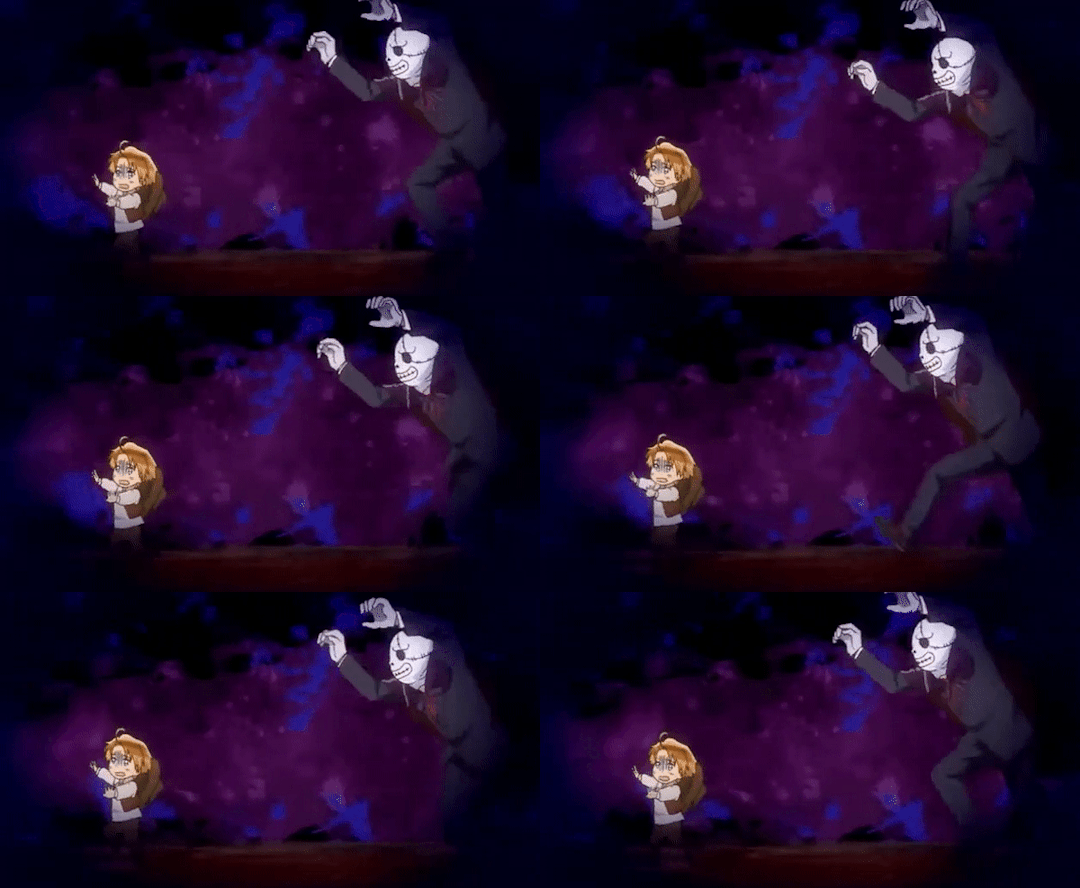
People often find it perplexing that America can’t see ghosts
or magical creatures, and assert that this is done for seemingly no reason. It’s
quite the contrary. There’s an underlying rule in the manga that’s been used
and consistently drawn on:
That is, whether it’s ghosts, aliens, or magical creatures,
the nation’s ability to see/ believe in them depends on if their citizens
strongly believe in them. In other words, superstitions of the supernatural and
unknown need to be part of the nation’s popular belief system if the respective
personification is also able to believe in them.
I say believe mostly
because as you’ll see soon, sometimes a nation will see an unknown being, and
yet not recognize or acknowledge its existence. For the most part,
however, the nation simply won’t be able to see the being.

The reason listed that explains why America can’t see and
believe in ghosts is because 23% of his people either believe in their
existence or have had an encounter with them. Again, this ability is predicated
around citizen belief.

I can’t attest for the exact figures of this statistic. Point is, this is what Hima cited, and it is thus included into the reasoning
behind America’s skepticism of the supernatural. Of course, this rule doesn’t
mean that these beings don’t exist. It just affects whether the nation will be
able to see them.
Notably, this approximate statistic has since changed. [I’ll
get back to this in a moment.]
Likewise, because Americans strongly believe in the existence
of UFOs, America can see and interact with Tony.

Meanwhile, although England can see Tony, since his people
don’t believe in extra-terrestrial life as strongly, he’s skeptical of the
alien and doesn’t truly believe in it. [x]

Quickly, it’s important to go over some supernatural ground
rules specifically pertaining to America.
On Halloween, the one day of the year where Americans
temporarily, albeit strongly, believe in the existence of the supernatural,
America’s able to see ghosts and other unknown creatures.

England is noted to be able to make anyone who visits his
country see ghosts/spirits; America is the only exception to
this rule. [x]
When accused of seeing illusions by America, England claims that
America can’t see the unicorn because he’s too impure.

Funny, considering that England gives America a
unicorn to celebrate his bicentennial despite knowing full well that the latter can’t see it….yet.

What I’m about to present indicates a considerable shift
in America’s “ghost and monster culture”, whereby it’s strongly hinted that he’ll
soon be able to see ghosts, spirits, and any other magical creatures rather than
just aliens.
Please note that ghost and monster culture are terms that
Hima’s coined in describing a nation’s folklore and superstitional culture.
It’s not like this shift is impossible either. We’ve already
seen with Japan how he’s able to forget and subsequently re-remember the existence of
youkai spirits as a result of his own people forgetting about and later
believing in them again.
For example, in the Meiji era, Japan lost his ability to see
them with respect to his people forgetting about their existence. On the other
hand, because England’s monster culture remained prevalent, he was able to see the spirits (i.e the Tengu and Kappa).

However, later in WW2, when Japan and Italy are taking a
bath in a hot spring, we learn that Japan’s regained his ability to see his
nation’s magical creatures.


The same thing happens with America.
While he initially can’t see and doesn’t believe in ghosts,
he’s still terrified of them.

The fact that he doesn’t believe in them becomes woefully
obvious when a ghost literally taps America on the shoulder and introduces
himself. America doesn’t notice the ghost and instead seems to attribute the poke
on the shoulder to the false feeling of being touched or watched given that he’s
watching a horror movie while this all happens.

It’s only until World Stars where we begin to see a possible
shift in America’s ghost culture.
America visits England in Chapter 290. What I want to place
particular emphasis on is that America admits to his increasing interest in
fantasy movies. If we follow the rule from above, this would mean that his citizens
have taken up an interest in the genre/ supernatural belief, and this interest
is thus reflected in America’s own interests. Movies genres are a reflection of popular culture, after all.

This scene in particular substantiates this claim.
The two take a tour of a haunted citadel. America mistakes ghosts
for current staff members. [They had worked there when they were alive.]

He takes a picture of the ghosts, only to realize that they
don’t show up in the photo. More importantly is the fact that America was actually able
to see the ghosts.
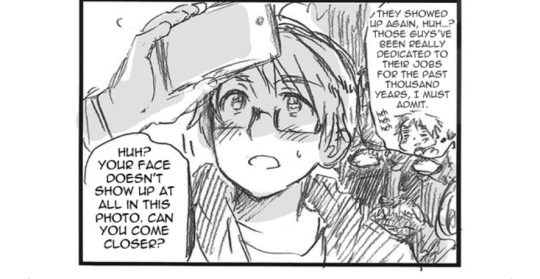
Even if America wasn’t able to make the connection and
realize what they were, it would seem that his newfound interest in fantasy means
that his ghost and monster culture are shifting.
If that’s the case, then we could very well see an America
that’s able to see supernatural creatures in future strips.

He’s an overgrown puppy that genuinely enjoys hanging out with his friends.


I think
it’s become obvious by now that almost every single nation embodies a good balance
between likeable and dislikeable traits. As such, it’s important to lay out
some essential characteristics if we’re to understand who England is as a
person, his motivations, his faults, and his highpoints.
While
England can be invariably cruel and pessimistic – especially towards America–
this stems from a latent insecurity that he keeps within himself. He pre-emptively
spites others to protect himself from the rejection he’s historically
experienced. In modern strips, his temper has calmed considerably, and this
spitefulness has transformed more into sarcastic banter and blunt teasing.
Nonetheless,
what this post will account for is why England’s loneliness caused him to have
such a volatile temperament, not to mention poor relationships with others.
The
following character notes are of utmost importance in preventing England’s
personality from being misinterpreted. [x]
He’s quite bad
at expressing himself. He himself knows that people often misunderstand him, he
uses this fact for self-depreciating jokes.
He could easily
be the most pitiful one in this webcomic.
His temper was
quite stormy during the decades after America’s independence.
Put
another way: England’s historical isolation caused him to develop a poor sense
of self-worth. To compensate for this, he worked hard to improve his nation and
external image of himself. Meanwhile, the insecurity remained even as he
emerged as a world superpower. Because he was so used to being teased and
berated, England treated others in a similar manner, only for this to work to
his own detriment.
Arrogance
and boastfulness quickly got the best of him. He fell hard and even deeper into
isolation after the American Revolution. His violent temper towards America is
a manifestation of his strong fear of rejection. What you’ll see is that
England is deeply considerate of others and wants to befriend them, but
unfortunately closes up and defensively makes scathing remarks to protect his
fragile self-image.
With all
that said, let’s tie this back to the strips and go through some examples.
We know
that having America as a ward helped ease England’s temper. He even admits
to this.

What’s
important to point out here is that this was during a time when America was
England’s primary ally.

England escaped the alienating
atmosphere of Europe by visiting America. America’s unconditional love was England’s security blanket.
This
security blanket was lost after the Revolution, thus explaining why England’s
temper explodes in the following years. He was all alone again.

England wants to be friends with America, but has trouble overcoming his loneliness. His crippling fear of rejection is often the cause.
In fact,
England can be quite shy at times. If anything, it proves how skeptical he is
to open himself up to others, let alone make the effort to get them to see him
for who he really is.

He embarrassedly
offers to be America’s friend when he realizes that the latter doesn’t have
any, only to defensively fall back on anger when America rejects him.


It’s a cruel
cycle of desiring to be close to another person, opening himself up, and either
1) rudely spiting them, inciting rejection or 2) politely engaging them as a ‘gentleman’,
only for this to incite rejection as well.
His anger
is a shell – it’s a tough habit to break, even though he woefully recognizes
how problematic it is in impacting how others perceive him.
The fact
that he doesn’t expect positive reactions from others is chiefly illustrated with how embarrassed he gets when he does receive praise.

Nonetheless,
England keeps trying to mend things with America to the extent that these efforts are excessively nosy.
He’s
skeptical that Lithuania will be treated well in America’s house, and takes it
upon himself to visit them. Curiosity is a form of caring, however skewed and
counterproductive as it may be.
Point is,
England’s covertly reaching out to America here, likely because he knows
firsthand what it’s like to be directly rejected by the latter. It’s the next
best thing he can do.

As
touched on above, it’s not just America that England’s isolated from. He’s not
referred to as the Black Sheep of Europe for nothing, after all.
During
the Splendid Isolation Period, and having experienced many political rejections
as a result of tensions with Russia, he desperately tries to convince himself
that being alone isn’t all that bad.

Eventually,
he’s able to successfully form an alliance with Japan. Of particular emphasis is
the strip’s title:
“The anglo-Japanese alliance between two lonely people.”
I really don’t think it can get more explicit than that.


Further,
this alienation among the other nations is a repetitive theme in the series.
England’s often left out of excursions and activities.
One
example that best demonstrates this is when Italy, Germany, and Japan take it
upon themselves to interview other nations about their Christmas traditions.
The whole strip entails England hiding in the background, fidgeting nervously
as he waits to be interviewed, only to be forgotten about.


Interestingly,
it’s Japan who remembers to interview England at the last minute. The two share
an implicit, but undeniably deep understanding of each other.

Another
way that England compensates for his loneliness is by turning to the
supernatural – his fairie friends. America thinks he’s crazy, but what he doesn’t
realize is that England likely summons these friends to mitigate his
loneliness, and therefore prevent himself from going mad.


The
imagery of a child-like imagination is later used to describe England’s love of
and desire to live in a world entirely made up of fantasy. He lives in his mind
because it’s safe. Similarly, he talks to his [real] fairie friends because he knows
that they’re safe too; they won’t ever reject him.

I’ve
brought this up before, but I think this is a good note to end on. During the
Anglo-Japanese alliance arc, which focuses on the subject of loneliness, why is
it that England is given the Kappa’s Miracle Cure?

It’s a
medicine said to cure any illness…
…but what
illness is there to cure if you’re an immortal being that will automatically
recover from illness anyway?
It seems
to me that the cure was intended for something less tangible, yet just as hard
to cure:
Heartsickness
and accompanying feelings of loneliness.


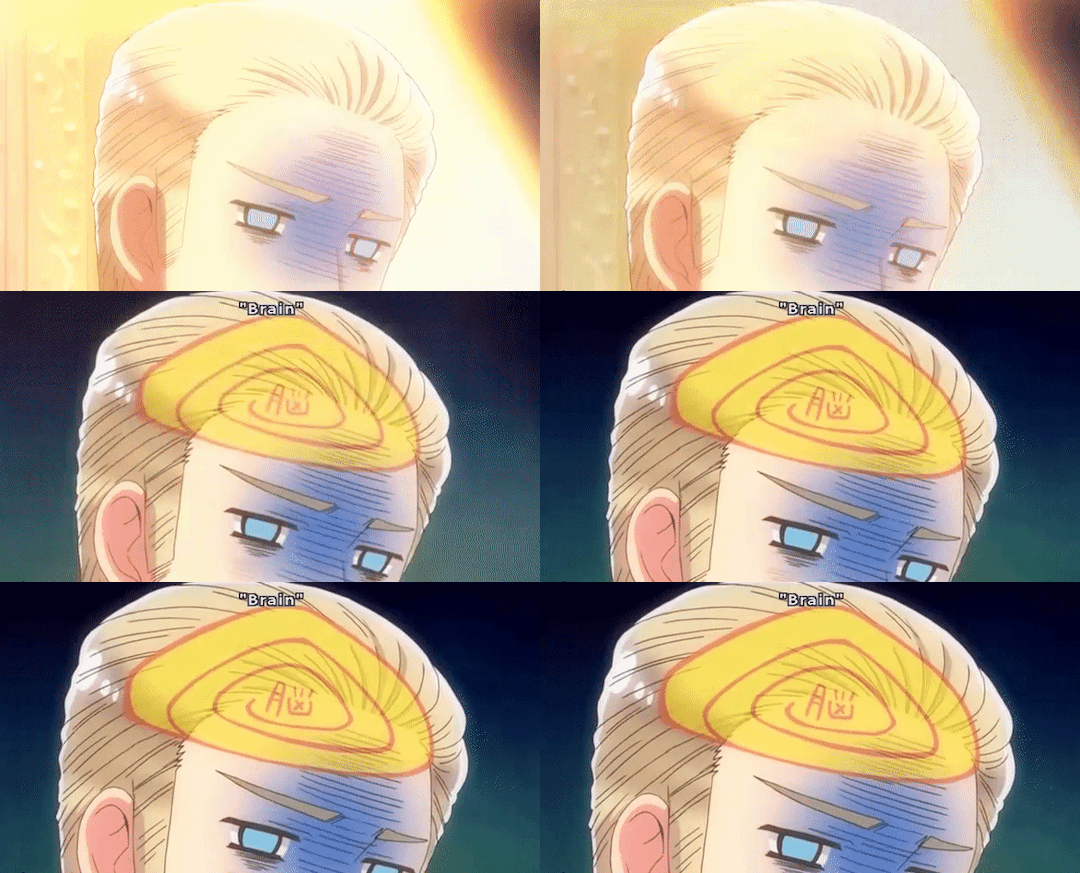
Before I start, it’s important to lay out some ground rules.
Thanks to Finland we know that the nations aren’t that
different from humans with regards to their physical strength and anatomy (with
the exceptions of Russia and America who are exceptionally strong).

The point in this is that the “not-so-different from a human
rule” pertains to their basic physiological structure. On the other hand, there
are immortal perks of nationhood, such as being impervious to experiencing the fatality of illnesses. They still can
fall ill, though. This happens when they’re….
1) Suffering from political instability.
2) They’re experiencing an economic recession.
3) There’s a rampant illness in their population (i.e Romano’s
Chorea).
With that said, we know that the nations are stronger than
normal humans regardless. They don’t age as fast, and as such, their memories
don’t deteriorate at nearly the same rate.
What this post will explore are the different examples where
nations have been shown to have gaps in their memories.

The thesis I’m putting forward includes a variety of
reasons to account for this:
One, older nations such as Japan and China have even larger gaps
in their memories as a result of their physical bodies aging. They’re therefore
unable to recall memories as fast as younger nations [This in part goes with my
third argument].
Two, the influence of their citizens pertaining to whether
or not the nations can see and therefore remember the existence of magical creatures.
Three, the nations simply aren’t able to remember
everything; it would be impossible.
And four, some
nations actively repress bad memories to minimize the anxiety and trauma they
previously experienced.
Without further ado, let’s go over some of these examples.
As stated above, the nations’ chronological age, while
influenced by their economic and political affluence, also seems to be affected
in part by how long they’ve lived (I.e. Both Japan and China refer to
themselves as old men.)
If Japan is shown to have higher blood pressure levels and hip pains as a
result of his old age, then it wouldn’t be too farfetched to assume that his
memory wouldn’t be as up to par as it would be in comparison to a nation younger
than him. Put another way, his age would cause him to have greater slips in his
memory.
It’s the body that’s old, despite not looking like it.


Ex: He’s unable
to remember who Lithuania is, and almost mistakes the latter to be Livonia.

Ex: While looking
through an album of him and Pochi throughout different periods, Japan
mistakenly recalls the chronology of them.

Likewise, China’s also referred to as an old man.

Ex: He admits to
being forgetful.

We’ve also seen the impact on how a population’s belief in
magical creatures respectively influences whether or not the nation will be
able to see them.
Ex: During the
Meiji Era, England could see the kappa and youkai spirits, meanwhile Japan couldn’t
as a result of his people no longer believing in them as strongly.

However, just as a nation can forget about magical
creatures, they can also re-remember them if popular culture strongly believes
in them again – presumably it would have to go past folklore superstitions.
While enjoying Japan’s hot springs, the two talk about
folklore.

Notice how Italy spots a strange creature beginning to approach them.
Although it’s not shown, the discussion of the topic could possibly mean that
Japan [and not just Italy] is also able to see the creature.

There’s also an exact replica of this hot spring scene
dating back to when they first met during WW2. I don’t think Hima did this for
no reason:


As Russia darkly puts it, perhaps it’s a good thing that the
nations don’t remember everything.

When Lithuania and Germany allegedly meet for the first time
during WW2, Lithuania expresses relief over Germany not remembering him. It’s
noted that Lithuania once beat-up one of Germany’s family members. This is
possibly a reference to when Prussia became a lackey to Poland under the
Lithuanian and Polish Commonwealth.

This is highly indicative of Germany existing well before
his ‘birth’ in 1871 given that Lithuania is fearful of being remembered and/or triggering
Germany’s memory. If anything, Lithuania’s fear of this points further in the
direction of Germany suffering from amnesia.
Why else is there a childhood version of Germany/Holy Rome pushing to be acknowledged in older strips? I’ve theorized before that this is
simply a part of his unconscious mind trying to get him to remember about his
forgotten childhood.

Or why is it that he’s seen to confusedly hold up Chibitalia in another strip?
“It’s me.” Jogging his memory much?

Similarly, Italy also dreams of a childhood version of
himself pushing to be acknowledged by him, only for Italy to refuse in doing so. Like
Germany, it seems that Italy has actively striven to forget his childhood.

Lastly, the most obvious hint of repressed childhood
memories is found in Buon San Valentino, where Germany appears to recall fuzzy
images of Chibitalia.


Prussia is the one to confirm this rule, considering that he’s
taken to recording every experience as a method in circumventing the inability
to recall them. It’s simply a matter of jogging his memory.

In sum, while the nation’s memories are limited, there are
different factors and contexts that account for this phenomenon. Age, trauma,
civilian belief, and limited physiological brain capacity seem to be the most
common reasons in accounting for this.


Misconception: China
hates Japan
Reality: While he
does hold against a grudge against Japan for betraying him in WW2, he’s deeply
affected by it.
We all know the scene. Japan stabs China – literally and
figuratively – in the back. You’d think this would generate hatred on
China’s part…


…but this couldn’t be anymore true.
China raised Japan. He was there with him through everything.
He protected Japan from other nations, like Mongolia, only to receive nothing
for it.

In other words, China’s heart was broken. A telling scene in
which this is confirmed is when China drinks away his sorrows and breaks down
into tears as he recounts what Japan has become.

Unfortunately, we are not provided with much insight on how
Japan and China fare in modern times, as we don’t get many moments where they
exclusively interact with each other.
Misconception: China
is weak
Reality: He
possesses immense strength, but because of his age he lacks stamina.
Ex: This strip
illustrates America’s perception of China’s innate strength and/or capacity for
it.

Despite this, however, because he’s lived for so long, China’s
physical body has aged and weakened. This is an exception to the rule of a nation’s
political and economic situation affecting their physical strength.
The physiology is more applicable to how they lead their
daily lives.
Ex: He’s referred to as a grandpa in modern times, and tires easily.

Ex: In another modern
strip, he’s affected by his population’s growing obesity rate and subsequently
gains weight despite his efforts to circumvent this.
This can be taken as another demonstrative impact of his
physiology age given that older people also have trouble shedding weight.
It’s still important to note that he’s nonetheless referred
to as a powerhouse [for obvious political and economic reasons.]

Accurate Conception:
China is likely an Ancient.
He’s lived for approximately 4000 years. Given that Quintillus, a Roman emperor, was once
seen to be holding a baby China, I would say that this pretty much confirms his
status as an Ancient.
This is aside from the fact that Quintillus can time travel
– the timelines correspond without the need for him to do so. Point is, this is a more concrete example of how old China is.

Misconception: China’s
rude and stand-offish.
While he can be petty and complain like a disgruntled old
man in comparison to some of the younger nations, China is probably one of the most
wholesome characters in the series.
Ex: He acts as a
mentor to Taiwan, Macau, and Hong Kong. The latter two live with him.


Ex: When Hong
Kong wants to leave China’s house, China begs for him to stay and promises to
stop cleaning Hong Kong’s room so often.

Bonus Facts:
He doesn’t like to lose.

He believes in fortune + luck and is able to see ‘monsters.’
Monster culture is just another way of Hima naming a nation’s ability to see magical
creatures.
Ex: He compiles an index of monsters. While it does contain
regular creatures, it also bears real monsters.


Not to mention that the other nations expressed fear towards
China in “Hetalia of the Dead” as they believe that he’s fully capable of summoning
dark spirits.

Amazing character, right?
There are a few
reasons.
1) We’ve seen the impact that their peoples’ belief
has on their ability to see ghosts or magical creatures.
Hima sourced that 23%
of Americans believe in ghosts; it’s not enough for America to be able to see
them, even though they exist in canon.

Because approximately 70% of Britons believe in
ghosts/supernatural beings, England’s able to see them.

2) Since Americans are really big on Halloween, and
tend to believe in the supernatural on this specific day, America’s likewise only
able to see magical creatures and ghosts on Halloween.

3) England claims that America isn’t “pure” enough
to see his pet unicorn.

However, as I’ll get into in a later post, it seems like as
time shifts, and his people’s belief in the supernatural subsequently grows,
America’s gradually gaining the ability to see them more consistently.
Ex: He goes on a citadel tour with England and mistakes ghosts as staff members.

When he takes a picture of them, they fail to show up. Confused, America still seems unable to make the connection. Perhaps he hasn’t yet realized that he’s acquiring the ability to see them.


NO ONE FUCKING REBLOG OR LIKE THIS ANYMORE.
It’s perfect.
Sure! While I’ve touched on the differences of the nations’ own wills in comparison to those of their bosses, I haven’t really talked about the extent to which they’re involved in their politics. Not to mention that they’ve been shown to be aware of corruption, and yet have very little power to do anything about it.
Post coming up soon!

 Ellawritesficssometimes