Random cosplayer
here- could you do a post on demon England sometime maybe, if it isn’t too much
trouble? I’m thinking of cosplaying him in the future and I know horridly
little about how much he was in canon and how he was portrayed in canon. You’re
pretty much the expert on this sort of thing and I’ve found shockingly little
official stuff online. Thank you so much for all of the work you do for the
fandom, it’s absolutely excellent! 😀 Keep up the good work and best of luck to
you!
Hello, and thank you!
I’m not sure what you mean by demon England… are
you perhaps confusing that with the Brittania Angel trope [x] ? Or is it the Halloween 2010 costumes you’re talking about? Even then, it was Prussia who was the demon. England looks more to be a vampire. Not all of the costumes are specified, though [x].
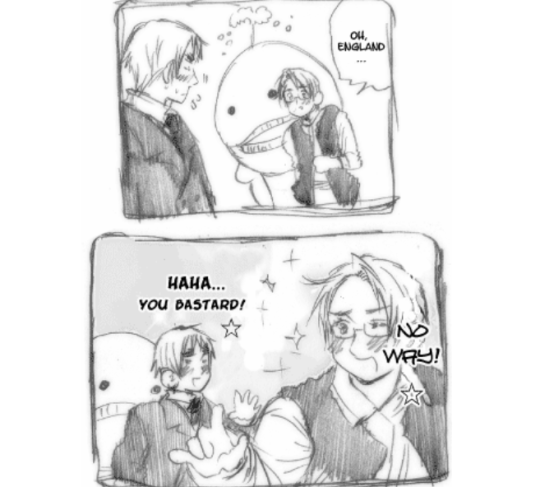
Do you think America is somewhat bitter at
Britain because he didn’t tell him about how humans aged and died or took
possibly 50 or so years to get a flower for him to give his friend? I know it’s
odd to ask but I just watched the davie episode and after watching it, certain
scenes like America running away and laughing after Britain says they could be
friends has a different feeling now.
It’s never really talked about nor are any links made. As
you figured, America must have learned for himself the hard way as he matured.
The grudge that prompted America’s reaction in the latter
strip you mentioned was mainly from the Revolution/ England meddling in his Civil
War [x] [x][x].
Ella, what are your thoughts on fans who create
OCs for countries that haven’t appeared in Hetalia?
As long as they’re respectful, who’s to stop
them? They’re exercising their creativity and tapping into their imagination.
Likewise, it would be hypocritical to criticize
someone else for taking the initiative to create their interpretation of a
country when that’s literally what Himaruya did.
What’s the source for America being modelled on
a Canadian?
Sorry about that,
thought I included it in the OP. It also has the note about Himaruya’s
American teacher not caring for geography all that much [x].
Out of all the countries who do you think is
the most lonely?
A lot of them are
lonely!
However, I would say
Russia is the most isolated since he doesn’t really have any solid friendships [x].
If anything, this could also indicate how removed England
was from the effect that his taxation had on his colonies. Great addition,
thank you for sharing! [x].
It seems like Canada is America’s adopted
introvert.
Yes and no. Early on, it
was more of a resentful push-and-tug relationship. Their relationship in the
present lines up more with what you’re saying!
Sorry, I have to make
this distinction because you still see people bitterly posting on trope
websites that the two remain primarily resentful of each other, which isn’t
true! [x].
Is North Italy really a virgin? If he’s not,
why does the fandom believe so? I mean I know he used the “I’m a
virgin” lie to get out being harmed, as for some reason they sympathize
for virgins, but the dude has a black book full of women he has dated, he still
dates and flirts with girls. Given how old he is, doesn’t it make more sense
for them to have lost it at some point in time? Maybe n teen years. Oh, that
time he ran home for sexual needs during war. So y proclaim it canon if 1 is
not sure
(Not sure why this
really matters lol but…)
It’s messy because you’re
leaping through several time periods here. They don’t occur simultaneously.
WW1–He plays the
sympathy card and states that he’s a virgin to prevent Germany from shooting
him. This also could have just been a spur of the moment thing he said to avoid being harmed.
We also know from this
character chart that Italy officially becomes an adult in the 20th
century [x].
The third comic you
referenced is from Comic Diary 2.It
takes place in WW2. Italy cites that fight or flight instincts in war create an
urge in men to reproduce, hence the greater occurrence of sexual intercourse
between men since no women are available. As you mentioned, he leaves to
presumably have sex [x].
The second strip you
mentioned is from volume 2 and seems to take place in WW2. It doesn’t actually confirm whether he’s had sexual
intercourse with these women but rather that he’s met them over the years from
his time spent in war (i.e., “battles). He could have, but it’s not made explicit.
Presently, there’s a
strip where Italy uses a sexual innuendo in front of an attractive girl at an
anime convention [x].
Overall, my guess is
that he probably was a virgin during WW1 having just become an adult but lost
it sometime during or before WW2.
Why does no nation (other than his family) look
behind Russia’s cruelty and see he’s very lonely? (While Russia has done very
questionable things in the past…)
It’s easy to say that from an outsider’s perspective. Even
though Russia wasn’t psychologically aware of the depth and extent of his
cruelty, he was still an abuser. Loneliness isn’t exactly going to make those
whom he tortured instantly want to be friends with him. They’re big enough to
empathize and feel some compassion from him, but none of that will negate the
terrible experiences they endured in his household. I don’t blame them [x].
It’ll take a long time to heal (as we saw with China and
Japan), but I do believe it’s possible that their relationship will
improve in the future.
I’m too disturbed by the fact that Germany
can’t drink beer legally because he’s underage. he’s 20. he became an adult a
few years ago. he literally killed a man in his sleep, but he can’t drink beer
yet / he’s just too mature for his age??? he’s still a bby boy???? he can still
grow a little at this age??? he’s so young???
He’s 20 physiologically but not chronologically and became
an adult decades ago. Drinking ages also vary from country to country.
I know there are a few occasions where nations
physiologically young are barred from drinking (Deleted strip:
America’s Brewster F2A Buffalo), but for
the most part, it doesn’t seem to matter [x].
If a nation ages, it’s usually a mesh between their
chronological age, and political, social, and economic developments.
Over the course of the series, I’ve
found several clever ways that Himaruya uses the nations physical bodies and
interactions to reflect wider historical, social, and political circumstances.
Political pressure and suppression:
Typically, I’ve noticed that the
use of physical force between a dominant and subordinate nation reflects
political pressure and suppression. Russia is a prime example of this. You’ll
often see him squeezing, bending, and pressing down on other nations—obliviously,
of course. Remember that he’s unaware of his cruelty [x].
Ex: I’ve speculated before that
the reason Latvia is so short is a symbolic representation of how he has been
politically marginalized and controlled for a significant part of his history [x].
In other words, he lacked the
independence and autonomy that would have allowed him to achieve growth and
flourish on his own. His growth was stunted by virtue of him being pushed down
into submission.
Latvia citing the reason for his
shortness as a result of Russia pushing down on his head, to me, acts as a
wider metaphor for political suppression.
Ex: Russia squeezes and hugs Czechia and Slovakia to end
their dispute over whether they should include a hyphen in their name. In this
context, the hug is Russia asserting pressure over not what he thinks should be
their name but rather what their name will be [x].
Ex: In the strips depicting the Baltics path to independence
from the USSR, Russia squeezes Lithuania’s shoulders [x].
Conflicts:
Wars and battles can also be depicted in seemingly trivial
interactions between nations. The battles occur literally but are repeated figuratively
in these interactions.
Ex: To symbolize how France picked at the remains of some of
Austria’s lost territories after the War of Austrian Succession, France also
loots from Austria directly [x].
Servility and Class:
Different classes and social status are reflected in the
clothing that dominant and subordinate nations wear. Nations who are
conquered, annexed, or made to be under the control of another nation are
adorned in servants’/ maids’ clothing.
Ex: Chibitalia becomes a servant to Austria after being
conquered [x].
Ex: Lithuania acting as Russia’s servant while the latter
attended a world meeting on both of their behalves.
Ex: Romania and Bulgaria during the Soviet era.
Misconception: He’s weak
because he’s terrified of Russia OR “stop portraying Estonia as a fraidy cat.
He’s strong!!!!”
Reality: Anyone in their
right mind would be terrified of Russia when he’s angry. Estonia and the other
Baltic nations being scared of him is completely logical. The real Estonia is
both a careful and extremely intelligent tactician who is realistically scared
of Russia should he get on the latter’s bad side.
To portray and argue that
Estonia isn’t scared of Russia is just as one-sided as portraying him to be a
trembling, sobbing mess.
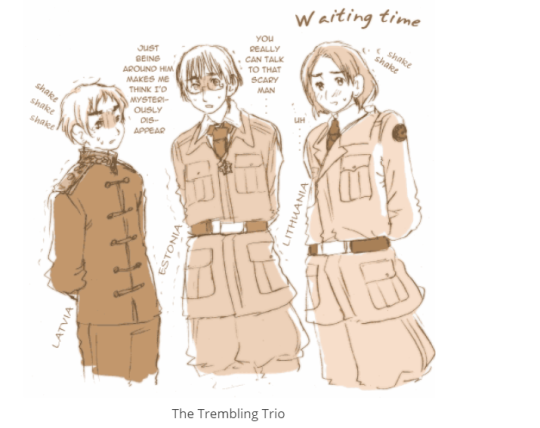
Ex:The Baltics aren’t called
the Trembling Trio for nothing. They withstood decades of oppressive Russian
rule [x].
Ex: Whether it has to do with
money or his plans to gain independence, Estonia prides himself on his
calculative nature [x][x].
Most of Estonia’s strength
comes from his wit.
Ex: He’s described as an
“honor student” [economically and politically] that’s “rational and businessman-like.”
Ex: He acts as Prussia’s
senior and gives the latter advice on how to live in Russia’s house [x].
On the other hand, Estonia
isn’t completely afraid of Russia either. He’s stood up for himself several
times.
Ex: He has no problem
confronting Russia when he believes that his blog was hacked by Russians [x].
Ex: He confronts Russia about his bullying behaviour during a world meeting.
Ex: He hangs up on Russia
during the 2010 Christmas event [x].
Ex: He was eager to sell any
belongings associated with Russia in the post-Soviet era [x].
Misconception: He’s a plain
‘in the shadows character” that is insecure of himself.
Reality: He’s very
self-confident.
Estonia arguably has the
highest self-esteem of all aph characters. When he commends/ boasts about himself, he truly means it [x].
He’s part of the Choral club
in the World Academy AU.
Estonia is the caretaker of
the mochis. He bought most of them from an online auction [x].
He wants to become a Nordic.
When asked why Estonia has so
many strange experiences – i.e. being transported into the world of the mochis
and the dream in which several male nations were replaced by their nyo versions
– Himaruya stated that his “elite glasses summon strange fellows,” [x].
This post will use attachment
theory to analyze Russia’s attachment style – how he forms relationships with
others – in adulthood. Unlike the case of Romano’s characterization [x], where
you can argue that attachment theory is actually used, this post applies
attachment theory to Russia for the sake of amusement. Although, things
strangely make a lot more sense when you look at him from this
perspective.
What is attachment theory?:
Attachment theory focuses
on the relationship between a child and their caregiver. Central to the theory
is the concept of needs. A child relies on their caregiver to protect them,
provide for them, and care for them. If all these needs are consistently met,
the child develops a healthy attachment to their parents. This healthy attachment style positively
affects both the child’s personality and their capability to establish and
maintain healthy relationships as they grow older.
However, if needs are not met at all, or are sometimes met and
at other times are not, this inconsistency causes the child to develop unhealthy attachment styles. As
such, they develop unhealthy personalities and form unhealthy relationships
with others.
The Ainsworth experiment was where this theory
originated. To test the attachment styles between toddlers and their
caregivers, they would put them in a room together at first. After a while, the
parent would leave and the child would be left on their own. Then, a stranger
would be introduced to the room and leave after the toddler had a chance to react.
The last part of the experiment analyzed the toddler’s reaction once they were
reunited with their parents again.
Being in a “strange situation” – a foreign room, absence of a
parent, and meeting a stranger [danger] – created a lot of
stress in the child. Since children seek protection from their caregivers, this
stress and fear would typically cause the child to become upset and seek
reassurance from their caregiver. It’s a survival instinct that innately kicks
in.
Those with a secure [healthy] attachment style would
cry or be upset for a bit but would be easily calmed once their caregiver
soothed them. The healthiness of this attachment style means that the child
knows that the parent is there for them – they can be relied on to satisfy
their needs.
While there are several
different unhealthy attachment styles, only one is important for this
post. An organized/ unresolved categorization is where Russia fits best. A
child with this attachment type functions better when their parent isn’t
around.
This is typically seen in
children who are abused and view their parent (s) as a source of fear. The
parent’s care is inconsistent in that they provide for the child and the child
attaches themself to them out of an instinct to survive; however, the abuse also
makes the parent the enemy. In the strange situation experiment, these children
would often approach their parent with hesitation or be paralyzed with
fear.
As adults, their attachment
system is subtle and needs to be activated. If they’ve had past traumas, such
as abuse, then they become disorganized. This often involves dissociation and
slipping in and out of consciousness. So long as they have trauma(s), they’ll
be disorganized. Sometimes, they’ll act in ways that are completely dependent
on others (activation), and at other times, they’ll be completely detached – perhaps from
reality.
What’s Russia’s attachment style?:
Russia’s organized/
unresolved attachment style, for the most part, stems from his relationship
with General Winter, who acted as his parent figure. The inconsistency of
General Winter’s care for Russia is seen in how he protected Russia from
invaders and yet attacks (abuses) Russia on an annual basis [x].
It’s far
from a healthy relationship. Not to mention that General Winter wasn’t always
able to protect Russia from countries who were accustomed to colder climates,
thus adding to the inconsistency of care that Russia received.
On the other hand, General
Winter wasn’t the only one who altered Russia’s conception of what a normal
human relationship is like. Having been conquered over and over again, in this
case by the Tatars, Russia normalized unequal power in a relationship.
This is why I believe that he
rejected becoming Lithuania’s friend when they first meet as children. They
didn’t have enough “power.” Notice how Russia’s environment has completely
misconstrued how he associates and attaches himself to others. What you’ll see
is that just like General Winter, Russia will repeat this abuse once he assumes
a position of power over others.
Point is, with a character
like Russia, there is no right and wrong. He’s not evil, and he’s not good. He
can’t have morals if he doesn’t realize that what he’s doing is wrong,
especially if it’s all he’s ever learned.
As such, Russia’s
understanding of friendship is warped. He believes that everyone is his friend,
including General Winter, his abuser.
A good example of this would
be when Lithuania points out to Russia that he shouldn’t really consider the
Allies to be his friends, given how they’re all ruled by self-interest. Russia
becomes dejected at this; he truly thought that they were his friends.
Russia’s Trauma:
We also know that given
Russia’s particularly rough and bloody history, he’s carried a lot of trauma.
Ex: A happy New Year’s for him
was not freezing to death [x].
Ex: He’s had several dramatic
shifts in government [x].
Ex: His bosses have tortured him. In this example, they ask him to stop a tank with his body.
Ex: During the Stalinization
era, he’s tasked with building a canal with no food or adequate clothing while
his boss – presumably Stalin – eats in front of him and wears a parka [x].
As mentioned above, because
Russia was subjected to so much violence, it’s been normalized for him. While
this is obviously wrong, violence is how Russia’s learned to solve his
problems [x].
Although, this isn’t canon,
Russia’s heart falling out – to me – acts as a metaphor for the fact that he’s
never learned what love is, let alone experienced it. Yes, he has his sisters,
but they couldn’t always be around for him.
Russia’s Dissociation:
There are several instances
in the manga where Russia dissociates to cope with a stressful situation.
A common coping mechanism for Russia is to
imagine being in a warm place, a long-time wish of his [x].
He also appears to
disassociate when he’s threatened with punishment if he doesn’t build a steam
engine [x].
In response to Latvia’s
trembling, Russia starts shaking him around and then snaps his neck –
presumably killing Latvia temporarily. Notice how Russia doesn’t even realize
the scope of what he did [x].
Activation:
While Russia is childish –
and therefore arguably detached from reality – there are moments where his
attachment system gets hyperactivated. His
childhood trauma is kicked into overdrive, and he becomes…terrifying.
Ex: When Lithuania outsources
himself to America after WW1, Russia isn’t exactly keen to see the latter off [x].
Ex: He’s commonly spotted
hugging and squeezing Soviet countries from behind to communicate his
possession over them/ desire to possess them.
Ex: He asks Moldova to call
him older brother [x].
Ex: In the present, Russia
wonders whether the ex-Soviet countries consider him as a friend.
Obviously, given the physical
abuse they were subjected to, they’re not very keen to be close to Russia. At
the same time, they also appear to realize that how Russia experiences his
reality and relationships isn’t normal. Again, he doesn’t realize that what he
did was wrong.
Just to put things into perspective, from a criminal law point
of view, Russia probably wouldn’t be convicted for his abuse, given that he
lacks the mental capacity – mens rea – to fully understand what he did.
In sum, Russia’s not an inherently
evil figure that maliciously inflicts abuse onto others. Instead, he’s a character
who has experienced his fair share of evil, and because it’s all he knows, he
inflicts this same evil on others. Of course, none of this pardons or justifies
his past actions, but hopefully it gives perspective into why he acts the way
that he does.
Misconception: He’s
an anxious person without a backbone.
Reality: He’s an
anxious person with an exceptionally strong backbone.
Lithuania used to be a world superpower. While he’s quiet
and introverted – like the other two Baltic countries – the fierce warrior
aspect of his personality hasn’t quite left him.
The most common piece of information that is used to
characterize him is that he “tends to think too much, which gets him depressed
and a stomach ache,” [x].
Ex: In his volume
3 character note, he’s described as a “serious young man with a strong body.”
Ex: In Italy’s
Chest Test series, Italy is surprised at how tough and muscular Lithuania is [x].
Ex: During the
Battle of Tannenberg, we learn from Finland that Lithuania is a “sharp” person.
In other words, he’s not someone to be underestimated on the
battlefield.
Prussia does exactly this, and it doesn’t turn out very well for
him. He actually hides from Poland and Lithuania after the battle, although he later
becomes a lackey to Poland.
Misconception: He’s
a sweet, pushover type.
Reality: He’s a
sweet, pushover type that has admirable moments of defiance. Lithuania isn’t only
defined by the above [partial] misconception. Even though he’s often bossed around and
later plays servitude to Russia, he’s still able to exercise his own agency.
Ex: The common
mistake is to only conceive him as someone who is introverted and good-natured.
He’s also a big brother type [x].
Ex: In addition,
he’s also noted to be bossed around frequently in Volume 5 – keep in mind that this
strip occurs during the Soviet Era.
Nonetheless, Lithuania’s seriousness and “strong perseverance”
is something that has consistently prevailed in him, no matter how dire the
circumstance.
Ex: Despite being pressured, Lithuania refused to convert to
Catholicism and holds defiance toward Prussia over this [x].
Ex: In strips that presumably take place during the Soviet Era
– as the setting is in Russia’s house – Lithuania’s old defiance for Prussia is
still alive and well. He gives him a “cold stare” and asks Prussia to leave him
alone [x].
Despite admitting to not liking him, Lithuania’s still civil
toward Prussia and gives him advice on living in Russia’s house [x].
Ex: It was
Lithuania who rallied the other Baltics to declare their independence from the USSR [x].
Misconception: He and Poland don’t have good relations
anymore.
Reality: He has some issues with Poland, stemming from their
past, but for the most part the two of them still share a good relationship in
the present.
Ex: Lithuania pulled a lot of the weight during their
union.
Ex: The fact that Poland laughed in his face as Russia
dragged him away during their forced separation didn’t sit well with Lithuania.
He holds clear bitter feelings about it [x].
Ex: On the other hand, Lithuania still cares about Poland
and tries to warn the latter of Russia’s intentions to partition him once again
in WW2.
Ex: While Lithuania is “dragged” around by Poland, he’s stated to still “enjoy himself” as this happens. My understanding
of this is that even though Lithuania does a lot of things for Poland, he doesn’t
mind the company [x].
On a similar note, in the World Academy AU, Lithuania is too
busy to attend the Choral Club’s meetings because he’s doing favors for Poland [x].
While he may be a pushover, I don’t think Lithuania would be doing this if he
didn’t care about Poland.
Misconception: He hates Russia.
Reality: He doesn’t have great relations with Russia, but he’s
civil.
Obviously, they’re not ‘friends-friends’ due to their past
together; however, it’s not pure hatred either.
Ex: He received many
scars during his time spent under Russian control.
Ex: He’s noted to be rehabilitating with Poland in the
post-Soviet era.
Ex: It’s alluded that Lithuania may suffer from PTSD. As he
recalls declaring his independence, he also remembers that Russia used to
squeeze his shoulders – a metaphor for political pressure. Without realizing it,
he begins squeezing Estonia’s and Latvia’s shoulders. It’s hard enough to cause
them pain [x].
Ex: Upon gaining independence, he was eager to get rid of
any belongings that were associated with Russia [x].
Ex: When asked if he considered Russia a friend, Lithuania
doesn’t “want anything in particular” and yet realizes that it’s probably
better to placate Russia. Of course, this is to be expected. The transition
toward a healthier relationship with Russia will take a long time for the ex-Soviet
countries to achieve. There’s also the fact that Russia’s sanity is unpredictable.
On the other hand, they still attend events together, so it’s
not as if the possibility of friendship – or at least acquaintanceship – isn’t
something on the horizon [x].
Bonus Facts:
Following WW1, Lithuania lived with America. This is done to
represent the Lithuanians who out-sourced themselves during this time.
Lithuania is later taken back by Russia once the Great
Depression hits [x].
America’s pets were very fond of Lithuania.
He has a crush on Belarus. On their first date, which predictably
didn’t last all that long (three minutes!), Belarus breaks his fingers [x].
In sum, as sweet, meek, and good-natured as Lithuania is, he’s definitely not someone to be underestimated. He’s an amazing, well-fleshed out character that is far more than the nervous wreck he’s commonly portrayed as.
Any strip that revolves around independence or revolution is
phenomenal in my opinion.
America – Fighting for independence from England [x].
The Baltics – Declaring independence from the USSR [x].
France – The fear of other European nations in response to
the French Revolution [x].
Italy– Fighting for independence from Austria [x].
To understand Russia’s brutal and violent side, it’s
important to step into his mindset, warped as it is. I go into this in greater
detail in another post [x], but to put it briefly here…
During his childhood, Russia experienced severe repression
and violence. As such, he wrongly learned to equate violence as both a show of
love and a solution to his problems. Not only that, but this violence continued
into his adulthood.
Ex: Russia considers General Winter and anyone he meets to be his friend. The key point to keep in mind here is that while General Winter
protects Russia, he also attacks him every year.
Ex: Russia naïvely refers to the other Allied powers are his
friends. Meanwhile, Lithuania has a more realistic view, stating that nations
operate on principles of self-interest.
Russia becomes saddened after hearing this.
Ex: Russia’s bosses are so notoriously cruel that they
torture him when they’re bored.
They once asked him to stop a tank with his own body.
Again, I’m not justifying any of what I’m about to show. I’m
providing an explanation and in doing so, I’m shedding light on how Russia’s
warped sense of mentality makes him incapable of differentiating between right
and wrong. In other words, he’s not able to possess any morals, despite often
having good intentions.
This amorality and confusion of what true friendship, or
rather, what a healthy relationship with another person entails ,are what caused
nations in the USSR a lot of pain, suffering, and fear.
What I don’t see a lot of people mention is that these nations
are fully aware of the fact that Russia is incapable of making these distinctions.
While they may be scarred and still fearful of Russia in present times, not all
of them hold this against him. There’s meaning and reason behind this abuse,
foul and irrational as the reasoning may seem to a normal person.
That said, let’s tie this back to the strips.
What living in Russia’s Home was like:
Nations under Russian control became servants to Russia.
They were indoctrinated into saying what Russia wanted to
hear. There was no tolerance for dissent.
Similarly, while Russia represented them at world
conferences, the controlled nations would either stay home or act as servants
during these meetings.
Just like Russia was forced to build a waterway in impoverished
conditions, Latvia was tasked with building an entire railway on his own.
Notice how Russia pushes down on Latvia’s head when he protests to this.
Prussia is noted to have worked unprofitable jobs during his
time spent in the USSR. [x]
How they were affected:
Lithuania received many scars on his back. This can be both
as a result of violent historical events marking themselves on his body and
Russia physically causing these marks. It’s left open-ended.
The trauma of Russia’s abuse is enough to have him experience
flashbacks.
Ex: Lithuania recalls declaring independence from the USSR. As
he imagines this, he remembers Russia squeezing his shoulders. Still immersed
in the memory, Lithuania begins squeezing Latvia’s and Estonia’s shoulders
without realizing it. He squeezes hard enough to cause them both pain.
In a volume 2 character note, Lithuania is said to be rehabilitating
from his time spent in the USSR.
I’ve said this before, but Russia pushing down on Latvia’s
head is likely a metaphor for political repression. Latvia’s growth was stunted
in the process.
What is of more relevance here is how ignorant Russia is to
Latvia’s suffering. He doesn’t connect Latvia’s trembling to feelings of fear
[of him].
To get Latvia to stop trembling, Russia’s solution is to
snap Latvia’s neck. You can’t honestly tell me that this is the rationality of
a sane person. This isn’t calculated pain; it’s irrational.
The imposition of Russian culture was so strong that Belarus
once forgot her own language.
How they get along now:
The tension and fear are still there, but most of it has to do with the fact that
Russia’s personality is still unstable and unpredictable. He perceived the USSR
as an opportunity to keep and make new friends.
You can imagine how hard Russia took this separation,
childish and unrealistic as his conception of reality is. He was all alone
again.
Latvia is still scared of Russia and is not keen to visit him
on New Years when invited.
Estonia also remains fearful of Russia but is not afraid to
stand up to him if needed.
Ex: Estonia confronts Russia when he believes that the
latter hacked his blog.
Ex: Estonia has no problem hanging up on Russia during the
2010 Christmas event.
Prussia holds a strong resentment toward Russia. The hatred
is so deep that he’ll puke if Russia even so much as lays a finger on him.
With all that in mind, I’d like to end this by pointing out
that while history may have divided the nations [personifications], they don’t only let this effect how they interact
with each other in the present. They may still resent and be fearful of him; however, it doesn’t stop most of them from making peace and acting as if they’re a unit again.
This is seen in the 2011 Halloween event, where most of the
ex-Soviet nations coordinated their costumes together. Perhaps this is one
stride closer to obtaining the true friendship that Russia had originally
sought in them.
Russia (the
personification) represented the USSR at world meetings.
Ex: The Baltics either stayed at Russia’s house or
acted as servants when Russia attended world meetings on their behalf. [x]
Ex: Bulgaria stopped attending the World Academy while he was under Turkish rule and didn’t come back until he was independent
again. [x]
The same
thing occurred with Romania too.
The nations are two-fold representations. By that I mean
that they have a literal body and a figurative body.
Bear with me, things get a bit tricky, but I’ll break it
down to the best of my ability.
Basically, the figurative body is what influences the nation’s
physical body.
The figurative body
is composed of two parts.
1) There’s the geography of the nation. The landmass is sometimes referred to as their body or house,
despite the real physical one that they possess.
The geography can influence both the physical appearance and
personality of the personification.
Ex: Since Sealand’s geographic body is small, so is his physical
one.
Ex: Iceland’s contrasting volcanic and freezing temperatures respectively
causes him to have a hot and cold side.
2) There’s the personality
of a nation. The personality of a nation (not to be confused with the
personification’s personality) is defined in terms of culture in the manga [x]
If the culture is well-developed
and thriving, then the personification will also thrive and be able to grow; to
age. However, if the culture is repressed, then the personification’s growth
will also be stunted.
The reason I’m outlining this is essentially to show how
geography/climate and historical events are reflected in the personifications’
appearances and personalities. Information on the impact that this has on their
health can be found here [x][x]
What this post will focus on, however, is why some nations
have scars and either suffer from or are affected with other physical symptoms.
Let’s go over some examples.
Ancient Rome:
Before dying, Rome was noted to have many wounds and scars –
a physical reflection of the turmoil his people suffered from.
Lithuania:
We know from his time spent in the USSR that Lithuania acquired
several scars on his back. The military repression of several revolts and the
banning of diverse cultural practices in favor of an atheist state very likely
had a role in causing these scars to appear.
Latvia:
Latvia’s case is similar to Lithuania’s. While we don’t know
if he has any scars, we know that Russia pushing down onto his head ultimately
stunted his growth. How I interpret this is that it’s a metaphor for political repression.
Put another way, Russian control stunted Latvia’s growth,
which, in turn, was reflected in the personification’s physical body.
China:
It’s hinted that China gained scars after being betrayed by
Japan in WW2. It’s both a literal and symbolic stab to the back.
Germany:
Each time America engages in reckless financial activities,
a new wrinkle develops on Germany’s forehead.
Finland:
Estonia’s quest to become a Nordic causes Finland’s back to
be itchy whenever he’s talked about.
Bonus cases that aren’t so clear…
Russia:
When he’s not wearing a scarf, Russia is shown to be wearing
bandages around his neck.
Netherlands:
An unknown event caused him to develop a scar on his
forehead.








 Ellawritesficssometimes
![x]](http://www.hetarchive.net/img/bamboothicket/halohalo2.jpg)
![[x].](http://www.hetarchive.net/img/bamboothicket/italy_hist.jpg)