image
image

Before I go through case examples, I want to go over some
important ground rules pertaining to the subject of economics and how nations are
affected by it.

1) When a personification has a cold or is
physically unwell, they’re having problems with their politics and/or are
experiencing a recession.

image
image

2) An economic recession will impact a nation’s
health differentially depending on their economic standing.

Ex: During the
Great Depression, some nations were more affected than others, as designated by
greater negative signs.

image

3) If the nation itself is poor, so will the
respective personification.

image
image

With all that in mind, just like political independence and
a stable, functioning government, the strength of a nation’s economy is an
equally important factor in influencing the personification’s age. The best way
I can explain this process is that a nation’s age is a result of an amalgamation
of factors.

Some personifications will go through a gigantic growth spurt
in reaction to their country’s own surge in economic prosperity. 

Other
personifications, while lacking official political recognition, are able to age
upon achieving and maintaining economic prosperity through high GDPs.

Lastly,
there are officially recognized nations who remain young as a result of poor and
inconsistent economic growth.

America: 

Of course, I’ll start with the most obvious and well-known
example. America grew up quickly in tandem to his growing economy, despite lacking
independence from England.

“Because he was relatively tolerant of religion forms, America became a melting pot for various cultures, arts and crafts. Soon, he began to grow an industrial prowess and rivaled England himself.”

image

Meanwhile, Canada, who didn’t possess the same
economic strength, aged at a much slower rate than America.

image

The point to differentiate between the two brothers is the
impact that their economies had on their biological ages.

Chinese Autonomous Territories: Macau and Hong Kong 

While they are presently considered to be autonomous territories under a one country-two systems mode of governance and therefore lack full
recognition as nations in themselves, Macau and Hong Kong’s strong industrial
economies allowed for them both to age. 

This lack of official autonomy is depicted by both of them
living in China’s household.

image

Macau: 

Macau was originally Portugal’s underling. He was East Asia’s
centralized and most successful trading port before being superseded by a
younger Hong Kong. 

image

As such, despite being part of Portugal’s house, Macau’s
commercial success was enough to make him an adult.

image
image

That’s all we know, as he’s not given an exact canon age.
Now, he remains as an older brother figure in China’s house. Again, it’s his
economy that primarily contributed to his physical maturity.

Hong Kong:

Hong Kong was little when he became English territory. 

image

Becoming an economically-successful trading port is what contributed to his growth. 

image

However, because he’s not a nation-state in himself,
this would explain why he’s 16-17. If he did become a full-blown nation, the
consistency in this rule would likely have him age again.

Historically, Macau’s a lot older than Hong Kong – this might
offer a plausible explanation for their differences in age.

image

Taiwan:

This one’s a bit tricky and controversial given the testy
disputes regarding China’s claim of sovereignty over a self-governing Taiwan.
Nonetheless, there’s still an economic factor that accounts for the reason why
Taiwan is older in age [as opposed to a small child]. She’s also a strong
industrial power, despite not receiving international recognition.

image

On the other hand, Taiwan was officially recognized as China
in the UN before losing its seat in 1971. This also may have had an impact on
Taiwan’s age, although since none of this is presented in canon, all I can do
is speculate.

Latvia: 

Not only was Latvia historically repressed politically, but
his agricultural economy isn’t doing all that great today either. Both of these
factors account for his young age, regardless of how long he’s existed
chronologically.

image

Moldova:

As one of the poorest countries in Europe, it’s no wonder
that Moldova’s growth has been stunted.

image

In sum, while economic sufficiency and success is only one
of the factors that allow a personification to age, it’s influence has a strong impact.

image

In your last post (great post btw!) you said that Romano considers himself older than America because he has been existing for a longer time. However, there’s still the thing that Romano is said to be 22-23, while America is 19 (which makes sense considering the historical and cultural baggage Italy has and America lacks), so he could actually be referring to that. Or am I missing something else that proves your theory? (it definitely could be this, but I can’t think of anything else…)

No, no. All I meant to say is that historical age is how the nations organize themselves. Biological age is predicated on political, cultural, economic, and historical factors. 

It wouldn’t make sense to take biological age as a way of organizing who’s an elder given that you have characters like Latvia who’ve existed way longer than countries like America, but because of political repression and a lacking industrial economy, they’re younger biologically.

When Romano says he’s an elder, it’s not referring to his biological age in comparison to America. I say this because in the strips covering the second Industrial Revolution (approx. 1870-1914), Romano had just become an adult having obtained his independence. 

Notice how he refers to America as a pipsqueak…

image

…and then later as someone [historically] younger than him. 

image
image
image

Misconception: Latvia’s physical body is young
and small for “no reason.”

I couldn’t
object anymore to this. While it’s not explicitly stated why Latvia is like this,
there are written rules and examples in the manga that provide a suitable
explanation. This is aside from the fact that Latvian people are among some of
the tallest in the world.

Since I
already have a theory on this, I’ll merely put a quick summary here:

For one
thing, we know that a nation’s health is predicated on their political and
economic situation. That is, if their economy is doing bad, or they’re experiencing
political instability, then they’ll develop a cold.

Likewise,
we know from the case examples of America, Canada, Italy, and Romano that
gaining independence causes the nations to age.

A strong
economy, a stable political situation, and political sovereignty are solid
factors in determining the age and size of full-blown nations – not micronations,
who are often anomalies to these rules.

That said,
because Latvia has historically experienced constant political repression and
subordination and lacks a strong economy, his physical body hasn’t aged as much
in comparison to the other nations.

image

Ex: Russia
pushing down on Latvia’s head is a metaphor for the political repression the
latter experienced at the hands of the former.

image

Further,
what differentiates Lithuania and Estonia in modern times is that both of them
are doing better off economically than Latvia is, who primarily relies on
agriculture. You also need to account for how Lithuania at one time was a
European superpower.

Ex: Estonia’s obsessed with money, and is good at managing economics.

Even then,
because of the political repression Estonia also experienced, he’s only a little bit
older than Latvia at 17.

image
image

Misconception: Because Latvia’s scared of
Russia and is physically weak, he’s just weak.

Latvia’s actually
a genius.

Ex: He
built an entire railroad by himself.

image

Ex: He
plays solo chess.

image

Misconception: His physical age means that he
has the mentality of a child

[He’s 15.]

While
Latvia does have a bit of a blabber-mouth –which gets him into trouble with
Russia, admittedly – that’s more of a character quirk than it has to do with his
maturity.

Ex: Latvia
has adopted a mentoring role when it comes to dealing with Sealand.

image

[He also
drinks a lot of alcohol.]

Misconception: He’s not scared of Russia
anymore

I’ve seen a
tendency for people to get angry when authors characterize the Baltics as being
afraid of Russia. Honestly, it’s accurate, especially given how terrifying their
past in the Soviet Union was and the extent to which they’re still traumatized
by it. (i.e. both Lithuania and Latvia are shown to escape from
reality, and maybe Estonia
too with his mochi-inspired dream + other dream fantasies).

The problem would be if you only depict
them this way, and don’t reveal the other aspects of their characters.

image
image

In other
words, “Stop making the Baltics weak!!!! They’re not scared of Russia!” is just
as bad as only showing them cowering
in the face of Russia.

Also remember that there was resistance and political
revolts on their part too. Either way, both depictions are biased,
one-dimensional, and don’t give the complexities of their personalities the
credit they deserve…

image
image
image
image

Keep in mind that the rules I’ve come up with here are not
canon. They’re simply just me compiling examples that form a consistent logic.

Overall, I’ve noticed two principle factors that causes the
nations to mature. There are other sub-principles that fall in tandem with
these categories.

1) They need a strong and autonomous economy, which
usually entails having a large population – If the nation is being taxed as a
colony, then they’re not economically autonomous.

2) They need to achieve political autonomy and
sovereignty (independence) – This includes a self-functioning and officially recognized
government.

Let’s go over a few examples.

America: 

At a young age, due to an early economic boom, we know that
America gained super strength. However, because his economy and legislatures
were authoritatively controlled by England, he grew weak for some time.

Now, notice how under England’s overbearing rule America’s
economy is strained. Not only that, but he looks considerably younger.

image

Then, look at him after he begins fighting for his
independence; there’s a notable increase in age between these two panels.

image

We also see this same growth spurt in volume 3, where
America ages exponentially right before he revolutionizes.

image

With control over his politics and economy, America was then
able to become an adult.

Admittedly, in the “Cleaning out the Storage” strip, America
admits that he feels like he’s becoming an “old geezer.”

Lithuania responds by telling him that he’s merely “becoming
an adult.”

Put into context, I interpret this as America maturing
mentally, as opposed to physically. From the example above, we know just how
dramatically he aged.

Likewise, what you’ll see in a moment is that America was considered
to be an adult well before the 1930s (around the time when the outsourcing
strips take place).

image

Canada: 

Canada is another good example of this autonomous economy/politics
requirement.

For one thing, he ages far slower than America, remaining as
a young child while the latter grew up at a faster rate. This is likely owed to
America’s larger economy.

That said, this proves the strong role that the total
strength of an economy overall plays
in the nations’ aging process. America and Canada were both under England’s
rule and were subjected to taxes, but because America’s economy [and
population] was larger, he matured more quickly.

image

The political autonomy rule is realized once Canada becomes
a Dominion (1867). While it’s not complete independence from Britain, it was
enough for Canada to physically mature from a teen to an adult.

image

Monarchies vs Constitutional Monarchies and Republics:

This is a more tentative example, but I’ve noticed that the
nations possibly could have aged as a result of a changed structure in their
governments.

Before constitutional monarchies or people’s republics, the
government was strictly run by the church and later monarchs, who ruled by
absolute divine right. Basically, the people had no say in their governments.

I mention this because in this strip here, we know that
Austria, France, and Russia are about 17-18 years old during the Seven Years’
war.

image

We know now that France is 26 and Austria is just a little
younger than Prussia, who’s 20↑

. We still don’t have a confirmed age for Russia
yet.

Nonetheless, the difference between now and then is that
democratic governments today are supposed to derive their power from their people (corruption
and tricky nuances aside, it’s the structure not the pragmatics that matters
here).

Starting in the late 18th century, this new era
of politics and the subsequent provision of constitutional rights might have
lent to stronger senses of national identities, thus causing the nations to
adapt and age in response.

We also know from France that the nations exist and therefore get
their power from their people.

image

Latvia:

With the following rules above applied, this explains why
Latvia remains so fragile, small, and young despite existing for far longer
than some of the other nations who are physically
older than him.

image

Latvia hasn’t historically experienced consistent political
independence and autonomy, and has been subjected to foreign control for much
of his existence.

His economy is also considerably poor. He lags behind in
industrial developments and remains largely dependent on agriculture.

image

So, before anyone says that Hima characterizes a nation’s
age for seemingly no reason, try applying these rules. I guarantee you that you’ll
find some sort of economic or political justification.

image

Having
lived for centuries, or sometimes even for thousands of years, it’s no wonder that
the nations are capable of accomplishing so many feats. They have the
intelligence and knowledge of several lifetimes at their disposal.

You have
your philosophers.

image
image

image

You have your artists. 

image
image
image

And you have your inventors.

image
image

That said, let’s not sell these characters short by dumbing them down.

image
image

Let’s jump into the pits of hell, shall we? Nah, I’m just
kidding. I think you guys know by now just how brutal the USSR was not only for
those under Russia’s rule, but also for Russia himself, as he’s always
struggled with chronic loneliness and making ‘friends.’

Political revolts aimed at gaining independence were
supressed through the use of force, dissenters were sent to gulags, and alcoholism
was rampant. That said, it’s no wonder that the Baltic nations were referred to
as the “Trembling Trio.” Anyone in their right mind would be terrified.

image

Russia, both the nation and personification, ruled with an
iron fist. To gain compliance, he either squeezed shoulders, or in Latvia’s
case, pressed down on the former’s head.

On the other hand,
the psychological damage is the most lasting here. Russia has a warped, child-like
mentality, one where he doesn’t quite understand the consequences or repercussions
of his actions. He uses violence to solve his problems.

image

When it comes to the damage Russia inflicted, Lithuania and the
cuts on his back immediately comes to mind.

image

Likewise, we know that Lithuania is still rehabilitating
from his time spent in the USSR.

image

Surprisingly, what I don’t see people talk about is this notion
of transference. That is, Lithuania has actually adopted some of Russia’s
violent tendencies, albeit unintentionally. You see this play out in chapter 96
of World Stars.

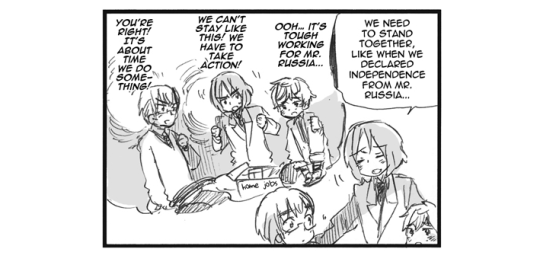
As Estonia gushes about wanting to become a Nordic, Lithuania
urges that they stick together and remain as the Baltic trio, just like they stuck
together when they gained independence from Russia.

image

Lithuania relives the first memory.Then, he remembers Russia squeezing his shoulders, and, without realizing it, starts squeezing Latvia and Estonia’s shoulders to the point that it causes
them pain. 

image
image

In my opinion, Lithuania doesn’t just seem to be experiencing
PTSD here. I honestly think he’s learned some of Russia’s violent tendencies,
not consciously, but more as an unconscious psychological consequence of the trauma
he experienced.

Latvia even asks Lithuania if he’s okay, but Lithuania is unresponsive. Just look at Lithuania’s expression; he’s pretty removed from the situation.

It’s these small, brilliant, and dark details that makes
this series enjoyable to read. Hima is so methodical in how he develops and
evolves his characters. In a single strip you see how unfathomably deep Russia
has hurt Lithuania, in more ways than one.

Just like humans, the nations become products of their
environment.

Who are the Schuyler sisters?

                            Hamiltalia:

Lithuania as Angelica Schuyler 

Belarus as Eliza Schuyler 

Latvia as Peggy Schuyler


Work, work! The Satellite sisters! 

Natalia! 

Toris! 

And Raivis!  

image

Latvia: Vanya said not to leave alone 

Lithuania: Vanya doesn’t need to know 

image

Latvia: Vanya said not to go out West

Lithuania: Like I said, you’re free to go (not really

image

But—look around, look around, the
Revolution’s happening in America! 

America!