
One lieter of wholesome coming right up!


Me: Time to get things done today.
Anxiety:

Yes, he’s tall too! [x]


If anything, this could also indicate how removed England
was from the effect that his taxation had on his colonies. Great addition,
thank you for sharing! [x].


It seems like Canada is America’s adopted
introvert.
Yes and no. Early on, it
was more of a resentful push-and-tug relationship. Their relationship in the
present lines up more with what you’re saying!
Sorry, I have to make
this distinction because you still see people bitterly posting on trope
websites that the two remain primarily resentful of each other, which isn’t
true! [x].

Is North Italy really a virgin? If he’s not,
why does the fandom believe so? I mean I know he used the “I’m a
virgin” lie to get out being harmed, as for some reason they sympathize
for virgins, but the dude has a black book full of women he has dated, he still
dates and flirts with girls. Given how old he is, doesn’t it make more sense
for them to have lost it at some point in time? Maybe n teen years. Oh, that
time he ran home for sexual needs during war. So y proclaim it canon if 1 is
not sure
(Not sure why this
really matters lol but…)
It’s messy because you’re
leaping through several time periods here. They don’t occur simultaneously.
WW1–He plays the
sympathy card and states that he’s a virgin to prevent Germany from shooting
him. This also could have just been a spur of the moment thing he said to avoid being harmed.

We also know from this
character chart that Italy officially becomes an adult in the 20th
century [x].

The third comic you
referenced is from Comic Diary 2. It
takes place in WW2. Italy cites that fight or flight instincts in war create an
urge in men to reproduce, hence the greater occurrence of sexual intercourse
between men since no women are available. As you mentioned, he leaves to
presumably have sex [x].

The second strip you
mentioned is from volume 2 and seems to take place in WW2. It doesn’t actually confirm whether he’s had sexual
intercourse with these women but rather that he’s met them over the years from
his time spent in war (i.e., “battles). He could have, but it’s not made explicit.

Presently, there’s a
strip where Italy uses a sexual innuendo in front of an attractive girl at an
anime convention [x].

Overall, my guess is
that he probably was a virgin during WW1 having just become an adult but lost
it sometime during or before WW2.
Why does no nation (other than his family) look
behind Russia’s cruelty and see he’s very lonely? (While Russia has done very
questionable things in the past…)
It’s easy to say that from an outsider’s perspective. Even
though Russia wasn’t psychologically aware of the depth and extent of his
cruelty, he was still an abuser. Loneliness isn’t exactly going to make those
whom he tortured instantly want to be friends with him. They’re big enough to
empathize and feel some compassion from him, but none of that will negate the
terrible experiences they endured in his household. I don’t blame them [x].

It’ll take a long time to heal (as we saw with China and
Japan), but I do believe it’s possible that their relationship will
improve in the future.
I’m too disturbed by the fact that Germany
can’t drink beer legally because he’s underage. he’s 20. he became an adult a
few years ago. he literally killed a man in his sleep, but he can’t drink beer
yet / he’s just too mature for his age??? he’s still a bby boy???? he can still
grow a little at this age??? he’s so young???
He’s 20 physiologically but not chronologically and became
an adult decades ago. Drinking ages also vary from country to country.
I know there are a few occasions where nations
physiologically young are barred from drinking (Deleted strip:
America’s Brewster F2A Buffalo), but for
the most part, it doesn’t seem to matter [x].

If a nation ages, it’s usually a mesh between their
chronological age, and political, social, and economic developments.


Over the course of the series, I’ve
found several clever ways that Himaruya uses the nations physical bodies and
interactions to reflect wider historical, social, and political circumstances.
Typically, I’ve noticed that the
use of physical force between a dominant and subordinate nation reflects
political pressure and suppression. Russia is a prime example of this. You’ll
often see him squeezing, bending, and pressing down on other nations—obliviously,
of course. Remember that he’s unaware of his cruelty [x].
Ex: I’ve speculated before that
the reason Latvia is so short is a symbolic representation of how he has been
politically marginalized and controlled for a significant part of his history [x].

In other words, he lacked the
independence and autonomy that would have allowed him to achieve growth and
flourish on his own. His growth was stunted by virtue of him being pushed down
into submission.
Latvia citing the reason for his
shortness as a result of Russia pushing down on his head, to me, acts as a
wider metaphor for political suppression.


Ex: Russia squeezes and hugs Czechia and Slovakia to end
their dispute over whether they should include a hyphen in their name. In this
context, the hug is Russia asserting pressure over not what he thinks should be
their name but rather what their name will be [x].


Ex: Russia hugs Bulgaria from behind [x].

Ex: In the strips depicting the Baltics path to independence
from the USSR, Russia squeezes Lithuania’s shoulders [x].


Wars and battles can also be depicted in seemingly trivial
interactions between nations. The battles occur literally but are repeated figuratively
in these interactions.
Ex: To symbolize how France picked at the remains of some of
Austria’s lost territories after the War of Austrian Succession, France also
loots from Austria directly [x].


Different classes and social status are reflected in the
clothing that dominant and subordinate nations wear. Nations who are
conquered, annexed, or made to be under the control of another nation are
adorned in servants’/ maids’ clothing.
Ex: Chibitalia becomes a servant to Austria after being
conquered [x].


Ex: Lithuania acting as Russia’s servant while the latter
attended a world meeting on both of their behalves.

Ex: Romania and Bulgaria during the Soviet era.


Me: I need more school friends.
Also me:

Probably Lithuania. The degree to which he’s been ruled over after his empire was dissolved vastly affected his view of the world [x].

Volume 1, Go Sealand!

Volume 5, Together with Russia.


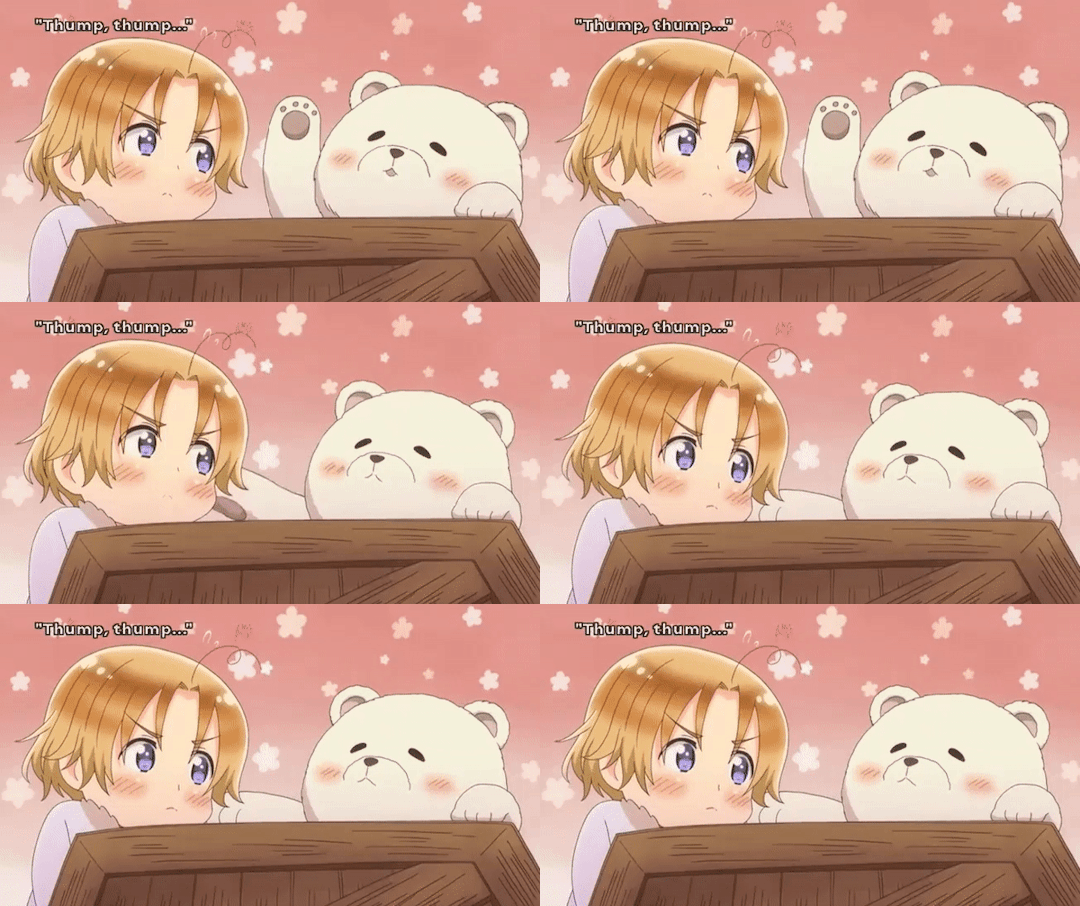
In previous posts, I’ve touched on the notion that pets in
Hetalia often function as a mouthpiece for their respective nation. Put another
way, while they are separate physical beings, symbolically they serve to
represent the psyches of their owners (i.e., their thoughts, feelings, and
emotions) [x].

Thus far, I’ve picked up on three consistent themes.
1)
They tell the nation something they need to hear.
2)
They speak what the nation doesn’t dare to say
out loud.
3) In conjunction to #2, they often reveal what the nation is
feeling.
That said, let’s tie this back to the strips.
The best example where America’s pets mirror his feelings is
their fondness of Lithuania.
America becomes disheartened when he can’t afford for Lithuania
to live with him anymore [x].
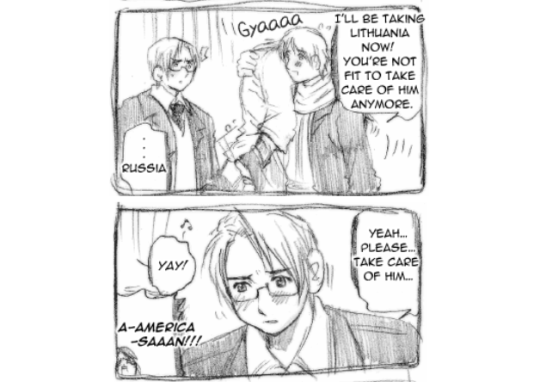
However, in earlier strips, we learn that America’s pets
hold a similar affection for Lithuania [x].

Before, I’ve speculated that Kumajiro represents Canada’s
psyche.
The focal point of Canada’s characterization is his struggle
to form a stable and memorable identity and overcome his invisibility. As such,
neither Canada nor Kumajiro getting each other’s names correctly figuratively reflects
how Canada still hasn’t figured out who he is.
Hence, Kumajiro’s infamous “Who are you?” catchphrase has another
level of depth to it [x]. He’s not just asking Canada who he is [as in his name]
but also who Canada stands to represent as a person and a nation. His identity and
self-concept is something that he continues to negotiate and work his way
around.

Some other examples would be…
Canada is too shy to ask England to have lunch with him.
Kumajiro then reassures Canada that it’s okay to be more demanding and urges
him to speak up for what he wants.

In the aftermath of the American Revolution, England diverts
most of his attention toward America. Kumajiro uses stuffed animals to convey Canada’s feelings. The puppet story depicts how Canada feels
neglected and excluded [x].
“I think the well-behaved baby bear should be loved more,
but what do you think, whoever you are over there?”


England becomes dismayed after watching a fantasy movie and
laments over his desire to live in such a world. His magical friends don’t hesitate
to give him a required dose of reality [x].

Mr. Puffin acts as both a mentor and mouthpiece for Iceland.
He’s able to see right through Iceland and recognize what he’s truly
feeling. In this case, he’s aware of how lonely Iceland is [x].

On the other hand, when he first meets baby Iceland, he comforts
him. At the time, Iceland was still figuring out his existence and questioned
why ‘no other guys like him’ existed. Mr. Puffin assures him that other
nations do exist, just in far geographic proximity [x].

He also teaches Iceland knowledge about the world from his
travels [x].


What this post will
explore is how, despite his independence, America is still equated to a child
by England. I will also touch on how America fights against this image and
overcompensates by attempting to discard any association of his childhood with
England.
As designated by the title,
America’s independence didn’t stop England from infantilizing him. Instead,
what you’ll see is that in light of losing his responsibility of guardianship,
England turns to criticizing everything America does and often meddles in his
affairs. Unconsciously, he’s unwilling to relinquish the authority that he had
over America.
Of course, America is
chronologically young in comparison to other nations, but there is still
something distinct in the way that England fusses over everything the former
does. It’s similar to an estranged parent that hasn’t come to terms with the fact
that they’ve lost control over their adult child.
Some examples of England’s
meddling would be…
Ex: England is caught
meddling in America’s political affairs during the latter’s Civil War [x].

Ex: England conveniently
shows up when America attempts to establish a trading agreement with Japan [x].


Ex: When Lithuania moves
in with America to pursue work, England immediately turns up. He wants to know
how Lithuania is being treated.
Translation: he wants to know what’s going on in
America’s life but is too prideful to admit it [x].

Some examples of his critical,
often condescending, attitude toward America would be…
Ex: When America arrives
at the African Warfront in WW2, England is dismayed over having to “babysit.”

In the same strip, he has
an entire dream sequence where he worries about America injuring himself.

Ex: He hypocritically
reprimands America for running his mouth during a world meeting despite having
a foul mouth himself.

Ex: He bashes America’s
[admittedly childish] world defense plan, referring to him as a “spoiled child” [x].


America’s hero complex,
in large, is an expression of his autonomy, his ability to succeed, and the
ability to assume the responsibility of making choices for both himself and
others. The only problem is that any reminder of his past with England doesn’t
reconcile with this new image of himself.
It’s for this reason that
I believe America suppresses any hint of his childhood with England. In other
words, it works against the mature, capable person that he’s constructed
himself to be.
Ex: England falls asleep
during a world meeting. It’s only until England starts murmuring his dream out
loud that America wakes him up. To be fair, it would be mortifying to have your
past bedwetting habit revealed.

Ex: America drinks
coffee out of spite. Drinking tea would be an acknowledgment of his past as a
subordinate. It’s a childish way of him wanting to differentiate himself from
England [x].

Ex: Lithuania finds the
toy soldiers that England gave to America when he was younger. *In arrives
England for a surprise visit* America becomes distressed and tells
Lithuania to hide the toy soldiers [x].

In sum, even though
America formally gained his independence from England, both struggled to readjust
and form new images of themselves in the aftermath.


I know it may seem random at times, but there is a
consistent logic running through the manga that explains why some nations live
on despite ceasing to exist politically. The reason that this causes a lot of
confusion among fans is because of how loosely the word nation is defined in
Hetalia.
Nation doesn’t strictly mean an autonomous and politically
recognized sovereign state. Instead, personifications exist as representations
of a group of people and their culture, hence explaining their wide diversity
(e.g., kingdoms, religious orders, micronations, city-states, provinces, etc.)
Remember that the modern nation-state is a recent phenomenon. Humans organized
themselves far differently in the past. Larger post on that here [x].
In “It’s a Treasure Box of Countries”, it’s confirmed that
the nations are cultural and citizen-oriented personifications. Two things can
happen when a nation dies.
1) They gradually fade when their people’s culture
or identity (personality) disappears.
“Usually, when the culture of the country’s personality
dies/ disappears, the country would gradually disappear or entrust him/herself
to the country that takes over him/ her.
2) The ex-nation becomes a state representative.
“Regardless if their people’s culture and
personality disappears, the personification can still live on as a state
representative.”
There are two points to take away from this. One, the
nations don’t cease to exist because of political recognition. First and
foremost, they exist for their people and their culture. Two, nations don’t
necessarily die right away, or at all if they decide not to.
Ex: In World Stars, France reaffirms again that the nations exist because of their people.

That said, let’s go through some examples.
After the third partition of their empire, it wasn’t just
Poland that ceased to exist on the political map.
Lithuania did as well. Nonetheless, as Lithuanians and Poles were absorbed by
Russia, Prussia, and Austria, thus ending their political identity, their
cultural identities remained in tact. Lithuanians and Poles didn’t disappear; their states did.
It’s for this reason on top of the fact that nations gradually
disappear that Poland and Lithuania are revealed to have lived during this era.
Poland made friends with Italy and bonded over their desire for independence.
Meanwhile, Lithuania became a servant to Russia.


Holy Rome didn’t die right away despite being dissolved,
once more demonstrating the gradual pace of how and when a nation fades.

Larger post covering him here [x].
Whether he’s East Germany or not, it’s clear that Prussia is
losing his immortality.
Ex: When Germany’s dog bites him, Prussia takes longer to
heal from a wound.


When asked on whether Prussia will disappear, Himaruya doesn’t rule this out as a
possibility [x].
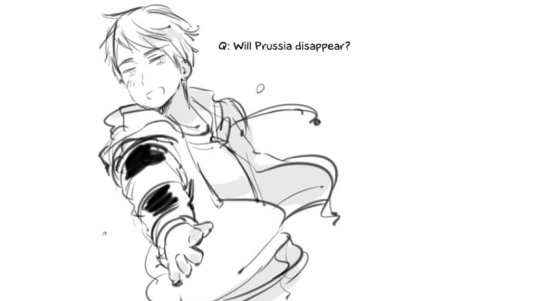

In sum, it’s important to note that the nations don’t exist
for political reasons. If they die, it’s because their people no longer
identify under a common identity, or their culture disappears. This death doesn’t
occur immediately and is a gradual process. On the other hand, personifications
can still choose to exist even without a group of people and culture to
represent.

 Ellawritesficssometimes
![[x].](http://www.hetarchive.net/img/bamboothicket/italy_hist.jpg)