image
image

In a previous post, I went over how the nations have
considerable gaps in their memories for a variety of reasons. [link here]. That
said, I also find it important to reiterate that the nations are not always
able to repress or forget traumatic memories, and often carry these
experiences with them – it becomes part of who they are, their personality.

Yes, their memories are full of holes, but these experiences
can just as easily be retained. It’s not that they repress everything, but
rather that they don’t remember everything.

1) Sometimes there are triggers – such as an object
or person – that allow the nations to remember an experience more vividly.
Prior to that, they simply have a general emotive idea of the experience, good
or bad.

2) Sometimes the nations carry the memories with
them, either consciously – it actively affects how they relate and interact
with others – or unconsciously – it latently affects how they relate and
interact with others outside of their own awareness.

3) Sometimes, no matter how hard a nation tries to
repress uncomfortable, unpleasant, or anxiety-ridden memories, they’re unfortunately
unable to.

4) Sometimes the nations retain the memories, but
purposefully refuse to either mention or acknowledge them.

Given their dark, chaotic, and bloody pasts, it would make
sense for the nations to protect their sanity by not remembering everything.
Nonetheless, what this post will argue and focus on is how these experiences
influence the nations both at an unconscious and conscious level.

Without further ado, let’s tie this back to the strips.

America:

America is a case of a nation who desires to forget his
past, but is unsuccessful in doing so. In particular, the experience he wants
to forget is his Revolution.

image

Likewise, while America retained vivid emotive and affective
memories from the Revolution, it’s only when he begins cleaning out old belongings
in his storage closet that he recalls the finer details of the unpleasant experience.

image

Simply put, even though America’s experience of the Revolution
has deeply affected him emotionally in how he perceives his sense of self, the
fact that the belongings flesh out these memories is essential in demonstrating
the limitations of his memory.

It’s just like what Finland’s claimed before; aside from physical strength and a strengthened immune
system, the nations aren’t all that much different from humans.

image

Italy: 

During a meeting, Italy’s boss takes an interest in Italy’s
immortality, and later remarks that it can be disadvantageous.

“You sure have been
through a lot, huh?”

Italy even agrees that his life has been tough. 

image

Even more
interesting is that Italy claims that he gets tired of seeing the same people
all the time, only to reverse this statement and say that seeing the same
people can be refreshing in a way.

image

How I see this is that while Italy may see the same people,
he experiences them differently each time. Perhaps this is why
Italy refers to this as refreshing – could it be that while he sees the same
people, they evoke different memories and emotional reactions in him?

What’s also important here is the initial reluctance in
Italy to disclose more “private” accounts of his life. Notice how uncomfortable
he looks. Not every memory is good, so of course he’s not going to be keen on
recalling them.

image

The scene ends with Italy offering to disclose these secrets
should his boss treat him to lunch. This could very easily be interpreted as
him deflecting the subject.

image

France: 

Having lost huge aspects of his culture following his own Revolution
–given that many old furniture pieces and decorations were either discarded, sold or burned – France still retains strong feelings of grief over this
in the present.

Put another way, France’s past still lives with him in how
he presently experiences himself.

image
image

Lithuania: 

Lithuania too is an example of a nation who’s still
traumatized by their past. It impacts every aspect of his daily interactions.

As he and the other two Baltics recall their arduous paths
to independence, Lithuania further recalls a memory of Russia squeezing his
shoulders.

Notice how Lithuania repeats this behavior, albeit unknowingly,
as he squeezes Estonia’s and Latvia’s shoulders upon remembering this troubling
experience.

image

Just to prove how consistent this memory rule has been, I’d
like to point out that Lithuania has suffered from triggered-induced flashbacks
as early as the first original chapters of the web comic.

When privy to the fact that Russia intended to invade Poland
in WW2, Lithuania repeatedly recalls traumatic experiences where his own
country was taken over and conquered.

image
image

Russia:

image

Lastly, Russia is a quintessential example of a nation who’s
affected by their past. What’s complicated about him is that he seems to
remember a lot about his past, despite their being holes in it, but fails to attribute
this to how he presently experiences himself.

In other words, while retaining many traumatic memories,
Russia doesn’t connect them to how distorted and unhealthy his conception of an ideal relationship is [either platonic or
romantic.]

For instance, take the Bloody Sunday strip. There, Russia
sheds tears over the revolt, considering how hard he had previously worked to
improve his nation.

The strip ends by largely hinting at him being tasked with
supressing the revolt through the use of violence.

image

“We don’t want children who can’t play nice, right?”

Now, let’s skip forward a bit to WW2.

As he and England discuss America’s boldness, you can
immediately start to pick up on how Russia’s past inadvertently affects how he perceives
the world and the people in it. Yes, he might have repressed the nuanced
details of his past, but he’s internalized a considerable amount of it without
his realizing.

He appears to take what happened during the Bloody Sunday revolt,
and applies the same rhetoric to America. Not only is his view of relationships
distorted, but so are his solutions to problems.

I specifically want you to pay attention to the child
imagery that emerges again with regards to how Russia equates rebellion with
immaturity.

“Aren’t the provocative [rebellious] ones more fun to snap
in half?”

Translation: Dissent is childish, and therefore it must be crushed [snapped].

image

In sum, while the nations do have considerable gaps in their
memories, they are still very much influenced by their past.

image
image
image

Misconception: Latvia’s physical body is young
and small for “no reason.”

I couldn’t
object anymore to this. While it’s not explicitly stated why Latvia is like this,
there are written rules and examples in the manga that provide a suitable
explanation. This is aside from the fact that Latvian people are among some of
the tallest in the world.

Since I
already have a theory on this, I’ll merely put a quick summary here:

For one
thing, we know that a nation’s health is predicated on their political and
economic situation. That is, if their economy is doing bad, or they’re experiencing
political instability, then they’ll develop a cold.

Likewise,
we know from the case examples of America, Canada, Italy, and Romano that
gaining independence causes the nations to age.

A strong
economy, a stable political situation, and political sovereignty are solid
factors in determining the age and size of full-blown nations – not micronations,
who are often anomalies to these rules.

That said,
because Latvia has historically experienced constant political repression and
subordination and lacks a strong economy, his physical body hasn’t aged as much
in comparison to the other nations.

image

Ex: Russia
pushing down on Latvia’s head is a metaphor for the political repression the
latter experienced at the hands of the former.

image

Further,
what differentiates Lithuania and Estonia in modern times is that both of them
are doing better off economically than Latvia is, who primarily relies on
agriculture. You also need to account for how Lithuania at one time was a
European superpower.

Ex: Estonia’s obsessed with money, and is good at managing economics.

Even then,
because of the political repression Estonia also experienced, he’s only a little bit
older than Latvia at 17.

image
image

Misconception: Because Latvia’s scared of
Russia and is physically weak, he’s just weak.

Latvia’s actually
a genius.

Ex: He
built an entire railroad by himself.

image

Ex: He
plays solo chess.

image

Misconception: His physical age means that he
has the mentality of a child

[He’s 15.]

While
Latvia does have a bit of a blabber-mouth –which gets him into trouble with
Russia, admittedly – that’s more of a character quirk than it has to do with his
maturity.

Ex: Latvia
has adopted a mentoring role when it comes to dealing with Sealand.

image

[He also
drinks a lot of alcohol.]

Misconception: He’s not scared of Russia
anymore

I’ve seen a
tendency for people to get angry when authors characterize the Baltics as being
afraid of Russia. Honestly, it’s accurate, especially given how terrifying their
past in the Soviet Union was and the extent to which they’re still traumatized
by it. (i.e. both Lithuania and Latvia are shown to escape from
reality, and maybe Estonia
too with his mochi-inspired dream + other dream fantasies).

The problem would be if you only depict
them this way, and don’t reveal the other aspects of their characters.

image
image

In other
words, “Stop making the Baltics weak!!!! They’re not scared of Russia!” is just
as bad as only showing them cowering
in the face of Russia.

Also remember that there was resistance and political
revolts on their part too. Either way, both depictions are biased,
one-dimensional, and don’t give the complexities of their personalities the
credit they deserve…

image
image
image
image

Keep in mind that the rules I’ve come up with here are not
canon. They’re simply just me compiling examples that form a consistent logic.

Overall, I’ve noticed two principle factors that causes the
nations to mature. There are other sub-principles that fall in tandem with
these categories.

1) They need a strong and autonomous economy, which
usually entails having a large population – If the nation is being taxed as a
colony, then they’re not economically autonomous.

2) They need to achieve political autonomy and
sovereignty (independence) – This includes a self-functioning and officially recognized
government.

Let’s go over a few examples.

America: 

At a young age, due to an early economic boom, we know that
America gained super strength. However, because his economy and legislatures
were authoritatively controlled by England, he grew weak for some time.

Now, notice how under England’s overbearing rule America’s
economy is strained. Not only that, but he looks considerably younger.

image

Then, look at him after he begins fighting for his
independence; there’s a notable increase in age between these two panels.

image

We also see this same growth spurt in volume 3, where
America ages exponentially right before he revolutionizes.

image

With control over his politics and economy, America was then
able to become an adult.

Admittedly, in the “Cleaning out the Storage” strip, America
admits that he feels like he’s becoming an “old geezer.”

Lithuania responds by telling him that he’s merely “becoming
an adult.”

Put into context, I interpret this as America maturing
mentally, as opposed to physically. From the example above, we know just how
dramatically he aged.

Likewise, what you’ll see in a moment is that America was considered
to be an adult well before the 1930s (around the time when the outsourcing
strips take place).

image

Canada: 

Canada is another good example of this autonomous economy/politics
requirement.

For one thing, he ages far slower than America, remaining as
a young child while the latter grew up at a faster rate. This is likely owed to
America’s larger economy.

That said, this proves the strong role that the total
strength of an economy overall plays
in the nations’ aging process. America and Canada were both under England’s
rule and were subjected to taxes, but because America’s economy [and
population] was larger, he matured more quickly.

image

The political autonomy rule is realized once Canada becomes
a Dominion (1867). While it’s not complete independence from Britain, it was
enough for Canada to physically mature from a teen to an adult.

image

Monarchies vs Constitutional Monarchies and Republics:

This is a more tentative example, but I’ve noticed that the
nations possibly could have aged as a result of a changed structure in their
governments.

Before constitutional monarchies or people’s republics, the
government was strictly run by the church and later monarchs, who ruled by
absolute divine right. Basically, the people had no say in their governments.

I mention this because in this strip here, we know that
Austria, France, and Russia are about 17-18 years old during the Seven Years’
war.

image

We know now that France is 26 and Austria is just a little
younger than Prussia, who’s 20↑

. We still don’t have a confirmed age for Russia
yet.

Nonetheless, the difference between now and then is that
democratic governments today are supposed to derive their power from their people (corruption
and tricky nuances aside, it’s the structure not the pragmatics that matters
here).

Starting in the late 18th century, this new era
of politics and the subsequent provision of constitutional rights might have
lent to stronger senses of national identities, thus causing the nations to
adapt and age in response.

We also know from France that the nations exist and therefore get
their power from their people.

image

Latvia:

With the following rules above applied, this explains why
Latvia remains so fragile, small, and young despite existing for far longer
than some of the other nations who are physically
older than him.

image

Latvia hasn’t historically experienced consistent political
independence and autonomy, and has been subjected to foreign control for much
of his existence.

His economy is also considerably poor. He lags behind in
industrial developments and remains largely dependent on agriculture.

image

So, before anyone says that Hima characterizes a nation’s
age for seemingly no reason, try applying these rules. I guarantee you that you’ll
find some sort of economic or political justification.

image
image

Let me just preface this by
clearing up the most common misconception about Russia; that is, he’s evil. In
canon, it’s the complete opposite. Russia is explicitly described as “not evil”,
albeit being “naturally scary.” Obviously, being scary in appearance and
possessing an evil mind are two entirely different things.

image

In the same character note,
it goes on to say that Russia thinks that Vodka and General Winter are his
friends. What’s more, everyone that he meets he thinks are his friends.
Strange, considering that aside from protecting Russia from invading nations,
General Winter attacks and torments Russia himself.

It’s this warped
understanding of reality and interpersonal relationships that I’ll be discussing
over the course of this post. To do that, we need to understand the core
influence of Russia’s childhood on his present person today.

In doing so, this will give
insight into the reasons why Russia wrongly sees violence as an answer; why he comes
off as cold; and why, despite having good intentions to make friends, he does
anything but.

To put it simply, Russia’s
childhood was brutal. For the most part, he spent his winters alone with little
help and no shelter. This strip darkly alludes to the fact that he grew
accustomed to freezing to death.

image

On top of that, Russia grew
up in oppressive circumstances. One example of this would be how he was
subjected to Tatar Rule (the Golden Horde).

In “The Yoke of Tatar”,
Lithuania first meets Russia and warns the latter that he’ll “freeze to death”
if he stays outside for too long. Of course, from the example above, we know
that Russia has already died this way several times before.

image

Here, Russia fantasizes about
becoming a bigger country and tells Lithuania that they’ll become friends one
day. Now, pay attention to what Russia says when Lithuania offers for them to
become friends in the present moment.

“We don’t have enough power.”
To me, that seems like a child with a twisted conception of what a healthy
relationship entails. Power in a relationship is what Russia’s been taught,
it’s all he knows.

image

He’s picked up on the
authority that the Tatars hold over him, and therefore applies it to how he
interacts with others. Put another way, the ruled strives to be the ruler.

This cycle of unhealthy
learned behaviour is also demonstrated in chapter 194 of World Stars. There,
Russia dismantles England’s naval brigade during the American Revolution. When
confronted about it, Russia’s response is so naturally oblivious that it
appears to have been internalized.

image

He’s literally equated power
with the ability to do whatever you want. Once again, you see how the influence
of his childhood factors in here. What Russia observed as a child is now being
repeated by himself.

Likewise, it’s not as if
Russia’s history has given him a break from suffering either. The damage only
keeps accumulating.

In the Bloody Sunday strip,
Russia’s brought to tears as he laments about how all his hard work to improve
his country has backfired, resulting in his people hating him.

image

Even darker is that at the end
the strip, it’s hinted that he’s been tasked with quelling the civil unrest.

image

Russia also hasn’t had any
mercy spared to him regarding his bosses. While we don’t get too much
information about them, what little that we do is heartbreaking.

When Russia is taken as a
prisoner of war in WW2 by Germany, he erupts with happiness and claims that
he’s in heaven. Out of everything, the most important comment is how he
mentions that he doesn’t have to deal with his boss.

image

Further, when he’s later
forced to build a railway by Stalin, Russia snaps. By snap, I mean that he
begins to fantasize about warm weather and loses all touch with reality.

image

This distance from/
misperceived reality is also to be taken into account regarding how Russia
doesn’t understand the consequences of his actions. He grew up with violence,
so violence is the only way he sees fit to solve his problems.

One example of this would be
when England’s caught sleeping at a meeting, and Russia offers to wake up
England by hitting him with a sickle. China’s comment, “violence is not the
answer!”, is the most telling indication of Russia’s troubled neuroses.

Another example of this
inability to recognize the consequences of his violent actions is when Russia
snaps Latvia’s neck in an attempt to get him to stop trembling.

image

That said, I would like to
end this by citing a favourite psychologist of mine, Karen Horney. She believed
that the “basic evil” (this is used loosely) in the world is parental
indifference, neglect, and hostility towards children.

While Russia may have had
Ukraine and Belarus, they weren’t around all the time. Centuries of oppressive
leaders, bloodshed, and isolation has taken a massive toll on Russia. What
Horney also said was that parents who exercised this basic evil of indifference
were incapable of treating their children with warmth and compassion as a
result of their own troubled childhoods.

Isn’t that what you see with
Russia? It’s not that he doesn’t want to be warm and compassionate towards
others, because he does. He wants nothing more than to make friends and help
ease his chronic loneliness.

The problem is
that he doesn’t know how.

image
image
image

Let’s jump into the pits of hell, shall we? Nah, I’m just
kidding. I think you guys know by now just how brutal the USSR was not only for
those under Russia’s rule, but also for Russia himself, as he’s always
struggled with chronic loneliness and making ‘friends.’

Political revolts aimed at gaining independence were
supressed through the use of force, dissenters were sent to gulags, and alcoholism
was rampant. That said, it’s no wonder that the Baltic nations were referred to
as the “Trembling Trio.” Anyone in their right mind would be terrified.

image

Russia, both the nation and personification, ruled with an
iron fist. To gain compliance, he either squeezed shoulders, or in Latvia’s
case, pressed down on the former’s head.

On the other hand,
the psychological damage is the most lasting here. Russia has a warped, child-like
mentality, one where he doesn’t quite understand the consequences or repercussions
of his actions. He uses violence to solve his problems.

image

When it comes to the damage Russia inflicted, Lithuania and the
cuts on his back immediately comes to mind.

image

Likewise, we know that Lithuania is still rehabilitating
from his time spent in the USSR.

image

Surprisingly, what I don’t see people talk about is this notion
of transference. That is, Lithuania has actually adopted some of Russia’s
violent tendencies, albeit unintentionally. You see this play out in chapter 96
of World Stars.

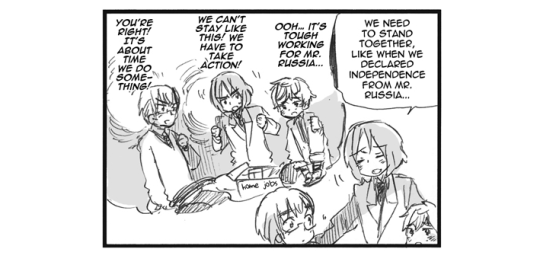
As Estonia gushes about wanting to become a Nordic, Lithuania
urges that they stick together and remain as the Baltic trio, just like they stuck
together when they gained independence from Russia.

image

Lithuania relives the first memory.Then, he remembers Russia squeezing his shoulders, and, without realizing it, starts squeezing Latvia and Estonia’s shoulders to the point that it causes
them pain. 

image
image

In my opinion, Lithuania doesn’t just seem to be experiencing
PTSD here. I honestly think he’s learned some of Russia’s violent tendencies,
not consciously, but more as an unconscious psychological consequence of the trauma
he experienced.

Latvia even asks Lithuania if he’s okay, but Lithuania is unresponsive. Just look at Lithuania’s expression; he’s pretty removed from the situation.

It’s these small, brilliant, and dark details that makes
this series enjoyable to read. Hima is so methodical in how he develops and
evolves his characters. In a single strip you see how unfathomably deep Russia
has hurt Lithuania, in more ways than one.

Just like humans, the nations become products of their
environment.

Who are the Schuyler sisters?

                            Hamiltalia:

Lithuania as Angelica Schuyler 

Belarus as Eliza Schuyler 

Latvia as Peggy Schuyler


Work, work! The Satellite sisters! 

Natalia! 

Toris! 

And Raivis!  

image

Latvia: Vanya said not to leave alone 

Lithuania: Vanya doesn’t need to know 

image

Latvia: Vanya said not to go out West

Lithuania: Like I said, you’re free to go (not really

image

But—look around, look around, the
Revolution’s happening in America! 

America!

image
image

There’s so many subtle hints and Easter Eggs that Hima
includes in his story-lines that I just have to talk about, since they appear to
be dismissed very easily. The amount of detail he puts into each strip, the
placement and sequence of the panels, the symbolism, and the foreshadowing he
uses to connect seemingly random strips together is sheer brilliance. With that
said, let’s start this new series!

In the “Lithuania’s Outsourcing” strips, Lithuania moves in
with America after WW1, as his economy had been experiencing a serious economic
recess­ion.

Immediately,
England gets suspicious, and being the nosy person that he is, he decides to
investigate if Lithuania’s being treated right by America. To me, this just
seems like a subtle form of jealousy in the sense that America is spending time
with someone else.

image

Anyways, America greets England by serving him coffee, which
is noted to be out of spite due to his lingering grudge from the Revolutionary
War. It’s a petty way of getting the last laugh over the situation.

image

Later, in the “Cleaning Out the Storage” strip, America reminisces
about said war and experiences several flashbacks. What Hima does next wraps
everything up subtly, and that’s what makes me admire his craft so much. You
can either enjoy Hetalia for its superficial face value, or you can look deeper
and find nuanced little details…well, everywhere.

image
image

Regardless, the scene ends with Lithuania serving America,
yes, coffee. This is the perfect conclusion in my opinion, as it reveals how
broken and fragmented America and England’s relationship is. It’s just the
right amount of conflict: 

You can see how
fond America is of his early days with England, and yet, it’s clear that he’s
not ready to let go of his grudge just yet.

image
image
image
image

A long-standing joke in the fandom is that because England’s
food is poor, America inherits said lack of taste from him and can therefore
eat it without a problem. However, evidence from the strips point otherwise. Just
like he chooses to read the atmosphere or purposefully ignore it, it seems that
America also chooses whether or not to give his true opinion on the food he
eats.

For example, in the sixth comic diary, an adult America reminisces
and bashfully admits that England isn’t very good at cooking.

image

He then has a flashback of his childhood, where his younger
self comments and shows disappointment in the fact that England has burnt his
food again. He also remarks that France is a better cook, which demonstrates
his ability to rank food according to taste.

image

What I’ll be arguing is that America doesn’t want to hurt England’s
feelings, and pretends to like his cooking instead. This is clearly seen in the
strip, as young America notices how intently
England watches him as he eats.

In other words, he wants to make England feel better. Quite frankly,
if England was giving me that look, I’d find it hard to tell him the truth too.
England’s reaction after America tells him that he likes the food is too cute
for words – it’s absolutely priceless – and this is likely why America keeps up
this façade.

image
image

Then, in another strip titled “America and England”, it seems
that America has become so used to ignoring the taste of food, that he’s
forgotten what ‘good’ food tastes like. That’s where I believe his ‘alleged’ lack
of taste comes from.

image

Why do I say this? Because there’s also instances where
America becomes aware of how bad the food he’s eating is, and has no problem making
his opinion known about it. It’s also important to mention that when he does
this, it’s usually in retaliation to England’s insults.

In other words, the moment England is rude to him, America is
no longer worried about trying to avoid hurting his former guardian’s feelings
and gives his honest opinion on the food. Here are just a few more examples:

After being called a collection of hicks by England, America
opens up about how awful the former’s scones are.

image

America is also known for hating the taste of marmite.

image

So, there you have it. It appears that America’s lack of
taste is more of an aversion to hurting England’s feelings. He may not openly
show it, but America truly does care about England; it’s the small hidden
details that you especially have to look out for with them since they’re both so stubborn.