image
image

What this post aims to
do is examine the ways in which the nations are impacted by the chronicity of
the wars they’ve endured as well as the coping mechanisms that they employ to bear
these hardships. Aside from the predictability of physical pain and illness,
there is a disturbing sense of normalization and domesticity in how the nations
negotiate their lifestyles in war. It’s
maladaptive.

That said, let’s go over
some examples.

Physical Pain and Illness: 

The most obvious impact
of war and political struggles—both
domestic and international—is the physical strain that it puts on a nation’s body.

Ex: During the Second World War, Germany and Italy are both taken as
prisoners of war. Germany compares the pain of torture to a mosquito bite, as
his daily life is far more painful.

image

Ex: England falls ill on several occasions following major political conflicts
(e.g., the American Revolution, the Napoleonic Wars, World War II) [x]

image

Ex: China complains of body aches, stemming from political infighting
in his country [x] [x]. 

image
image

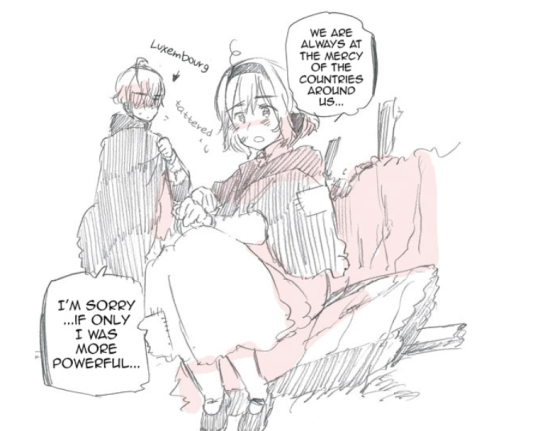
Sense of Helplessness:

Of course, smaller
powers are rendered vulnerable and pliable to the discretion of larger powers.

Ex: Belgium and Luxembourg discuss their inability to protect themselves
during both World Wars [x].
image

Ex: The conditions that Russian soldiers experienced were so bad that
Russia becomes ecstatic when Germany takes him as a prisoner of war. He
compares the German POW camps to heaven.

image
image

Ex: England’s normalized being captured by
the Axis and pre-preemptively brought a spare change of clothes [x]. 

image
image

Suspicion and Hostility:  

War is a breeding ground
for distrust and betrayal. As such, the nations must always be ready to fight
for their lives, even in seemingly innocuous circumstances.

Ex: When the two first
meet in World War I, Germany second guesses himself several times on whether
Italy poses a threat to him.

image
image
image

Ex: Russia shares his tea
ration with England. While skeptical at first, England accepts. The sweetness
of the tea initially causes England to conclude that Russia poisoned him. What
matters here is the fact that England rationalized this outcome as a legitimate
possibility…[x].

image
image

Domesticity, Normalization, and Adaptation:

image

As horrible and gruesome
as war may be, there are still moments where the nations are able to enjoy
themselves and share a good laugh. The problem, then, is that having had
experienced countless wars, the nations bring the domestic into the world of
war—i.e., war becomes their home and the private
and public sphere divide becomes muddled.

Ex: England drinks tea in
the middle of the battlefield. Trivial as this may appear, on a latent level,
he’s attempting to include a routine and sense of normalcy in an environment
that is otherwise chaotic and unpredictable.

image

Ex: After infiltrating
America’s war camp, Prussia teases Germany for his impression of an American.

image
image

Ex:Having just occupied
Rome, America asks the terrified Italy Brothers if they could make him
authentic Italian cuisine [x]. 

The casualness in the way
America speaks is disturbing considering that from his perspective, taking over
another country is normal. It’s not
something that should produce fear but rather should be accepted as is. He
doesn’t consider the Italy Brothers to be his personal enemies. The personal is not political in this case.

image

Relief:

The best nations that
illustrate the burdens of war are those who have passed on. Rome and Germania
visit Earth together and upon reflecting on their lives, they reach a similar
conclusion: death gave them a sense of liberation.

They’re no
longer bound by their bosses’ orders and aren’t forced to participate in wars
they have no interest in being involved in [x]

image
image

Q & A

For those curious,
it’s 116 f or more up there. Yikes. I’ll take our 83 to 96 f later today. I
wanted to ask yesterday, but the ask box didn’t seem to
be connected to the server (at least that’s what it told). How do you think the
Republic of Ireland is related to the UK brothers? It’s not been stated they
are a sibling, or even a relative, so that makes me curious. Happy Canada Day
up there
🎆

[Thank you! The ask box situation has been fixed, but the
read more coding issue still hasn’t been resolved! I’m so sorry, but I can’t
always answer asks right away….]

Himaruya isn’t sure what to do with Ireland, so no relation
has been confirmed [x]. Thus far, we only know that England is the son of four
siblings, including Scotland, Wales, and Northern Ireland [x]

If I’m to speculate here, they could be siblings if Himaruya ever decides to elaborate on the
character. Aside from historical relations, geographic proximity is
occasionally used as a defining factor for sibling relationships.

Given that Northern Ireland is England’s sibling and was originally
partitioned from Ireland, I don’t think this is too much of a stretch. Things get even
more complicated when you see that Northern Ireland is listed as England’s older brother… what a can of worms, eh?

image

Do you happen to know why people say APH
England doesn’t know how to swim? I’m pretty sure that was a joke in the comic
strips, but everyone seems to consider it canon.

Like you said, it is a joke, stemming from how British
people in horror films have a tendency of not being able to swim. I know I’ve
talked about this before, but my opinion has since shifted. I personally wouldn’t
consider it to be canon given the context [x]. 

image

Which Hetalia character has the biggest amount of
ships/harem? Why is it that a lot of the characters can be shipped with everything?
(including fridges apparently).

(Fridges aren’t even the
brink of some of the madness in the fandom :P)

In my experience of
reading fanfiction, I would probably say England. He’s very versatile and fits
well in several dynamics. (e.g., FrUk, UsUk, AsaKiku, EngSey, EngBel, EngIta, and SpUk). 

People have different tastes; of course it’s going to vary. 


How do you think the Eastern European countries (Ukraine and
Hungary in particular) would interact with their Romas/Gypsies? What would
their relationships be like?

From what I can recall, there is no canon
depiction of this. It’s difficult to say due to the fact that citizenship in one country
doesn’t have meaning in their way of life. 

However, given that the nations
represent all people within their territories, including those of different
ethnicities, race, religion, and class, Hungary and Ukraine would personally treat them the same way as they
would with any other citizen, even if they don’t possess citizenship. Citizenship
is a social construction. I believe what’s more important is the fact that
these people live in certain jurisdictions.


I know you said Luxembourg was referring to Belgium and
Netherlands as older siblings are terms of endearment rather than him being
biologically related but, do you think he could at least be related to Belgium
considering that a lot of his former land now belongs to Belgium and their countries
have close relations? (sorry for this being long.)

(Please don’t be sorry!)

The corroborating source
I mentioned in an earlier post [x]. 

The post [x]. 

image

It’s complicated because
as I mentioned before, the Bamboo Thicket post and the corresponding Hetarchive
page state two different things. The post is listed as a rough
translation, but the fact that Himaruya refers to Luxembourg using terms of
endearment instead of directly confirming a sibling relationship to Netherlands
and Belgium in the question is pretty clear.

I don’t know what else
to say. If it doesn’t claim that they’re biological siblings, then they’re not. I’m not a translator and don’t speak Japanese either. Still, what I would like to look into more is why that translation is cited
as rough…

image
image
image

Misconception: He
hates Spain

Reality: He hated
Spain but puts up with him now [x]. 

image
image

While Netherlands may be annoyed by Spain, they’re not
hostile.

image

Ex: Spain and
Netherlands are spotted together during the 2010 Christmas Event. Spain wants
to take a photo and Netherlands’ is reluctant. Netherlands’ threat to flip
Spain over is actually pretty funny [x]

image

Further, when they’re attacked by parallel France, Spain
comes to Netherlands’ aid.

image
image

Ex: They
coordinate their costumes during the 2011 Christmas Event, along with Belgium
and Romano [x]. 

image

Ex: Having been there
for part of Romano’s childhood, it’s Netherlands who points out how unaware the
latter was of the sacrifices that Spain made for him. In this case, Spain spent most of his money on Romano.

image
image

Ex: He helps lift
Spain onto Romano’s back as Belgium cheers them on [x]

image

Ex: Spain teases
Netherlands by putting on glasses to make himself more approachable and
suitable for business [x]. 

image

Misconception: He’s
rude

Reality: He’s kind and an older brother type.

 On
the other hand, he can also be crabby and has a ‘dirty side.’

image

Ex: He attempts to help Belgium and Luxembourg, who were at the
mercy of other countries, through diplomacy. The running gag is that all of his advice is about money, albeit well-intentioned [x]. 

image
image
image

Ex: He teaches Luxembourg the business skills that propelled him
into the thriving economic state that he’s in now.

image

Ex: He’s in his element when he’s surrounded by tulips [x]. 

image

Ex: He socializes and involves himself in a discussion on gardening [x]. 

image
image

Netherlands’
personality is complex in that he has faults. He’s not rude all the time. Like
everyone, there are moments where he loses his composure.

Ex: He tends to lose his composure when it comes to economic
matters relating to Greece in the EU. He’s still noted to usually be a
pleasant coworker [x].

image
image

Ex: His sister declaring independence from him made him cranky
when he visits the then isolationist Japan for trade.

image
image

Nonetheless,
like other Dutch merchants, he respectively adopted the customs of his business
partners and engaged in them during transactions.

image

Side note: I’ve seen enough people take a dub line
as canon, so I want to clear it up.

In the “Before an International Meeting” strip… [x]. 

What
Netherlands does not say: “What? Do
you envy my scarf?”

What he does say: “Yo, good morning.”

image

It’s a big
difference.

Misconception: Business is everything.

Reality: Business isn’t everything, but it’s extremely important. It’s what taught him how to thrive.

Ex: Witnessing the wealth of his younger sister, Belgium,
motivated him to evolve past his agrarian roots.

image

Ex: It’s for this reason that Belgium believes that he’s become
so stingy and obsessed with profit.

image

Ex: He exchanges weapons with Spain while they’re at war.

image

Ex: He has no problem mixing his business and personal lives
together.

image

Ex: When the prospect of the nations’ memories being full of
gaps is introduced, Netherlands is able to recall business transactions from the
last three hundred years, as well as European countries’ weaknesses.

image

Bonus Facts:

Like England,
he may, in fact, have a tattoo [x]. 

His hair is
naturally flat and limp [x]. 

image

His
relationship with Denmark is good enough for him to offer the latter a cheaper “buddy
price.”

image

He’s extremely
neat and tidy – he won’t eat in his kitchen despite cleaning it + doesn’t like
messy gardens.

As such, these compulsions, along with his obsession with money, is likely why he is described as neurotic in a character note.

image
image

In sum, while
Netherlands may appear to be rough on the edges, stemming from his occasionally
“rough’ business practices, he’s far more than that. He’s kind and is more than
capable of sharing close relationships with others. It’s not that he’s
unfriendly either. He has a stand-offish appearance. Meanwhile, he’ll stand up
for himself and those close to him.

image

Are Belgium, Netherlands, and Luxembourg siblings?

It says that on the
wikipage, but if you go to the direct source, it’s different. The translation is noted to be rough, but the distinction is nonetheless made very clear [x].

Netherlands and Belgium are the ones that are
siblings.

Luxembourg refers to
France, Spain, Netherlands, and Belgium as big brother and sister respectively
as terms of endearment.

This is a common trope in
the series, although it often causes a lot of confusion because it’s taken
literally.

It doesn’t help that the
trio was once referred to as sworn siblings. [x]

Although, if you go on
the above piece of information, it seems to be conveying a bond similar to siblings. It’s not uncommon
for close friends to consider themselves siblings – in this case, it would be
Luxembourg due to his close proximity.

Just to give more
examples of this trope, France is referred to as a big brother type/ big
brother of the world.

Hungary is referred to
as an older sister.

And so is Belgium.

I’m working on a larger
post that will go into more detail about the brother/sister figures and relations,
but it’s going to take some time.