Idk if this is of any use to your DenNor
analysis but there’s that scene in a Hetaween event where Norway demands that
Denmark asks if he’s lonely after Den has already asked Sweden and Finland.
Denmark tells him that they’re always around each other so he’d know if he’s
lonely and Norway doesn’t seem completely okay with that answer…
Yes, but Norway’s just annoyed with his response [x].
I summarize
relationships for these posts, so I can’t use every example 🙂
I think all nations are
just inherently smarter than the average human, regardless of their populations’
intelligence levels. Yes, they do act foolish in the manga, but they’re just
comic gags/ stereotypes. If you think about it, each nation has gone
through several political, economic, and social revolutions. Centuries and millennias
of existence would inevitably lead to increased intelligence.
Italy never lost his
smarts either.
Ex: He participated in
the Second Industrial Revolution and invented cars [x].
It’s really random and
there’s not much logic to it. I’ll get into some patterns that I’ve found
in a more detailed post, but the basic rule is that regardless of history, nations
aren’t related to each other unless explicitly stated by Himaruya.
The following post will examine Denmark and Norway’s
relationship. It serves to summarize their dynamic, which, while complicated,
is still nonetheless a friendship. For those wishing to characterize them in a
romantic relationship, these strips will also be useful tools to incorporate into
your works.
I’ve organized their relationship into three themes: Childhood
Nostalgia, Rocky Waters, and Nexus of Inseparability.
Childhood Nostalgia:
The first theme is particularly important because it sets
the framework for how the two associate with each other. Because they were
childhood friends, Denmark believes that Norway still thinks of him as his best
friend [x].
Meanwhile, in the same character note section, Norway is
noted to “somberly pick on Denmark” despite the latter not noticing this [x]. In
other words, Denmark isn’t aware of Norway’s quips or criticisms, while it’s
left unspecified how Norway truly feels about Denmark. What I’ll show soon is
that Norway does care about Denmark but is also easily agitated by him,
remaining externally aloof in their interactions.
Overall, a panel that bests captures their dynamic is this
one. The prompt is what they would be like as
elementary students. Of particular importance is that they’re closely depicted
together [x]. There’s a reason for that…
Rocky Waters:
This theme is in reference to how the sea has been used as a
metaphor for time in the series. Historically, Denmark and Norway have had
several ups and downs in their relationship (e.g., fighting against each other,
fighting with each other, and being separated by force).
As mentioned above, the two were childhood friends.
One thing that fans don’t often mention is that Himaruya’s acknowledged
that his depiction of Denmark and Norway’s union gives off the “impression that
Norway is completely disinterested in Denmark.” Not only that, but he goes on
to mention that the two were in actuality working together very well at that time [x].
He also makes note of Norway’s oppression leading up to
their separation and how the two drifted apart afterwards. Denmark even went so far as to throw a
tantrum and send a letter that cut his ties with Norway when he had heard about
the latter’s new union with Sweden.
Ex: This panel depicts their mutual poor relations in the
aftermath of their separation [x].
On the topic of Norway’s oppression and the poverty/
turmoils he experienced under their union, it’s important to recognize
that Denmark was initially unaware of this.
Ex: He cries when he realizes the delipidated living
conditions Norway experienced because of him. In this strip, Denmark had
originally been tasked with increasing taxes onto the Norwegian population but
was unable to follow through with it [x].
Ex: He becomes distressed when a naval blockade prevents him
from reaching Norway [x].
Lastly, even though Norway may come off as indifferent and
make several jabs at Denmark, he still expresses concern for him. It’s not that
he doesn’t care at all. What confuses a lot of people is that Norway will act
indifferently one moment and then express concern for Denmark in the same
scene.
Ex: Norway tells Denmark not to worry about him. He then reassures
him by admitting that he knows Denmark was trying his best despite his
impoverished circumstances [x].
Ex: Denmark doesn’t want to look uncool in front of Norway
and engages in a fight with Sweden that he knows he’s going to lose. Norway
makes a few remarks about Denmark’s well-being but is waved off as a worrywart.
It’s only after Denmark is defeated that Norway goes back to the trope of
remaining indifferent…which brings me to my next point [x].
Nexus of Inseparability:
The most resounding theme of their relationship is that the
two are inexplicably bound to each other, regardless of how many ups and downs
they’ve experienced.
What I haven’t seen anyone point out is that while one of
Norway’s hobbies is to “gently poke fun” at Denmark (vol 4), this stems from a Norwegian
stereotype.
Although Norway is perturbed by the fact that Denmark thinks
they’re best friends, he’s resigned to it. He isn’t exactly the type of person
to say something as explicit as that, which is why the phrase “competent
partner” was probably used [x].
Make no mistake either. Denmark irritates Norway, but the
two always end up together.
Ex: Iceland chides Norway for being contrary to Denmark, as it’s completely
ineffective. Denmark is described as a person who ignores unkindness, so Norway’s
jabs go right over his head [x].
As is the same for anyone who wants to depict the Nordics,
Himaruya touches on how historical tensions between them have been replaced by
cooperation and closeness in the present [x].
Conclusion:
All in all, it would be a misnomer to claim that Denmark and
Norway hate each other or that it would be impossible to depict them in a romantic
relationship. Just be mindful that they’re not buddies like Denmark sees them
and that they have a complicated personal dynamic stemming from their history together.
Figured you would appreciate this sarcastic response to fans [x].
I wouldn’t say it’s impossible, but there are some ups and downs in their political history together that have influenced their relationship. For shipping purposes, I’m of the opinion that a slowburn type of romance is most accurate for their relationship (i.e., it would take Norway a lot of time to be receptive to Dan given how much the latter annoys him).
Post coming up tonight! (It’s going to be a weird mix of a friendship and shipping post. It would be redundant to use the same examples twice.)
I strictly base my
opinions on the information presented in the manga [x].
From what we’ve seen,
Norway can see and communicate with fairies (including England’s fairy friends), and Iceland can see these creatures but chooses not to let people
know this to avoid being seen as childish and weird [x].
There’s no indication
that they can perform magic, unlike Romania and England who are in the magic
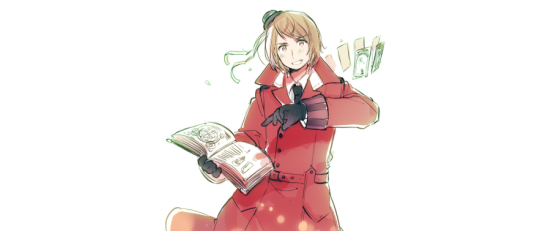
club in the Gakuen AU and are depicted with spell/fortune books in other blog updates [x] [x]
Given the legends, it’s
possible that Himaruya will decide to give them the ability to cast spells, but for now,
no. That doesn’t mean you can’t headcanon this, though!
Russia and America are distinctly
singled out as the strongest as the nations, but Germany is noted to possess
significant strength and muscles too [x].
This doesn’t go to say that
Germany wasn’t strong enough to defeat America or Russia in different battles (obviously), but
Himaruya has been consistent in elevating Russia and America’s strength above
other nations [x].
The fact that he cuts Iceland’s hair [x] and his love for nature [x].
Which Hetalia mochi or
cat would you keep as a pet?
No mochis
for me. Too much of a hassle.
I like
Spain cat because he’s super cute and Franchat, mainly because of the pun.
He can see and communicate with supernatural beings with his barrette but hasn’t been shown to be capable of using magic (e.g., he’s not part of the magic club in the World Academy AU). [x].
So far, it’s only England and his three older brothers and Romania whose magic-performing abilities have been confirmed.
One thing I’ve noticed is that fans approach and analyze
relationships between the nations from a human perspective. The problem with
this is that it doesn’t capture the elasticity and interchangeability of
titles of beings who are immortal– not mortal– go through. In other words,
aside from direct biological relations which don’t change, you can’t apply
words of human organization to immortal beings who routinely change how and who
they relate to.
For example, just because a nation lives with another
nation, doesn’t automatically make them family. In the case of a nation, they
don’t live with other nation(s) by choice but rather circumstance. Often
enough, it was the product of being conquered.
Some nations living together will choose to identify as a family,
as their bond as a unit most closely resembles one. Nonetheless, these
families, or households rather, are temporary.
Ex: Hungary refers to Holy Roman Empire’s household as a
family [x].
Ex: Having lived with France in Rome’s household
for some time, young Italy referred to France as big brother.
Out of respect, some nations will continue to refer to the
other nations they lived with as an older brother. In Japanese, “onii-chan” is
a term coined out of affection and adoration for a figure. It doesn’t mean
older brother in a blood sense.
Ex: France claims to be the older brother figure of the
world. Meanwhile, only Italy and Monaco choose to refer to him with this title
of affection [x]. Again, not to be mistaken with a relation.
A nation can be a guardian for several centuries and later
evolve into a companion, friend and/or mentor figure.
This is best seen with America and Canada, biological
brothers who temporarily held a family unit with their colonizers. Although,
they didn’t physically live together, settling for occasional visits instead.
For one thing, it’s important to distinguish the fact that biological relations are inherently sensed by the nations.
There’s a difference between Iceland, who senses Norway to
be his brother from birth [as does Norway]… [x].
…and England and France, who make America and Canada their
family [x].
Ex: America doesn’t inherently sense a brother among his
colonizers, Finland, France, and England.
Instead, they fight over who will assume the role of
America’s brother [x].
As mentioned, it’s difficult to apply human words for
relationships to capture relationships between immortal beings. It doesn’t
quite fit. Think of it this way: The nations have unique experiences that we as
humans will never have. So, why are we using words that describe our
experiences to describe theirs?
Respectively, England has trouble deciding what America
should call him.
Again, notice America’s choice of the word onii-chan.
Titles like guardian and older brother, two very different
terms, are loosely thrown around. Of course, older brothers can be guardians, but you’ll see what I mean by this muddled distinction in a moment.
It’s hard to make sense of a relationship
using words that don’t describe but instead confine and water down the
complexity of the colony-colonizer and simultaneous guardian-adoptive
relationship they’ve established.
This uncertainty and fumbling to find words that best
describe their relationship is seen again when America declares his
independence. Even he doesn’t know if what they had entailed a parent-child or
sibling relationship [x].
Nonetheless, he cuts off these ties and no longer views
England as this type of figure for him.
The point I want to emphasize is that due to political
circumstances, the nations’ relationships with each other are dynamic. It’s not
as rigid as human forms of organization; therefore, it doesn’t make sense to
approach these family-like dynamics from a human perspective. It’s like
comparing apples and oranges.
Lastly, to avoid falling into a trap of reasoning, there’s a
stark difference between conquering/ colonizing a nation and living together and
willfully forming a union [economic or political] and living together.
Ex: Switzerland adopted Liechtenstein into his household and
the two consider each other to be siblings. Because this is how they presently
identify and relate to each other, they are siblings.
I’m not particularly big on headcanons, but I sometimes do charts like this 😀
Most insecure nations
–
America, Canada, England, Germany, Italy,
Romano, and Poland.
Loneliest nations
–
America, England, Iceland, Prussia, and Russia.
Happiest nations
–
Denmark, Finland, Seychelles, and Sweden.
Most sarcastic nations
–
England, France, Norway, and Romano.
Nations we need more of
–
Belgium, Belarus, India, and Vietnam.
Note: This is a
guide. It’s not meant to cover an exhaustive list of all relevant examples in the manga. If I did that, this post could
easily be a novel.
Before I get into the direct blood relations of the
characters, this guide aims to chart out and differentiate between the different
types of relationships that we see in the manga.
Biological:
Biological siblings, obviously, means that the nations in question
are blood-related.
Ex: America and Canada.
Ex: Greece and Egypt and their moms, Ancient Greece and
Ancient Egypt.
The best example of a biological relation is that of Norway and
Iceland’s.
Iceland had no native people. Since it was Norwegians alone
who first settled on the island, the two are directly related [x].
Iceland innately senses Norway when he’s first born.
Norway
also senses Iceland.
Likewise, DNA testing – in this case, a land excavation – is
done to confirm their biological relation.
Now, let’s do a comparison.
When America’s born, he doesn’t sense a biological brother
among the countries colonizing him. The reason for this is that he’s referred
to as an ingredient, meaning that not only were there native tribes living on
the land he represented but that America existed as a mix of several European
cultures [x].
The point to differentiate here is that America doesn’t have
a direct biological relation to these colonizing countries due to the large
volume of them.
Instead, what you’ll see is that the colonizing countries
fight over assuming the role/ title of being America’s big brother, or
onii-chan.
Onii-chan:
Continuing from America’s example, after he chooses England
over France, he asks England if he can refer to him as onii-chan – ‘Big Brother.’
As stated in the translator’s note, onii-chan can be used as
an expression of adoration and endearment. Put another way, ‘big brother’ here
has an entirely different cultural connotation. It’s a brother-figure relationship
and isn’t meant to be taken literally.
Not to mention the fact that England initially rejects the
label of onii-chan, claiming that “just ‘England’ is fine.’” The reason England
is hesitant to accept the label stems from the horrible relationship he has
with his own older brothers.
France is another example where the term Big Brother is used affectionately.
Ex: He claims to be the Big Brother of the world.
Ex: He’s described as a Big Brother-type.
Ex: The first thing that he does when he meets Lisa, Jeanne
d’Arc’s reincarnate, is introduce himself as Big Brother.
Ex: The reason that Italy refers to France as Big Brother is simply because they grew up in Rome’s house together for some time.
This title of endearment is confirmed in one of Hima’s blog
posts, where he clarifies that Italy and Monaco both call – as in refer – to France as Big Brother [x].
More examples of France’s use of the title ‘Big Brother’ can
be found here [x].
One last example of this is that of Netherlands, Belgium,
and Luxembourg.
Netherlands and Belgium are biological siblings. Meanwhile,
Luxembourg refers to Netherlands, France, Spain, and Belgium as Big Brother and Big Sister respectively [x].
While the translation is noted to be rough, the distinction
is nonetheless made very clear.
All that needs to be known is that when two nations
willingly unite – not to be confused with being conquered/ annexed – the personifications
involved are considered to be married.
Austria is notorious for this, being noted to have solved
all his problems in the past through marriage (e.g., the Austro-Swiss
partnership, The Hapsburg Monarchy, the Austro-Hungarian Empire).
Ancestors:
In the manga, sharing similar ancestors doesn’t make the
nations involved biologically related. In this case, I’m talking about cultural
influence.
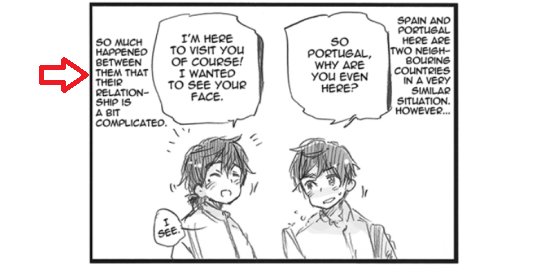
Ex: Spain and Portugal. (Chapters 77-79 of World Stars).
Both are noted to share a similar ancestry. As such,
Seychelles can’t tell which one is Portugal when she has a letter to deliver to
him.
Given the context in which the topic of their physical resemblance and relationship is discussed, if they were siblings, France would have attributed the reason for their likeness to this. He doesn’t.
Not once is a relation ever confirmed except for the fact that they’re neighbors.
Point is, it’s the similar ancestry that causes them to look alike.
While Romania may have inherited much of Rome’s culture, he’s
not related to the Italy brothers.
This brings me to my next point.
Influence:
While cultural influence often affects the physical
and personality traits of nations, it doesn’t make them biologically related.
Ex: Seychelles was originally designed to have one thick
eyebrow and one thin one to represent French and English influence.
Ex: As an amalgamation of several cultures, America
resembles bits of Finland, France, and England.
Ex: France’s influence prevents America, Canada, and
Seychelles from inheriting England’s bushy eyebrows [x].
Ex: Young Canada inherits France’s hair due to his
influence. This is before England had assumed control over him.
The House System:
When a country is conquered and their conqueror is on the
same continent, the conquered personification lives with the conquering personification.
Ex: France, Holy Rome, and Chibitalia living in Rome’s house (panel used above).
Ex: Chibitalia and Hungary living in Holy Rome’s house. Despite the rough start, they become so close that they refer to each other as family.
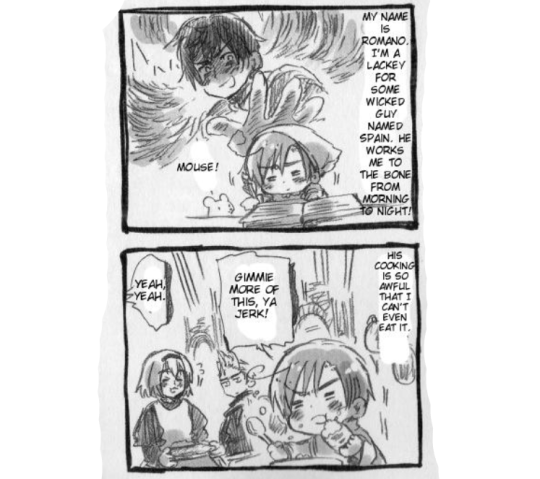
Ex: Romano, Netherlands, and Belgium living in Spain’s house.
In modern times, we still see this occur, albeit it’s a bit
different.
The Chinese provinces +
Macau and Hong Kong (under a one country two systems principle) all
live in China’s household.
The Colony/ Household System:
*Note – I made up the labels of house and household system
to better clarify and more easily distinguish between the two different living circumstances.
In canon, ‘House’ and ‘Household’ are terms used loosely and interchangeably in the translations.
The household system is separate from the house system in
that because the colonies are on separate continents, they’re part of a
household. In other words, they’re together and considered to be a unit despite
not living with the ruling nation.
Ex: England visits America, but America doesn’t live with
him in England.
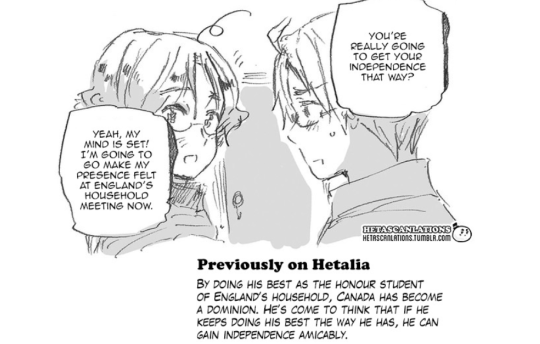
Ex: England hosts a household meeting, requiring the colonies to travel [x]. (America is already independent here, by the way. He’s not part of the household.)
Ex: Likewise, England has holiday houses in Hong Kong and
India, as alluded to in one of his character songs [x].
“
Curry, Chinese cuisine, my holiday houses’ meals.”
Ex: Hong Kong, who used to live with China and referred to him
in a more intimate way [x], changed after he became an English colony.
When he becomes Chinese territory again, he refers to China
as teacher/ Mr., seeing him more as a mentor.
What I want to stress here is how fluid interpersonal relationships
between nations are in Hetalia. They’ve lived for centuries; how they view and
interact with each other changes with time. Their relationships – aside from
biological relations – aren’t as static as human patterns of organization.

















 Ellawritesficssometimes