I’m not ignoring requests for a characterization post. It’ll
be a separate thing later on.
Anyways, the answer as to why Poland speaks like a valley girl
and cross-dresses is pretty underwhelming and anticlimactic. There isn’t all
that much to say.
Post coming up tonight!
Below will be a list
of events that have contributed to Lithuania’s resilience and strength of
character. There’s a reason why he’s known for his perseverance and willpower
to survive through adversity.
He was routinely targeted by the Teutonic
Knights:
On several occasions,
Prussia attempted to forcefully convert Lithuania. Meanwhile, Lithuania refused
to back down and gained enough reputation to cause Finland to be wary of his
fierce warriorhood [x].
Polish-Lithuanian Commonwealth:
To circumvent against the
threat of larger powers, he and Poland joined forces. The series depicts
Lithuania as the one who held up their partnership, doing most of the work
whilst being bossed around by Poland [x].
In modern times this
dynamic remains, as Lithuania still ends up doing a lot of running around for
Poland. It’s important to note that Lithuania chooses to do this, as the two
are close friends that have since smoothed out the hiccups from their past.
Lithuania’s just a bit of a pushover and is too kind to say no.
Ex: In the
intermission between the world wars (given the date that these character notes take
place), Lithuania is said to be seemingly enjoying himself whilst being dragged around by
Poland. He is also said to be rehabilitating with Poland after initially freeing
himself from Russia.
Partitions and The Death of the Commonwealth:
Lithuania bore
considerable resentment towards Poland due to the circumstances of their separation.
As Lithuania was being forcefully dragged away by Russia, Poland laughs and
makes fun of Lithuania’s expression [x].
However, it’s likely Poland didn’t understand the severe implications of what
it meant to be under Russia’s rule (e.g., physical abuse and degrading servitude). I say this because after the two gain their independence from
Russia, Poland becomes shocked when he learns that Lithuania acquired many scars
on his back.
Since Poland and Lithuania had just gained their independence and
there’s a mention of Italy having gained his independence not that far in the
past, this leads me to believe that this strip took place between WW1-WW2 [x].
On the other hand,
earlier strips contradict this. Poland is once shown to have found a half-dead
Lithuania after a fatal encounter with Russia. It’s messy to get around, but
you’ll notice that later strips fall more align with the former point.
While Lithuania may
have bore a grudge over Poland’s apathetic reaction to their separation, this
doesn’t stop Lithuania from fretting about Poland and warning the latter of
Russia’s intent to annex him prior to the outbreak of WW2.
Likewise, it seems
that after Poland realized the horrific truth of the adversity Lithuania
experienced under Russian rule, Poland became more protective of Lithuania,
even going so far as to call out Russia on several occasions despite being
scared of him and having also been under USSR influence.
Brief Respite:
Although he was poor
and had to outsource himself for work, Lithuania was able to find a stable and
welcoming environment in America’s home [x][x].
Unfortunately, America
himself became too poor to host Lithuania during the Great Depression and
Lithuania again found himself being forcefully dragged away by Russia.
USSR:
Lithuania went back to
a life of servitude and lacked full agency (e.g., Russia attended world
meetings on his behalf.)
He was the one who
rallied the Baltics into gaining their independence from the USSR. Afterward, Lithuania
didn’t hesitate to throw away any belongings associated with this period of his
life [x][x].
Poland: You lived
with America, right? Don’t you have any dirty secrets on him?
Lithuania: I did.
Poland: Soooo…?
Lithuania: …
Poland: He made
you sign a non-disclosure agreement, didn’t he?
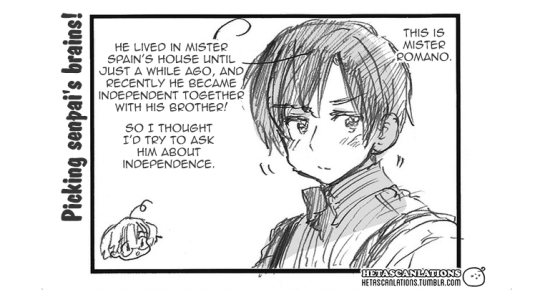
Since when was Canada and Romano best friends?
Apart from the brief encounter when Canada asks Romano about independence,
there has been no interaction that shows them as friends. In fact, isn’t Romano
one of the ones who forgets Canada unlike his brother, Veneziano? I know he’s
friends with America, but only acquaintances with Canada, or an I missing
something?
They’re not friends? I’m
as confused as you. Like you said, they had that interaction in WS where Canada
asked Romano how he had gained his independence [x].
Not exactly. I think you’re
referring to the Christmas 2011 event. Veneziano recognizes Canada but we don’t
get to see Romano’s reaction [x].
do you believe that
monaco and france are siblings the way that norway and iceland are? like…
biologically (even though biology and nations is an iffy thing lol)
It is an iffy thing lol. I’m still in the process
of putting together a model, but to avoid a slippery slope, Himaruya has made
it so that descendants aren’t necessarily biologically related (e.g., Bulgaria
and Romania aren’t considered to be Rome’s grandsons, even though Romania
strongly insists otherwise).
Anyways, as for your question, no. Monaco is referred to as his protégé in a
volume 4 character note [x], although I’ve seen printed English translations where she’s referred to as his sister in the same note…
In Volume 6, she’s referred to as his “kind-of sister.”
She and Italy refer to France as big brother;
however, we know that Italy uses it as a term of endearment and given that
Monaco is his protégé, I would apply the same logic [x].
Hey, so, before some wars in the 1700s, the French and
Spanish had A LOT more colonized land in North America than England, so in
Hetalia, wouldn’t that make France more of a parental figure? Before the wars
in 1700s at least. (I got this from my AP US History book)
Hetalia isn’t historically accurate, so it’s not the best
lens for analyzing relationships between the characters. Use the original
source material for interpretation (i.e., the manga).
I’ve done some posts that highlight the paternal
relationship that France has with America
[x][x], but it still stands that England was
his primary father figure/ mentor. Even so, we know that because of England’s
long absences it was minimal.
Ex: America is jealous of kids who get presents from their fathers on Christmas [x].
Hello! Can you tell please in which period of
time strip “While you were gone” takes place?
I think it takes place
during the intermission period between WW1 and WW2. Both Lithuania and Poland
were independent, but Lithuania still warns of political tensions and the
likely possibility of Poland being targeted. Italy had also just gained his independence [x].
I’m very
sorry to hear that.
In the series, what
we’ve seen is that if ordered to, the nations will promote propaganda despite
not necessarily believing in it. This doesn’t mean that you can’t characterize them as you wish either.
Ex: Germany is
morally opposed to annexing Austria but is forced to [x]. In a later strip, he’s
seen promoting the annexation with other officers [x].
I hope this helps. All the
best, and thank you for sharing your voice and permitting me to comment.
I’ve already done posts on this subject. You can find them in my post directory [x][x]
I think I read somewhere that Belarus can see
ghosts? Do you know if this is true.
I don’t have a direct English translation to link you to, but it is
revealed that she can see ghosts in “Desktop Buddies” [x].
This is
the anon from earlier asking about your askbox status. I’ll send the ask now
then. So I was wondering if the canon human names that Himaruya’s picked out
for the countries have any historic relation, significance, or connotation to
be kept in mind? I believe that Hima in the past has explained some of his
reasoning to an extent, but a lot of it I think he’s left up for debate so I
was wondering if you could provide a list of plausible reasoning for their
canon names. Thanks!
The human names were deleted, so some people don’t take them as canon. Many speculate that this was because the names and surnames were not well-researched on Himaruya’s part (which is true).
Hetarchive has an entire page dedicated to extracting the possible historical references and/or significance from each of the names [x].
Although the nyos were later given names, they’re not official or canon. Himaruya stated that fans could name them however they please [x].
I love your post on
micronations and states. I’m hoping hima will put Mexico and Texas in there. I
know mexico was mentioned once. I just am hoping Texas will be
official-official since Texas used to be a country and hima saying nations
continue living if the become territory’s.
Thank you!
The strip where Mexico was mentioned is from Comic Diary 2. America speaks of the Alamo grudge [x].
As for statetalia? While state personifications exist for other nations, they don’t [officially] for America.
On the other hand, Himaruya does create a dialogue and panel in which the American states hypothetically existed [x].
I think I saw somewhere that Prussia asked
Italy on a date once- is that true?
Yup! It’s from Prussia’s Drama CD, titled “The CD of the Awesome Me,” [x].
Hi Ella! Can nations teleport? (France
disappeared after talking to Joan so I was wondering) Or maybe he just ran away…
Hello! They can transport; however, distance and the ability to travel on foot conventionally seems to be a major factor (e.g., Finland can’t transport to Seychelles and vice-versa during the 2010 Christmas Event).
*After talking to Lisa, Jeanne’s presumable reincarnate*
It’s not confirmed, but that could be the reason why France disappeared so quickly. Either that, or he was just being dramatic for flare.
Do you know some moments that Italy may looks naive, but he knows more
then he looks?
Italy’s not canonically naïve.
Yes, I’m aware that the comic gag is that he’s a “Hetare” but even in the
original webcomic, he’s not clueless at all. In fact, he constantly worries
about how he’s perceived by his allies in terms of his worth and ability to
contribute to the alliance [x].
Overall, he’s incredibly
intelligent and perceptive. He puts on a front of cheerfulness but is keenly
aware of what’s going on around him. Most of the time he brushes it off and
chooses not to focus on it.
You see this more when he refers to corruption in his nation’s
politics [x].
Why are Austria and Switzerland suddenly so
distant from each other? Okay their relationship was cut because of their boss,
but after that, why are they like cold towards each other like ex lovers or
something?
As far as I’m concerned, it’s
literally just that reason. There isn’t much of a romantic overtone (they were kids). It was more like a very tight partnership or camaraderie. I say this because Switzerland has flashbacks of the times he spent with Austria when he experiences similar moments of fondness with Lichtenstein.
He’s still bitter over the loss, having been discarded and mistreated by someone he trusted. Please remember that nations follow their bosses orders, so it’s not like Austria had any malicious intent [x].
Okay, just a quick question. Do you remember
that strip where Romano wanted his room of hopes and dreams cleaned? There was
a roman emperor looking statue on the front. Maybe he wanted to rule the empire
once? I’m feeling curious y’know.
That’s an interesting thought. My personal take on it is that it represents Romano’s failed hopes to live up to his grandfather’s legacy and inheritance [x].
You see this complex with him when he’s younger too [x].
Veneziano isn’t exclusive to failing up to this legacy either. Germany actually overestimates him when they first encounter each other in WW1 (Volume 1, Prologue).
Which character do you think is least accurate
to the country they are based upon?
Poland 100%
I know it may seem random at times, but there is a
consistent logic running through the manga that explains why some nations live
on despite ceasing to exist politically. The reason that this causes a lot of
confusion among fans is because of how loosely the word nation is defined in
Hetalia.
Nation doesn’t strictly mean an autonomous and politically
recognized sovereign state. Instead, personifications exist as representations
of a group of people and their culture, hence explaining their wide diversity
(e.g., kingdoms, religious orders, micronations, city-states, provinces, etc.)
Remember that the modern nation-state is a recent phenomenon. Humans organized
themselves far differently in the past. Larger post on that here [x].
In “It’s a Treasure Box of Countries”, it’s confirmed that
the nations are cultural and citizen-oriented personifications. Two things can
happen when a nation dies.
1) They gradually fade when their people’s culture
or identity (personality) disappears.
“Usually, when the culture of the country’s personality
dies/ disappears, the country would gradually disappear or entrust him/herself
to the country that takes over him/ her.
2) The ex-nation becomes a state representative.
“Regardless if their people’s culture and
personality disappears, the personification can still live on as a state
representative.”
There are two points to take away from this. One, the
nations don’t cease to exist because of political recognition. First and
foremost, they exist for their people and their culture. Two, nations don’t
necessarily die right away, or at all if they decide not to.
Ex: In World Stars, France reaffirms again that the nations exist because of their people.
That said, let’s go through some examples.
Poland and Lithuania:
After the third partition of their empire, it wasn’t just
Poland that ceased to exist on the political map.
Lithuania did as well. Nonetheless, as Lithuanians and Poles were absorbed by
Russia, Prussia, and Austria, thus ending their political identity, their
cultural identities remained in tact. Lithuanians and Poles didn’t disappear; their states did.
It’s for this reason on top of the fact that nations gradually
disappear that Poland and Lithuania are revealed to have lived during this era.
Poland made friends with Italy and bonded over their desire for independence.
Meanwhile, Lithuania became a servant to Russia.
Holy Rome:
Holy Rome didn’t die right away despite being dissolved,
once more demonstrating the gradual pace of how and when a nation fades.
Whether he’s East Germany or not, it’s clear that Prussia is
losing his immortality.
Ex: When Germany’s dog bites him, Prussia takes longer to
heal from a wound.
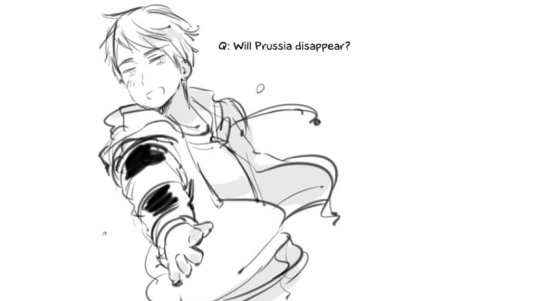
When asked on whether Prussia will disappear, Himaruya doesn’t rule this out as a
possibility [x].
In sum, it’s important to note that the nations don’t exist
for political reasons. If they die, it’s because their people no longer
identify under a common identity, or their culture disappears. This death doesn’t
occur immediately and is a gradual process. On the other hand, personifications
can still choose to exist even without a group of people and culture to
represent.
I’ll kindly direct you to my post directory, considering
that most of my posts tackle how Hetalia is riddled with serious,
thought-provoking, and dark subject matter [x].
The scars that accumulated on Lithuania’s back, a
consequence of being under Russia’s rule [x].
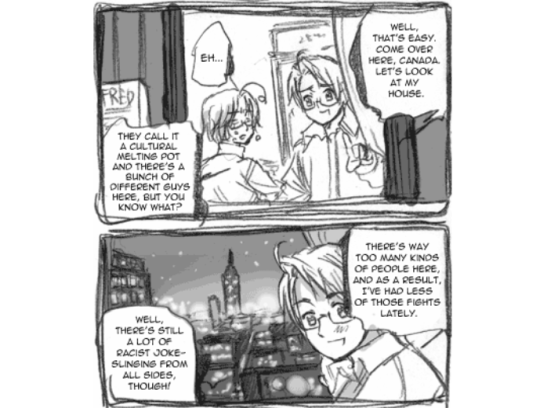
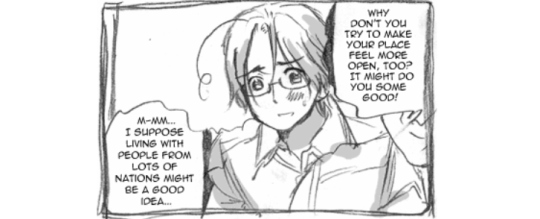
America giving advice to Canada on being open to welcoming people from different races, ethnicities, cultures, and religions [x].
England asking for Italy’s help in improving his artistic
skill during the second Industrial Revolution. Due to his and Romano’s rough and
sudden unification, Italy breaks down crying:
“It’s been so long since anyone has trusted me this much.” [x].
Prussia signing a treaty with Japan and teaching him German during the latter’s Westernization period [x].
I’m not particularly big on headcanons, but I sometimes do charts like this 😀
Most insecure nations
–
America, Canada, England, Germany, Italy,
Romano, and Poland.
Loneliest nations
–
America, England, Iceland, Prussia, and Russia.
Happiest nations
–
Denmark, Finland, Seychelles, and Sweden.
Most sarcastic nations
–
England, France, Norway, and Romano.
Nations we need more of
–
Belgium, Belarus, India, and Vietnam.
Misconception: He
hates Spain
Reality: He hated
Spain but puts up with him now [x].
While Netherlands may be annoyed by Spain, they’re not
hostile.
Ex: Spain and
Netherlands are spotted together during the 2010 Christmas Event. Spain wants
to take a photo and Netherlands’ is reluctant. Netherlands’ threat to flip
Spain over is actually pretty funny [x].
Further, when they’re attacked by parallel France, Spain
comes to Netherlands’ aid.
Ex: They
coordinate their costumes during the 2011 Christmas Event, along with Belgium
and Romano [x].
Ex: Having been there
for part of Romano’s childhood, it’s Netherlands who points out how unaware the
latter was of the sacrifices that Spain made for him. In this case, Spain spent most of his money on Romano.
Ex: He helps lift
Spain onto Romano’s back as Belgium cheers them on [x].
Ex: Spain teases
Netherlands by putting on glasses to make himself more approachable and
suitable for business [x].
Misconception: He’s
rude
Reality: He’s kind and an older brother type.
On
the other hand, he can also be crabby and has a ‘dirty side.’
Ex: He attempts to help Belgium and Luxembourg, who were at the
mercy of other countries, through diplomacy. The running gag is that all of his advice is about money, albeit well-intentioned [x].
Ex: He teaches Luxembourg the business skills that propelled him
into the thriving economic state that he’s in now.
Ex: He’s in his element when he’s surrounded by tulips [x].
Ex: He socializes and involves himself in a discussion on gardening [x].
Netherlands’
personality is complex in that he has faults. He’s not rude all the time. Like
everyone, there are moments where he loses his composure.
Ex: He tends to lose his composure when it comes to economic
matters relating to Greece in the EU. He’s still noted to usually be a
pleasant coworker [x].
Ex: His sister declaring independence from him made him cranky
when he visits the then isolationist Japan for trade.
Nonetheless,
like other Dutch merchants, he respectively adopted the customs of his business
partners and engaged in them during transactions.
Side note: I’ve seen enough people take a dub line
as canon, so I want to clear it up.
In the “Before an International Meeting” strip… [x].
What
Netherlands does not say: “What? Do
you envy my scarf?”
What he does say: “Yo, good morning.”
It’s a big
difference.
Misconception: Business is everything.
Reality: Business isn’t everything, but it’s extremely important. It’s what taught him how to thrive.
Ex: Witnessing the wealth of his younger sister, Belgium,
motivated him to evolve past his agrarian roots.
Ex: It’s for this reason that Belgium believes that he’s become
so stingy and obsessed with profit.
Ex: He exchanges weapons with Spain while they’re at war.
Ex: He has no problem mixing his business and personal lives
together.
Ex: When the prospect of the nations’ memories being full of
gaps is introduced, Netherlands is able to recall business transactions from the
last three hundred years, as well as European countries’ weaknesses.
His
relationship with Denmark is good enough for him to offer the latter a cheaper “buddy
price.”
He’s extremely
neat and tidy – he won’t eat in his kitchen despite cleaning it + doesn’t like
messy gardens.
As such, these compulsions, along with his obsession with money, is likely why he is described as neurotic in a character note.
In sum, while
Netherlands may appear to be rough on the edges, stemming from his occasionally
“rough’ business practices, he’s far more than that. He’s kind and is more than
capable of sharing close relationships with others. It’s not that he’s
unfriendly either. He has a stand-offish appearance. Meanwhile, he’ll stand up
for himself and those close to him.










 Ellawritesficssometimes