image
image

I’ll start this by doing a brief summary of what I’ve already theorized on the topic before adding my recent addition to it.

image

Prussia and Fritz’s flute playing, along with the motif of
marching forward and national consolidation in a military context, also bears
extreme significance when you connect it to some of the underlying themes
running through Germany and Prussia’s current relationship.

The flute is symbolically important in that it’s often
depicted as an instrument used by the Gods. It’s used to channel their voices.
For instance, Ancient Egyptians believed that it channeled the voice of Isis,
the Goddess of life and magic. She was also known for her healing spells, those
of which cured the sick and brought the dead back to life.

In Greek mythology the flute is associated with Pan, God of
the wild. He is also associated with the shepherd, whose primary duty is to
tend to their flock of sheep by bringing them together.

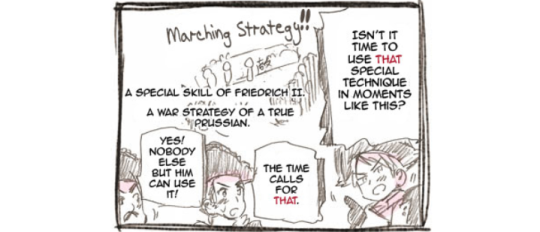
Now, the flute was first used by Fritz in a marching song
intended to instill a sense of consolidation and strength among his troops.
Taken symbolically, Fritz, as the shepherd, used the flute to bring his flock of
troops together.
image
image

I’ve also theorized before that Prussia, who adored Fritz
and therefore likely adopted the flute-playing from the latter, also took on the
role of the shepherd when he united the flock of fragmented German
states to form one sovereign nation – the German Confederation. It was a
military march that culminated in unification.

image

With that said, this theory will be making the assertion
that Prussia has chosen his next successor to undertake the role of the
shepherd – Germany.

The strip “Private Flute Concert” is essential to this
theory in that it gives us  some of the biggest hints of connections
between Germany and Holy Rome. Evidence of this symbolic divine reference can be found
when Prussia talks about the “sacred journey of the flute.”

image

As designated by the title, Prussia gives Germany a private
flute concert.

image

Notice how as Prussia plays, he has a flashback to another private concert he had… with his little brother no less. 

There, a sick
and bed-ridden Holy Rome expresses surprise at Prussia’s ability to play the
instrument. What’s important here is that Holy Rome refers to Prussia as a “war-maniac.”

image

The connection surfaces once Prussia halts playing and removes himself from the flashback. Germany expresses surprise at Prussia’s ability to
play, and Prussia echoes his previous conversation with Holy Rome by likewise referring
to himself as a “war-maniac” in his defense of this ability.

image
image

So, why is it that I think Germany is the next shepherd to
be?

For one thing, in another chapter that echoes Prussia’s
flashback, Prussia reads Grimm Fairy Tales to a dying Holy Rome.

image
image

Another connection emerges when you notice that one of the
illustrators was named Ludwig Grimm, who also
just so happened to play the flute. Once again, notice the flute’s herding
properties; in this case, Ludwig Grimm’s flute causes a flock of pigeons to come
together.

image

Perhaps this is why Germany’s human name is Ludwig. What if
it was Prussia who gave it to him, either as a tribute to his predecessor, or as a tribute to his forgotten past? [I lean more towards the latter]

While Holy Rome himself was not good at drawing and was more erratic and impulsive in temperament, we know that
Germany has a more structured and composed personality. He would therefore be more adamant
on practicing and perfecting this skill. Here, he’s shown to have considerable artistic competency when
he draws Italy.

image

That said, it’s also important to mention that this personality
difference between Holy Rome and Germany is accounted for and justified in
chapter 1 of World Stars. When a personification gains a new title, it’s
possible for them to acquire a new personality.

image

Since Holy Rome is seen to exist well after his
dissolution, it’s not farfetched to assume that he never actually died. A
theory on that [here]. In fact, given how much evidence there is that Germany
is suffering from amnesia [theory here], these two arcs seem to form yet another
connection whereby Hima’s implying at the possibility of him being Holy Rome.

All right. With all that said, let’s tie this together.

Prussia is no more in modern times, and so is East Germany, albeit formally. [It’s heavily and painfully obvious that he’s East Germany, but I have yet to
see him explicitly be referred to as this].

Here’s one example of how obvious, yet indirect the hints of Prussia being East Germany are: 

“We have to get rid of the “wall in our hearts”, so that the country can get better and the progress will be naturally more effective! 

When the Ostalgie level gets higher, Russia imposes himself on my big brother.
[ T/N: Ostalgie is a combination of Ost (East) and Nostalgie] ”

image

Nonetheless, in the same concert strip, we also know that Prussia doesn’t
heal as fast as he should after being bitten by Germany’s dog. On top of that, he lies to Germany about when he acquired the injury. It would follow,
then, that perhaps Prussia’s immortality is waning. 

image
image

However, this shouldn’t cause us any panic, since we know that
it’s possible for personifications to live on and become state representatives
after losing their nationhood: 

Usually, when the culture or the country’s personality dies/disappears, the country would gradually disappear or entrust him/herself to the country that takes over him/her.

There are also cases that him/her is not a country but continues to live leisurely as a representative of a region.”

[Source: It’s a treasure box of countries.]

It’s these particular panels that are of interest to
me.

image

That’s right. Prussia’s pushing for Germany to take up
playing the flute. Situating this in its symbolic context, doesn’t it seem that
Prussia is asking for Germany to heal his newfound mortal weakness?

The country was consolidated by a march that Prussia led. Now that the country is consolidated again after the fall of the
Berlin Wall, his reason of being [a personification] is no more.

It’s Germany who now leads the figurative march in running
their country. There’s also the fact that Germany has a character song titled “Vorwärts Marsch!” Translation: Forward March!

If Germany’s marching forward
in running an already consolidated nation, he leaves Prussia behind. There’s
not much use for the latter now.

How I interpret this is that
by giving Germany the flute, Prussia is recognizing  that 1) his time has
passed or 2) he’s relying on Germany to help fix/heal his broken immortality.

Prussia gave life to Germany, but what about vice-versa?

image

Can we see some more wholesome Prussia?

Sure. While reading fairy tales to Holy Rome, he realizes that there’s a lot of erotic content in them.

image

He nervously makes up parts of the tales to avoid mentioning the explicit content, but inadvertently makes plot holes in the process. 

Of course, Holy Rome is quick to point out these plot holes, despite Prussia’s attempts to end the session. 

Prussia’s solution is everything here. [He literally kicks the book
out the window.]

image

Another misconception of Prussia is I see a lot of people say that he’s most likely to cheat on his S/O but I don’t see it because 1.he yearns to be close to someone again and he’s really upset that he has no one 2. He’s always been loyal to all of his leaders

I think that has more to do with a misinterpretation of his
character, given that we don’t canonically see him in any romantic
relationships. A misconception for me is when people flip canon facts 🙂

However, both canon pieces of
information that you provided are extremely relevant and I cannot stress them enough
if you ever intend to characterize Prussia in a fanwork.

Just wanted to point out that Prussia was married to one of his brothers, Brandenburg, in 1618. And they seem to have remained close after.

Just wanted to point out that while they did indeed form a
union and are historically tied that way, Hima hasn’t gone that route, nor has
he characterized them in that close of a way. There’s very little canon
information provided about them; that’s an assumption
on your part, even if it is founded in historical fact.

Given that the character note is from as early as Volume 2,
and in pretty much all the events you can find Prussia lamenting about his loneliness, I don’t think Prussia thinks/thought of their relationship as all
that important or close. 

Likewise, while this does conflict with other canon
material, Prussia is said to have started out as the Margraviate of Brandenburg in “Lichtenstein’s Journal of Swiss
Dopiness.” He was later absorbed into the Teutonic Knights. Meanwhile, other
canon material (such as the Volume 2 character note) conflicts with this. There’s
also the fact that Brandenburg is a separate character.


Prussia, too, began as the Margraviate of Brandenburg intended to buffer Slavic expansion, and later incorporated the territory of the Teutonic Knights.”

image

Either way, it doesn’t seem like Hima has placed much
emphasis on Brandenburg. Again, given how lonely Prussia is for having not been
in a close relationship [of any kind], I’m sticking with the Volume 2 character note until it’s
stated otherwise in canon. There’s really no point disputing over small
historical facts when we’re dealing with loosely fictional characters.

image
image

Misconception: He’s
lazy and unmotivated

Reality: He’s extremely
strict, neat, and places great importance in his appearance. Nonetheless, on
occasion, he has been shown to grow bored easily when faced with the prospect of
work.

Ex: He trained America and his military during the American
Revolution.

image

Ex: He keeps his clothes spick and span.

image

Ex: He gets bored and sneezes when he’s given a book on how
to socialize with people. 

image

Misconception: He’s
full of himself, so he doesn’t need anyone.

Reality: He’s
painfully lonely.

Ex: He never
married.

image
image

As such, he’s brought to tears when he sees Austria and
Hungary as a couple on Christmas.

image
image

He unconvincingly rationalizes to himself that he’s happy to
be alone.

image
image

This is repeated in his character song Mein Gott!, where he claims
that “Being alone is too much fun.”

Ex:
He misses Frederick II, and hasn’t found someone to fulfill this strong [but nonetheless implicit] desire for companionship.

It’s even said that he grows
depressed at the mere mention of Fritz. Ironic considering that he has a picture
of him on his nightstand.

image

Notice how Prussia also calls
on Fritz during Valentine’s Day, and once again attempts to convince himself
that he’s happy to be single.

image
image

Misconception: He’s overly-confident.

Reality:
Prussia’s narcissistic, but this stems from being extremely insecure about
himself.

He’s always trying to gain
power for self-reassuring purposes. This reassurance acts to discount his
insecurities over being weak. His use of the word awesome, then, is more
defensive and reparative than it is an exercise of confidence.

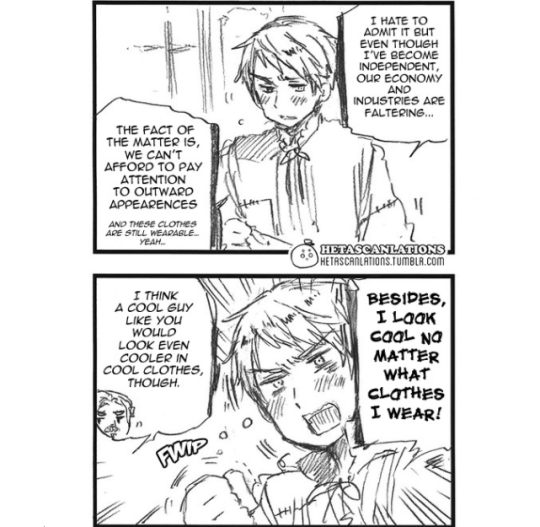
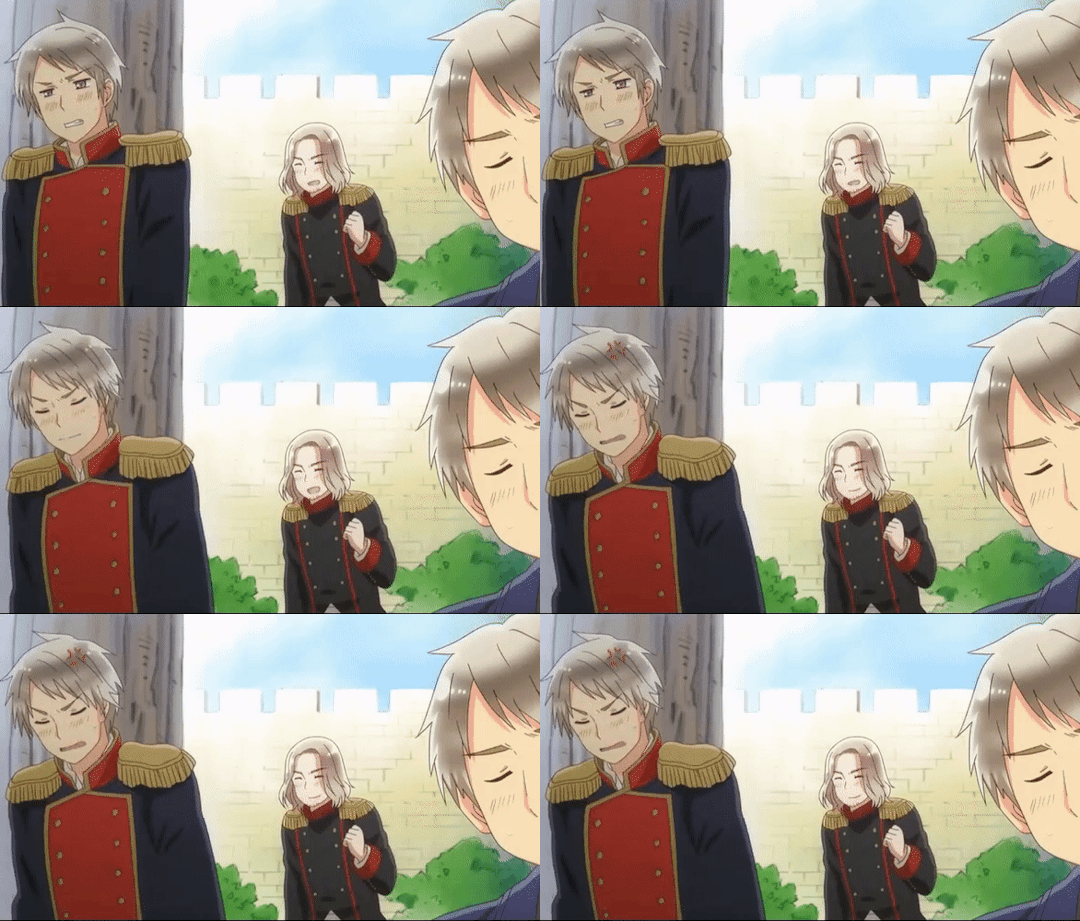
Ex: He associates fancy
clothes with strength + brags to bolster and reinforce confidence within himself.

image

Before his country grew in
strength, notice how he falsely tries to convince himself that his clothes are
still cool, despite them being worn down. The important difference is that he
doesn’t make use of the word awesome. This a time where his confidence and
morale is low. Awesome for him is equated with strength.

image

Bonus Facts:

He’s noted to feel like an enclave as opposed to an actual
nation.

He’s an incredible older brother:

Ex:
He reads Fairy Tales to a dying Holy Rome, and is revealed to be heartbroken
after the Napoleonic Wars.

image
image

Ex: He immediately
steps in to protect young Germany when he’s born.

image

Ex: He’s very supportive
and encouraging of Germany, despite teasing him a lot.

image

To be honest, given all this, I find it redundant for
Prussia to refer to himself as awesome.  

image

Did Prussia always hate Russia?

No. He was maybe initially a bit creeped out by Russia, but
they’re both seen co-operating with each other back when they were tasked with
studying France’s culture in the 1700s.

                                                         …

It’s only really until after WW2 where we see things shift, albeit
it’s a bit clear as to what actually happened to cause this hatred.

All we know is that is
that it’s bad considering that Prussia is later noted to puke if Russia even so
much as lays a finger on him; either that or he’ll lose four eyelashes (likely
a reference to the four Allied-controlled zones).

Likewise, we also know that Prussia worked unprofitable jobs
for Russia post-WW2.

“He was under Russia’s control after WWII, dreaming of Italy’s warm sunshine, while stuck with doing unprofitable jobs.”

image
image

As a series that works with stereotypes, it isn’t surprising
that Germany comes off as relatively
stiff and cold. However, what’s important to realize is that the stereotype is
used for a specific purpose; it’s essential to Germany’s characterization in proving
that he’s anything but stiff and
cold. Nonetheless he’s still perceived that way because of his stereotype.

In other words, Germany is anything but this stereotype.
Instead, what you’ll see is that he has trouble expressing his sentimental side
as opposed to lacking it entirely. It’s not that he doesn’t want to smile and
be expressive either. He simply isn’t able to.

He’s seen as angry, when all he truly wants is to be able to
be himself with others, void of being fearful, anxious, and hesitant in doing
so. You’ll see that he’s actually quite shy and uncertain with regards to how
he navigates around social situations.

That said, this is a pivotal inner conflict that he’s
consistently experienced. I’ll get into why a little bit later. First, it’s
important to demonstrate how pervasive and repetitive this theme has been.

In Comic Diary 4, he’s revealed to possess an
intimidating aura.

image

As
such, even Italy misinterprets Germany’s genuine intention to get drinks
together as him being angry.

image

A more explicit mention of this frequent misinterpretation of
his mannerisms is found in this character note.

image

He’s troubled because his voice comes across as harsh and he’s seen as angry. The
only beings he feels openly comfortable in expressing his affection for are his
dogs.

image

But, what about his troubles with smiling?

For one thing, he’s once shown to be reading a manual on “how to
smile naturally.”

image

In the 2010 Christmas event, he states that he “can’t smile
the way Italy can.”

image

Likewise, in an exaggerated comic gag from the Strange Laws
mini-series, Germany is kicked out of an area where it is legally required for
people to be smiling all the time.

image

In the few times where we do see Germany smiling [widely],
he’s drunk. If anything, this only reiterates how he’s repressing and
containing a whole other side of his personality. It’s in these rare moments
where we see the masked frontier of inhibitions that he’s constructed fall apart,
thus revealing the realer aspects of his true person.

image

Further, we know for a fact that Germany experiences chronic
loneliness in his character song “Einsamkeit.” The literal translation of this
is loneliness.

This song gives us the best insight into how Germany feels
about constantly coming across as harsh and angry to others. It’s not only
loneliness that he feels in being isolated from others – there’s also a
considerable internal estrangement from himself. He feels lost in his own skin
given that he doesn’t know how to express this happier, more expressive, and
thereby less restricted aspect of his personality.

Though I look like I’m lecturing,
I’m actually just conversing
It’s not really…
At times my face may look grim,
But I’m actually just cold
Though I don’t mind it…

What’s interesting here is that he recognizes that others
tend to misinterpret him. This only ripens the possibility of losing a sense of
one’s self. The social mask he puts on is not who he truly is.

Einsamkeit
Einsamkeit
Einsamkeit
I want to be found.

This could have a plethora of meanings.
I’ll go over the main two. One, it simply means that he wants people to see him
for who he actually is, and that he’s helpless in being able to change these
perceptions.

Two, it could act as a double-meaning
to represent him being unable to recall the lost memories of his childhood [as
Holy Rome]. Simply put, he feels lonely because he’s missing a part of himself.

I’m always said to be scowling,
But my smiling face hasn’t been erased
You may think I’m frightening,
But it’s only because I’m straining to laugh

Now, in a previous post (link here), I
talked about the psychological concept of catharsis. Basically, when a memory
causes a person too much anxiety or trauma, they repress the memory as well as
the emotions associated with it. The result is that the person can no longer
consciously access the memory, and sometimes, depending on how strongly they’ve
repressed the memory, they don’t experience the emotions associated with it at
full capacity. You only experience them partially.

Perhaps this is why Germany is
“straining to laugh.”

The role of the psychologist is to bring that traumatic
memory back into the patient’s conscious mind. Catharsis is the emotional relief
that comes upon recalling and subsequently resolving the internal unconscious
conflict tied to the traumatic memory.

image

Let’s tie this back to the strips.

Germany’s stated before that he doesn’t have much experience
with relationships, hence the reason why he’s constantly referring to manuals
all the time. Similarly, because he was born into war, the hostility and trust
he grew accustomed to also caused him to be relationally-stunted.

image

It’s for this reason that he has trouble interacting with others and
expressing emotions other than anger or frustration; these are more primal. Happiness
and compassion is something that’s taught. In psychology, there’s a general
agreement that how one’s raised impacts how they are as an adult.

This doesn’t mean to say that his personality is fixed
though. All it really means is that he’s still affected and possibly traumatized
by being thrust into war from birth.

On the other hand, let’s take another route in approaching
this. If Germany is Holy Rome, then he would have likely repressed the
traumatic memories of the war that caused his dissolution. However, for that to
happen, he would have also had to have repressed his entire life as Holy
Rome to get rid of this trauma.

As such, this would involve repressing all the happy emotions
that Holy Rome experienced with Chibitalia.

If that’s the case, when Germany feels happiness, his mind
unconsciously subdues it to avoid triggering any accounts of his past as Holy
Rome. It’s because his brain unconsciously minimizes the anxiety generated from
these traumatic memories that Germany is completely unaware as to why he’s
unable to smile. All he knows is that he’s unable to.

Simply put, when Germany experiences happiness, his brain
represses it to prevent him from accessing childhood memories associated with
the same emotions.

In sum…

Germany may have trouble smiling because…

1) He’s relationally-impaired
and inexperienced due to having been originally reared in a world of hostility
and aggression. He can express happiness, but it very rarely has to do with
people. I.e. His dogs, machinery during the Industrial Revolution.

He hasn’t quite learned to become
comfortable in showcasing this other side of himself to others. Maybe this is
because of the anxiety generated from only being seen as stiff and cold and him
not knowing how to compensate for this by expressing how he truly feels.

2)  He’s repressed all childhood memories from his
past as Holy Rome, which just so happens to include the happier ones. If he
smiles and consciously –not drunkenly, which doesn’t involve full awareness–
expresses happiness, he risks recalling his traumatic dissolution. To safeguard
against this, his brain suppresses feelings of joy and happiness. As such, he
isn’t aware of the reason why he has trouble smiling.

He just knows that he can’t smile.

image
image