AusHun (platonic and romantic) would probably need a whole post on its own, but I can certainly go into the relationship dynamic shared between the three of them.
As for PruHun, it’s more one-sided on Prussia’s part. It’s still worth exploring, though, as it requires delving into the depression and loneliness Prussia keeps contained within himself.
Post coming up soon!
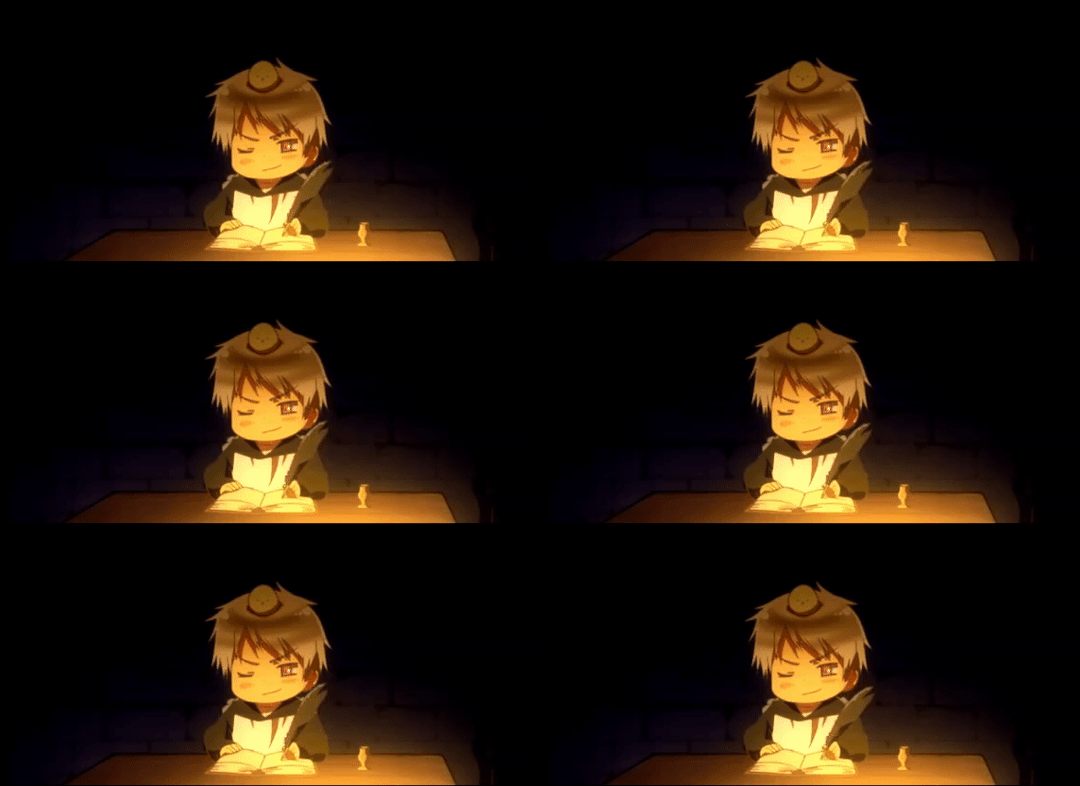
We know that Prussia’s been diligently recording diary
entries ever since his birth, taking note of his moments of “awesomeness.”
We also know that the nations’ memories aren’t limitless, as
they don’t remember everything.
Now, what would you say if I told you that Prussia’s diaries
are purposed to prevent him from forgetting his past lives?
Roughly speaking, he started out as St. Maria’s order,
became the Teutonic Knights, somehow evolved into Prussia, and is now
presumably – and obviously – East Germany.
But, there’s one particular strip that hints at and makes me
believe that the nations lose their memories from past personifications.
If it’s possible for them to adopt new personalities upon
acquiring a new title or land, then wouldn’t it follow that they also lose all
memories from their past personifications?
Your personality is very much grounded in your interactions
and experiences in the world, so to possess a new one would imply that you have
new experiences to shape who you are. It would also imply that your old
experiences have had little impact on your character; either they’re discarded
or repressed from your conscious memory.
Here’s where things get cryptic. Assuming that Holy Rome is
Germany’s past personification, this means that Hima has an active motif of
memories present, one that covertly threads the German brothers’ storylines together.
On one hand, you have Prussia, brother #1, who records
memories from previous personifications to maintain and keep his “awesome”
sense of self consistent.
On the other hand, you have Germany, brother #2, who has
possibly had a past life, but is unable to recall it.
Again! There’s so many strips that can do that for me, but since this is the most recent one to jog my memory, here:
[Descriptive writing, brought to you by Prussia]
Despite the anachronism, there’s a reason why Prussia makes
such use of the word. His history in terms of strength is extremely messy,
considering that he fluctuates between being a large and dominant power to a
smaller, subordinate, and less important one.
For example, after the Battle of Tannenberg, then as the
Teutonic Knights, Prussia became a lackey to Poland. He’s also noted to have
mellowed out considerably during this time.
The obvious and simple conclusion is that the use of the
word awesome helps console Prussia when he’s in one of these power slumps. But,
there’s a much deeper insecurity and superficiality lurking behind the word
that I’d like to explore briefly.
There’s a sort of desperation to it that matches well with
one of his character notes. That is, Prussia’s willing to do anything if it
means becoming stronger. In tough situations where he’s been sapped of physical
strength, however, he turns to the pen to help reassure himself.
His diary entries, regardless of the time period, only
record his moments of self-proclaimed awesomeness. It conveniently leaves out a
whole lot of information.
Let’s explore one of these fluctuations in power, as well as
the impact that it had on Prussia’s self-esteem. In the early 1700s, Prussia’s
culture and economy lacked in comparison to other strong-heads in Europe –
France in particular.
When Frederick I confronts Prussia about this, Prussia gets
defensive and says that he looks cool regardless of the clothes he wears.
You’ll see in a second that this is a straight-out denial, as he believes the
exact opposite.
Regardless, what’s important to emphasize is that at this
point, Prussia wasn’t on par with the other “great nations” in Europe. Wanting
to become stronger, Prussia then spies on France’s blooming culture and studies
it rigorously.
Prussia quickly internalizes France’s aristocratic
appearance as something that equates to strength and power, and subsequently agrees
to let France help style his military uniforms.
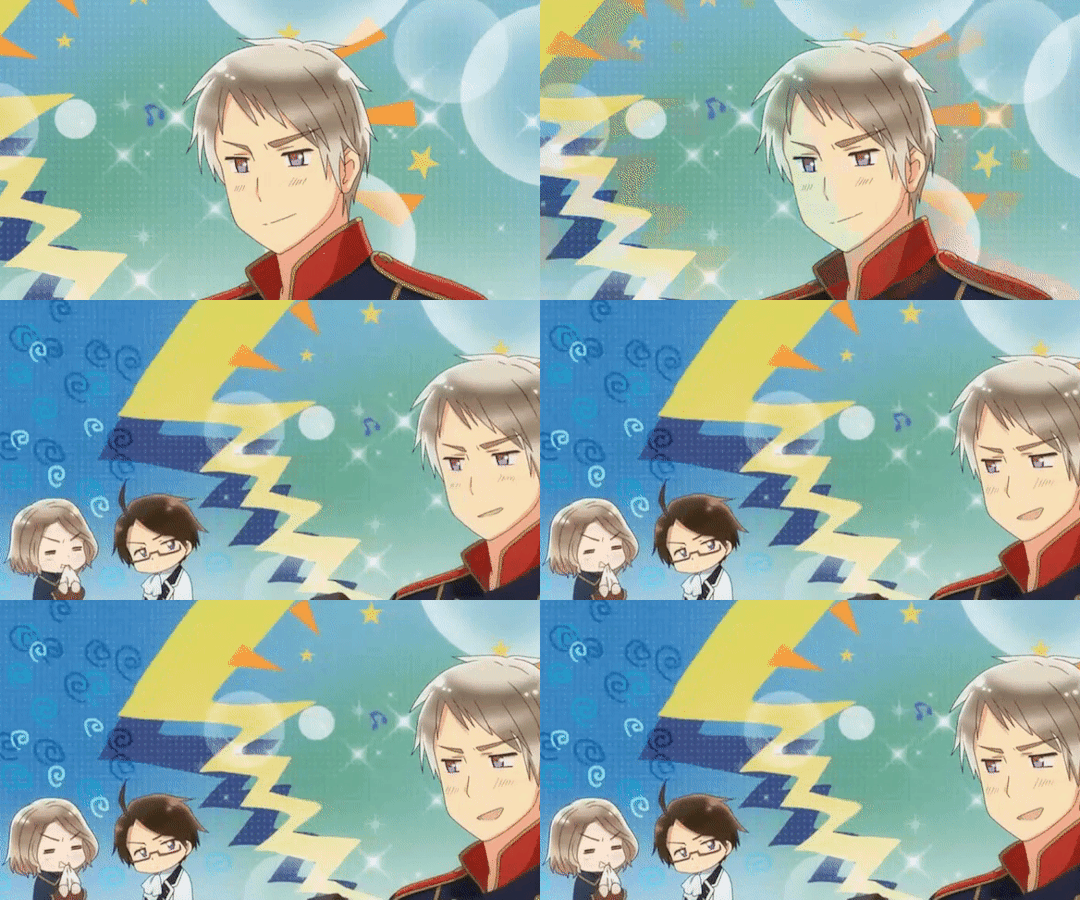
Once he has a flashy uniform, notice how Prussia’s words
change. It’s not just a cool uniform. It’s an “awesomely” cool uniform. The
fact that he’s vocalizing the word seems to suggest that he’s taking more pride
in his appearance; more than that, he truly believes what he’s saying.
Prussia’s obsession with strength and power is clearly
unhealthy, and Austria is quick to call Prussia out on this… not that he
listens.
Overall, what you see with Prussia is a consistent bouncing back and forth in terms of dominant or subordinate status. He goes
from frugality and relative unimportance to a dominant figure, and then back to
a lesser power again.
His self-image is everything to him, whether it’s preserving
it, convincing himself that it’s something that it’s not, or relishing in the
high that comes upon experiencing a periodic phase of power and prestige.
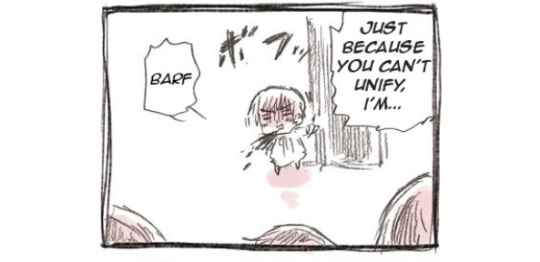
This strip just before German Unification really reiterates just
how badly he wants to become a powerful nation again. He wants to be the center
of it all…all the time.
To me, Prussia’s arrogant behaviour is a sort of overcompensation
for someone, who, at a deeper level, realizes their inadequacies and inferiorities,
but refuses to accept them. He likes to live in the sun, to flaunt his
achievements, but until he learns to confront the shadow that these vulnerabilities
leave behind, he’ll continue to live an artificial and lonely existence.
There’s a difference between power and control, and a sense
of empowerment and competence that comes with acknowledging one’s true self,
both the good and bad elements of your person.
Considering how lonely Prussia is, it would seem that he’s
unable to reconcile these insecurities into part of who he is. It’s for this reason
I believe that he’s remained single/ hasn’t married, aside from the obvious political
and historical justifications.
Prussia’s very selective in what he chooses to show, whereas
the intimacy of a romantic relationship involves acknowledging one’s strengths
and weaknesses to your partner.
In other words, he doesn’t want to appear small to others,
as in his eyes, that may echo the subordination he’s historically
experienced.
Let’s just go straight for the unhealthy and depressing stuff, shall we? Post coming up soon!
I know this might sound like a radical thing to say, but
honestly, after reviewing the strips, there’s enough evidence that points
towards the fact that… yes, Holy Rome never truly
died.
Before I start, let’s just get a few disclaimers out of the
way. Otherwise, this theory won’t work.
There’s a deleted comic where France tells Italy that Holy Rome
is dead. Note the word deleted. As such, the strip should not be taken for
canon value.
Next, there’s also the fact that people have said that Holy Rome
is given a teenage appearance in one of the requests Hima completed for the Christmas
2011 event. If this were true, then there would be a notable inconsistency
regarding his other appearances.
However, to me, this hardly seems to be the case. Holy Rome
doesn’t look like a teenager at all here. He still very much looks like a
child, judging by his height and his size when Hungary carries him in her arms.
It’s important that I mention this, because Holy Rome’s appearance in the 2011
strip is consistent with his appearance in World Stars.
With that out of the way, let’s get to the good stuff. In
chapter 187 of World Stars, we find out that even though he’s been dissolved
and should have died already, Holy Rome is very much alive and is hiding away
in Prussia’s house. He’s still very sick though, as “death is near.”
Since Holy Rome’s so weak, a “heartbroken” Prussia reads him
fairytales, likely to distract the former from the fact that he’s dying.
Moving forward a bit, we know that it was Prussia who led
the German Unification movement. He would have every reason to, as we’ve seen
from the Christmas strip how negatively a lack of unity among the German states
affected Holy Rome’s health.
If Holy Rome hadn’t died at this point, which I’m assuming
to be the case, then it would be in Prussia’s best interest to unify the states
and form a stronger country in order to save his younger brother.
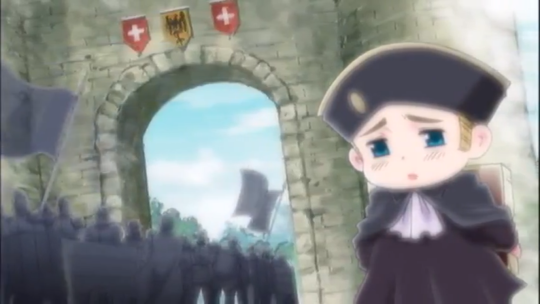
This strip takes us to just before the unification process. Pay
attention to the language used by the German states here. “New Country” and “New
brother.”
It seems like they might not be aware of the fact that Holy
Rome is still alive. Being nations themselves, they would know that it’s
possible for personifications to adopt new titles. But, judging by the words
they use, they believe him to be dead. Because of this, the possibility of Holy
Rome adopting a new title wouldn’t have even crossed their minds.
It seems that only
Prussia knew about Holy Rome still being alive…whenever that strip took place
as it’s not entirely clear. (It’s sometime after the first publication of the Brothers Grimm Fairytales.)
Anyways, before the German Confederation is able to form, Austria, also
thinking that they’re about to form a new country, insists that he will be the one to raise the newborn Germany.
Yadda yadda, Prussia and Austria go to war, skip forward, and now we’re at
Germany’s actual birth (???).
This is so important and I cannot stress it enough. There’s
a massive difference in how the anime portrays Germany’s birth versus how the strips
do.
In the anime, it makes it seem like the German states huddle
together, only to have Germany emerge once they’re finished unifying.
The strips, which I’ll be using as the basis for this
theory, depicts an entirely different reality. When Germany’s born for real, it
doesn’t show the German states huddled together. Instead, it only shows a young
Germany being helped up and/or greeted.
He’s wearing a nightgown…exactly like the one Holy Rome was
wearing in chapter 187.
Yes, I’m aware that the nations are born in nightgowns,
but there’s multiple ways of interpreting this. The nightgown/birth motif is definitely
there, but…
Look at the one German nation holding Germany’s hand. He’s
crying. Now, put this into perspective. How would you feel if you thought your
little brother was dead, only to find out that he’s been alive all this time?
Maybe I’m biased, but Germany being helped up as well as
wearing the nightgown seems as if he’s standing for the first time after being
bed-ridden with illness for who knows how long. There’s also the fact that his
age is consistent with the Holy Romes from the Christmas event and chapter 187.
Which brings me to my next point. At the end of the chapter,
it states that Germany wasn’t born as a baby because he already had an existing
body.
We all know Hima and how much he loves to make puns. What if
“existing body” literally means an existing
body. Holy Rome adopted the title of the German Confederation and became a
stronger nation, but never actually died.
The German identity never died either, despite a lack of
formal unification. Maybe that’s why Holy Rome still managed to exist,
regardless of how physically weak he was.
The only setback to this is that there’s hints of Germany
(aka Holy Rome) suffering from amnesia. Remember that in World Stars, it’s been
made canon that it’s possible for the nations to acquire new personalities upon
changing what they personify.
Now, isn’t it weird that in the same strip where Germany’s
born, Prussia takes to reminding Germany that it’s okay to refer to him as an
older brother…482 times? It’s like Prussia’s attempting to trigger Germany’s
memory in the hopes of getting the latter to remember that he’s Holy Rome.
It would seem that on top of adopting a new title and
personality, it might be possible for the nations to also lose memories from
their past personifications.
It’s reincarnation, and yet it isn’t. I’m going to take the
liberty and coin it as “re-personification” from now on.
Having
lived for centuries, or sometimes even for thousands of years, it’s no wonder that
the nations are capable of accomplishing so many feats. They have the
intelligence and knowledge of several lifetimes at their disposal.
You have
your philosophers.
You have your artists.
And you have your inventors.
That said, let’s not sell these characters short by dumbing them down.
I’ll admit. At first I was skeptical as to whether Prussia
shooting birds out of his hands had any particular reason outside of comedical
purposes. While what I’m about to say may still be a stretch, the symbolism of
the type of bird used adds a whole new understanding to this strip. It’s fascinating
and incredibly clever if Hima truly did mean to employ this extra layer of
meaning.
In Chapter 12 of World Stars, we’re given insight into the
origins of Germany. Right from birth, he was thrust into wars. It’s a good thing Prussia was there to step in and protect him.
Now, I think it’s already assumed by most that Prussia’s
birds are canaries. As a spirit animal, the canary represents new beginnings. The
sound it makes is also seen as a sort of healing song, one that cures the wounds
from a past life.
Tying this back to the strips, if Germany is reincarnated
from Holy Rome, then the canary’s symbolism of birth, new beginnings, and the
healing of wounds from past lives is especially relevant.
What’s more, we also
know that Prussia plays the flute, which in Greek mythology symbolizes the shepherd.
The shepherd’s role is to tend to their flock of sheep; that, as well as
herding said flock together.
I went into this in
an older theory, but basically, Prussia’s flute-playing – while also stemming from
the influence of Old Fritz, who also played the instrument – may in fact
symbolize how he herded the ‘flock’ of German states together into one sovereign
nation. Remember that it was Prussia who led this unification.
Taken together, Prussia shooting canaries out of his hands in a figurative sense can mean several
things. One, it represents Prussia soothing the wounds of the before fragmented
Germany. Two, it symbolizes Germany’s new beginning. Three, it can serve as a
reference to the brutal wounds that were
inflicted onto Holy Rome before he died in, yes, war.
And four, it can also be a reference to the number of new
beginnings Prussia himself has undergone. He started out as the St. Maria’s
order, evolved into the Teutonic Knights, somehow became Prussia, and then presumably
into East Germany.
I still don’t know how to feel, considering that the most
asinine thing – a bloody bird – can actually
symbolize all this.













 Ellawritesficssometimes