image

Note: This is not a theory. I’m simply just presenting canon information to answer a question. 

image

Despite some inconsistencies regarding Prussia’s first
personification, all of them are German. That said, my answer to this question
is no. Prussia may have conquered territory that held indigenous Baltic peoples
(Old Prussians) but again, his starting points are all rooted in German
ancestry.

In “Liechtenstein’s Journal of Swiss Dopiness” we learn that
Prussia began as Margraviate of Brandenburg (1157-1806), which is considered to
be the ancestor of the Kingdom of Prussia. Brandenburg-Prussia was a leading
state in the Holy Roman Empire until its dissolution. It later incorporated the territory of the Teutonic Knights.

image

However, what I’m more willing to accept as his starting
point is this panel, as we see him depicted more frequently as such in the strips.

image
image

It states that Prussia began as St. Mary’s order and then
became the Teutonic knights (1190 – Present). I believe this might be a small
error, as St Mary’s Order is short for “The Order of Brothers of the German
House of Saint Mary in Jerusalem”, which was more commonly known as the
Teutonic Knights.

There’s also the
Monastic State of the Teutonic Knights (or State of the Teutonic Order), which
was an actual state formed by the Teutonic knights (Teutonic Order) in the 13th
century.

What Hima also does is leave how Prussia became Prussia from the Teutonic Knights
open-ended. All this put together only ends up causing a lot of confusion, as
well as a problematic timeline. Either way, the personifications mentioned are
still nonetheless German.

image

The reason why some people believe Prussia used to be a Baltic is likely
because of the 13th century German invasions of
the original Baltic tribes (Old Prussians) that resided in Prussia. The
Monastic State of the Teutonic knights were then formed to conquer more
territory. Prussia was actually a name taken from the Baltic people originally
living in the region, hence the term Old Prussians

The point to reiterate once again is that Prussia’s stated origins
are all German, not Baltic.

One last thing. It’s not really related, but it’s been
speculated that Prussia once represented Livonia too. I disagree with this
theory. In “Lazy Comic Country” Japan has trouble remembering who Lithuania is,
despite knowing that he’s likely a Baltic.

Japan ponders if Lithuania is Livonia, but in the end, can’t
figure out who he is and decides to use a
more general greeting to avoid any awkwardness.

image

We also see in “Opening a Country is tough, too”, that
Prussia is one of the few countries that Japan allows into his country during
his recluse period and even signs a treaty with him.

Point is, Japan doesn’t show any lapse or uncertainty in his
memory when he sees Prussia, and if he at least remembers Livonia in the other
strip, then I’m sure he would recognize Prussia as Livonia if he truly was
Livonia – I don’t think he is. Livonia’s likely a separate personification that
has yet to be created.

image
image

Either way, given the information provided for in the
strips, I don’t believe that Prussia was a Baltic. He seems to be German
through and through.

Due to popular request, I’ll be starting to analyze the several instances in the series where it’s alluded that Germany is Holy Rome in some way or another. There’s too many of them to include all in one post, so welcome to yet another new sub-series!  

You’ll notice how subtle these hints are, as well as how uncomfortable they make the nations feel as they recall certain memories. Without further ado, let’s get started.

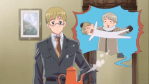
First, there’s England. In the “About why there is Italian architecture in England” strip, France shows surprise at the sight of an Italian-styled house in England and even praises it. England then has a flashback of when Holy Rome gave him this house as a gift, despite it not being suitable for the harsher English climate.

Note the expression on England’s face once the flashback ends. Sure, the reminder of Holy Rome’s legacy must be painful to relive, but why become so nervous and uncomfortable? If he was sad, I could understand, but the former two emotions make me think that something is still unresolved in the present; that is, England is reminded of how HRE is still around today except in the more modern form of Germany.

It almost seems as if the nations are aware of Holy Rome’s reincarnation/rebirth/ revival (whatever you want to call it) but don’t have the courage to tell Germany about his past. It’s not really their place anyway.

Then, you have France. We already know from the Napoleonic Wars, the first world war, as well as the German military occupation of France in WW2, that France has every reason to hate Germany, and is even depicted stating so.

In modern times, he still shows an evident aversion to Germany. Call this a stretch if you want, but I interpret a lot of this aversion more so in terms of guilt. Napoleon’s army ended the Holy Roman empire, after all.

However, it’s also important to note that recently France has slowly been starting to spend more time with Germany and is noted to no longer hate him.

In the “Germany’s playing an impossible game” strip, France is shown to be secretly backing Germany, referring to himself as the latter’s Big Brother. (Yes, I’m aware that France considers himself the Big Brother of the world).

What makes me suspicious is that in a few panels below, Hima mentions how France and Germany’s economic relations in the EU isn’t always agreeable and that they don’t see eye-to-eye in a lot of matters.

Why am I mentioning this? Well, flip back to when Holy Rome and France lived in Rome’s house. They used to refer to each other as brothers then too – they’re not actual brothers, it’s just a form of endearment.

Historically speaking, I can understand France’s grudge towards Germany after the Napoleonic wars. What I’m curious about is that even in modern times, well after WW2, France still appears to be hesitant/ walking on egg-shells around Germany.

That’s why I believe France is not completely open in his support for Germany. Again, I think he still feels guilt for causing the Holy Roman Empire’s demise and doesn’t know how to compensate for this.

Lastly, as I couldn’t possibly leave him out of this, there’s Prussia. Prussia is the one who tells Germany all about his past, being his older brother/ father figure. I say father figure sarcastically, because Prussia is lame enough to be wearing a Dad shirt in the 2011 Christmas event.

Anyways, in that same event, Japan and Italy reminisce about how Prussia, as the Teutonic knights, used to be. Germany expresses his confusion towards these stories by shouting, “What is that brother of mine doing?!”

We then get a brief bit of inner dialogue from Japan, who also seems confused over the fact that Germany believes everything that Prussia tells him about his past. Perhaps Prussia is purposefully fabricating parts of Germany’s birth to spare him from the pain of remembering how he had died before.

More notably, Germany remarks that he’s going to cross-examine Prussia, which may mean that the truth (whatever it is) is going to be revealed to him. Now that’s exciting.

On that note, there’s one last thing I want to talk about. In “The Guns of Italy and Germany”, Germany is completely bewildered by the shoddy guns Italy makes, all for the sake of making them easier to clean. When he asks Prussia if Italy has always been like this, Prussia ominously stares off into the distance and tells him this:

Hmmm. Another potential hint that just like Holy Rome had an ‘appreciation’ for Italy, Germany will eventually develop one too? Questions, questions. So many strips and not nearly enough confirmations…

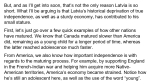
The answer to the title is no, by the way. To
elaborate on why I believe this is, it’s important to understand that the modern
definition of a nation-state is much different now than what it was centuries
ago. People often organized themselves in terms of city-states, kingdoms,
principalities, or small territories.

That said, during the Renaissance era, Italy
consisted mostly of small city-states. This would explain Italy’s full name,
Italy Veneziano, an obvious reference to the city of Venice. This fragmentation
was due to the larger foreign powers of Austria, Spain, France, and the Holy
Roman Empire coming in and taking land for themselves.

However, as I just said, Italy Veneziano is
repetitively referred to as North Italy, which simply includes Venice. He
doesn’t only represent Venice. I
don’t mean to say that North Italy wasn’t born
to represent Venice, though. That certainly seems to be the case. What I am
saying is that as the concept of a nation changed, so did Italy. He likely absorbed
the entire northern region. I mean, we’ve already seen this multiple times in
the series where nations adopt new lands and titles. Take the Teutonic Knights
and Prussia for example.

Now, this wouldn’t be a theory if I didn’t have any evidence, so here.

Then, at the end of the strip, North Italy mentions
that parts of his house were taken. We already know that a nation’s house, or
rather, an empire to be more applicable to the time period, consisted of other
nations under their rule. However, in Italy’s case, his house consisted of the
many different sovereign city-states of northern Italy.

So no, I wouldn’t worry about Italy Veneziano
disappearing anytime soon just because Venice is likely to sink in the coming
years. He’s got the whole rest of northern Italy to embody.

Further, and as I’ll get into with a much, much larger post, there is no dominant
Italy – between the two Italian brothers, I mean. The south and north are different
enough for them both to personify the land, and Hima makes sure to mention this
countless times.

image

So, about the whole Prussia situation: since nothing is
confirmed in canon, I’m going to keep coming up with possible theories and
explanations. All of which, in my opinion, make some sort of sense. This time,
I’ll be presenting evidence that suggests that Prussia is neither dying, a
nation, nor quite a human.

image

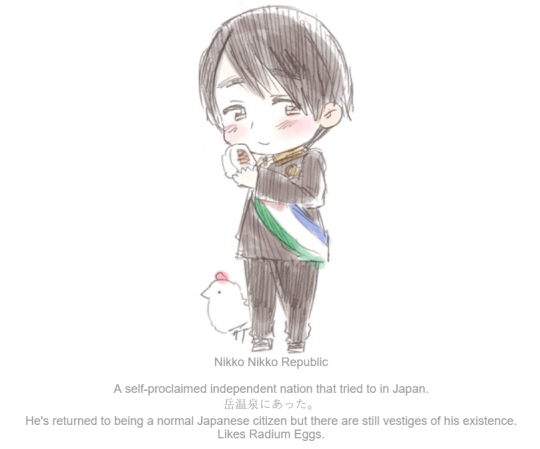
In “It’s a treasure box of countries”, we’re given a
goldmine of information with regards to the rules of nationhood. We learn that NikoNiko,
a human who achieved micro-nation status, went back to being a regular citizen
and human. It’s also stated that it was difficult for NikoNiko to revert back
to being a human, despite resuming normal aging again.

image
image
image

However, the last two bits of information are crucial.
First, we learn that when a nation’s culture or personality dies, said nation
in question will fade; that or the nation entrusts themselves to their
successor. That’s what most people, including myself, have speculated about
Prussia’s fading status as the personification of East Germany.

image

On the other hand, Hima also drops this last little bomb on
us.

image

Yes! It’s possible for the ex-nations to become political
representatives, as opposed to personifications. What’s more, we’ve seen
Prussia attend world meetings with Germany. For example, in the strip titled
“Germany’s Playing an Impossible Game”, Prussia is seen attending an EU
meeting.

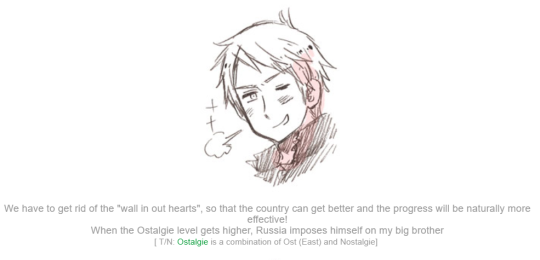
Further, I think this may be a typo on the translator’s
part, but Prussia at the end of the strip states:

image

For the sake of this post, I’ll be making the assumption
that he actually said, “the wall in our hearts.” Why? Because we’ve already
seen with Sealand that the nation’s landmasses are reflected in their physical
bodies. What I mean by this is that because Sealand’s landmass is a minuscule
fort, being a nation would be hard on his heart.

image

Simply put, it would seem the hearts Prussia is referring to
relates back to German Reunification following the fall of the Berlin Wall. Yes,
we get it, it’s very heavily implied that he’s East Germany (especially with that nostalgia pun, geez). Just call him it already, damn it! Enough with these
roundabout East and West nicknames.

Anyways, why do I think Prussia’s a representative then?
Well, aside from the fact that he’s attending world meetings, we’ve seen in the
“Private Concert” strip that he doesn’t heal from his injuries quite as fast as
a regular nation would.

Is he a nation? Probably not.

Is he a human? Not sure.

Is he a representative?

At the very least, he sure seems to be.

Sorry, another Mean Nations, Annexation question coming from a random anon. Would it have been Italy who was driving the bus that hit Austria? Or maybe Spain. ‘Cause I can see that happening.

 Austria (Regina) to Prussia (Cady): 

You can take that second-class
German attitude and shove it up your pasty – “ 

image

*Gets hit by a tank that exists anachronistically*

“Veeee, scusi~!” 

image

Prussia: “And that’s how I kicked out Austria’s tit-looking face and unified Germany.”

image

Okay, but imagine an AU where Prussia’s room is completely Gilbird-themed. His walls are bright yellow, the curtains are orange (like the beak), he has Gilbird-themed bedspreads, and he has those cute, dorky kid’s wallstickers that he printed out himself after having someone take professional pictures of Gilbird at the local photo studio. You name it, it’s Gilbird-themed. Germany is embarassed. He no longer invites their friends to their house anymore. Prussia is awesome.

The birb obsession is real: 

Prussia: Cheap! Cheap!

Hungary: What’s he doing?

Germany: He’s going to keep cheeping until I give him more money. 

Prussia: CHEAP! CHEAP! 

image

                         Mean Nations, Annexation Powers: 

Austria as Regina George –  

“Get
in, demon douche, I’m heading the Holy Roman Empire.”

image

France as Gretchen Wieners – 

“I’m not sorry that people are so jealous of moi.” 

image

Spain as Karen Smith – 

“Yeah, but he’s my favourite colony…see you got your other
colonies, then your favourite colony…that’s
not right is it?”

image

Prussia as Cady Heron – 

How come your eyes are red if you’re German?

“I used to be a Baltic.”

image