*joining the fandom*

*never being able to leave*


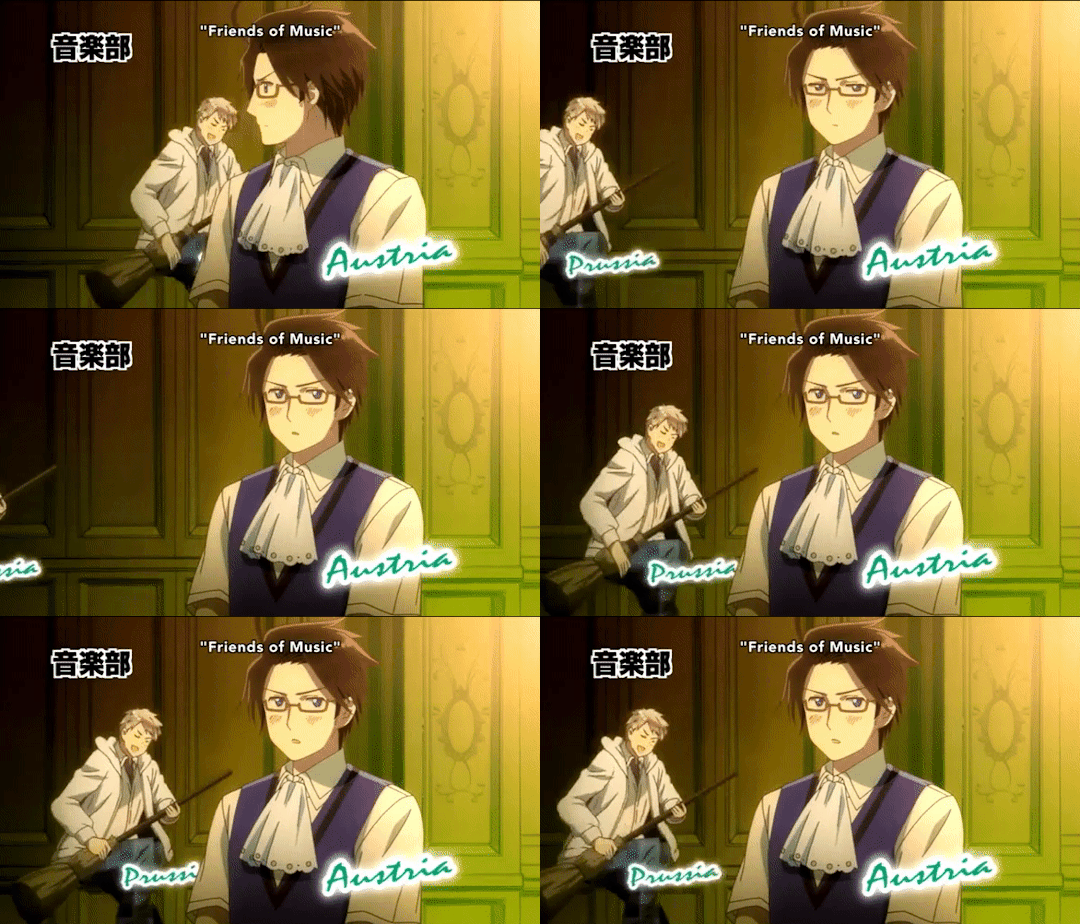
Misconception: He’s
weak.
Reality: Austria
was born a fighter [x], but as he turned to marriage to solve his political
problems, he lost shape and became accustomed to home life. He’s actually quite
lazy now [x].


Misconception: He
was cruel and heartless when he ruled over Chibitalia.
Reality: While he
was strict and stern with Chibitalia, a lot of this can be attributed to the extreme
and exaggerated humour employed by Himaruya in the series’ early days.

Even with the strict punishments, Chibitalia still shared
many fond moments with Austria—nations living in Holy Rome’s household
considered each other to be family and even maintained this sense of closeness
decades afterwards [x] [x].


Misconception:
Due to historical tensions, it’s impossible that he and Hungary were able to
possess such a strong relationship under their empire. [x].

Reality: Yes and
no.
You have to remember that the nations are people too. They
have a political self and a personal self. It’s for this reason that while
Hungary has “defiant” feelings from her time spent under Austrian rule, she also
has “complicated, yearning-like” feelings for him [x].
How I interpret this is that she despised Austria for what
Austria the country stood for at the time but not who he stood for as a
concrete and separate person.
Lest we forget all the times where it’s hinted that the
two still have feelings for each other. The most notable panel that substantiates
this claim is from Buon San Valentino. There, Hungary receives a Valentine’s
day gift from someone with “glasses and one hair standing up,” [x].
“He hides his name but not his Mariazell.”

Misconception:
Austria and Prussia hate each other.
Reality: Again,
yes and no. It depends on the time period. The ‘hatred’ isn’t deep-set but
rather it’s temporary. Himaruya once said that it would be fun to draw Austria, Germany, and Prussia as a “chaotic sort of family,” [x].
Undoubtedly, Prussia gets on Austria’s nerves…a lot [x]. (Another good reference would be the Maria Theresa series).

Still, the strips have also shown that they don’t truly hate each other.
Ex: Austria
receives a censored letter from Prussia (who was under Soviet rule at the time)
and reads it out of pity [x].

Ex: The two still
consider each other to be ‘family’ and spend their holidays together despite
all the fighting it causes (Christmas 2010 Event).
(Prussia initially didn’t want to let Austria spend
Christmas with him because he was a “lesser German”. He was just being an ass;
I wouldn’t take it seriously, especially given Germany’s response).


Bonus Facts:
He’s considerably self-critical.
Ex: He wears his glasses to avoid looking plain. It’s not
from poor eyesight. Instead, they represent his “musical something,” [x].
Ex: Being unsatisfied with his appearance is enough to make
him feel discontented [x].

Similar to Freud’s “anal-retentive” personality-type,
Austria is a stingy [x] perfectionist [x].
His mole acts as an erogenous zone, not his ahoge
[Mariazell] [x].
He gets grumpy when he doesn’t have coffee.

He spent part of his life in a wheelchair [x].
He doesn’t have a sense of direction.

He once avoided fighting with Prussia because he didn’t want
to harm young Germany [x].


Me: I need more school friends.
Also me:


I think I read somewhere that Belarus can see
ghosts? Do you know if this is true.
I don’t have a direct English translation to link you to, but it is
revealed that she can see ghosts in “Desktop Buddies” [x].

This is
the anon from earlier asking about your askbox status. I’ll send the ask now
then. So I was wondering if the canon human names that Himaruya’s picked out
for the countries have any historic relation, significance, or connotation to
be kept in mind? I believe that Hima in the past has explained some of his
reasoning to an extent, but a lot of it I think he’s left up for debate so I
was wondering if you could provide a list of plausible reasoning for their
canon names. Thanks!
The human names were deleted, so some people don’t take them as canon. Many speculate that this was because the names and surnames were not well-researched on Himaruya’s part (which is true).
Hetarchive has an entire page dedicated to extracting the possible historical references and/or significance from each of the names [x].
Although the nyos were later given names, they’re not official or canon. Himaruya stated that fans could name them however they please [x].
I love your post on
micronations and states. I’m hoping hima will put Mexico and Texas in there. I
know mexico was mentioned once. I just am hoping Texas will be
official-official since Texas used to be a country and hima saying nations
continue living if the become territory’s.
Thank you!
The strip where Mexico was mentioned is from Comic Diary 2. America speaks of the Alamo grudge [x].

As for statetalia? While state personifications exist for other nations, they don’t [officially] for America.
On the other hand, Himaruya does create a dialogue and panel in which the American states hypothetically existed [x].
I think I saw somewhere that Prussia asked
Italy on a date once- is that true?
Yup! It’s from Prussia’s Drama CD, titled “The CD of the Awesome Me,” [x].
Hi Ella! Can nations teleport? (France
disappeared after talking to Joan so I was wondering) Or maybe he just ran away…
Hello! They can transport; however, distance and the ability to travel on foot conventionally seems to be a major factor (e.g., Finland can’t transport to Seychelles and vice-versa during the 2010 Christmas Event).
*After talking to Lisa, Jeanne’s presumable reincarnate*
It’s not confirmed, but that could be the reason why France disappeared so quickly. Either that, or he was just being dramatic for flare.


Do you know some moments that Italy may looks naive, but he knows more
then he looks?
Italy’s not canonically naïve.
Yes, I’m aware that the comic gag is that he’s a “Hetare” but even in the
original webcomic, he’s not clueless at all. In fact, he constantly worries
about how he’s perceived by his allies in terms of his worth and ability to
contribute to the alliance [x].
Overall, he’s incredibly
intelligent and perceptive. He puts on a front of cheerfulness but is keenly
aware of what’s going on around him. Most of the time he brushes it off and
chooses not to focus on it.
You see this more when he refers to corruption in his nation’s
politics [x].


MORE WHOLESOME AMERICA PLEASE
Your wish is my command [x].
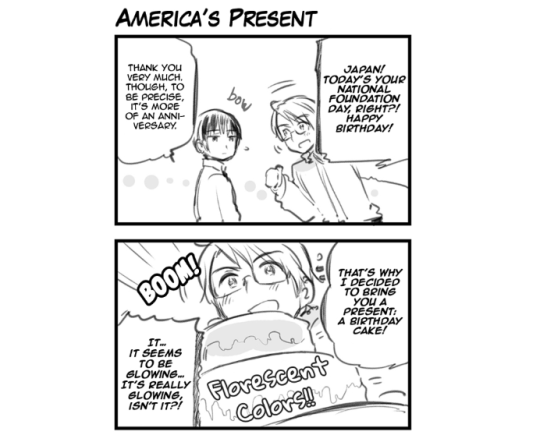
Why are Austria and Switzerland suddenly so
distant from each other? Okay their relationship was cut because of their boss,
but after that, why are they like cold towards each other like ex lovers or
something?
As far as I’m concerned, it’s
literally just that reason. There isn’t much of a romantic overtone (they were kids). It was more like a very tight partnership or camaraderie. I say this because Switzerland has flashbacks of the times he spent with Austria when he experiences similar moments of fondness with Lichtenstein.
He’s still bitter over the loss, having been discarded and mistreated by someone he trusted. Please remember that nations follow their bosses orders, so it’s not like Austria had any malicious intent [x].
Okay, just a quick question. Do you remember
that strip where Romano wanted his room of hopes and dreams cleaned? There was
a roman emperor looking statue on the front. Maybe he wanted to rule the empire
once? I’m feeling curious y’know.
That’s an interesting thought. My personal take on it is that it represents Romano’s failed hopes to live up to his grandfather’s legacy and inheritance [x].

You see this complex with him when he’s younger too [x].

Veneziano isn’t exclusive to failing up to this legacy either. Germany actually overestimates him when they first encounter each other in WW1 (Volume 1, Prologue).

Which character do you think is least accurate
to the country they are based upon?
Poland 100%
Do You think that it’s okay to think in China,
India and Turkey as Ancients Nations. I don’t know if to be an Ancient, the
nation has to be old and had passed a long time ago.
There’s no explicit rule on what makes an ancient an ancient. I use a
rule of thumb and go by chronological age.
Yes, to China given that he’s lived for 4000+
years (e.g., he’s alive the same time as Rome) [x].
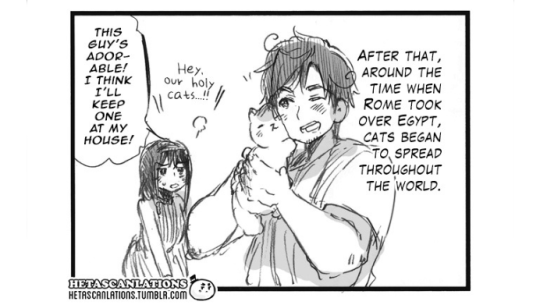

India, we don’t know enough information about
to pinpoint if he’s a more recent personification/ if he has an ancient
counterpart.
Yes, to Turkey too. In one of the drama CDs, it’s
revealed that he was the one who killed the Byzantine Empire (previously Ancient
Greece) [x].
Why does Turkey wear a mask?
No real reason is given. The
closest we’ve come to an answer only leaves us with more ambiguity… (Source:
Christmas 2007 event).
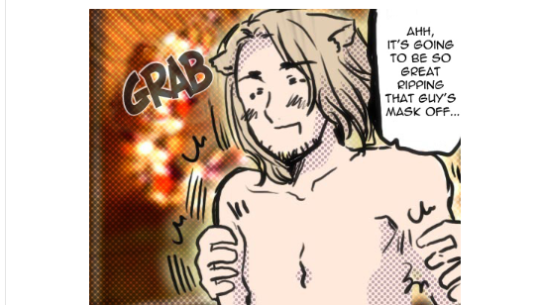


On the other hand,
Himaruya does play with the idea of the mask. He’s created posts, where if you
click on Turkey’s image, a new image of him without a mask will appear [x].

What do you think of Germanys character song Steady Rhythmus?
A lot of people seem to be confused because it’s rock/“metal”. Idk
why tho, considering that a shitload of Germans (including me) love those genres.
I mean, we have rock/metal bands and festivals everywhere 
Not a fan of it, but I do get why it’s of that genre. I
actually kind of like Prussia’s “My song that is written for me, by me”, save
for some parts lmao. The instrumentals are good.
Would Prussia still be considered a nation, or is he now
human? If we’re ignoring the East Germany theory, that is.
The simple answer is that he seems to be somewhere in
between. He takes longer to heal, yet Gilbird is still around him. Since
the personifications’ immortality rubs off on their pet, Prussia may have still
retained some of his immortality, although it could be waning. Hypothetically,
if Prussia was human, being constantly around Germany—whom he lives with—would drive him mad [x].
The main reasons I say this are:
1) He’s once referred to as being “in a pitiful state of an
enclave” [x].
2) When asked if Prussia would eventually fade away, Hima states
this: [x].


Do you think that Italy is underestimated by others nations,
sometimes?
Yes and no.
Germany often underestimates him, being biased from what he
witnessed of Italy during the World Wars.
Ex: Germany’s reaction at
the Galata Bridge scene where Turkey recalls how strong young Italy used to be (Source: Volume 4).

There are also moments where nations recognize that it’s
better not to underestimate Italy (Source: Christmas 2011 Event).


Aside from the muddled waters of his previous [deleted] and
inappropriate characterizations, which, unfortunately, have bred several
accompanying misconceptions—an important topic that I will eventually delve into in greater detail—Spain’s
personality is arguably one of the most benign, kind, caring, and compassionate
among the nations.

Being oblivious to the feelings of those around him and goofy-natured,
Spain has a tendency to act with his heart rather than his head. It’s not so
much that he’s emotionally-unintelligent. It’s more so along the lines that he
doesn’t always read into others correctly because he doesn’t bother to read
them at all.
Nonetheless, there are notable moments where he’s able to
see right through to those he cares about, knowing exactly how they’re feeling,
what needs to be said, and, of course, expressing his support for them.
In the past, I’ve seen his character unjustly be watered
down as a “plain” type, merely because he’s cheerful, as if people like this
don’t exist in real life. There’s nothing wrong with a character being sweet
and genuinely cheerful to those close to him. It’s this overcritical
attitude that causes people to overlook how benign and supportive characters
like Spain serve to compliment others and their respective relationship
dynamics. Often times, this support comes at the cost of self-sacrifice.
Ex: Spain gave Romano a whole new wardrobe at the cost of
wearing rags.

That said, below will be a list of examples detailing just
how much of a gem Spain is.
While Spain may have generally favored Veneziano over Romano
when they were younger—[not always the case, post on that here [x]]—this
dynamic has since changed. As adults, Spain’s attention has almost completely
been diverted to Romano.
What’s humorous is that Spain’s smothering irritates Romano
greatly.

Ex: Spain asks a tourist to stop Romano in order to get his
attention [x].


Ex: The two of them have matching tomato boxers [x].
Ex: He escorts a drunk Romano home [x].

Ex: Spain’s perceptiveness comes to light when he realizes
the real reason why Romano dressed Roman style for Halloween.
He smiles
knowingly when Romano refuses his suggestion that this is done in honor of
Rome. Having been his guardian for centuries, Spain knows Romano better than
anyone else [x].

In the same strip, Iceland, having experienced the same type
of overbearingness with Norway, alludes to the fact that Romano doesn’t
actually mind Spain paying him all this attention. Romano’s blush says everything.

The two are just really good friends. There’s a reason why
they’re always depicted together [x] [x].


It’s not just Romano who Spain’s excessively kind with
either. As mentioned, it’s just who he is as a person.
Ex: In recognition of how Germany has trouble smiling, Spain covertly tries to teach him how [x].


Ex: He’s described as the type of person who would ask about
the contents of a book he’s not interested in [x].

Ex: Spain’s kind nature is what makes the Bad Friends Trio dynamic complimentary and memorable. It just works [x] [x]


Note: This post will
use Swiss psychologist Kubler-Ross’s model of grief to analyze how Prussia has
come to terms with his death/ potential [future unconfirmed] death.
Kübler-Ross’ Model:
Having worked with terminally-ill patients, Kübler-Ross
recognized universal themes in which people passed on. There were certain
phases that her patients experienced before dying. While the model isn’t
successive in that patients don’t have to experience one phase in order to
experience the next and that some patients don’t necessarily experience all
stages, these themes were a common phenomenon that she observed. It’s not
measurable and empirically supported, but it does provide a good description of
the phenomenon.
The stages, which can be experienced several times
throughout the dying process are: Denial
and isolation, anger, bargaining, depression, and acceptance.

Denial is pretty
self-explanatory. The person refuses to accept the reality that they’re dying
and will usually avoid talking about it all together. Mostly, there is a
partial acceptance of their death (e.g., recognizing their fatal diagnosed
illness). It’s very rare where the person will maintain a consistent denial
until death. This stage is ultimately characterized by numbness and stoicism.
What’s isolating is that the person refuses to accept any other reality but
the one they’ve constructed.
Anger is also
fairly explanatory. Once the denial
can’t be maintained and upon recognizing their lack of control over the
situation, the person gets angry and resentful. This entails displacing their
anger and projecting it onto everything around them, including their family
members.
Bargaining is a sort of middle ground. If they’ve
consistently denied their death and are still angry at everyone and everything,
including God, they will attempt to bargain with their fate. The lack of
control renders them childlike in that they’ll wish for a postponement of their
death with the implicit promise that they won’t ask for anything else.
Ex: “Just let me
live past one last Christmas. That’s all I ask.”
Depression is seen as a necessary phase if the person is to
die peacefully and with a state of acceptance. Rather than trying to cheer the
person up, Kubler-Ross recommends encouraging the person to accept their
sorrow.
Acceptance includes neither an angry or depressed state.
Nonetheless, it shouldn’t be mistaken for happiness. They may not even feel
anything. This final stage typically involves the person withdrawing into themselves.
They don’t want too many visitors and are more contingent on their family
members presence as their support rather than verbal communication.

That said, the best example where I 100% believe Himaruya
has used this model is with Prussia. Regardless of what he personifies/
personified, it can’t be denied that Prussia has become weaker and may or may
not fade away.
In my interpretation, his character song, Mein Gott!, is an exemplification of
Prussia’s unwilling confrontation with the possibility of his death. He goes
through all stages with the exception of anger. Just like the model, Prussia
flips through the stages in a non-linear manner and experiences them several
times throughout the song [x].
“Someone is calling,
I’m being called
Alright, leave it to me; let’s go
More! More!
To the east and to the west
I’ll keep running”
He hears the call of death but
runs away from it.
“The awesome me’s the most supreme! The
strongest!
The one who gets the last laugh, yeah!
Is the awesome me, of course!
Danke!
The best! The most fearsome!
You guys can praise me
I’ll show you my massive dream
A succession of victories for sure!
…
All of the maps will someday be in these hands…
I’ll laugh as I run through
That’s right, it’s not because I’m weak
It’s because I’m too strong”
He hasn’t come to terms with
the fact that he’s not the political superpower he used to be. Instead, he
deflects by boasting about his strength in a hypermasculine way.
Ex: Prussia flat-out lies to Germany when the latter
recognizes that his bite wound has taken an abnormal amount of time to heal…for
a nation, that is.


The isolation pertains more to how Prussia himself feels alone.
Ex: When asked why Prussia is so alone, Himaruya answers
that it’s because of the “pitiful state of an enclave he’s in,” [x].
Enclave has two distinct meanings. In this case, I interpret
it as Prussia feeling different and excluded from other nations whose
immortality still remains.
Definition: ENCLAVE, a place
or group that is different in character from those surrounding it.
“Danke!
Everyone! Come here!
Let’s exchange email addresses?
Being alone is too much fun
Everything will be in these hands! Just you
wait!”
“Mein Gott!
In a pinch! Punch!
Sometimes even a warrior starts shaking
(…I’ll leave things at this point)
A reverse in the situation, I’m going to be
hasty!”
(Beobachten Sie es bitte,
Fritz Vater) x 3
(Watch over me please, Father
Fritz)”
Here, it’s evident that Prussia desires to reverse
his weakened state. He bargains with fate by asking Fritz, his father figure,
to watch over him.
Ex: Prussia has a picture of Fritz on
his night table. It gives him a sense of security, insulating him from his fear
of dying.

“Hey
little bird chirp for my sake
It will heal me; niyo niyo!”
Prussia actively recognizes
that he’s been weakened. His sorrow is displaced to his bird, whom he hopes
will cheer him up.
“This is bad, a panda that
will bring happiness
I won’t be fooled.”
In the 2009 April Fools’
Event, China gives Prussia a panda with the promise that it’ll bring him
happiness.

“Alone in my room
I’ll write it today too
A memorial of the awesome me
More! More!”

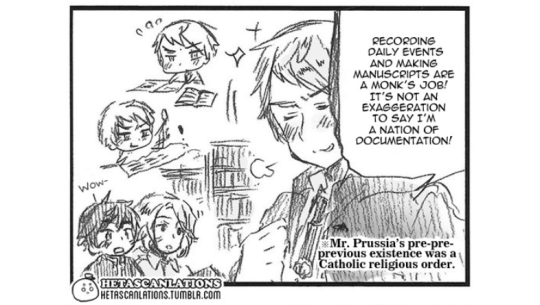
We all know that Prussia’s
been writing diaries since he was little. It’s the mention of a memorial that
signifies his acceptance of death.

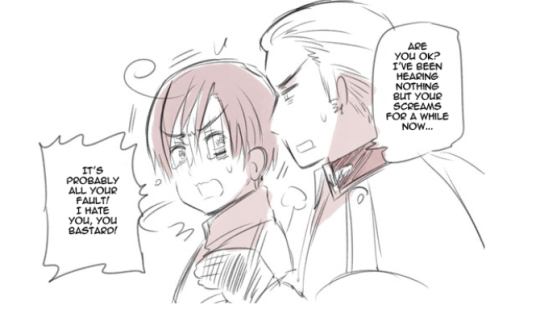
There’s also the recognition
that Germany is his successor.
Ex: When asked if Prussia will
disappear, Himaruya doesn’t rule out the possibility [x].

That said, it still amazes me
how people still conceive Hetalia as thoughtless, random, and simple. With the
large volumes of intertexts and historical and theoretical references woven
into the series, it’s anything but.


 Ellawritesficssometimes