*Has no books*
The meme collection on my phone:

*Has no books*
The meme collection on my phone:

Definitely! Prussia by far is the most obvious.
On the other hand, Rome does experience some of this
in the strip “Grandpa Rome’s Visit Home.” There are also bits of the theory
expressed in how he once tied up God to visit his grandsons and occasionally visits
them in their dreams.
To me, Prussia’s character song Mein Gott! is a song that
involves him confronting each stage of death. Post coming up tonight!


I know it may seem random at times, but there is a
consistent logic running through the manga that explains why some nations live
on despite ceasing to exist politically. The reason that this causes a lot of
confusion among fans is because of how loosely the word nation is defined in
Hetalia.
Nation doesn’t strictly mean an autonomous and politically
recognized sovereign state. Instead, personifications exist as representations
of a group of people and their culture, hence explaining their wide diversity
(e.g., kingdoms, religious orders, micronations, city-states, provinces, etc.)
Remember that the modern nation-state is a recent phenomenon. Humans organized
themselves far differently in the past. Larger post on that here [x].
In “It’s a Treasure Box of Countries”, it’s confirmed that
the nations are cultural and citizen-oriented personifications. Two things can
happen when a nation dies.
1) They gradually fade when their people’s culture
or identity (personality) disappears.
“Usually, when the culture of the country’s personality
dies/ disappears, the country would gradually disappear or entrust him/herself
to the country that takes over him/ her.
2) The ex-nation becomes a state representative.
“Regardless if their people’s culture and
personality disappears, the personification can still live on as a state
representative.”
There are two points to take away from this. One, the
nations don’t cease to exist because of political recognition. First and
foremost, they exist for their people and their culture. Two, nations don’t
necessarily die right away, or at all if they decide not to.
Ex: In World Stars, France reaffirms again that the nations exist because of their people.

That said, let’s go through some examples.
After the third partition of their empire, it wasn’t just
Poland that ceased to exist on the political map.
Lithuania did as well. Nonetheless, as Lithuanians and Poles were absorbed by
Russia, Prussia, and Austria, thus ending their political identity, their
cultural identities remained in tact. Lithuanians and Poles didn’t disappear; their states did.
It’s for this reason on top of the fact that nations gradually
disappear that Poland and Lithuania are revealed to have lived during this era.
Poland made friends with Italy and bonded over their desire for independence.
Meanwhile, Lithuania became a servant to Russia.


Holy Rome didn’t die right away despite being dissolved,
once more demonstrating the gradual pace of how and when a nation fades.

Larger post covering him here [x].
Whether he’s East Germany or not, it’s clear that Prussia is
losing his immortality.
Ex: When Germany’s dog bites him, Prussia takes longer to
heal from a wound.


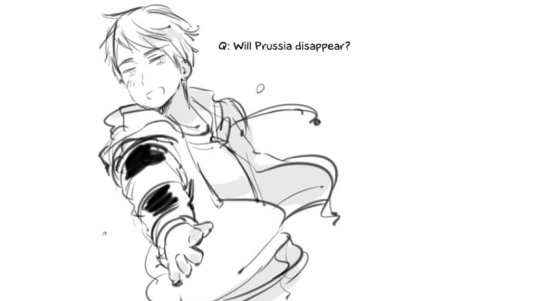
When asked on whether Prussia will disappear, Himaruya doesn’t rule this out as a
possibility [x].

In sum, it’s important to note that the nations don’t exist
for political reasons. If they die, it’s because their people no longer
identify under a common identity, or their culture disappears. This death doesn’t
occur immediately and is a gradual process. On the other hand, personifications
can still choose to exist even without a group of people and culture to
represent.


Prussia: *laughs*
France:

I’ll kindly direct you to my post directory, considering
that most of my posts tackle how Hetalia is riddled with serious,
thought-provoking, and dark subject matter [x].
The scars that accumulated on Lithuania’s back, a
consequence of being under Russia’s rule [x].

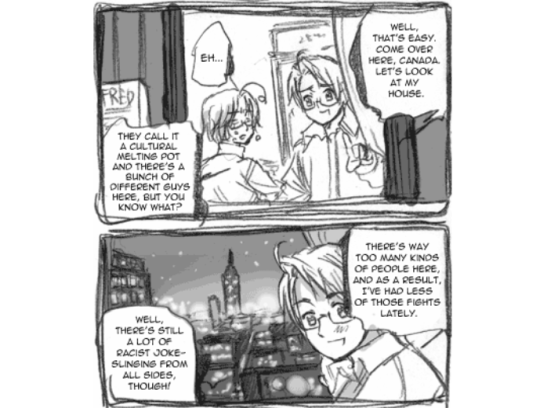
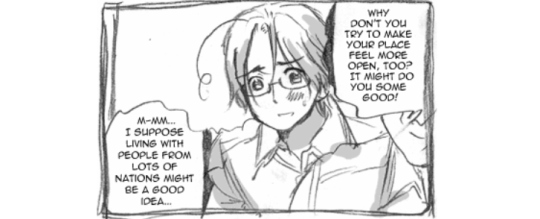
America giving advice to Canada on being open to welcoming people from different races, ethnicities, cultures, and religions [x].
England asking for Italy’s help in improving his artistic
skill during the second Industrial Revolution. Due to his and Romano’s rough and
sudden unification, Italy breaks down crying:
“It’s been so long since anyone has trusted me this much.” [x].

Prussia signing a treaty with Japan and teaching him German during the latter’s Westernization period [x].


This guide will go over
the stereotypes that affect how the Germanic nations are able, or rather, unable
to express their feelings. The steely emotionless stereotype of Germans/
German-speaking countries often prevents the respective nations from being
understood properly. It’s not that they’re incapable of experiencing love or
feeling care and affection. It’s quite the contrary. Instead, they just have a
difficult time showing and communicating how they feel [x].

For the purpose of this
post, I’ll only be going over the Germanic nations that are listed in this
strip, as they are what Himaruya characterizes to be of German inheritance and influence.
I recognize that there are many more Germanic countries than this. I’m just
going by what we see portrayed in the manga.
That said, let’s go over
some examples.
The German stereotype of
being emotionally steely and hot-tempered is a complex that Germany is defined
by in the manga.
He’s sweet and
compassionate but is often mistaken to be angry by those around
him [x].

Germany also claims to
have trouble smiling. It’s not something that comes naturally to him [x] [x].


In terms of
relationships, Germany is emotionally withdrawn. This is most seen in Buon
San Valentino [x].
There, the premise of
the arc is that Germany has trouble defining what his relationship with Italy
is.
He first buys a popular
book in Germany titled “Communicating with your partner.” The comic gag
of this is the stereotype that Germans aren’t savvy at reading emotions; they’re
‘emotionless.’ Obviously, this isn’t truly the case.

As Germany reads this
first book, he begins to question whether Italy likes him as a friend or as a
romantic partner.
When Germany gives
details of his relationship with Italy to Austria, Austria is repulsed due to
the romantic overtones = seeing someone every day, kissing and hugging them,
bathing with them etc. The irony is that Austria later realizes that Germany
was talking about Italy, an anomaly of a person who normally does all these
things.


Unfortunately, Germany
doesn’t know this, and he forms the conclusion that Italy has romantic feelings
for him. It’s a “misunderstanding.”
Since he’s still clueless about this aspect of human relations, Germany then buys a book that gives dating advice.


His dismay grows when he remembers that Italy’s a guy [wow!] so of course, his next course of action is to ask Austria if he can practice these newly learned romantic gestures on him.


He later reveals to Austria that he has no previous experience with romantic relationships and that he’s only read romance novels.

The strip culminates in
Germany mistakenly proposing to a very confused Italy.

Despite having never
been married, Prussia is the most sensitive and emotionally-expressive Germanic
nation.
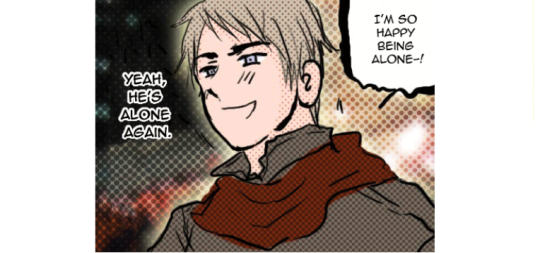
He’s often found crying
and lamenting over the fact that he’s single and “alone.”
Ex: He cries when he
spots Hungary and Austria spending their Christmas together during the 2007 Christmas event [x].


The Germanic stereotype
has more to do with the fact that he’s a poor socializer.
For example, he’s given a
book on “How to Socialize with People.” He sneezes and claims to be bored with
it [x].

In direct contrast to
Prussia, as someone who’s been in several marriages, Austria is arguably just as
clueless as the German brothers.
He may have solved his
problems with marriages…

…but when it comes to
relationship troubles, he’s read his fair share of manuals and guides too.
Austria had copies of both
books that Germany purchased in Buon San Valentino. Had he have known this
beforehand, he would have lent them to him.


He becomes flustered
when Hungary reads the dating book and laughs at how inaccurate it is. It would
be to his own embarrassment should he have admitted that he had been an avid
reader of it.

On the other hand, in his defense, it’s largely hinted that he’s the one who gave Hungary flowers on Valentine’s Day.

Switzerland’s similar to
Germany in that he’s an angry-type that’s soft on the inside and well-intentioned.
He shouts at Japan to
give his own opinion, scaring the latter despite the good intentions of this
action. It’s tough love in that he’s trying to get Japan to stand up for himself.


He cringes and gets
angry for remembering all the fond moments that he had experienced with Austria during
their childhoods. This is sometimes at the expense of ruining the fond moments that
he shares with Lichtenstein [x].


Nonetheless, Switzerland
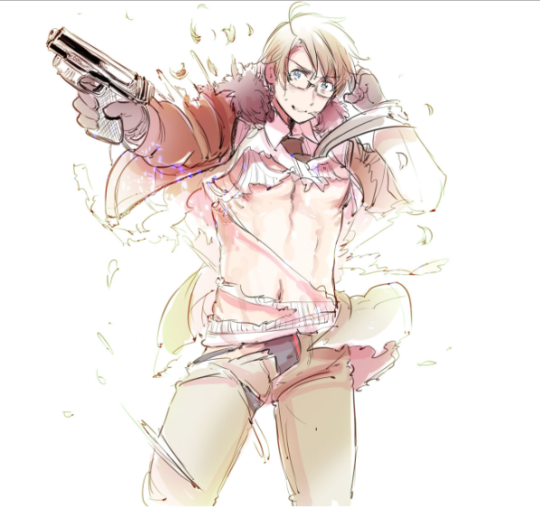
shooting at Italy in the frilly pajamas that Lichtenstein made for him is
iconic, and you can’t tell me otherwise.

Sweden’s slightly
different in that his minimal facial expressions are intimidating to people.
Finland finds Sweden
scary at first… [x]

…but later warms up to
him and realizes that Sweden smiles and expresses his happiness subtly [x].


In reality, he’s also
quite the softie.
He sews smaller
clothes for Finland [x].

He acts as a father
figure to Sealand [x].

In sum, while the
Germanic nations may come across as hard and steely, they’re easily among some
of the sweetest, most considerate characters in Hetalia.




 Ellawritesficssometimes