Yes, but it’s indirect [x].

Yes, but it’s indirect [x].
[You’re so polite omg
bless you]
Yes, both Austria and
Prussia share similar issues, likely because of the steely stereotype that’s often applied to the German people. I think this
is the post you’re talking about [x].
And for sure! I’ll put together a quick guide
on this tonight!


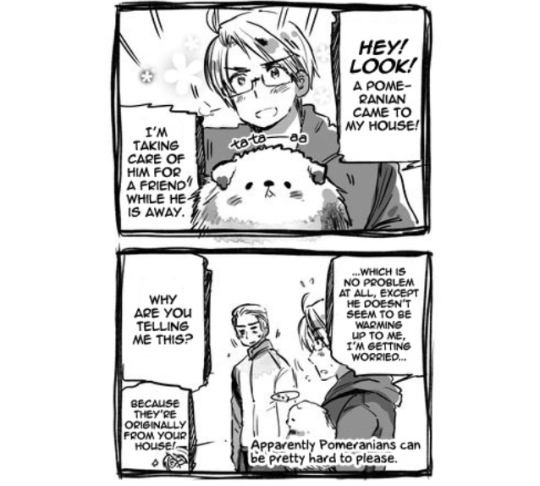
America taking care of his friend’s Pomeranian and asking for
Germany’s help.
Canada crying and doing his best to heal England after the
American Revolution [x].


Hungary secretly cleaning up for Austria after their empire
is dissolved.

After telling the story of Germany’s birth, you see a break
in Prussia’s egocentrism – or rather the act of it. He goes from “worship me
all you like” to agreeing to do laundry for Germany. In reality, he’s an
incredibly helpful, hardworking, and diligent person.

I’m not particularly big on headcanons, but I sometimes do charts like this 😀
Most insecure nations
–
America, Canada, England, Germany, Italy,
Romano, and Poland.
Loneliest nations
–
America, England, Iceland, Prussia, and Russia.
Happiest nations
–
Denmark, Finland, Seychelles, and Sweden.
Most sarcastic nations
–
England, France, Norway, and Romano.
Nations we need more of
–
Belgium, Belarus, India, and Vietnam.

Any strip that revolves around independence or revolution is
phenomenal in my opinion.
America – Fighting for independence from England [x].


The Baltics – Declaring independence from the USSR [x].

France – The fear of other European nations in response to
the French Revolution [x].


Italy– Fighting for independence from Austria [x].

Russia – Bloody Sunday [x]


+ the 1917 Revolution [x]


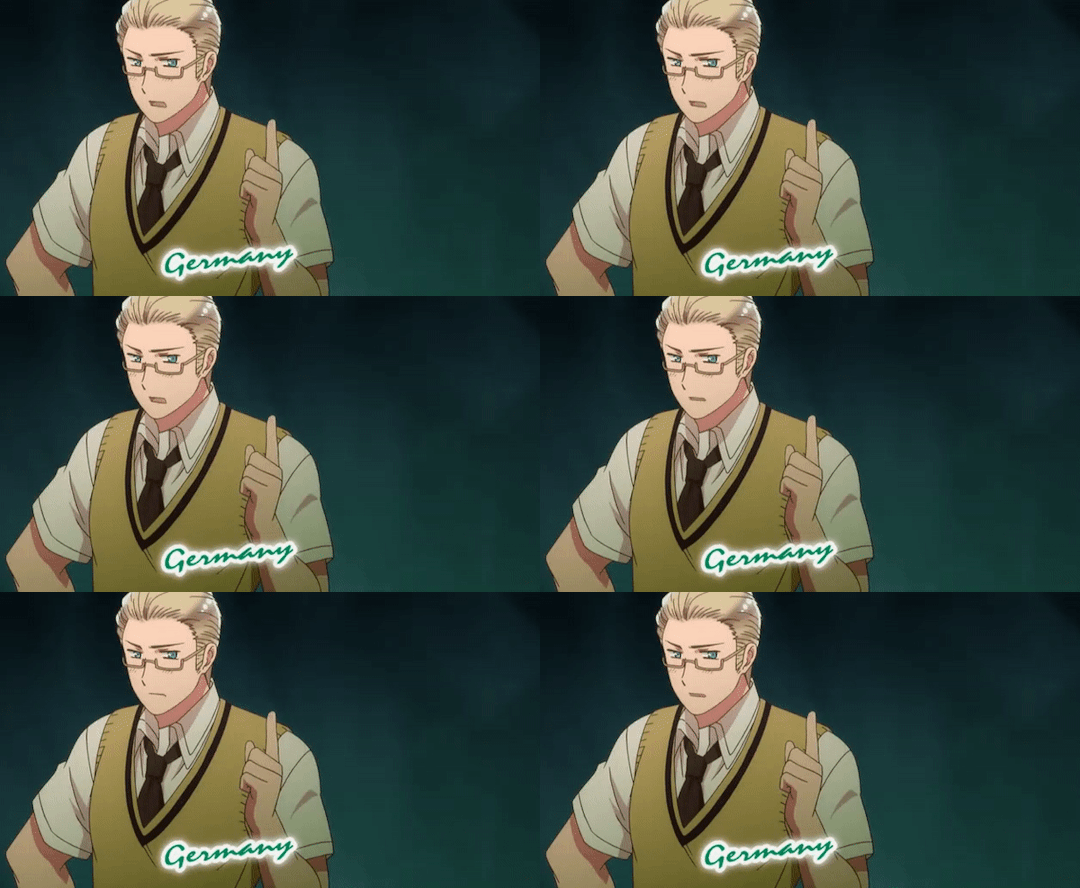
The purpose of this post will be to clarify much of the
confusion that has been generated by changes made in the anime concerning Germany’s
birth.
In the anime, what you’ll see is that the process of Germany’s
birth is depicted as a clear result of the German states huddling [combining]
together to form one state.
Meanwhile, in the manga, the process of Germany’s birth isn’t actually shown – all that’s
revealed is the end result. It’s left vague and open-ended, perhaps for the
purpose of giving Himaruya leeway to later confirm that Holy Rome is, in fact,
Germany.
That said, let’s go over the strips that cover Germany’s
birth.
In this chapter, a meeting for all German states is held [x].
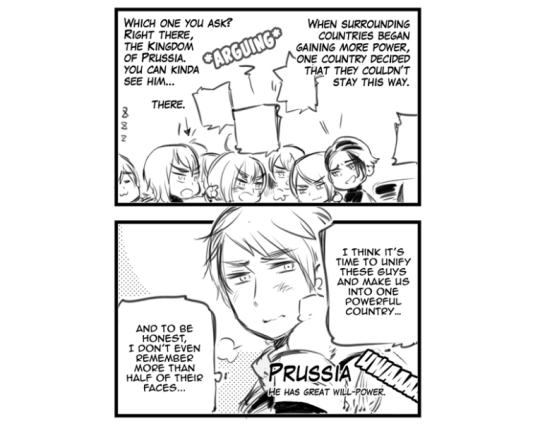
Prussia’s suggestion of merging into one sovereign state is received
well.


Admittedly, before the German states are able to form
Germany, they’re excited about “the birth of their new baby brother.” I’ll get back to this in a minute, hold on.

Austria stops the process and claims that he’ll assume
responsibility over Germany once he’s born.

Prussia kicks out Austria from the German Confederation.

What’s critical is that when Germany is born, the previous
process in which the German states were to huddle together to form him isn’t
shown.
Instead, the strip skips straight to Germany being born.

My explanation:
I’ve done a full post on this [x], but it’s important that I
go over this again before comparing it to other strips.
The reason that I believe the German states aren’t depicted
to be huddling together, only to step back and reveal a new personification –
as shown in the anime – is because the personification already existed.
Holy Rome hid in Prussia’s house after his dissolution
He
didn’t die right away.

On top of that, we know that Holy Rome became sick as a
result of the fragmentation and lack of unity in his empire. This illness only
became worse once he was dissolved.

I
believe the reason that Germany was born as a young child is because he changed titles. The existing body panel is meant to be taken literally in
this sense. The personification was already alive – but not well.
Note: I also recognize that baby nations canonically wear nightgowns. As I’ll reveal below, I believe Germany was wearing a nightgown for an entirely different reason.

As stated in chapter 1 of World Stars, it’s completely
possible for nations to change titles and assume new personalities.

Since your
personality is very much driven by life experiences and memories from them, to have a new
personality inevitably means that you’ve obtained new memories.
Or, in Holy Rome’s case, for him to assume a different personality
as Germany would mean that he’d have to completely forget about his past life. Otherwise,
these past memories would influence his personality.
So, maybe Germany’s an amnesiac Holy Rome then…is there any
evidence of that?
Yes.
In the same strip, Prussia reminding Germany that he can
call him big brother several hundred times can easily be interpreted as him attempting to trigger the newly-born Germany’s memories of being Holy
Rome.

As such, the fact that Germany emerges wearing a nightgown,
as a child, can likewise be interpreted as an amnesiac Holy Rome – who also
conveniently wore a nightgown in his later days – stepping off his deathbed for the first time. In
other words, German Unification fixed Holy Rome’s health, the only problem
being that he’s lost all of his previous memories.
Ex: Holy Rome, sick in bed as Prussia reads him fairy tales.

Ex: An edited comparison of Germany and Holy Rome, both of whom are wearing nightgowns. They also look exactly alike.
Left – Germany, Chapter 12 of World Stars, Right – Holy Rome, Chapter 187 of World Stars.

Lastly, this would explain one German state’s sobbing
reaction to Germany being born.

This is all behind the scenes speculation, but I believe
what happened is that when the German states initially agreed to form into one
country prior to Austria’s interruption, they believed that Holy Rome was dead.
Remember that Holy Rome was hiding in Prussia’s house. That’s why they thought
they would be gaining a new younger brother.
The reason that the process of Germany’s birth was skipped
the second time around is, again, because the personification (Holy Rome) that
represented them already existed.
This panel, then, can be interpreted as one of Germany’s
older brothers realizing that Holy Rome hadn’t in fact died and had been alive the whole time.
Timeline wise, this was made before World Stars. Nonetheless, here too, the process of Germany’s birth isn’t depicted [x]. All we see is the end result.

This is a redrawn and reprinted version of Comic Birz
Episode 11. It’s especially important because it’s what the anime adapts, as World Stars hadn’t yet come out at the time.
Notice again how the process of Germany’s birth isn’t
depicted. It doesn’t show the German states huddling together.

I think you already know what I’m getting at here.


Unlike the strips listed above, Germany’s birth in the anime
is drastically different. It actually shows Germany’s birth process.
Episode 5 of World Twinkle animates this, adopting the strip
from Volume 6.
I cannot stress this enough: The German States huddling
together and later stepping back to reveal a young Germany is not canon.

With all that in mind, I can see how easy it would be to
assume that Holy Rome and Germany are separate persons just by basing opinions off the anime. While the connection between them isn’t confirmed in canon,
however, the manga leaves things far more open-ended.
I’m currently working on a mega post that compares literally every example of the parallels between them (e.g., dialogue, expressions, replicated scenes).
For now, this is what I find to be the most interesting.
We know that pets in canon live longer if they’re around a nation, as the latter’s immortality rubs off on them, right? [x]
Well, doesn’t Holy Rome’s dog look a lot like Berlitz?


VS


Person: *insults me*
Me: Alrighty then.

Person: *insults my friend*
Me:

Totally! That’s what I love about Hetalia.
The personifications can temporarily hate each other on a
personal level and yet be aligned due to politics.
Or, they can be political enemies and still view each other with
positive regard on a personal level.
Or, they can dislike each other on both a political and
personal level and yet still be allies.
Just to give an example of what you mentioned, we see this
with Austria, Russia, and France during the Seven Years’ War.


+

+


Note: This
theory will make use of Freudian theory. While I recognize that Freud’s ideas
do not bear much contemporary relevance, that shouldn’t take away from the fact
that many of his concepts (e.g., erogenous zones, childhood memory repression,
catharsis) are nonetheless employed by Hima in the series. The purpose of this
post is to give some insight into the psychologies of the characters.
Terminology I’ll go over: Psychosexual stages,
causality, regression, fixation.
Yes, that’s right. Freud’s ideas are very much prevalent in the
series. A big area of his work was analyzing the impact of childhood on
personality development. Freud believed in causality, meaning that who you are as
an adult can be directly traced back to your childhood.

How you’re parented and
brought up is the most crucial factor. I don’t need to go into this in too much
detail, but basically, we go through five stages of development titled: Oral,
anal, phallic, latency, and genital.
For this specific post, we
only need to focus on the early stages of development, which focus on sensual
(sensory) pleasure and stimulation, often for the purposes of soothing and
experiencing relief.
Each stage has corresponding needs. If these needs are not met (under-gratification) or
if they are too easily met (over-gratification), then the person develops a
fixation.
A fixation essentially means that the person is
stuck at that level of development, which causes them to develop a problematic
and unhealthy personality type.
However, it’s only when that individual is met with
confrontation or a stressful situation that they regress back
to the stage in which they developed this fixation. The stress causes them to
revert back to the age where their needs weren’t met, and as such, they engage
in childish behaviours.
For example, if you get into an argument with someone and they
start behaving selfishly, like a toddler, then you have every right to poke fun
at them for having Daddy or Mommy issues. Or, there are those who bite their
nails and pick at their lips, something akin to the soothing acquired from
sucking one’s thumb as a child.

Germany is an explicit example of someone who’s fixated at the anal
stage, right down to an exact tee. It’s uncanny.
Yes, laugh all you want.
Anyways, the anal stage focuses on potty training. This is a
crucial event in a child’s life and how their parents receive their successes or
accidents, in this framework, has a huge impact on the child’s personality in
adulthood.
If the child is met with encouragement and praise when they succeed
and patience when they have an accident, then they develop a healthy
personality type.
On the other hand, if the child is met with irritation,
ridicule, or shame–
Ex: “You’re a big boy/ girl now! Everyone else your age already
knows how to use the toilet! Why can’t you?!”
– from the parent when they make an accident, hostility is
formed. This hostility then results in the child developing an unhealthy
personality type.
The toddler’s hostility in reciprocation to their parent’s
hostility can either manifest in them refusing to go potty (holding it in), or
going whenever they please.
In this case, the hostility, shame, and ridicule, that Germany experienced in
his childhood didn’t come from his brother, Prussia, but rather, other nations
whom he was immediately thrown into war against right from birth. Put another
way, Germany grew up in an unhealthy environment where ridicule and hostility
was the norm.


Germany has all the qualities of an anal-retentive personality type. These people are described as:
“Stingy perfectionists
who may experience problems with constipation and are obstinate, neat, and
orderly.”
People with this personality-type also tend to withhold their
emotions – they’re regressing back to the stage in which they held their fecal
matter in. Remember much of Freud’s theories are symbolic and allegorical.
That said, let’s go over these qualities.
As mentioned, Germany has trouble expressing his emotions.
Ex: He has trouble smiling and can’t smile the same way Italy
can.


Ex: He comes off as angry to others.


Ex: In Buon San Valentino, a pan-in on Germany’s head reveals
that he experiences emotions like shame, happiness, and heartbeat for the first
time.


Germany’s a neurotically neat and orderly person. Everything
about him is structured and regimented.

Ex: He folds his clothes a particular way.

Ex: He has a love for manuals, guides, agendas.


Ex: He’s timely and punctual.

Ex: He allots exact minutes for nations to give speeches at
world meetings.

He’s a perfectionist.
Ex: He watches Italy intently as the latter cooks, cleaning up
after every spill or splatter.

Ex: He has trouble accepting praise and will often find faults
in what he does.


He’s incredibly stubborn.
Ex: He’ll follow GPS directions, no matter where they lead him.


Ex: He reports to the police after Italy has his car and phone
stolen from him. Italy knows that his police are useless, which is likely why
he didn’t report the missing property himself. Meanwhile, Germany reports this
anyway.


In sum, from a Freudian standpoint, Germany’s emotional withdrawnness
stems in large from the hostile environment that he grew up in; he learned to view others with distrust and closed himself off. Not only that,
but much of his stubbornness and need for organization arises from the desire
to find order from what was previously chaos. It takes a resilient mindset to do that.

 Ellawritesficssometimes