image
image

I’ll
preface this by saying that I know Prussia is East Germany. On the other hand,
we don’t have any strips that concretely refer to Prussia as East Germany.

That said, until Prussia is either referred to
as East Germany or labelled as such, by rules of canon, he technically isn’t
East Germany. Yes, I know this is a bit confusing since his wiki page states
that he’s East Germany… I’ll get back to that in a moment.

Essentially,
the purpose of this post will be to illustrate how we know that Prussia is East
Germany; it just hasn’t been confirmed with a direct reference. 

Opening Misconception:

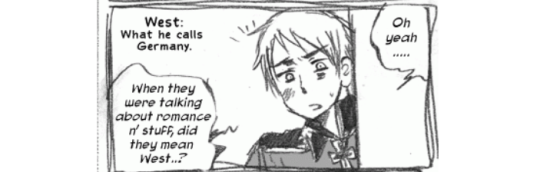
Some people
claim that Prussia is East Germany because he refers to Germany as West. This
is incorrect because we see Prussia referring to Germany with this nickname
well before WW2 ended. The nickname likely has to do with geographic proximity, as Prussian
territory is located in the East of the country.
image

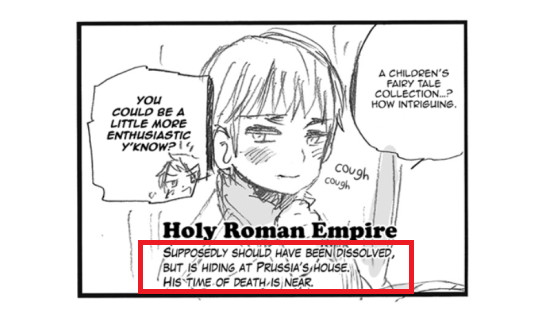
Is it possible for a personification to exist after dissolution?: 

Yes.

Ex: We’ve seen
Holy Rome exist well after his dissolution.
image

Usually, when the culture or the country’s personality
dies/disappears, the country would gradually disappear or entrust him/herself
to the country that takes over him/her.
[x]

In other
words, the personification’s existence is personality-based. This personality
is based on how strong their people’s culture is. Even after dissolution, if
the culture doesn’t die right away, the personification will still have a
reason to be. Basically, the path to death is gradual.

The second
part of this rule is what is of particular interest to me. It’s an option where
death isn’t required, regardless if the culture is gone or not.

“… or
entrust him/herself to the country that takes over him/her.”

In the
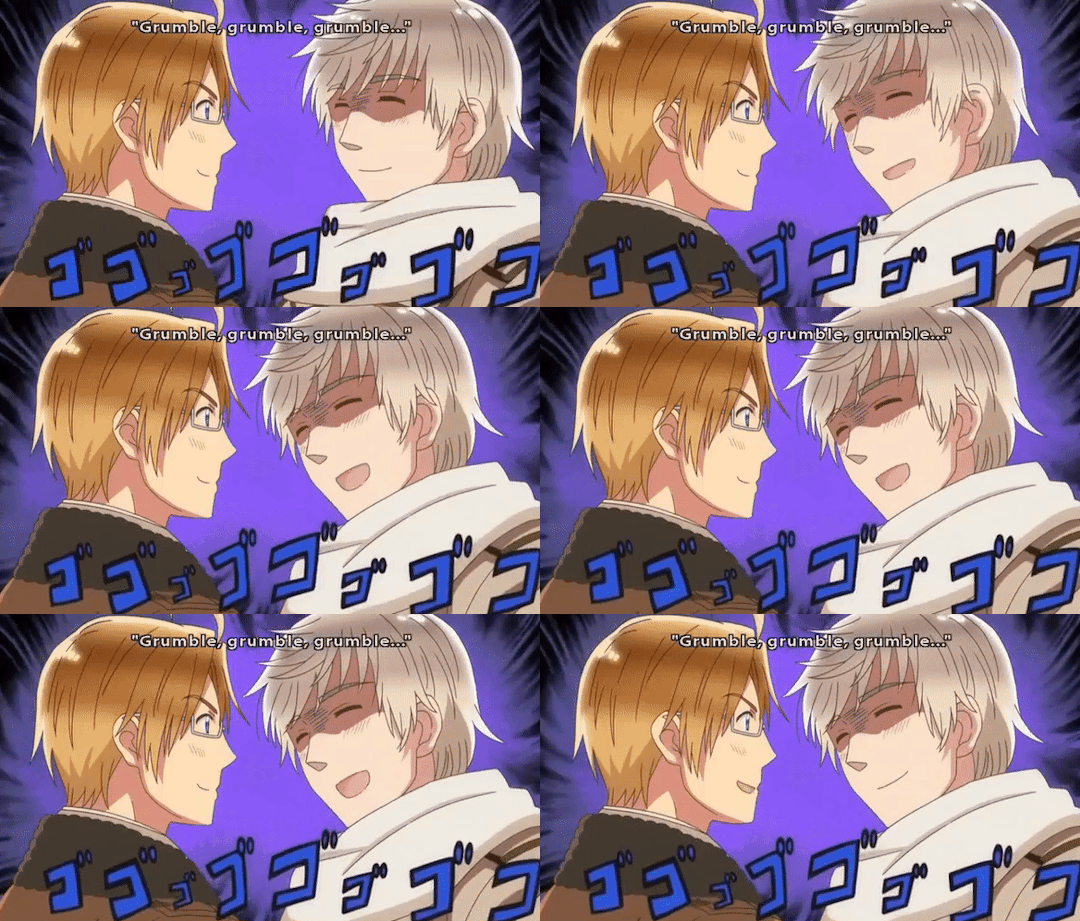
present day, Prussia mentions that he’s no longer afraid
of Russia because Germany is strong enough to protect him. Of course, this is making
the obvious assumption and conclusion that he’s East Germany.

image

Lastly,
another reason that could account for Prussia still being alive is that
personifications who have lost their culture can still live on as
representatives of their region.

“There are also cases that
him/her is not a country but continues to live leisurely as a representative of
a region.”

How I see
this is that the personifications become active in politics. In that case, this
would explain why we see Prussia still attending world meetings.

Ex: He
attends an EU meeting. [x]

image

What happened to Prussia after WW2?: 

Character
notes state that he fell under Russia’s control and was stuck working unprofitable
jobs for him [x]

Ex: Russia’s
political indoctrination of Prussia.

image

Ex: Prussia
working alongside the other Soviet countries.

image

Ex: In the
Christmas 2010 strips, Prussia reveals his deep hatred of Russia. He’ll puke if
Russia touches him. If not, he’ll lose four eyelashes – this is likely a
reference to the Allied-controlled zones that divided Germany into four post-WW2.

image

Ex: When
asked why Prussia’s alone so often, Hima answered that he’s in an enclave of a pitiful state. [x]

image

 “An
enclave is a territory, or a part of a territory, that is entirely surrounded
by the territory of one other state.”

If that’s the case then this would translate into Prussia
being amalgamated into/surrounded by Germany. Take note of this mention of weakness, because I’ll be bringing it up again soon. 

Why we know he’s East Germany… 

[…despite it not being confirmed.]

There are
several hints of the East-West divide that still lingers in the country.

image

Ex: In
terms of infrastructure, the East is on average poorer than other regions of
the country.

image

Ex: During
the same EU meeting from the example I listed above, Prussia talks about Ostalgie
and uniting the wall in [his and Germany’s] hearts. *Ostalgie is nostalgic
feelings for East German life and culture.

“We have to get rid of the “wall in our
hearts,” so that the country can get better and the progress will be
naturally more effective! When the Ostalgie level gets higher, Russia
imposes himself on my big brother.”

An obvious
reference to German Unification. No doubt.

Ex: When
the two brothers are finally unified, Prussia comes to Germany wearing old clothes.
Of more importance is the car he arrives in. It has an uncanny appearance to
a Trabant, an East German car.

image

He’s grown weak:

As seen in
one of the examples above, Prussia relies on Germany to protect him from
Russia since the latter is strong.

We also
know that Prussia doesn’t heal as fast as a typical nation would. This doesn’t
mean that he’s dying, given that personifications can still live on without
culture, but it does mean that he’s weaker than he used to be.

Ex: He’s
bitten by Germany’s dog. A full week passes, and his wound still hasn’t healed.  What’s even more troubling is that Prussia lies to Germany about how long he’s had the wound for.

image
image

Prussia’s always been reluctant to admit to
weakness, so I wouldn’t say that this is all too surprising…

image

Briefly put, we know that Prussia is East Germany, but he hasn’t been formally introduced or referred to as such. 

On the wiki page, they cite “Germany is playing an impossible game” as the strip where Prussia’s status as East Germany is confirmed. It pretty much is [it refers to German Unification], but again, it’s not explicit. Technically, it’s not confirmed then, as I’ll elaborate on later.  

I actually disagree with how this was done. No matter how obvious something is, I’m of the mindset that things shouldn’t be accepted as canon until it is explicitly stated as such. Most East Germany references have to do with German Unification or Prussia working for Russia, however, no labels are given…

Guide on what we know about Prussia’s extremely probable status as East Germany coming up tonight! 

image
image
image

In previous posts [x] [x], I’ve laid out the rules that explain what
affects a nations’ health. This post, however, will elaborate in more detail to
show the different ways in which they can be affected and why that is.

For one thing, we know that the personification’s health is
predicated on their economic and political situation. That is, if they are
suffering from political issues (either domestic or international) or are
experiencing an economic recession, they will fall ill.

image
image

That said, let’s go through the symptoms they can experience. 

They can get colds or fevers: 

Ex: Several nations develop fevers or colds in reaction to
the Great Depression.

image

image

Ex: Austria will develop a high fever and eventually collapse if
Germany acquires a cold [from an economic slump].

image

“A reliable country that likes to approach things with a sober seriousness.
He approves of and supports lots of Germany’s ideas so he may look like one of the helper countries, but in reality the level of his dependency is pretty high.

So high that when Germany catches a little cold, Austria goes straight to high fever and eventually collapses, and so he doesn’t have much of a choice than to take good care of himself.”

Ex: England develops a cold after the American Revolution.

image

They can suffer from fatigue and exhaustion:    

Ex: The aftermath of the Napoleonic Wars.

image

They can die:    

Ex: Spain nearly dies during an economic recession before
Romano starts helping him recover with imports.

They can cough up blood:

This symptom in particular is depicted more as a consequence
of war (which includes separate battles/attacks) or civil strife. You’ll often
see the most devastated nations coughing up blood in panels where Hima
introduces different sides of the conflict.

Ex: Prussia, Spain, and Italy during the Napoleonic Wars.

image

Ex: Prussia during the American Revolution.

image

Ex: China during WW2 after being betrayed by Japan.

image

Ex: The disunity in the Holy Roman empire causes Holy Rome
to fall ill and cough up blood. His political situation isn’t stable, which, in
turn, is reflected in his poor health.

image
image

Bonus case: 

The nations cough up blood and get sick during conflicts,
but are nonetheless able to heal from these wounds with time as their country’s
situation stabilizes.

But, what if a personification never healed emotionally from
a conflict and keep reliving it over and over again?

image

Wouldn’t that explain why England coughs up blood and falls
ill every year during the fourth of July? The event is still fresh in his mind,
and regardless if it’s over and done with, his body reacts as if it’s still
happening.

image
image
image

I think it goes unsaid that how the nations relate to one
another is not only based on their present political relations.

In other words, while they may not be on good terms with
each other, these relations don’t define their relationship in whole. There are
times where nations get along, and there are times where they will fight
frequently and ‘hate’ each other. Point is, the hate doesn’t typically last.

While current relations do cause tensions, their pasts have
the most impact on how they view one another. It would therefore be shallow to
say that if nation A and nation B grew up together, only to go to war centuries
later, that they would unequivocally hate each other and be unable to reconcile.
Relationships don’t work like that, and this is especially the case for
immortals who have lived several lifetimes.

I’ve stressed this in other posts before, but the nations
don’t represent their government. They represent their people – they’re cultural,
not political representations. The irony is that they’re forced to serve their government, which may or may
not represent their peoples’ best interest. [x] [x]

It is for this reason that even in times of war, nations on
opposing sides are shown to be getting along with each other when they’re not
on the battlefield.

Ex: America’s occupation of Rome. He doesn’t treat the Italy
brothers as enemies, but rather friends.

image
image

Ex: England, Russia, and Germany share their military
rations with each other.

image
image

While humans from other nations may bear present grudges
towards each other, this doesn’t always reflect itself in the personification.
It’s important to remember that they’re people themselves, and have had more experiences
that influence their outlook on life.

That said, what this post will set out to demonstrate is
that nations rumoured to canonically hate each other don’t actually. The hatred
isn’t deep-set or genuine. It’s more like a rivalry between someone who constantly
gets on your nerves…someone who you routinely get into arguments with and can
never see eye-to-eye. On the other hand, old war grudges have been shown to heal with time.
Although, some take far longer than
others.

With all that in mind, let’s go over some of the most common
characters that are mistakenly depicted to be in hate-hate relationships. And
yes, while this is intended to be ship neutral, all of these examples can be
used to counter bashes against your ship.

Russia and America:  

While they may have been on thin ice with each other in the Cold
War, their history runs far deeper than that. Unfortunately, we get very
minimal insight into American-Imperial Russia relations. The strips only depict
Russia’s participation in the American Revolution.

image
image

Either way, the two countries don’t hate each other,
regardless of how tense their political relations were and still are. They even
acknowledge this tension as they spend time with each other in the present.
Russia in particular admits to how much America gets on his nerves.

image
image

China and Japan: 

Japan’s betrayal in WW2 caused China to develop a strong
grudge towards him.

image

Nonetheless, in recent strips, we do see China attempting to
reconcile with Japan through diplomacy.

image
image

Hungary and Romania:  

The two are noted to fight like cats and dogs. Each nation
depicts each other in a negative historical light. They may have resented each
other, and still do from time to time. However, it’s not true, long-lasting hatred.

image

Ex: Hungary’s somewhat smug reaction to Romania and Bulgaria fighting with
each other.

image

Regardless, they’re still capable of getting along. 

image

Greece and Turkey: 

The two bicker every time they see each other. 

image

Comic gags
aside, the two still care for each other and are mentioned to be making some grounds
in their relationship.

image

Ex: Turkey’s form of bullying Greece is taking him to a
bathhouse and massaging him.

image

Switzerland and Japan:

Switzerland yells at Japan to be more assertive and voice
his opinion. It has nothing to do with hatred. If anything, it’s an aggressive form of encouragement.

image
image

Veneziano and Romano: 

Romano suffers from an inferiority complex in comparison to
Veneziano, who received most of their grandfather’s attention. As such, he is
often very hostile to Veneziano, referring to him as “stupid little brother”,
or something similar to that depending on his mood.

image

However, this is only done to Veneziano’s face. When he’s
not around, Romano’s been shown on several occasions to look out for Veneziano.

image

America and England:

Short story short, the two have been able to reconcile their
rocky relations in the years following the Revolution. England’s bitter and
scathing nature towards America has softened considerably over the years.

It’s said that England once suffered from one hundred years
of heartbreak, presumably a hint to the American Revolution.[x]

Ex: England still goes to America’s centennial celebrations, despite
how sick it makes him.

image

He also offers to fix a crack in the first liberty bell he
gave to America, and gives him another one for his bicentennial. 

image

Ex: The two are close enough to make fun of each other’s
politics.  

image

America and Canada: 

Canada doesn’t hate America. Instead, he hates America’s
egocentrism and often calls him out for this.

image

France and England:  

While these two are notorious for fighting, having their own
designated preserve to quarrel in…

image

…they can get along with each other just as well too.

Ex: France used to be England’s cook.

image

Ex: England proudly calls on France’s cooking skills again
when he opens a butler café.

image

Ex: A summary of how their relationship’s progressed. 

image

Prussia and Austria:

The two don’t get along with each other.

image

However, that doesn’t stop them from spending Christmas together as ‘family.’ Prussia, of course, initially [teasingly] refuses to accept Austria and Hungary as guests.

image

                                                            …

image

Real Hatred – Prussia and Russia:

Albeit the fact that it’s one sided, Prussia’s hatred of
Russia is deep. It’s probably one of the only case examples where it’s not a
matter of two nations simply not getting along.

Ex: Prussia will cough up blood if Russia touches him.
Either that, or he will lose four eyelashes.

image

With all that in mind, long-lasting hatred between nations
is rare in canon. Similarly, while current political relations may have an
influence on how nations interact with each other, the influence of the past –
on a personal level – is much greater.

image
image

Someone is calling,
I’m being called
Alright, leave it to me; let’s go
More! More!

image

To the east and to the west
I’ll keep running

image
image
image
image

If you desire it too,
I’ll come pet you

image
image

That’s right, if fighting is
your only option
Then that’s what you’ll have to do

image

The awesome me’s the most supreme! The strongest! 

image

The one who gets the last
laugh, yeah!
Is the awesome me, of course!

image

Danke! 
The best! The most fearsome!
You guys can praise me

image

I’ll show you my massive dream
A succession of victories for sure!

image

Alone in my room
I’ll write it today too

image

A memorial of the awesome me
More! More!

image

Hey little bird chirp for my
sake
It will heal me; niyo niyo!

image

This is bad, a panda that will bring happiness
I won’t be fooled

image
image

The awesome me will show up! Burn it up!
I’ll do whatever I want and I’ll do it violently
Old man, please watch over me!

image

Mein Gott! 
In a pinch! Punch!

image

Sometimes even a warrior starts shaking
(…I’ll leave things at this point)

image
image

All of the maps will someday
be in these hands…
I’ll laugh as I run through

image

That’s right, it’s not because I’m weak
It’s because I’m too strong

image
image

The awesome me’s the most
supreme! The strongest!
The one who gets the last laugh, yeah!
Is the awesome me, of course!

image
image

Danke!
Everyone! Come here!
Let’s exchange email addresses?
Being alone is too much fun

image

Everything will be in these
hands! Just you wait!
A succession of victories for sure!

Watch over me, Father Fritz

Watch over me Father Fritz

Watch over me Father Fritz

image

Sorry but I’m slightly confused. Why is it do you think that Prussia would have forgotten about his previous existences if he didn’t have his diaries?

There are a
few reasons.

1)  Personality Change = Loss of Memory

It’s stated in chapter 1 of world stars that upon gaining a new title,
nations can also undergo a personality change.

image

Because your personality, as in how you interact with others and the
world, is very much rooted in experience [memories], this implies that gaining
a new title causes the nation to lose all memories from their previous
existence.

In other theories, this is what I
use to explain the overwhelming evidence that Germany is suffering from amnesia
and doesn’t remember his past existence as Holy Rome.

Basically, how I read the panel is that the personality change is
sudden; it happens spontaneously. In that case, there wouldn’t be new
experiences to account for this change.

2)  Prussia’s canonically undergone
several title changes.

image
image

If the above rule applies, then he should have
eventually forgotten about these previous existences. That is, unless he had
access to something that could trigger his memory…

3) The nations’ memories aren’t
perfect. 

Prussia openly admits to recording diaries to avoid
forgetting things.

image

Notice again how Hima places emphasis on the fact that Prussia’s had
several existences. 

image

Why would he do that in a strip that revolves around memory
if it wasn’t to hint at the fact that Prussia is actively striving to maintain
memories of his past?

image
image
image

I want to begin by pointing out that I’m simply presenting
canon information. That is, what we’ve seen
about religion in the strips.

Just because one nation follows the dominant religion of their
people doesn’t necessarily mean that they don’t hold their own beliefs or can’t
engage in the religious practices of other groups amongst their citizenry – all
I’m saying is that the latter point hasn’t been demonstrated in the series.

It’s also important to mention that the nations are
stereotypical personifications – they’re not characterized for specificity.

With all that in mind, religion in Hetalia encompasses a
generalized population rule. Similar to how they’re affected by the demographic
statistics of their citizens (e.g., their weight, income, behavioural habits),
the nations have also historically abided by the most dominant religion in
their country.

The Clergy as a ‘Boss’: 

Since the Church used to be the Head of State, they would
have also been the respective personification’s boss.

Ex: We saw this with England, who spent some time on the run
from a Bishop who ordered him to cut his hair.

image

The Personification as a Religious Entity:

Ex: Prussia first emerged as a Catholic religious order.

image

As a reflection of his people and their beliefs, he was
therefore extremely religious.

image

Ex: There’s also Knights Templar, who likewise represented
a Catholic religious order.

image

War:  

The Polish-Swedish wars are a good example of how the
different religious orientations of the two countries are reflected in their personifications.

image
image

Conversion: 

As mentioned above, the nations only follow a religion if it’s
prevalent within their population.

Ex: During the year 1000 [the Christian Millennium Apocalypse),
France and England truly believed that the world was going to end.

France feared going to hell. Because he thought they were both
going to die anyway, England fulfilled France’s last wish and pretended to be
conquered by him (ironic, considering that the Norman Conquest wasn’t that far
in the future).

image

Meanwhile, Hungary who had just converted to Christianity
that year, hadn’t yet acquired the religious beliefs that would have also made
her fearful of the so-called apocalypse.

image

Ex: There’s also this beautiful gem of a scene where Iceland’s
converted to Christianity. Note again how this happens only because his people
are being converted.

image
image

There is a Real God in Canon Verse:

Ex: Despite being a secular state in modern times, France
still believes in God. This is seen in his encounter with Lisa, Jeanne d’Arc’s
reincarnate.

image

Ex: Ancient Rome ties up God so that he’s able to leave Heaven and visit Veneziano.

image
image

Ex: God visits Hungary in her dreams and orders her to hit
France with her frying pan.

image

Ex: God visits Estonia in his dreams and fulfills his
fantasy to be surrounded by girls.

image

Of course, this wouldn’t be a religion-based post without mentioning the Vatican. While he doesn’t have an official design and appearance, Hima does say what his personality would be like should he ever become canon. 

image
image