*is
drowning in work*
Person: How’s
school?
Me: Good.

My brain:


Note: This theory
will make use of Freudian theory. While I recognize that Freud’s ideas do not
bear much contemporary relevance, that shouldn’t take away from the fact that many
of his concepts are nonetheless employed by Hima in the series. The purpose of
this post is to give some insight into the psychologies of the characters.
Terminology I’ll go
over: Psychosexual stages, causality, regression, fixation.

Yes, that’s right. Freud’s ideas are very much prevalent in
the series. A big area of his work analyzed the impact of childhood on
personality development. Freud believed in causality, meaning that who you are
as an adult can be directly traced back to your childhood.

How you’re parented and brought up is the most crucial factor.
I don’t need to go into this in too much detail, but basically, we go through
five stages of psychosexual development titled: Oral, anal, phallic, latency, and genital.
For this specific post, we only need to focus on the early
stages of development, which focus on sensual (sensory, not sexual) pleasure and
stimulation, often for the purposes of soothing and experiencing relief.
Each stage has corresponding needs. If these needs are not
met (under-gratification) or if they are too easily met (over-gratification),
then the person develops a fixation.
A fixation essentially
means that the person is stuck at that level of development, which causes them
to develop a problematic personality type.
However, it’s only when that individual is met with confrontation
or a stressful situation that they regress back to the stage in which they
developed this fixation. The stress causes them to revert back to the age where
their needs weren’t met, and as such, adopt childish behaviours.
For example, if you get into an argument with someone and
they start behaving selfishly, like a
toddler, then you have every right to poke fun at them for having Daddy or
Mommy issues. Or, there are those who bite their nails and pick at their lips,
something akin to the soothing acquired from sucking one’s thumb as a child.

The stage that the Italy brothers appear to be fixated on is
the first stage: Oral.
The Oral stage involves the stimulation and pleasure of the
mouth. It’s where babies get their nourishment. The feeding phase within the oral stage of development is labelled
as Incorporative.
Thus, if the baby is given too much nourishment, they’ll
develop an Oral Incorporative personality type.
An Oral Incorporative personality type is someone who’s fixated
on activities that involve the use of the mouth. This can include being
extremely talkative, as well as excessive drinking, smoking, and chewing. In a figurative sense, they’re also
extremely gullible as they will “swallow” anything they’re told.
Sound familiar? If you thought of Italy, then you’d be
correct. Because Ancient Rome coddled and spoiled him, Italy’s needs were overgratified.
Italy’s extremely talkative and social, flirting with girls
left and right.

He’s also quite gullible.

Lastly, he absolutely loves to eat.

Romano, on the other hand, is the product of what happens to
a child that’s been weened off prematurely, meaning that the baby stops drinking
its mother’s milk too early. This second phase within the oral stage of
development entails teething, merely titled as Sadistic.
In the context of Hetalia this weening and subsequent
teething would be better fitted to parental neglect. Romano’s needs weren’t met
by Ancient Rome, as the latter focused most of his attention on Italy.

It’s this lack of nourishment/ care that results in an Oral Sadistic
Personality type.
An Oral Sadistic Personality type is someone that is
verbally abusive. They use “biting” sarcasm.
I mean, come on. That’s literally Romano. Cue montage.


That said, there can also be a mix of these personality
types. It isn’t just one or the other. I think we all know by now that the
characters in the series are extremely fleshed out. They remain likeable
despite bearing so many flaws.
Still, using Freud’s terminology, isn’t it uncanny how well
the Italy brother’s personality/ childhood experiences fit into this chart?
Actually, the Italy brothers have been confused for each
other before. During the Christmas 2011 event, Cyprus can’t differentiate between
them and comments on how similar they look. Romano’s annoyed response hints that
this isn’t the first time he’s explained their differences.
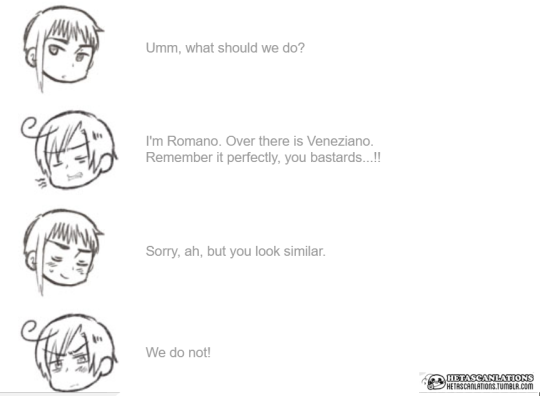
Likewise, just before, Canada isn’t remembered. What I find interesting is that it’s Italy who recognizes him.

I think what distinguishes Italy and Romano from each other
more so than the NA brothers is that the formers’ personalities are conspicuous;
they stand out more.
Because Canada is soft-spoken, he’s easily overlooked. Meanwhile, America’s boisterousness is more memorable.


Note: This theory
makes the assumption that Germany was reincarnated from Holy Rome.
A lot of people seem to be confused about why it is that
Germany can be seemingly emotionless at times, or rather, too logical and
rational. This is especially true in Buon San Valentino, as Germany is noted to
experience emotions like shame, confusion, and heartbeat (presumably love) for the first time.

From the point of a psychoanalyst, however, they would understand
this perfectly, as Hima consistently adopts Freud’s ideas into his craft. It’s
not so much that Germany is emotionless; it’s more like he’s repressed traumatic
memories where these emotions have been experienced.
This puts the person in an emotionally-stunted and subdued
state. The emotions are subdued because experiencing them can trigger the
recollection of these traumatic memories.
Now, it’s not directly said that Freud’s ideas are used, but
both Germany and Austria have been shown to read psychology books. As the most
famous psychologist and being an Austrian himself, it wouldn’t be a farfetched
guess to assume that Germany and Austria have read some of Freud’s work.

Terminology I’ll go
over: Defense mechanisms, repression, the unconscious mind, catharsis.
Bear with me here. I’m slowly going to go through some
concepts before tying this all back to the strips.
For Freud, anxiety is something that we all experience the
moment you exit the womb. You’re in an unfamiliar environment, and anxiety is
there to warn you of impending danger. Basically, because it’s so uncomfortable
to experience, anxiety controls your behaviour by causing you to avoid
threatening environments or situations.
However, if it’s a certain reality you can’t cope with, a
person will employ defense mechanisms to
avoid confronting it.
Repression is one
of those mechanisms, whereby the person is either unable to reflect upon or
remember an event in their conscious mind. The memories are no longer accessible
to them, hence repression; the burying away of emotions.
The unconscious part
of our mind extends beyond our conscious awareness. It’s where all our
repressed memories, emotions, instincts, and biological urges are stored.

All right, not so bad I hope? Let’s tie this all together.
Holy Rome’s dissolution ended a brutal series of wars. That
said, if Germany is his reincarnate, wouldn’t it make sense to repress these
memories? How nice would it be
to be born, only to have a wave of pain and heartbreak immediately hit you?
It would be too hard for the recently-born nation to handle.
That’s why I believe Holy Rome’s memories were repressed before Germany was
even born. Again, it acted as a safe guard to protect him from the trauma Holy
Rome endured beforehand.

There’s even a small hint that Germany has amnesia and has
possibly repressed his memories. Once born, Prussia reminds Germany that it’s
okay to refer to him as a brother several hundred times. To me, that seems like
Prussia may be attempting to trigger Germany’s memory, only to realize that
Germany doesn’t remember anything from his past.

Last term, I promise.
The job of a psychoanalyst is to bring these unconscious
memories or thoughts to their patient’s conscious mind. In this case, it would
allow Germany to remember the past he’s repressed. The goal of psychotherapy is
to achieve catharsis – emotional relief.
When a patient goes through catharsis and their unconscious conflicts are
resolved, they’re able to healthily experience all emotions again.
As I’ve said before, patients who have repressed traumatic memories
to their unconscious minds are subdued emotionally. Because they are unable to
confront these emotions, they have trouble expressing them, or in the most
extreme cases, don’t express them at all.
You see this with Germany too. He’s emotionally-stunted, not
only from his past, but also as a result of his early life. He was immediately
thrust into wars and likely missed out on learning how to form healthy
relationships with the other nations.

For Freud, what you experience in childhood determines your
personality. So, basically, Germany not being good at socializing and
expressing his emotions is a product of his childhood. Now combine that with
repressed memories from a previous life and you have some serious emotional stunting
at play here.
Repeatedly throughout the series, he’s stated to have trouble
smiling.

Likewise, he also has a habit of improperly expressing his
emotions, coming off as angry and scary to other people.

In summary…
The reason Germany has trouble with his emotions is that he’s
likely repressing memories that prevent him from expressing these emotions
freely. If he does, then it puts him at risk of remembering the trauma from his
past. It’s not a conscious decision to not remember things either, it’s something
he can’t control.
In other words, Germany does experience emotions, but some
of them he may not experience fully or properly. He’s emotionally stuck from
this repression, and his troubled childhood only adds more fuel to the fire.
For Freud, if Germany wanted to be able to smile and express
his emotions more freely, then he would have to confront his past. Until Germany
goes through the emotional relief brought on by catharsis, then he won’t be
able to overcome the present hurdles he faces in forming healthy relationships
with the other nations.


China after Japan betrays him in WW2.

South Korea uses mind-reading binoculars, only to find out that China is annoyed by him.

An insecure Italy having Germany repeat that he doesn’t
hate him.

Russia during Bloody Sunday.

Davie.

What I presume you all look like now:

Final main chapter is up!
https://www.fanfiction.net/s/12172853/1/21-Hump-Street
Alfred and Arthur are sent on an undercover mission. Their task is to take down the Nordic drug ring at the local high school. Let the chaos ensue. Rated T because Arthur’s a sarcastic snob. (Cop AU/ NO pairings).

Note: Spamano is
not confirmed in canon and should not be taken as such. What this post aims to
do is show some of the hints revealing
at a more intimate and romantic relationship between them. Believe me, there’s
plenty.

Well, you guys asked for it! Ah, Spamano. Where to start?
There’s just so many hints at them sharing romantic feelings. The problem is that
whenever it occurs it’s always one-sided.
Still, I’ll start with the most obvious hint. Yes, Spain does
in fact propose to Romano. While Romano doesn’t say yes, he doesn’t say no
either. Instead, Romano sets conditions, which, in my opinion, makes it seem
like he’s not entirely opposed to the idea of it.

In “Spain’s lazy morning,” Spain dreams (more like
fantasizes) about Romano. As he rouses to consciousness, there’s notable drool
on his face.


In the April Fools’ 2008 event, after hearing what happened,
Romano chastises Spain for letting himself get fooled into stripping. Notice
how embarrassed and flustered Romano is – he’s
blushing.

That said, there’s a really sweet dynamic between the two of
them that’s also in desperate need of being talked about. While none of what I’m
about to show you is romantic per say, it still nonetheless fleshes out their
relationship.
During a financial crisis, Spain lies on his alleged deathbed
and is running a high fever. Romano panics and starts sending imports en masse
to Spain despite having a cold himself.

Even when the Italian mafia threatens to steal these
imports, Romano finds the willpower to stand up to them. In any other normal circumstance,
Romano is terrified of them and will comply with whatever they ask of him. It
just goes to show you how important Spain is to Romano, even if he’s not the best
at vocalizing this.


Romano also finds it easier to talk to Spain, given how forced
and rushed the unification with his brother was.
While this next strip takes place right after Unification, what’s
important is that this tension between Romano and North Italy still persists
today. Romano’s far closer with Spain than he is with his own brother.
What’s also interesting is that Spain is the person Romano goes to whenever he’s lost, experiences discomfort, or needs help. When he moved to America and was in an unfamiliar and foreign environment, Romano’s first choice is to call Spain. Admittedly, Spain is initially surprised by this.

Sometimes they can read each other’s thoughts too, despite
not always being in synch all the time.

The mutual support
and shared history between Spain and Romano makes for a good relationship of
any kind. Platonic, mentorship, or romantic, the bond that Spain and Romano
share is truly touching.


Note: I made a timeline error, as pointed out
by @feyna-v. Thank you! Please disregard the last few posts. It was a
silly mistake on my part. Thank you!
It’s not clear when exactly
Italy goes through the later stages of puberty, but unless there’s an
inconsistency in the timeline, it appears that it occurs before the Austrian
Wars of Succession. Once Italy voice drops, Austria and Hungary buy him male
clothing to wear.

In the Maria Theresa series, Italy is
shown to be wearing boy’s clothes. He’s also shorter than his adult height,
which means that he hasn’t matured in full yet.

Later, as he begins fighting for his independence from Austria,
you see that Italy has grown up, or has at least come very close to it.

The same thing happens with Romano too. Before he leaves Spain’s house, he’s matured significantly.

That said, Italy went through puberty some time before the Austrian Wars of Succession, and aged into an adult as he got closer to his independence.


America invents
a gun that makes men fall in love with each other. The intention behind it is
to demoralize enemy troops by distracting them.

Later, Japan points out
that relationships among male soldiers in Ancient Turkey and Greece made them
more focused and ultimately stronger, as they wanted to look good in front of
their lovers. The strip ends when America points the gay-gun at his head.

Survival instincts kick in during war, causing men to feel the urge to reproduce. There weren’t too many women around, hence…

Spain proposes to Romano. Romano doesn’t say yes, but he doesn’t say no either. He sets conditions instead.


The rest are pretty straight forward.


Pretty gay already if you ask me.
I’ll go over these in greater detail in separate posts, but here’s a basic chart of what I’ve got jotted down.
America – Wanting to be liked, fear of criticism, fear of being hated, fear of being challenged, his weight/ muscles.
Russia – Wanting to be liked, being alone, fear of being hated, fear of exclusion.
England – Uses biting sarcasm in order to hide feelings of inferiority, feeling like an outsider despite being included, being lonely, can actually be really sweet but is too shy to openly help or give direct advice to the other nations, loss of power.
Canada – Not being unique or relevant enough, not being recognized for his own accomplishments.
France – Loss of power, being alone, worries of becoming irrelevant.
China – Fears being left behind in a more modern world (he’s doing just fine), fear of abandonment (earlier with Japan, now with Hong Kong), feeling like an alien due to his old age.
Germany – Problems with expressivity of happiness, being alone, worries that he comes off as cold to others, works hard but quickly becomes flustered when praised (relates to low feelings of self-worth).
Prussia – Being alone, melancholy over having never married, low self-worth and loss of superpower status.
Romano – Feelings of inferiority in comparison to younger brother, regret over snapping at people and not being seen as agreeable and likeable.
Ukraine – Size of breasts, ambivalence over leaving the Soviet Union and distancing herself from Russia.
South Korea – Wanting to be liked, unhealthily perfecting physical appearance, wanting to be unique despite following in the footsteps of Japan, China, and America.
 Ellawritesficssometimes