image
image

What this post aims to
do is examine the ways in which the nations are impacted by the chronicity of
the wars they’ve endured as well as the coping mechanisms that they employ to bear
these hardships. Aside from the predictability of physical pain and illness,
there is a disturbing sense of normalization and domesticity in how the nations
negotiate their lifestyles in war. It’s
maladaptive.

That said, let’s go over
some examples.

Physical Pain and Illness: 

The most obvious impact
of war and political struggles—both
domestic and international—is the physical strain that it puts on a nation’s body.

Ex: During the Second World War, Germany and Italy are both taken as
prisoners of war. Germany compares the pain of torture to a mosquito bite, as
his daily life is far more painful.

image

Ex: England falls ill on several occasions following major political conflicts
(e.g., the American Revolution, the Napoleonic Wars, World War II) [x]

image

Ex: China complains of body aches, stemming from political infighting
in his country [x] [x]. 

image
image

Sense of Helplessness:

Of course, smaller
powers are rendered vulnerable and pliable to the discretion of larger powers.

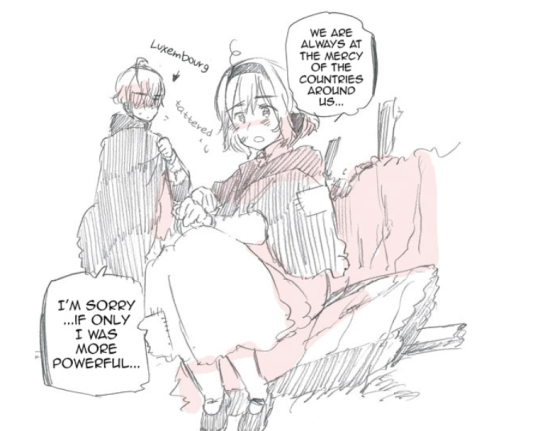
Ex: Belgium and Luxembourg discuss their inability to protect themselves
during both World Wars [x].
image

Ex: The conditions that Russian soldiers experienced were so bad that
Russia becomes ecstatic when Germany takes him as a prisoner of war. He
compares the German POW camps to heaven.

image
image

Ex: England’s normalized being captured by
the Axis and pre-preemptively brought a spare change of clothes [x]. 

image
image

Suspicion and Hostility:  

War is a breeding ground
for distrust and betrayal. As such, the nations must always be ready to fight
for their lives, even in seemingly innocuous circumstances.

Ex: When the two first
meet in World War I, Germany second guesses himself several times on whether
Italy poses a threat to him.

image
image
image

Ex: Russia shares his tea
ration with England. While skeptical at first, England accepts. The sweetness
of the tea initially causes England to conclude that Russia poisoned him. What
matters here is the fact that England rationalized this outcome as a legitimate
possibility…[x].

image
image

Domesticity, Normalization, and Adaptation:

image

As horrible and gruesome
as war may be, there are still moments where the nations are able to enjoy
themselves and share a good laugh. The problem, then, is that having had
experienced countless wars, the nations bring the domestic into the world of
war—i.e., war becomes their home and the private
and public sphere divide becomes muddled.

Ex: England drinks tea in
the middle of the battlefield. Trivial as this may appear, on a latent level,
he’s attempting to include a routine and sense of normalcy in an environment
that is otherwise chaotic and unpredictable.

image

Ex: After infiltrating
America’s war camp, Prussia teases Germany for his impression of an American.

image
image

Ex:Having just occupied
Rome, America asks the terrified Italy Brothers if they could make him
authentic Italian cuisine [x]. 

The casualness in the way
America speaks is disturbing considering that from his perspective, taking over
another country is normal. It’s not
something that should produce fear but rather should be accepted as is. He
doesn’t consider the Italy Brothers to be his personal enemies. The personal is not political in this case.

image

Relief:

The best nations that
illustrate the burdens of war are those who have passed on. Rome and Germania
visit Earth together and upon reflecting on their lives, they reach a similar
conclusion: death gave them a sense of liberation.

They’re no
longer bound by their bosses’ orders and aren’t forced to participate in wars
they have no interest in being involved in [x]

image
image

Q & A

Do You think that it’s okay to think in China,
India and Turkey as Ancients Nations. I don’t know if to be an Ancient, the
nation has to be old and had passed a long time ago.

There’s no explicit rule on what makes an ancient an ancient. I use a
rule of thumb and go by chronological age.

Yes, to China given that he’s lived for 4000+
years (e.g., he’s alive the same time as Rome) [x].

image
image

India, we don’t know enough information about
to pinpoint if he’s a more recent personification/ if he has an ancient
counterpart.

Yes, to Turkey too. In one of the drama CDs, it’s
revealed that he was the one who killed the Byzantine Empire (previously Ancient
Greece) [x].


Why does Turkey wear a mask?

No real reason is given. The
closest we’ve come to an answer only leaves us with more ambiguity… (Source:
Christmas 2007 event).

image
image
image

On the other hand,
Himaruya does play with the idea of the mask. He’s created posts, where if you
click on Turkey’s image, a new image of him without a mask will appear [x].

image

What do you think of Germanys character song Steady Rhythmus?
A lot of people seem to be confused because it’s rock/“metal”. Idk
why tho, considering that a shitload of Germans (including me) love those genres.
I mean, we have rock/metal bands and festivals everywhere :/

Not a fan of it, but I do get why it’s of that genre. I
actually kind of like Prussia’s “My song that is written for me, by me”, save
for some parts lmao. The instrumentals are good.


Would Prussia still be considered a nation, or is he now
human? If we’re ignoring the East Germany theory, that is.

The simple answer is that he seems to be somewhere in
between. He takes longer to heal, yet Gilbird is still around him. Since
the personifications’ immortality rubs off on their pet, Prussia may have still
retained some of his immortality, although it could be waning. Hypothetically,
if Prussia was human, being constantly around Germany—whom he lives with—would drive him mad [x].

 The main reasons I say this are:

1)    He’s once referred to as being “in a pitiful state of an
enclave” [x].

2)    When asked if Prussia would eventually fade away, Hima states
this: [x].

image
image

Do you think that Italy is underestimated by others nations,
sometimes?

Yes and no.

 Germany often underestimates him, being biased from what he
witnessed of Italy during the World Wars.

 Ex: Germany’s reaction at
the Galata Bridge scene where Turkey recalls how strong young Italy used to be (Source: Volume 4). 

image

There are also moments where nations recognize that it’s
better not to underestimate Italy (Source: Christmas 2011 Event).

image
image
image

It flows
differently for them:   

Of course,
being immortal affects how the nations experience time. They’ve lived for
centuries/ millennia and experience time at a much faster pace. A year, let
alone a decade, for a human is nothing to them.

Ex: Canada once
spent an entire weekend in a trance, staring into Kumajiro’s eyelashes. [x]

image
image

Ex: Because time flows differently for him, by the time America visits his child/ later teen friend Davie again, the latter’s had both children and grandchildren [x].

Interestingly,
the nation’s immortality can also rub off on other beings.

Ex: Pets like
Hanatamago, Pochi, or the Gilbird’s have extended lifespans as a result of
being around their owner nations. Should they separate, they would become
normal pets again. [x]

image

Ex: The
situation with humans is similar, but not quite the same. Unlike pets, humans
have a stronger developmental capacity to perceive time. It’s likely for this
reason that being around a nation for too long would cause them to go mad. The
drastic warping of time would be too much to handle.

image

How the Nations cope with their Immortality:

From what we’ve
seen in the strips, immortality is depicted to be more of a curse than it is a
blessing. There are several instances where nations have expressed regret over
their existence.

Ex: Germania
and Rome, as fallen ex-nations, experience relief over not having to deal with
wars and their leaders.

image
image

Ex: As an
Ancient in his own right, China romanticizes about the past, wishing that the
world was the same as it was 4000 years ago.

image

Ex: Italy
admits that he sometimes gets bored of seeing the same people every day [x]. Also
notice how his boss recognizes that immortality isn’t beneficial in practice,
as Italy’s had to endure countless painful memories and experiences. 

image

Ex: The nations
have gaps in their memories [x]. 

image

While it would
be impossible for them to remember everything, as they’re not perfect immortals
and can get injured and die, the fact that Russia claims that it’s good that
they don’t remember all the bad in their life may allude to an unconscious repression
of memories.

image

Still using
Russia as an example, given how he’s historically been tortured and punished by
his bosses, it’s easy to understand why he wouldn’t want to remember everything.

image
image
image
image
image
image

The nations are two-fold representations. By that I mean
that they have a literal body and a figurative body.

Bear with me, things get a bit tricky, but I’ll break it
down to the best of my ability.

Basically, the figurative body is what influences the nation’s
physical body.

The figurative body
is composed of two parts.

1) There’s the geography
of the nation. The landmass is sometimes referred to as their body or house,
despite the real physical one that they possess.

The geography can influence both the physical appearance and
personality of the personification.

Ex: Since Sealand’s geographic body is small, so is his physical
one.

image
image

Ex: Iceland’s contrasting volcanic and freezing temperatures respectively
causes him to have a hot and cold side.

image
image

2)  There’s the personality
of a nation. The personality of a nation (not to be confused with the
personification’s personality) is defined in terms of culture in the manga [x]

If the culture is well-developed
and thriving, then the personification will also thrive and be able to grow; to
age. However, if the culture is repressed, then the personification’s growth
will also be stunted.

The reason I’m outlining this is essentially to show how
geography/climate and historical events are reflected in the personifications’
appearances and personalities. Information on the impact that this has on their
health can be found here [x] [x]

What this post will focus on, however, is why some nations
have scars and either suffer from or are affected with other physical symptoms.

Let’s go over some examples.

Ancient Rome: 

Before dying, Rome was noted to have many wounds and scars –
a physical reflection of the turmoil his people suffered from.

image

Lithuania: 

We know from his time spent in the USSR that Lithuania acquired
several scars on his back. The military repression of several revolts and the
banning of diverse cultural practices in favor of an atheist state very likely
had a role in causing these scars to appear.

image

Latvia: 

Latvia’s case is similar to Lithuania’s. While we don’t know
if he has any scars, we know that Russia pushing down onto his head ultimately
stunted his growth. How I interpret this is that it’s a metaphor for political repression.

image

Put another way, Russian control stunted Latvia’s growth,
which, in turn, was reflected in the personification’s physical body.  

image

China:

It’s hinted that China gained scars after being betrayed by
Japan in WW2. It’s both a literal and symbolic stab to the back.

image
image

Germany: 

Each time America engages in reckless financial activities,
a new wrinkle develops on Germany’s forehead.

image
image

Finland: 

Estonia’s quest to become a Nordic causes Finland’s back to
be itchy whenever he’s talked about.

image

Bonus cases that aren’t so clear…

Russia: 

When he’s not wearing a scarf, Russia is shown to be wearing
bandages around his neck.

image

Netherlands:

An unknown event caused him to develop a scar on his
forehead.

image
image

What would you say if I told you that a lot of the nations had
Roman look-alikes – more like clones
in the far past? Insane, right? Well, believe
it or not, it’s true.

First, there’s Augustus and Agrippa.

image

It’s crazy to me how uncanny they both look to North Italy
and Romano respectively. Despite some personality differences, they also share
a lot in common. Augustus is charming, charismatic, and weak at fighting.

Meanwhile, Agrippa
wasn’t given the inheritance he expected from Caesar (the title of Emperor). We
see the same thing happen with Romano and North Italy, as the latter inherits
most of Ancient Rome’s wealth once he passes on.

image

Further, Agrippa also shares Romano’s reserved nature, and
is only kind to those whom he is close with.

image

There’s also this picture that Germany draws of Italy. It’s almost
identical to the facial expressions Augustus makes. 

Note: It’s manga Germany is referring to, not a textbook.

image

Now here’s Augustus again:

image

But it doesn’t stop there. There are plenty more Roman look-alikes.
Here are just a few more examples.

Tiberius looks scarily similar to a Sweden without glasses. He
is also feared by those around them and is perceived as anti-social.

image
image

Mark Antony looks a lot like Denmark.

image
image

Japan resembles Ancientus quite a bit too.

image

Gothicus looks like Genoa.

image
image

Probus too looks a lot like
Norway, and is even stated that he perplexes people and is often misunderstood
for this.

image
image

Now, I know what you’re all
thinking, and as much as I want to blow the whistle and say that there is, there
actually isn’t any reincarnation present. Sorry to disappoint. Anyways, what’s happening
here is extremely strange, but also fascinating.

In a brief inter-text character
note, it’s stated that Quintillus is able to break dimensional boundaries and
travel through time. For example, he’s visited Japan and China before. What I want
to talk about more is Quintillus’s recent visit to Germany.

image

Prior to Quintillus’s visit,
Germany was doing research on Roman history, reconstructing it to make old records
more accurate. It’s for this specific reason that Quintillus visits Germany; to
clarify that his older brother Gothicus wasn’t as bad as people have portrayed
him to be.

image

Of course, true to his love for
science, Germany doesn’t believe that Quintillus is the ghost of a real Roman
emperor and dismisses him. What’s odd is that in the last panel,
Germany says, “That Roman boy is interesting.”

image
image

I don’t know, but to me this
indicates that Germany might know that Quintillus is a supernatural being, but
is only able to acknowledge this in private. You’ll see with Hima that he’s
obsessed with linking Germany to Italian culture and Roman history. Another
Holy Rome hint perhaps?

Nonetheless, let’s get back to the
proof against reincarnation. One would think that maybe as Germany is reliving
history, he imagines it with the faces of those around him, hence the
look-alikes. A sound argument, but the strips prove
otherwise.

Here,
Ancient Rome is seen talking to Probus, Norway’s Roman look-alike. 

image

Then, Gothicus, Genoa’s Roman
look-alike enters the scene and talks about how he’s not positively talked
about in modern textbooks. This confirms that the look-alikes are in fact real
and are not just a product of Germany’s imagination.

image
image

If I had to guess, I’d say that they’re
all in heaven in this scene, since they’re long dead. If they exist seperately now, then
clearly, they haven’t been reincarnated into their nation look-alikes.

Still, I can’t help but wonder why
Hima has made them look so uncanny to one another.

image
image

In both his and his brother’s character notes, it’s said
that if their curls are pulled, it will cause an involuntary physiological
(bodily) response. Italy Veneziano will say “Ve”, whereas Romano will make a
purring “chigi” sound.

image

We know that the different parts of a nation are reflected
in their human body. For example, America’s Nantucket or Austria’s Mariazell
ahoges. I say this because I believe that the physiological and verbal response
pulling the curl causes is in reference to a specific body of land, or rather a
part/ governmental organ of the nation.

Yes, “ve” is also an Italian verbal tick/ dialect, but what
you’ll see with Hima is that he likes to play around with words, give them double
(sometimes several) meanings, and make puns out of them. In Italy Veneziano’s
case, I believe the same logic applies.  

In other words, ‘ve’ could be attributed to the dialect and the city of Venice, which is commonly
believed to be North Italy’s first title as a personification. Although, if it
is in reference to a dialect/verbal tick, North Italy doesn’t say it nearly as
much as China does with his “aru”, which makes me think of it more in terms of a
reference to a body of land, rather than speech.

Anyways, in Romano’s case, I think it’s a reference to the
Palazzo Chigi in Italy’s capital, Rome. It’s where the Prime Minister of Italy
resides. The point here is that we already know that Romano does his fair share
of work for his government.

image
image

If that’s the case, then this reference only reiterates his
purpose as a second personification for Italy. This, of course, is in addition
to him representing the cultural differences of those from the southern regions
of the nation.

Further, we know that Ancient Rome left behind a legacy.
Italy inherited his charm, artistic aptitude, and wealth. Meanwhile, it’s not
very clear what Romano inherited from Ancient Rome… not unless you do a bit
of digging. What I’m arguing is that Romano inherited the role of governance
from his grandfather.

That doesn’t mean to say that North Italy doesn’t do his
share of government work either, because he does, just not nearly as much as
Romano nor with the same amount of commitment.

image

So? What about them hints?

When visiting Italy from heaven, Ancient Rome remarks that
Rome (as his capital) acted as his heart. Well, what if Romano inherited that?
Italy Veneziano is likely a reference to Venice as stated above, and as such,
Romano is just as likely to be derived from Rome – where the governing happens.

image

If you take a closer look at Ancient Rome, he resembles both
Italy brothers depending on the emotions he’s experiencing.

image

It’s not just Italy Veneziano who looks like Ancient Rome. Some of Romano’s expressions makes him a near clone of his grandfather.

image

Hard to tell the difference, right? Overall, it would seem
that Romano inherited quite a bit from Ancient Rome, contrary to popular
belief.