To celebrate April Fools’, here are some of the best pranks
pulled in the manga
🐇 🎉
Poland sends Russia a “scary” chainmail
letter threatening to make Warsaw his capital.
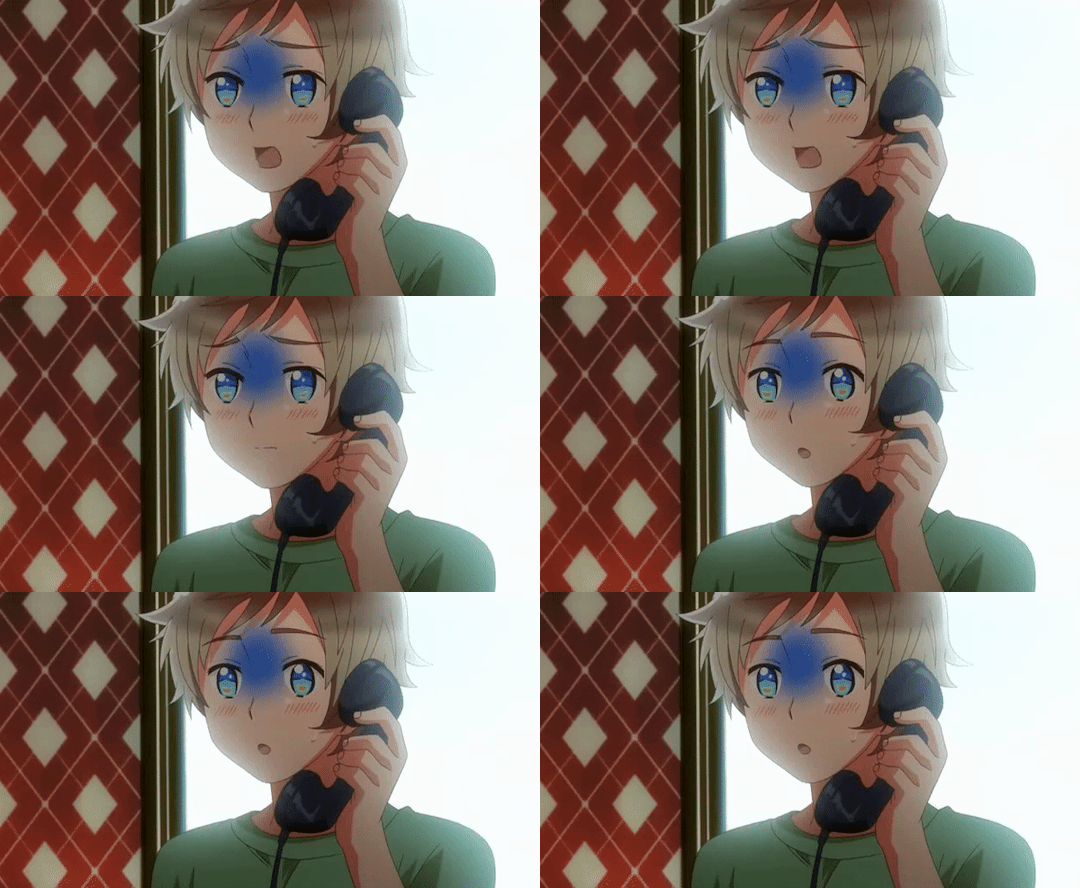
America annually prank calls England.
France thinks that Spain is joking with him when he’s
offered a bottle of olive oil to chug.
Spain wasn’t joking.
To get China to leave, Hong Kong lies and tells him that
there’s a new monster for him to collect. It’s really just a mailman.
In a previous post, I went over how the nations have
considerable gaps in their memories for a variety of reasons. [link here]. That
said, I also find it important to reiterate that the nations are not always
able to repress or forget traumatic memories, and often carry these
experiences with them – it becomes part of who they are, their personality.
Yes, their memories are full of holes, but these experiences
can just as easily be retained. It’s not that they repress everything, but
rather that they don’t remember everything.
1) Sometimes there are triggers – such as an object
or person – that allow the nations to remember an experience more vividly.
Prior to that, they simply have a general emotive idea of the experience, good
or bad.
2) Sometimes the nations carry the memories with
them, either consciously – it actively affects how they relate and interact
with others – or unconsciously – it latently affects how they relate and
interact with others outside of their own awareness.
3) Sometimes, no matter how hard a nation tries to
repress uncomfortable, unpleasant, or anxiety-ridden memories, they’re unfortunately
unable to.
4) Sometimes the nations retain the memories, but
purposefully refuse to either mention or acknowledge them.
Given their dark, chaotic, and bloody pasts, it would make
sense for the nations to protect their sanity by not remembering everything.
Nonetheless, what this post will argue and focus on is how these experiences
influence the nations both at an unconscious and conscious level.
Without further ado, let’s tie this back to the strips.
America:
America is a case of a nation who desires to forget his
past, but is unsuccessful in doing so. In particular, the experience he wants
to forget is his Revolution.
Likewise, while America retained vivid emotive and affective
memories from the Revolution, it’s only when he begins cleaning out old belongings
in his storage closet that he recalls the finer details of the unpleasant experience.
Simply put, even though America’s experience of the Revolution
has deeply affected him emotionally in how he perceives his sense of self, the
fact that the belongings flesh out these memories is essential in demonstrating
the limitations of his memory.
It’s just like what Finland’s claimed before; aside from physical strength and a strengthened immune
system, the nations aren’t all that much different from humans.
Italy:
During a meeting, Italy’s boss takes an interest in Italy’s
immortality, and later remarks that it can be disadvantageous.
“You sure have been
through a lot, huh?”
Italy even agrees that his life has been tough.
Even more
interesting is that Italy claims that he gets tired of seeing the same people
all the time, only to reverse this statement and say that seeing the same
people can be refreshing in a way.
How I see this is that while Italy may see the same people,
he experiences them differently each time. Perhaps this is why
Italy refers to this as refreshing – could it be that while he sees the same
people, they evoke different memories and emotional reactions in him?
What’s also important here is the initial reluctance in
Italy to disclose more “private” accounts of his life. Notice how uncomfortable
he looks. Not every memory is good, so of course he’s not going to be keen on
recalling them.
The scene ends with Italy offering to disclose these secrets
should his boss treat him to lunch. This could very easily be interpreted as
him deflecting the subject.
France:
Having lost huge aspects of his culture following his own Revolution
–given that many old furniture pieces and decorations were either discarded, sold or burned – France still retains strong feelings of grief over this
in the present.
Put another way, France’s past still lives with him in how
he presently experiences himself.
Lithuania:
Lithuania too is an example of a nation who’s still
traumatized by their past. It impacts every aspect of his daily interactions.
As he and the other two Baltics recall their arduous paths
to independence, Lithuania further recalls a memory of Russia squeezing his
shoulders.
Notice how Lithuania repeats this behavior, albeit unknowingly,
as he squeezes Estonia’s and Latvia’s shoulders upon remembering this troubling
experience.
Just to prove how consistent this memory rule has been, I’d
like to point out that Lithuania has suffered from triggered-induced flashbacks
as early as the first original chapters of the web comic.
When privy to the fact that Russia intended to invade Poland
in WW2, Lithuania repeatedly recalls traumatic experiences where his own
country was taken over and conquered.
Russia:
Lastly, Russia is a quintessential example of a nation who’s
affected by their past. What’s complicated about him is that he seems to
remember a lot about his past, despite their being holes in it, but fails to attribute
this to how he presently experiences himself.
In other words, while retaining many traumatic memories,
Russia doesn’t connect them to how distorted and unhealthy his conception of an ideal relationship is [either platonic or
romantic.]
For instance, take the Bloody Sunday strip. There, Russia
sheds tears over the revolt, considering how hard he had previously worked to
improve his nation.
The strip ends by largely hinting at him being tasked with
supressing the revolt through the use of violence.
“We don’t want children who can’t play nice, right?”
Now, let’s skip forward a bit to WW2.
As he and England discuss America’s boldness, you can
immediately start to pick up on how Russia’s past inadvertently affects how he perceives
the world and the people in it. Yes, he might have repressed the nuanced
details of his past, but he’s internalized a considerable amount of it without
his realizing.
He appears to take what happened during the Bloody Sunday revolt,
and applies the same rhetoric to America. Not only is his view of relationships
distorted, but so are his solutions to problems.
I specifically want you to pay attention to the child
imagery that emerges again with regards to how Russia equates rebellion with
immaturity.
“Aren’t the provocative [rebellious] ones more fun to snap
in half?”
Translation: Dissent is childish, and therefore it must be crushed [snapped].
In sum, while the nations do have considerable gaps in their
memories, they are still very much influenced by their past.
Can we stop and think
about how messed up the nations’ childhoods were for a minute?
You’re very welcome. I
would like to point out that both nations you mentioned are not always cheerful
or empty-headed. They can actually be quite threatening and terrifying (especially Russia).
While
they don’t remember everything in vivid detail, they still carry their dark
pasts with them. It affects their
personality, and these temperaments show up when you least expect it.
Spain: [That’s caution tape around him.]
Russia:
Before I start, it’s important to lay out some ground rules.
Thanks to Finland we know that the nations aren’t that
different from humans with regards to their physical strength and anatomy (with
the exceptions of Russia and America who are exceptionally strong).
The point in this is that the “not-so-different from a human
rule” pertains to their basic physiological structure. On the other hand, there
are immortal perks of nationhood, such as being impervious to experiencing the fatality of illnesses. They still can
fall ill, though. This happens when they’re….
1) Suffering from political instability.
2) They’re experiencing an economic recession.
3) There’s a rampant illness in their population (i.e Romano’s
Chorea).
With that said, we know that the nations are stronger than
normal humans regardless. They don’t age as fast, and as such, their memories
don’t deteriorate at nearly the same rate.
What this post will explore are the different examples where
nations have been shown to have gaps in their memories.
The thesis I’m putting forward includes a variety of
reasons to account for this:
One, older nations such as Japan and China have even larger gaps
in their memories as a result of their physical bodies aging. They’re therefore
unable to recall memories as fast as younger nations [This in part goes with my
third argument].
Two, the influence of their citizens pertaining to whether
or not the nations can see and therefore remember the existence of magical creatures.
Three, the nations simply aren’t able to remember
everything; it would be impossible.
And four, some
nations actively repress bad memories to minimize the anxiety and trauma they
previously experienced.
Without further ado, let’s go over some of these examples.
Age:
As stated above, the nations’ chronological age, while
influenced by their economic and political affluence, also seems to be affected
in part by how long they’ve lived (I.e. Both Japan and China refer to
themselves as old men.)
If Japan is shown to have higher blood pressure levels and hip pains as a
result of his old age, then it wouldn’t be too farfetched to assume that his
memory wouldn’t be as up to par as it would be in comparison to a nation younger
than him. Put another way, his age would cause him to have greater slips in his
memory.
It’s the body that’s old, despite not looking like it.
Ex: He’s unable
to remember who Lithuania is, and almost mistakes the latter to be Livonia.
Ex: While looking
through an album of him and Pochi throughout different periods, Japan
mistakenly recalls the chronology of them.
Likewise, China’s also referred to as an old man.
Ex: He admits to
being forgetful.
The Ability to See Magical Creatures:
We’ve also seen the impact on how a population’s belief in
magical creatures respectively influences whether or not the nation will be
able to see them.
Ex: During the
Meiji Era, England could see the kappa and youkai spirits, meanwhile Japan couldn’t
as a result of his people no longer believing in them as strongly.
However, just as a nation can forget about magical
creatures, they can also re-remember them if popular culture strongly believes
in them again – presumably it would have to go past folklore superstitions.
While enjoying Japan’s hot springs, the two talk about
folklore.
Notice how Italy spots a strange creature beginning to approach them.
Although it’s not shown, the discussion of the topic could possibly mean that
Japan [and not just Italy] is also able to see the creature.
There’s also an exact replica of this hot spring scene
dating back to when they first met during WW2. I don’t think Hima did this for
no reason:
Repression of Traumatic/Guilt-Ridden Memories:
As Russia darkly puts it, perhaps it’s a good thing that the
nations don’t remember everything.
When Lithuania and Germany allegedly meet for the first time
during WW2, Lithuania expresses relief over Germany not remembering him. It’s
noted that Lithuania once beat-up one of Germany’s family members. This is
possibly a reference to when Prussia became a lackey to Poland under the
Lithuanian and Polish Commonwealth.
This is highly indicative of Germany existing well before
his ‘birth’ in 1871 given that Lithuania is fearful of being remembered and/or triggering
Germany’s memory. If anything, Lithuania’s fear of this points further in the
direction of Germany suffering from amnesia.
Why else is there a childhood version of Germany/Holy Rome pushing to be acknowledged in older strips? I’ve theorized before that this is
simply a part of his unconscious mind trying to get him to remember about his
forgotten childhood.
Or why is it that he’s seen to confusedly hold up Chibitalia in another strip?
“It’s me.” Jogging his memory much?
Similarly, Italy also dreams of a childhood version of
himself pushing to be acknowledged by him, only for Italy to refuse in doing so. Like
Germany, it seems that Italy has actively striven to forget his childhood.
Lastly, the most obvious hint of repressed childhood
memories is found in Buon San Valentino, where Germany appears to recall fuzzy
images of Chibitalia.
They Can Only Remember So Much:
Prussia is the one to confirm this rule, considering that he’s
taken to recording every experience as a method in circumventing the inability
to recall them. It’s simply a matter of jogging his memory.
In sum, while the nation’s memories are limited, there are
different factors and contexts that account for this phenomenon. Age, trauma,
civilian belief, and limited physiological brain capacity seem to be the most
common reasons in accounting for this.
No. He was maybe initially a bit creeped out by Russia, but
they’re both seen co-operating with each other back when they were tasked with
studying France’s culture in the 1700s.
…
It’s only really until after WW2 where we see things shift, albeit
it’s a bit clear as to what actually happened to cause this hatred.
All we know is that is
that it’s bad considering that Prussia is later noted to puke if Russia even so
much as lays a finger on him; either that or he’ll lose four eyelashes (likely
a reference to the four Allied-controlled zones).
Likewise, we also know that Prussia worked unprofitable jobs
for Russia post-WW2.
“He was under Russia’s control after WWII, dreaming of Italy’s warm sunshine, while stuck with doing unprofitable jobs.”
First off, let’s be clear that Russia’s relationship with
General Winter is not a healthy one. It’s among one of the darkest elements in the manga.
That said, General Winter is both a protector/guardian
of Russia and an enemy.
1) On one hand, he’s saved Russia from invading
armies.
The only setback of this is that his protection doesn’t work
on countries who are used to the cold. It’s for this reason that Russia doesn’t
have high expectations for General Winter, despite calling on him in times of
desperation.
It’s also important to note that at the time this strip took
place, both Russia and his sisters were powerless. He had no one to rely on but
General Winter, and even then, notice how passively devastated he is when he
realizes that he has no choice but to surrender.
“Do whatever you want.”
Those are the words of a child who has been repeatedly let down,
someone that hasn’t had their needs met and is used to surviving under abusive circumstances
– i.e. He was also under the repressive control of the Tatars here.
This brings me to my next point.
2) On the other hand, General Winter also attacks
Russia.
Consider this. You’re constantly being jostled around by
tyrannical controlling leaders, and the one person who protects you also abuses
you. In other words, you have an inconsistent parent who switches back and
forth between a nurturing figure and a physically forceful tyrant with no
regard for your well-being.
How do you think that would affect a person, let alone a
nation who has survived long enough to endure several lifetimes of this?
It’s because General Winter has protected Russia before that
Russia relies on him. What’s problematic about this is what Russia’s taken from
this relationship. It affects everything he does; how he expresses his
emotions, who he trusts, who he regards as his friends, what he expects from
others, how he interacts with them, and what he falsely deems to be a suitable and
healthy relationship.
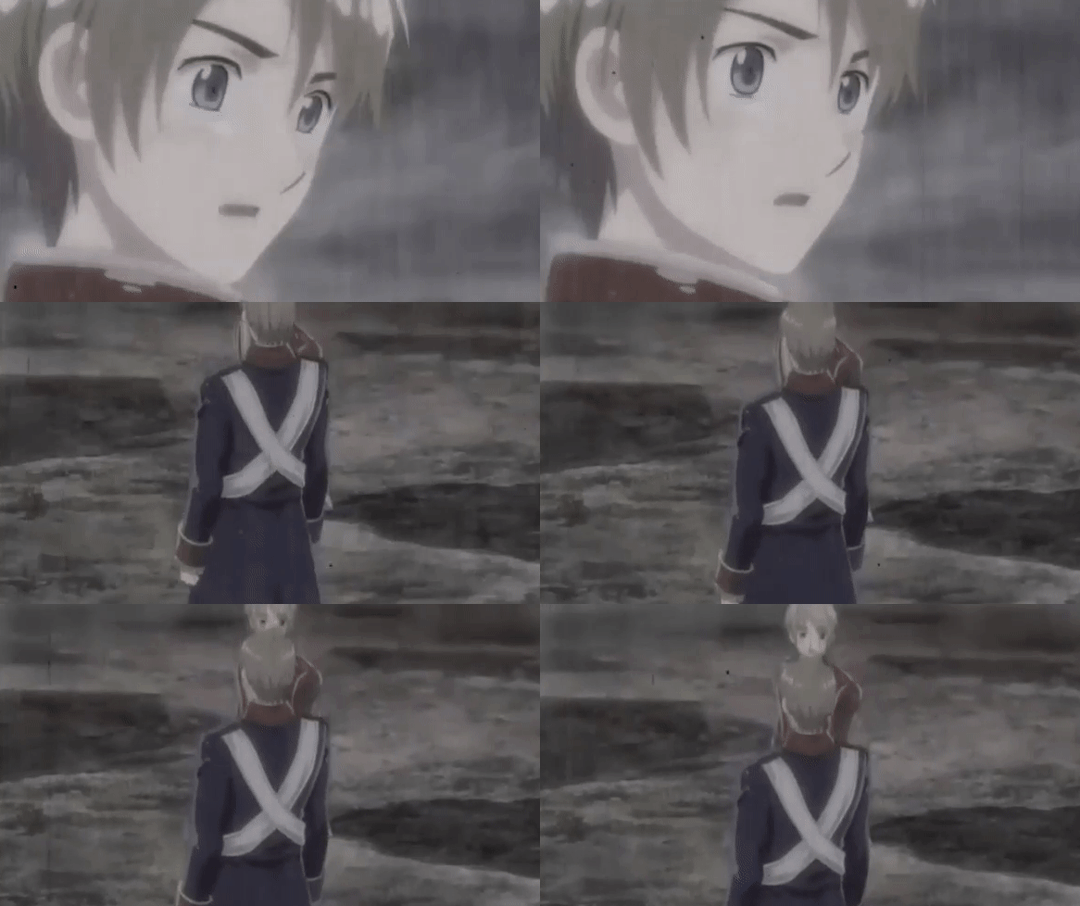
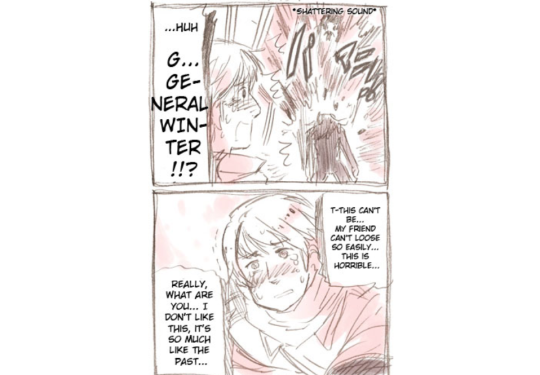
On top of this, we know for sure that Russia has been traumatized by
his relationship with General Winter.
Ex: When Parallel
France attacks Russia during the 2010 Christmas Event, Russia calls on General
Winter for help. When General Winter is defeated, Russia breaks down into tears
and remarks how “similar” this incident is to the past.
What’s more, notice how screwed up Russia’s relational
perceptions are.
He calls General
Winter a friend.
However, we know that in one of his character notes, he
refers to anyone he meets as a friend. It would follow, then, that Russia doesn’t know what a friend is. Simply put, he doesn’t know how to differentiate between the
good or the bad because he’s normalized this inconsistency. He expects that
others might be abusive, while at the same time provide for him – that’s what
he sees as a friend.
As such, Russia repeats and mimics this inconsistent ‘affection’ in
how he interacts with the other nations.
Ex: He sends political pressure with hearts.
How I see this is that it acts as a metaphor in representing
how Russia has equated love with force; they go hand in hand for him
because that’s what he’s accustomed to experiencing.
Likewise, since he has endured whole winters on his own
without any shelter, this also demonstrates the inconsistencies under which he was nurtured
and cared for during his childhood. Again, his sisters couldn’t always be there for
him.
A happy New Years’ was not freezing to death.
This could also be why his heart falls out.
On top of it literally being frozen during the Winter,
Russia has yet to learn what true love is. The care he received – cold
temperatures – was a double-edged sword in that it simultaneously assaulted and
insulted him. The warped love he knows is both forced on him and forced out of
him as he attempts [and fails] to make friends.
All he needs now is for someone to thaw through his frigid
past and to help him experience a healthy and consistent relationship.
When you have to drag the dead weight of your group partner to avoid failing.
Yikes, you guys sure want me to get into the dark stuff! All right, post coming up tonight!
Misconception: Latvia’s physical body is young
and small for “no reason.”
I couldn’t
object anymore to this. While it’s not explicitly stated why Latvia is like this,
there are written rules and examples in the manga that provide a suitable
explanation. This is aside from the fact that Latvian people are among some of
the tallest in the world.
Since I
already have a theory on this, I’ll merely put a quick summary here:
For one
thing, we know that a nation’s health is predicated on their political and
economic situation. That is, if their economy is doing bad, or they’re experiencing
political instability, then they’ll develop a cold.
Likewise,
we know from the case examples of America, Canada, Italy, and Romano that
gaining independence causes the nations to age.
A strong
economy, a stable political situation, and political sovereignty are solid
factors in determining the age and size of full-blown nations – not micronations,
who are often anomalies to these rules.
That said,
because Latvia has historically experienced constant political repression and
subordination and lacks a strong economy, his physical body hasn’t aged as much
in comparison to the other nations.
Ex: Russia
pushing down on Latvia’s head is a metaphor for the political repression the
latter experienced at the hands of the former.
Further,
what differentiates Lithuania and Estonia in modern times is that both of them
are doing better off economically than Latvia is, who primarily relies on
agriculture. You also need to account for how Lithuania at one time was a
European superpower.
Ex: Estonia’s obsessed with money, and is good at managing economics.
Even then,
because of the political repression Estonia also experienced, he’s only a little bit
older than Latvia at 17.
Misconception: Because Latvia’s scared of
Russia and is physically weak, he’s just weak.
Latvia’s actually
a genius.
Ex: He
built an entire railroad by himself.
Ex: He
plays solo chess.
Misconception: His physical age means that he
has the mentality of a child
[He’s 15.]
While
Latvia does have a bit of a blabber-mouth –which gets him into trouble with
Russia, admittedly – that’s more of a character quirk than it has to do with his
maturity.
Ex: Latvia
has adopted a mentoring role when it comes to dealing with Sealand.
[He also
drinks a lot of alcohol.]
Misconception: He’s not scared of Russia
anymore
I’ve seen a
tendency for people to get angry when authors characterize the Baltics as being
afraid of Russia. Honestly, it’s accurate, especially given how terrifying their
past in the Soviet Union was and the extent to which they’re still traumatized
by it. (i.e. both Lithuania and Latvia are shown to escape from
reality, and maybeEstonia too with his mochi-inspired dream + other dream fantasies).
The problem would be if you only depict
them this way, and don’t reveal the other aspects of their characters.
In other
words, “Stop making the Baltics weak!!!! They’re not scared of Russia!” is just
as bad as only showing them cowering
in the face of Russia.
Also remember that there was resistance and political
revolts on their part too. Either way, both depictions are biased,
one-dimensional, and don’t give the complexities of their personalities the
credit they deserve…










 Ellawritesficssometimes