Exactly. You got it, my friend. It’s not just America either. Both him and Russia are referred to as super humans by the other nations.
This is likely a reference to the Cold War, as they were the two largest world Superpowers at the time.


Exactly. You got it, my friend. It’s not just America either. Both him and Russia are referred to as super humans by the other nations.
This is likely a reference to the Cold War, as they were the two largest world Superpowers at the time.

Having
lived for centuries, or sometimes even for thousands of years, it’s no wonder that
the nations are capable of accomplishing so many feats. They have the
intelligence and knowledge of several lifetimes at their disposal.
You have
your philosophers.


You have your artists.


And you have your inventors.


That said, let’s not sell these characters short by dumbing them down.
Mhmmm. You
see this happen in chapter 145 of World Stars. France gives Russia a tour of
the Mont Saint-Michel monastery. When Russia inquires about why most of the
rooms are barren of furniture, France “flinches” and “winces.”



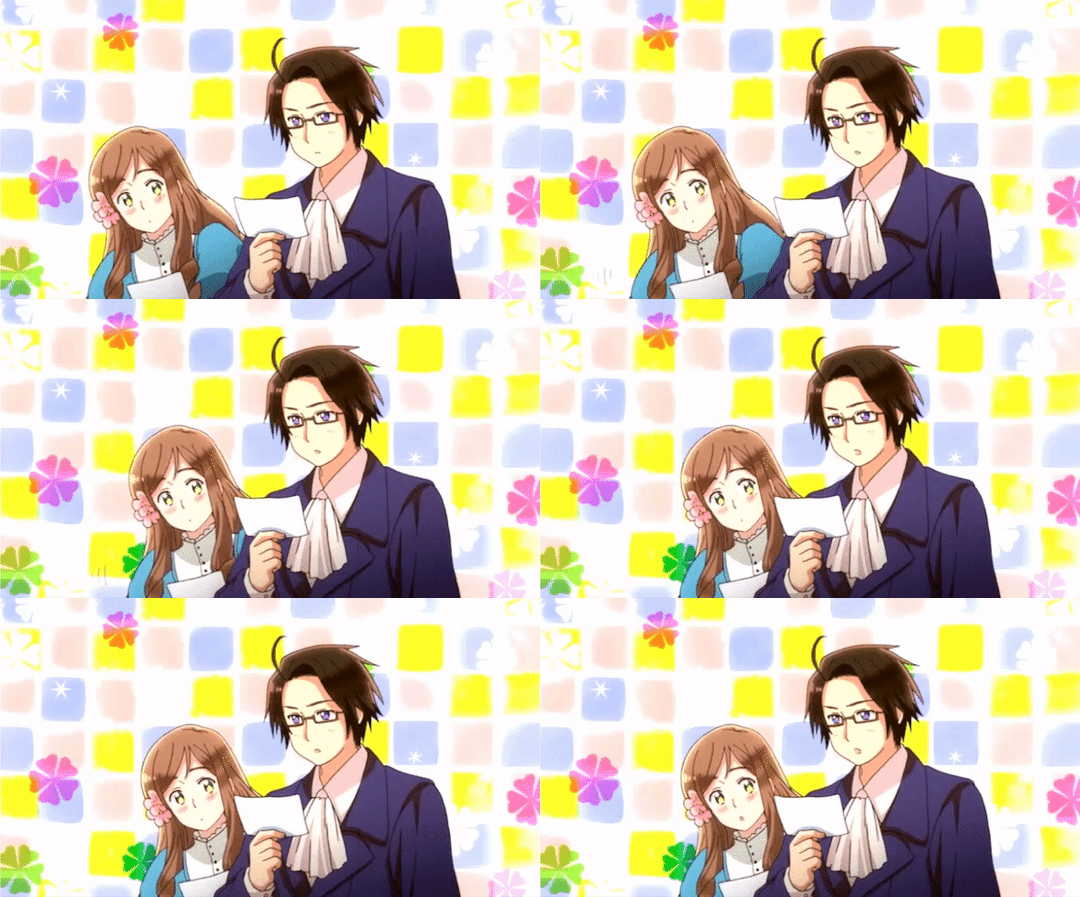
Marriage with the nations is a lot different than
traditional, primarily Western notions of it. It arises more out of a sense of
political duty, an arranged alliance or
partnership, and sometimes it just so happens that a romance forms between
the two countries involved.
Typically, what I’ve seen is that marriage at its core in
the series involves two countries merging together, either into a co-state empire,
a co-state kingdom, or a separate sovereign nation with distinct ethnic groups
and cultures. There aren’t any ceremonies, but rather, it entails a mutual dependence
and relative respect between two political entities.
That said, it’s important to mention that two countries joining
together via annexation does not fit into this marriage equation. There’s a
difference between being conquered and subordinated and forming a mutual
union. On the other hand, that doesn’t go to say that there’s perfect equality or
power balances in marriages between nations; Austria’s control over Hungary is
a perfect example of that.
All right. Let’s go over some examples of marriages, shall
we?
Austria’s character is known for his quirky tendency to
solve his problems through marriage.

First, there was arguably his early ties with Switzerland. I’m
counting this as a marriage mainly because it involves the use of the word
partnership and honeymoon (albeit jokingly).

Notice how as soon as one tries to control the other, the partnership ends. While Switzerland does
reveal some fondness over his early memories spent with Austria, there’s
nothing particularly romantic about it, especially given the fact that they
were young children at the time. Again, marriage for them is essentially the
joining together of nations.
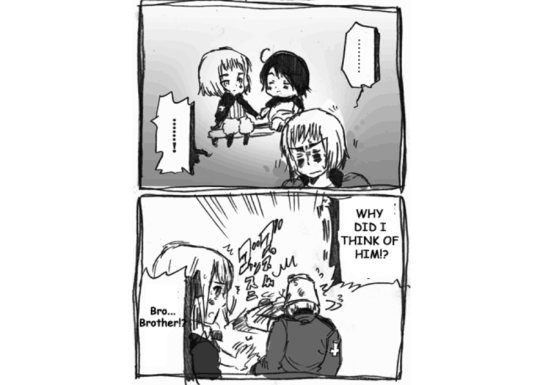
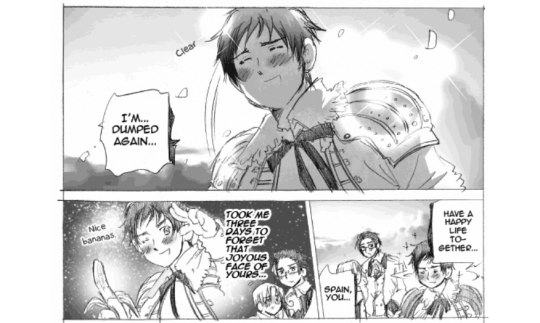
Next, Austria marries Spain via the Hapsburgs Monarchy.
Here, you actually see a hint that Spain harboured romantic feelings for
Austria during the Austrian Wars of Succession. It was a political merger
that likely later involved the development of some intimacy between the two.
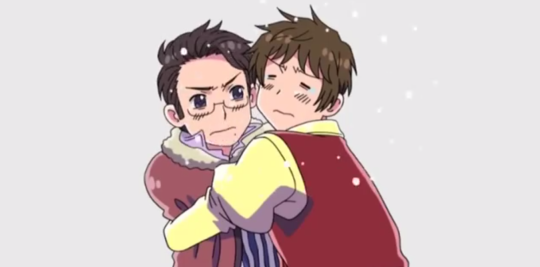
Then, you have Hungary. After the dissolution of the Austro-Hungarian
empire, it’s very heavily hinted that Austria still bears feelings for Hungary.
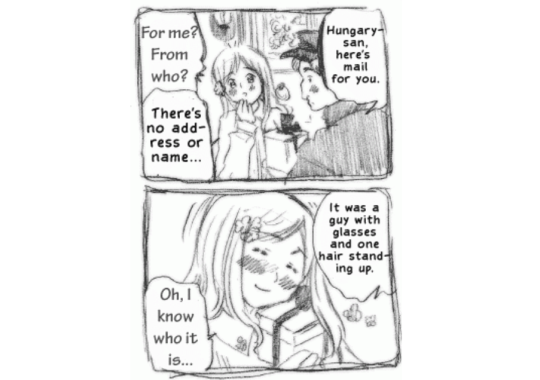
In Buon San Valentino, Hungary receives roses from an anonymous man that’s
conveniently described as having glasses and one hair sticking up.
On the other hand, there are marriages that involve little
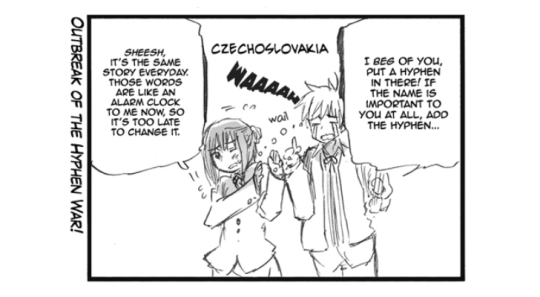
or no romance at all. Take Czechoslovakia for example, two countries united by a
hyphen. Yes, that’s an actual joke in the series.
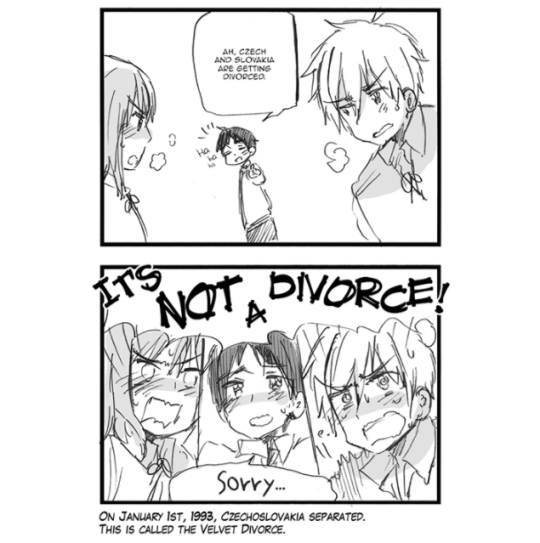
Still, what’s interesting is that when Bulgaria talks about
their separation in terms of a divorce, they’re quick to deny the claim, mainly
because of the romantic connotation marriage carries.
How I interpret this is that the two may have developed
feelings, but never told each other.
Bulgaria bringing up the topic of marriage in a casual political
sense merely may have caused them to get defensive because of these unvoiced feelings.
This isn’t confirmed, so don’t take it at canon value.
I know I’m repeating this, but it’s important that I make
this as clear as possible:
Marriage = a merger between two countries.
I say this because I’m going to apply these rules to Belarus
and Russia. Belarus wants to marry Russia and loves him to the point of obsession.
She’s even forgotten her own language at one point in favour of learning Russian.
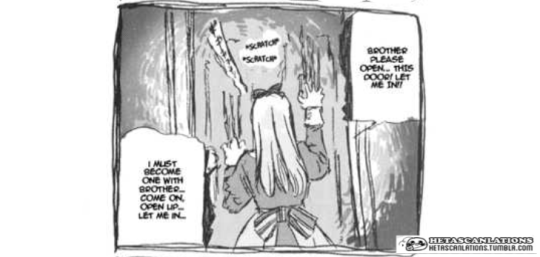
But, does it ever say that Belarus loves Russia in a
romantic way?
No.
What it does say is that she wants to “become one” with him.
Sounds like a merger if you ask me.
When Belarus says marriage, she wants their countries to
join together. There’s nothing romantic about it, so hopefully this stops
people from misinterpreting their relationship.
In summary, marriage between the nations seems to involve a political
merger between two countries (partnership, co-ruled kingdom/empire). It can have
a romantic element to it, but this isn’t always the case.
Oh yeah, for sure. The Brothers Grimm and Hans Christian Andersen even make a few appearances in later chapters of World Stars.
I’ve always thought that the idea of Russia’s heart being frozen has really similar parallels with what happened in Andersen’s “The Snow Queen.”
Basically, shards from a magical mirror get splintered in a little boy’s heart. He slowly begins to freeze and looses his sense of humanity, becoming increasingly aggressive and cruel without realizing it. There’s also the antagonist of the Snow Queen, a rough female equivalent of General Winter.
I guess I’ll have to make a post on that some time soon, huh?

For comedic value, Belarus’s
obsession with her brother is exaggerated. However, what you’ll find in the
series is that history and puns are often molded together. In particular,
Belarus’s name, Natalia/ Natalya, may serve as one of those puns.

History time! Falling back
to the late 17th century, Russian ruler Peter the Great ascended to
power. He was known for, well, being great. A lot of it had to do with reforming
Russia’s culture, as due to previous oppressive Mongol rule, the nation had
missed out on a lot of the cultural and artistic achievements that occurred in
Western Europe during the Renaissance period.

Basically, it was a
modernization project that involved bringing in Western ideas of art, politics,
and science. For example, many Russian aristocrats learned French dress and
spoke the language too.

What also made Peter great
was that he had transformed the Tsardom (the Russian kingdom) into an extremely
successful and powerful imperial empire. A lot of the structures in Russian political
institutions today still echo some of the traditions from these initial
reforms.
Peter arguably represents
the pinnacle of Russian achievement; again, all that is great.
Now, what’s interesting is
that Peter had a very supportive sister named Natalya (Kirillovna Naryshkina).
She and Peter shared a close
relationship, one where it’s reported that she would like anything that her
brother did. Sound familiar?

Side note: I’m aware that Peter
eventually co-ruled with his half brother, Ivan. For the purposes of this post,
it’s not that important. Given that the first part of a Russian name is their Christian
one, many males and females will share the names of Saints. It’s more about the
personalities of the figures who held the names that I’m looking at here.
Belarus, Natalya, is also extremely supportive of
her brother, going so far as to want their countries to unite into one. She
will agree with almost anything Russia says, perceiving him as the greatest
nation out there…
She wants to remain with him
forever.

This obsession with Russia
and its culture has even caused her to forget her own language at one point.

Notice how Belarus’s love
and devotion for Russia echoes the human Natalya’s love and devotion of Peter,
who’s highly regarded as representing the greatness of Russia.


China after Japan betrays him in WW2.

South Korea uses mind-reading binoculars, only to find out that China is annoyed by him.

An insecure Italy having Germany repeat that he doesn’t
hate him.

Russia during Bloody Sunday.

Davie.

What I presume you all look like now:


Let’s jump into the pits of hell, shall we? Nah, I’m just
kidding. I think you guys know by now just how brutal the USSR was not only for
those under Russia’s rule, but also for Russia himself, as he’s always
struggled with chronic loneliness and making ‘friends.’
Political revolts aimed at gaining independence were
supressed through the use of force, dissenters were sent to gulags, and alcoholism
was rampant. That said, it’s no wonder that the Baltic nations were referred to
as the “Trembling Trio.” Anyone in their right mind would be terrified.

Russia, both the nation and personification, ruled with an
iron fist. To gain compliance, he either squeezed shoulders, or in Latvia’s
case, pressed down on the former’s head.
On the other hand,
the psychological damage is the most lasting here. Russia has a warped, child-like
mentality, one where he doesn’t quite understand the consequences or repercussions
of his actions. He uses violence to solve his problems.

When it comes to the damage Russia inflicted, Lithuania and the
cuts on his back immediately comes to mind.

Likewise, we know that Lithuania is still rehabilitating
from his time spent in the USSR.

Surprisingly, what I don’t see people talk about is this notion
of transference. That is, Lithuania has actually adopted some of Russia’s
violent tendencies, albeit unintentionally. You see this play out in chapter 96
of World Stars.
As Estonia gushes about wanting to become a Nordic, Lithuania
urges that they stick together and remain as the Baltic trio, just like they stuck
together when they gained independence from Russia.
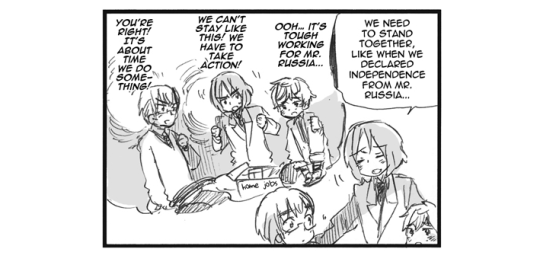
Lithuania relives the first memory.Then, he remembers Russia squeezing his shoulders, and, without realizing it, starts squeezing Latvia and Estonia’s shoulders to the point that it causes
them pain.


In my opinion, Lithuania doesn’t just seem to be experiencing
PTSD here. I honestly think he’s learned some of Russia’s violent tendencies,
not consciously, but more as an unconscious psychological consequence of the trauma
he experienced.
Latvia even asks Lithuania if he’s okay, but Lithuania is unresponsive. Just look at Lithuania’s expression; he’s pretty removed from the situation.
It’s these small, brilliant, and dark details that makes
this series enjoyable to read. Hima is so methodical in how he develops and
evolves his characters. In a single strip you see how unfathomably deep Russia
has hurt Lithuania, in more ways than one.
Just like humans, the nations become products of their
environment.

 Ellawritesficssometimes