-You’re not being rude,
so don’t worry about that. I appreciate that you’ve gone through the lengths to
inquire about the reasons. Not many people are capable of this, unfortunately
🙂
-I’m a multi-shipper, so
it’s not like I only ship them together. (Mainly saying this for those who see this
post).
-In general: Not
everyone has to have a reason for their ship other than simply liking it. They
shouldn’t feel obligated to justify it either.
-It’s a misconception
that Russia and America don’t get along [x]. During the Cold War, their relationship
was a myriad of passive-aggressiveness [x] and yes, dick jokes [x]. Presently, the
two get along really well. Although, the passive-aggressiveness remains.
-I don’t want to
persuade anyone to ship RusAme. They can see the information and decide for
themselves. I’ll just point toward some neat parallels between them that would
form the grounds for effective fic writing.
Post coming up tonight!
Yes, because clearly
something that depicts war and division must
be promoting it. Of all the things to criticize Hetalia for given the
controversy its generated—albeit mainly from past content—this isn’t something that it has
ever stood or advocated for.
Sure! These character notes are super helpful. Here’s just
some evidence from the manga to corroborate and flesh them out [x].
• “Before he was a little
brother-like crybaby who would immediately rely on England or France but getting blown at by the harsh
wind of the Wild West, at some point he grew abnormally quickly both mentally
and physically.”
• “Because of England’s
influence has no taste, no matter what kind of colours it has he’ll just settle
with ‘cute.’ But I
think he has some more taste left than England. Lately he has been getting into
sushi.”
What this post aims to
do is examine the ways in which the nations are impacted by the chronicity of
the wars they’ve endured as well as the coping mechanisms that they employ to bear
these hardships. Aside from the predictability of physical pain and illness,
there is a disturbing sense of normalization and domesticity in how the nations
negotiate their lifestyles in war. It’s
maladaptive.
That said, let’s go over
some examples.
Physical Pain and Illness:
The most obvious impact
of war and political struggles—both
domestic and international—is the physical strain that it puts on a nation’s body.
Ex: During the Second World War, Germany and Italy are both taken as
prisoners of war. Germany compares the pain of torture to a mosquito bite, as
his daily life is far more painful.
Ex: England falls ill on several occasions following major political conflicts
(e.g., the American Revolution, the Napoleonic Wars, World War II) [x].
Ex: China complains of body aches, stemming from political infighting
in his country [x][x].
Sense of Helplessness:
Of course, smaller
powers are rendered vulnerable and pliable to the discretion of larger powers.
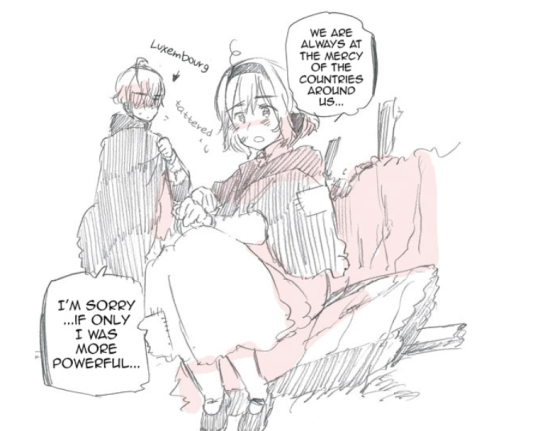
Ex: Belgium and Luxembourg discuss their inability to protect themselves
during both World Wars [x].
Ex: The conditions that Russian soldiers experienced were so bad that
Russia becomes ecstatic when Germany takes him as a prisoner of war. He
compares the German POW camps to heaven.
Ex: England’s normalized being captured by
the Axis and pre-preemptively brought a spare change of clothes [x].
Suspicion and Hostility:
War is a breeding ground
for distrust and betrayal. As such, the nations must always be ready to fight
for their lives, even in seemingly innocuous circumstances.
Ex: When the two first
meet in World War I, Germany second guesses himself several times on whether
Italy poses a threat to him.
Ex: Russia shares his tea
ration with England. While skeptical at first, England accepts. The sweetness
of the tea initially causes England to conclude that Russia poisoned him. What
matters here is the fact that England rationalized this outcome as a legitimate
possibility…[x].
Domesticity, Normalization, and Adaptation:
As horrible and gruesome
as war may be, there are still moments where the nations are able to enjoy
themselves and share a good laugh. The problem, then, is that having had
experienced countless wars, the nations bring the domestic into the world of
war—i.e., war becomes their home and the private
and public sphere divide becomes muddled.
Ex: England drinks tea in
the middle of the battlefield. Trivial as this may appear, on a latent level,
he’s attempting to include a routine and sense of normalcy in an environment
that is otherwise chaotic and unpredictable.
Ex: After infiltrating
America’s war camp, Prussia teases Germany for his impression of an American.
Ex:Having just occupied
Rome, America asks the terrified Italy Brothers if they could make him
authentic Italian cuisine [x].
The casualness in the way
America speaks is disturbing considering that from his perspective, taking over
another country is normal. It’s not
something that should produce fear but rather should be accepted as is. He
doesn’t consider the Italy Brothers to be his personal enemies. The personal is not political in this case.
Relief:
The best nations that
illustrate the burdens of war are those who have passed on. Rome and Germania
visit Earth together and upon reflecting on their lives, they reach a similar
conclusion: death gave them a sense of liberation.
They’re no
longer bound by their bosses’ orders and aren’t forced to participate in wars
they have no interest in being involved in [x].
Yes and no. A good villain is a good villain to me so long as you characterize and develop them well. In fact, a difficult and rare trope to pull off but something that I’ve always loved is when an author is able to portray America as the villain despite his claim of being a hero. Now that’s interesting!
The series is based on stereotypes, bad and
good, although we could do without some. At the very least, this subject is
touched on in Volume 5.
If anything, this could also indicate how removed England
was from the effect that his taxation had on his colonies. Great addition,
thank you for sharing! [x].
It seems like Canada is America’s adopted
introvert.
Yes and no. Early on, it
was more of a resentful push-and-tug relationship. Their relationship in the
present lines up more with what you’re saying!
Sorry, I have to make
this distinction because you still see people bitterly posting on trope
websites that the two remain primarily resentful of each other, which isn’t
true! [x].
Is North Italy really a virgin? If he’s not,
why does the fandom believe so? I mean I know he used the “I’m a
virgin” lie to get out being harmed, as for some reason they sympathize
for virgins, but the dude has a black book full of women he has dated, he still
dates and flirts with girls. Given how old he is, doesn’t it make more sense
for them to have lost it at some point in time? Maybe n teen years. Oh, that
time he ran home for sexual needs during war. So y proclaim it canon if 1 is
not sure
(Not sure why this
really matters lol but…)
It’s messy because you’re
leaping through several time periods here. They don’t occur simultaneously.
WW1–He plays the
sympathy card and states that he’s a virgin to prevent Germany from shooting
him. This also could have just been a spur of the moment thing he said to avoid being harmed.
We also know from this
character chart that Italy officially becomes an adult in the 20th
century [x].
The third comic you
referenced is from Comic Diary 2.It
takes place in WW2. Italy cites that fight or flight instincts in war create an
urge in men to reproduce, hence the greater occurrence of sexual intercourse
between men since no women are available. As you mentioned, he leaves to
presumably have sex [x].
The second strip you
mentioned is from volume 2 and seems to take place in WW2. It doesn’t actually confirm whether he’s had sexual
intercourse with these women but rather that he’s met them over the years from
his time spent in war (i.e., “battles). He could have, but it’s not made explicit.
Presently, there’s a
strip where Italy uses a sexual innuendo in front of an attractive girl at an
anime convention [x].
Overall, my guess is
that he probably was a virgin during WW1 having just become an adult but lost
it sometime during or before WW2.
Why does no nation (other than his family) look
behind Russia’s cruelty and see he’s very lonely? (While Russia has done very
questionable things in the past…)
It’s easy to say that from an outsider’s perspective. Even
though Russia wasn’t psychologically aware of the depth and extent of his
cruelty, he was still an abuser. Loneliness isn’t exactly going to make those
whom he tortured instantly want to be friends with him. They’re big enough to
empathize and feel some compassion from him, but none of that will negate the
terrible experiences they endured in his household. I don’t blame them [x].
It’ll take a long time to heal (as we saw with China and
Japan), but I do believe it’s possible that their relationship will
improve in the future.
I’m too disturbed by the fact that Germany
can’t drink beer legally because he’s underage. he’s 20. he became an adult a
few years ago. he literally killed a man in his sleep, but he can’t drink beer
yet / he’s just too mature for his age??? he’s still a bby boy???? he can still
grow a little at this age??? he’s so young???
He’s 20 physiologically but not chronologically and became
an adult decades ago. Drinking ages also vary from country to country.
I know there are a few occasions where nations
physiologically young are barred from drinking (Deleted strip:
America’s Brewster F2A Buffalo), but for
the most part, it doesn’t seem to matter [x].
If a nation ages, it’s usually a mesh between their
chronological age, and political, social, and economic developments.
Over the course of the series, I’ve
found several clever ways that Himaruya uses the nations physical bodies and
interactions to reflect wider historical, social, and political circumstances.
Political pressure and suppression:
Typically, I’ve noticed that the
use of physical force between a dominant and subordinate nation reflects
political pressure and suppression. Russia is a prime example of this. You’ll
often see him squeezing, bending, and pressing down on other nations—obliviously,
of course. Remember that he’s unaware of his cruelty [x].
Ex: I’ve speculated before that
the reason Latvia is so short is a symbolic representation of how he has been
politically marginalized and controlled for a significant part of his history [x].
In other words, he lacked the
independence and autonomy that would have allowed him to achieve growth and
flourish on his own. His growth was stunted by virtue of him being pushed down
into submission.
Latvia citing the reason for his
shortness as a result of Russia pushing down on his head, to me, acts as a
wider metaphor for political suppression.
Ex: Russia squeezes and hugs Czechia and Slovakia to end
their dispute over whether they should include a hyphen in their name. In this
context, the hug is Russia asserting pressure over not what he thinks should be
their name but rather what their name will be [x].
Ex: In the strips depicting the Baltics path to independence
from the USSR, Russia squeezes Lithuania’s shoulders [x].
Conflicts:
Wars and battles can also be depicted in seemingly trivial
interactions between nations. The battles occur literally but are repeated figuratively
in these interactions.
Ex: To symbolize how France picked at the remains of some of
Austria’s lost territories after the War of Austrian Succession, France also
loots from Austria directly [x].
Servility and Class:
Different classes and social status are reflected in the
clothing that dominant and subordinate nations wear. Nations who are
conquered, annexed, or made to be under the control of another nation are
adorned in servants’/ maids’ clothing.
Ex: Chibitalia becomes a servant to Austria after being
conquered [x].
Ex: Lithuania acting as Russia’s servant while the latter
attended a world meeting on both of their behalves.




 Ellawritesficssometimes
![[x].](http://www.hetarchive.net/img/bamboothicket/italy_hist.jpg)